Publication: Cactaceae Syst. Init. 16: 7 (11 Oct. 2003)
Description
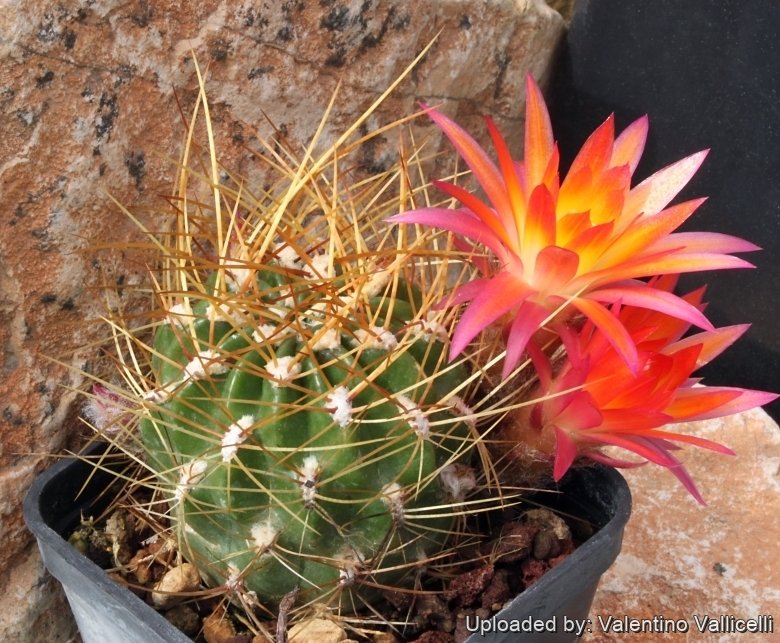
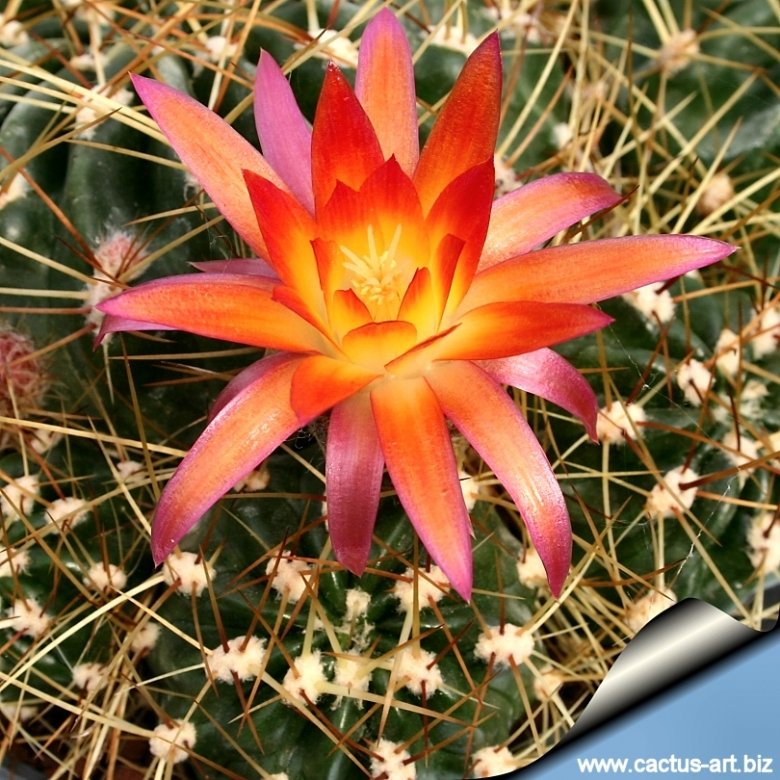
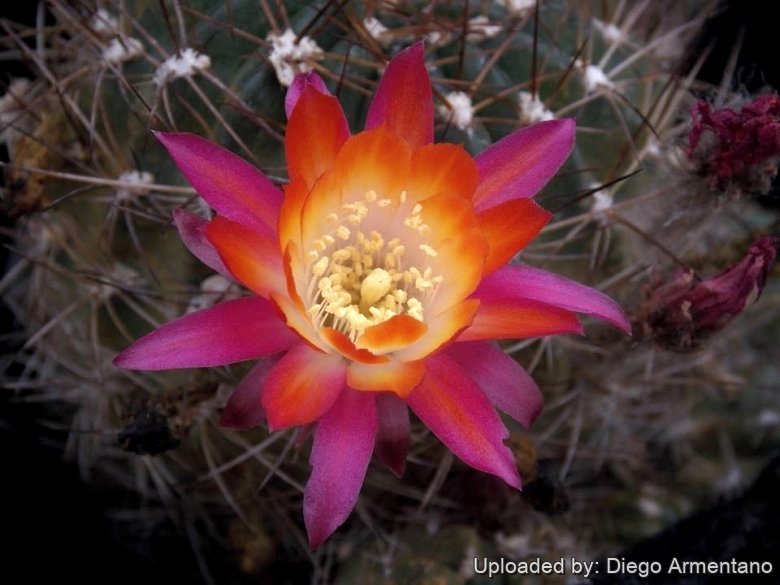
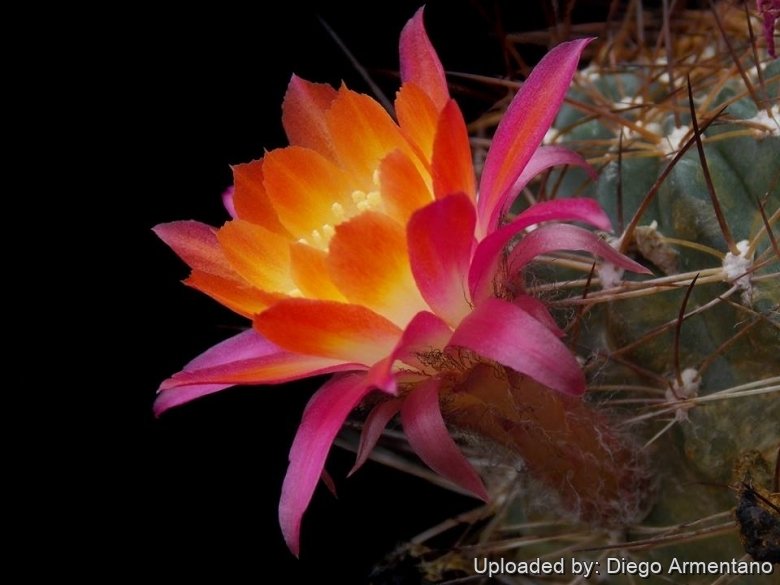
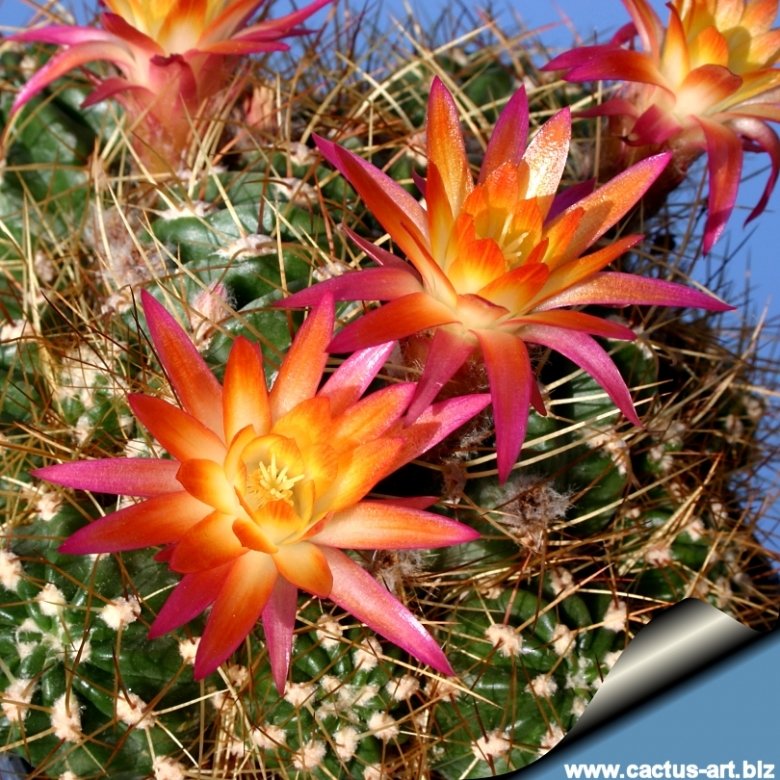
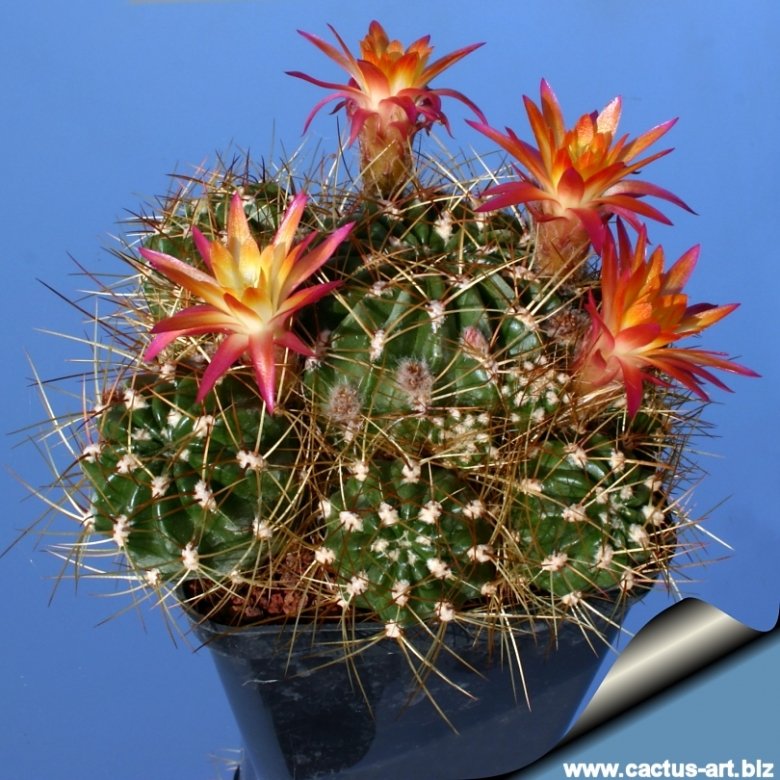
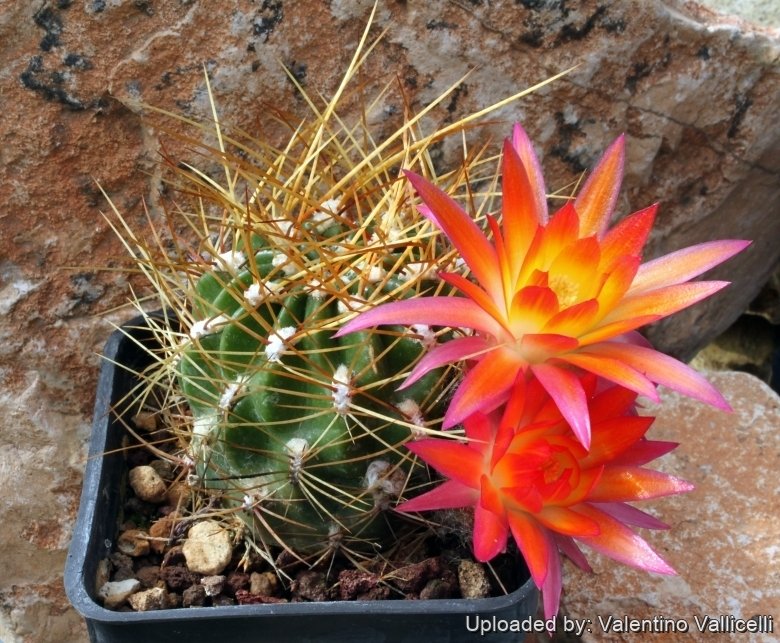
Echinopsis maximiliana subs. westii (firstly described as Lobivia westii by Hutchison in 1954 ) is a local or morphological form of the widespread and variable Echinopsis maximiliana. At fist solitary it will soon start to branch at the base, older plants forms dense, large mats with straw-coloured spines, sprinkled brown. Is has a predominantly honey-coloured, orange or red flower with pale yellow throat and sometime violet tipped petals. Flower colour, as elsewhere in the genus is quite variable. However the distinguishing characteristics of the subspecies westii, appear to fall within the natural variation of Echinopsis maximiliana and it is often synonymized with the latter.
Root: Not beet-like.
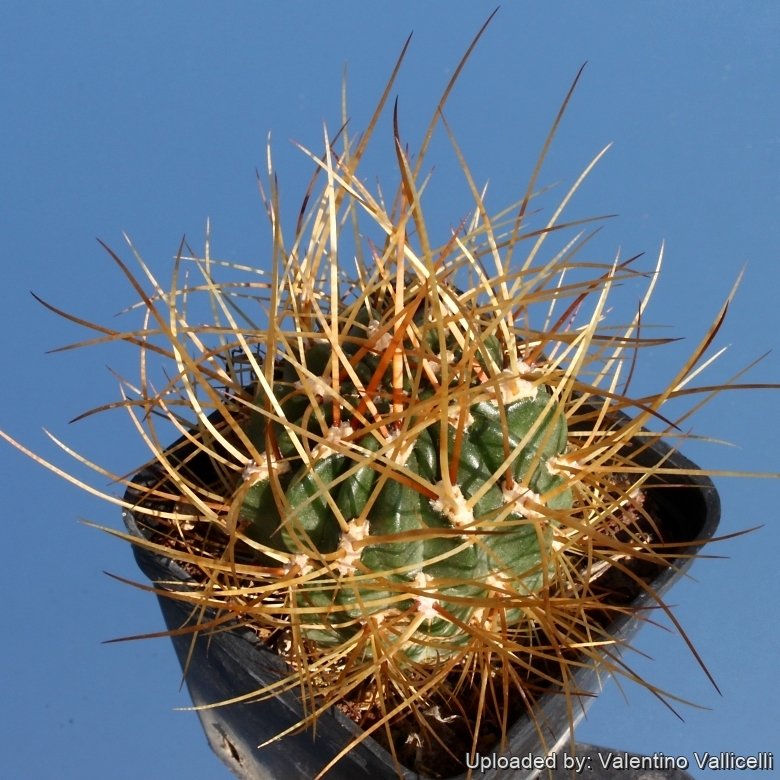
Stem: Flattened globular (often elongated in cultivation), somewhat umbilicate at apex, bright green 5-15(-20) cm long, 5 cm in diameter.
Ribs: 16-18 spiral notched-tuberculate.
Areoles: With dull white wool, ± 2 cm apart.
Spines: Needle-like, yellow, amber or brown, unequal and somehow curved backward .
Radial spines: Around 8, up to 9 mm long.
Central spines: 1, 2.5 -4 cm long .
Flowers: Lateral, narrow funnel-shaped, 4-7 cm long. Inner perianth segments narrowly obovate abruptly acute spreading brilliant orange/golden-orange, outer perianth segments very colourful orange-red and often violet coloured. Throat white-yellow. The tube is greenish to reddish up to 4 cm long. Stamen and style short
Fruits: Globular, dull green, reddish or maroon, woolly 1-2(-4) cm long and in diameter.
Seeds: Black.
Origin and Habitat
Andahuaylas and adjacent areas, Apurimac, Peru
Altitude range: (2800-)3200-3700(-3900) metres above sea level.
Habitat and ecology: Echinopsis maximiliana subs. westii grows in ther Central Peruvian Andes at high elevations together with Oroya peruviana, and Tephrocactus floccosus. It has adapted to survive in a extremely rocky habitats that other plants can’t survive in because of the lack of soil (at least in large amounts) and how dry it is. The plants are exposed to appreciable freezing in a tropical alpine climate where summer night-time temperatures can be -8° C.
Cultivation and Propagation
It is a summer grower species that offers no cultivation difficulties. It has a fairly large tap root, and should be kept in a deep pot with a very draining mineral substrate. Water regularly in summer (but do not overwater ) keep dry in winter. Feed with a high potassium fertilizer in summer. Repot yearly until reaching about 100 mm in size, then every two or three years will suffice. Repotting is best done at the end of winter but can be done at other times. Do not water for a couple of weeks after repotting to reduce risk of root rot via broken roots. Repotting will increase size of stems. It is quite cold tolerant if kept dry (hardy to -5° C). Outside it need a bright exposure, full sun or half shade in summer, inside it needs bright light, and some direct sun.
Propagation: Seed, grafting, cutting.
Bibliography
Major references and further lectures
-
Willy Cullmann, Erich Götz, Gerhard Gröner “The encyclopedia of cacti” Alphabooks, 1986
-
Walter Rausch “Lobivia: The Day Flowering Echinopsidinae from a Geographical Distribution Point of View”, Volumes 1-3 R. Herzig, 1975
-
Hans Hecht “Cacti & succulents” Sterling Pub. Co., 1997
-
Lowry, M., Ostalaza, C., Cáceres, F. & Roque, J. 2013. Echinopsis maximiliana. The IUCN Red List of Threatened Species 2013: e.T152125A599858. http://dx.doi.org/10.2305/IUCN.UK.2013-1.RLTS.T152125A599858.en. Downloaded on 03 March 2016.
Gallery