Publication: Allg. Gartenzeitung (Otto & Dietrich) (Otto & Dietrich) 14: 250. 1846
Description
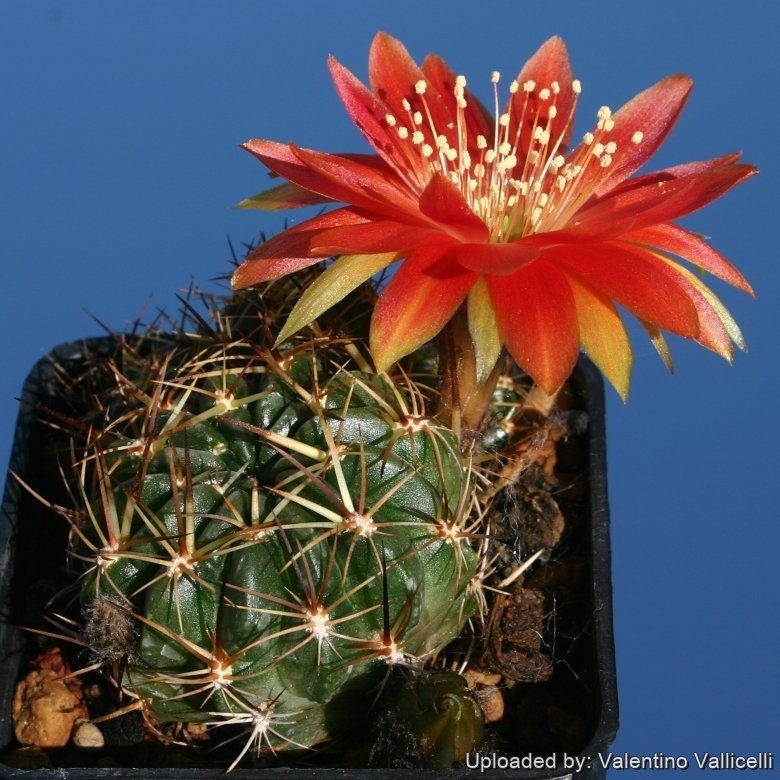
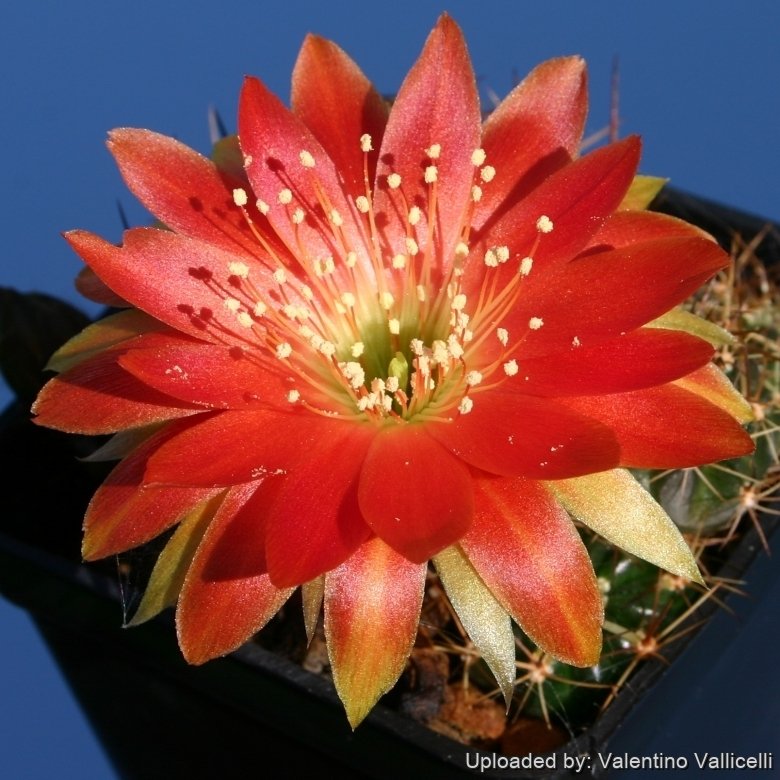
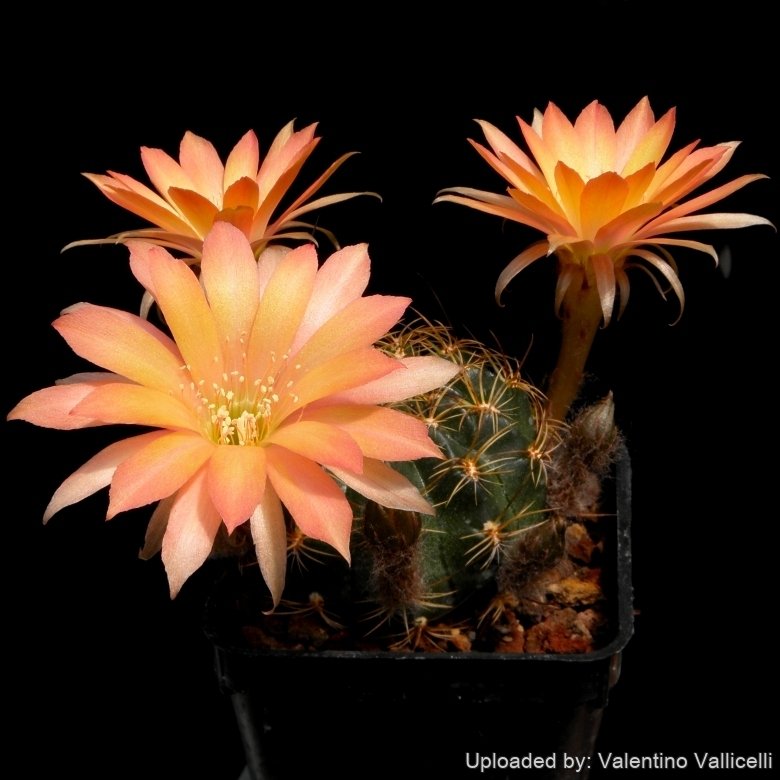
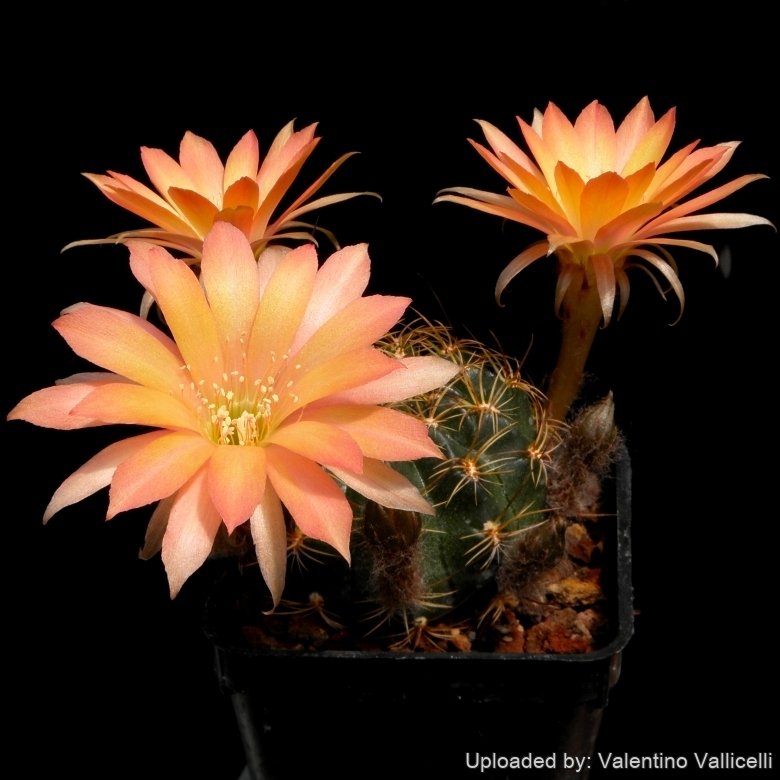
Echinopsis maximiliana is a widespread and very variable cactus species commonly forming clusters. It has dark green globular to short cylindrical heads about 5 cm in diameter; each head has up to 20 ribs. The spine colour varies from off-white and yellow to brown. The flowers are very beautiful, orange-red a with orange-yellow throats and long lasting. Three subspecies are recognized (Hunt et al. 2006), namely the nominate form, subsp. caespitosa (J.A.Pupus) M.Lowry and subsp. westii (Hutchison) M.Lowry.
Stems: Depressed-spherical, to obovoid, to short cylindrical, grass green to dark green, shiny, 7-20 cm high and 5(-7.5) cm in diameter.
Ribs: 12-20 (or more), straight, acute, with hatchet-shaped tubercles between the areoles.
Areoles: Whitish with little wool, to 2 cm apart.
Spines: Extremely variable, usually not clearly differentiated as central and radials.
Radial spines: 4-12, to 1.25-5 cm long, curved, unequal, brownish yellow.
Central spines: Absent or 1(-2), to 7 cm long, curved.
curved, unequal, brownish to yellowish, 3-5 cm long. central absent or 1, to 7cm, upcurved.
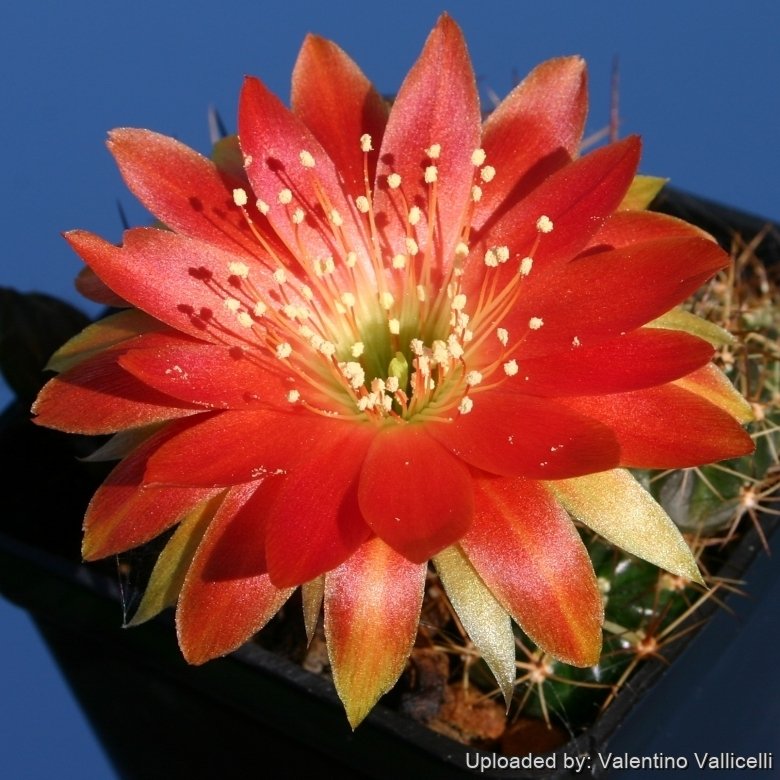
Flowers: Funnel-shaped, scarlet with orange-yellow throats, 5-8 cm long and in diameter, sometimes the inner tepals tipped darker. Innermost tepals somewhat reduced, more or less erect. Stamens bunched round the style. Tube very hairy.
Fruits: Reddish green, hairy, to 1.2 cm in diameter.
Origin and Habitat
Echinopsis maximiliana occurs in Bolivia and Peru.
Altitude range: 3,200 to 4,600 metres above sea level.
Habitat and Ecology: It occurs in high-altitude grasslands (Puna). Echinopsis maximiliana has a wide distribution and is locally abundant. It is not exposed to any major threat. There is cattle and llama grazing in the area, but this activity is not expected to significantly affect the species.
Cultivation and Propagation
It is a summer grower species that offers no cultivation difficulties. It has a fairly large tap root, and should be kept in a deep pot with a very draining mineral substrate. Water regularly in summer (but do not overwater ) keep dry in winter. Feed with a high potassium fertilizer in summer. Repot yearly until reaching about 100 mm in size, then every two or three years will suffice. Repotting is best done at the end of winter but can be done at other times. Do not water for a couple of weeks after repotting to reduce risk of root rot via broken roots. Repotting will increase size of stems. It is quite cold tolerant if kept dry (hardy to -5° C). Outside it need a bright exposure, full sun or half shade in summer, inside it needs bright light, and some direct sun.
Propagation: Seed, grafting, cutting.
Bibliography
Major references and further lectures
-
Lowry, M., Ostalaza, C., Cáceres, F. & Roque, J. 2013. Echinopsis maximiliana. The IUCN Red List of Threatened Species 2013: e.T152125A599858. http://dx.doi.org/10.2305/IUCN.UK.2013-1.RLTS.T152125A599858.en. Downloaded on 03 March 2016.
-
Hunt, D., Taylor, N. and Charles, G. (compilers and editors). “The New Cactus Lexicon.” dh Books, Milborne Port, UK. 2006
-
Edward Anderson “The Cactus family” Timber Press, Incorporated, 2001
-
James Cullen, Sabina G. Knees, H. Suzanne Cubey “The European Garden Flora Flowering Plants: A Manual for the Identification of Plants Cultivated in Europe, Both Out-of-Doors and Under Glass” Cambridge University Press, 11/Aug/2011
-
N. L. Britton, J. N. Rose: “The Cactaceae. Descriptions and Illustrations of Plants of the Cactus Family.” Vol 3, The Carnegie Institution of Washington, Washington 1922
-
Walter Rausch “Lobivia: The Day Flowering Echinopsidinae from a Geographical Distribution Point of View”, Volumes 1-3 R. Herzig, 1975
-
Hecht, “BLV Handbuch der Kakteen”, 290 (as Lobivia chrysochete) & 294 1982
-
Haustein, “Der Kosmos-Kakteenfuhrer”, 159 1983
-
Cullmann et al., “Kakteen”, edn 5, 198 1984
-
Brian Lamb “Letts guide to cacti of the world” Letts, 17 October 1991
From llifle page Lobivia corbula
Description
Small mat forming cactus
Stems: 5 -10 cm wide, basally branching.
Ribs: 12-20 sharp-edged with inclined protuberances.
Spines: Needle-like, more or less curved and interlaced with one another, radials 4-15, centrals 1-3, to 6 cm long, gold-yellow to brown.
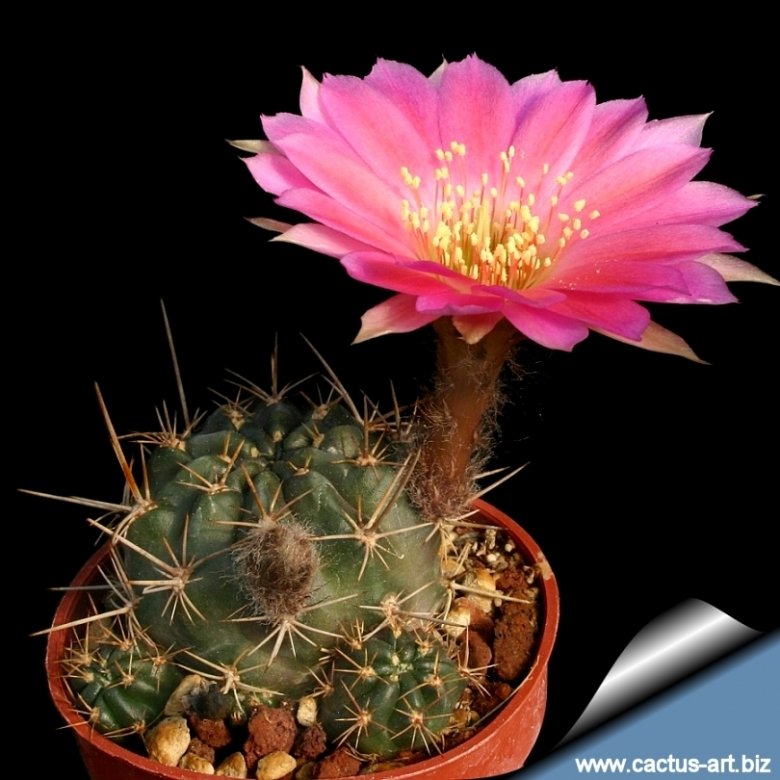
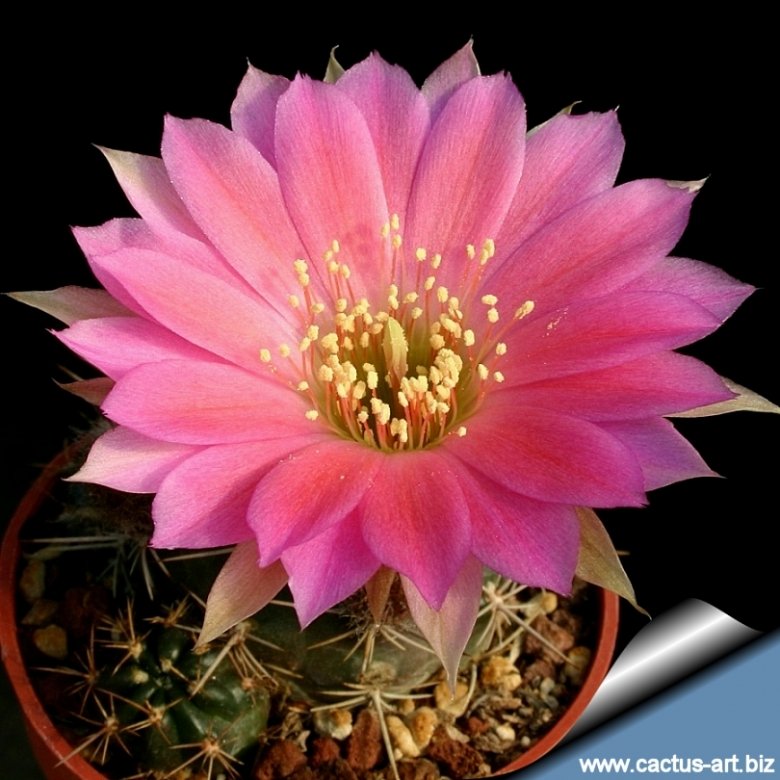
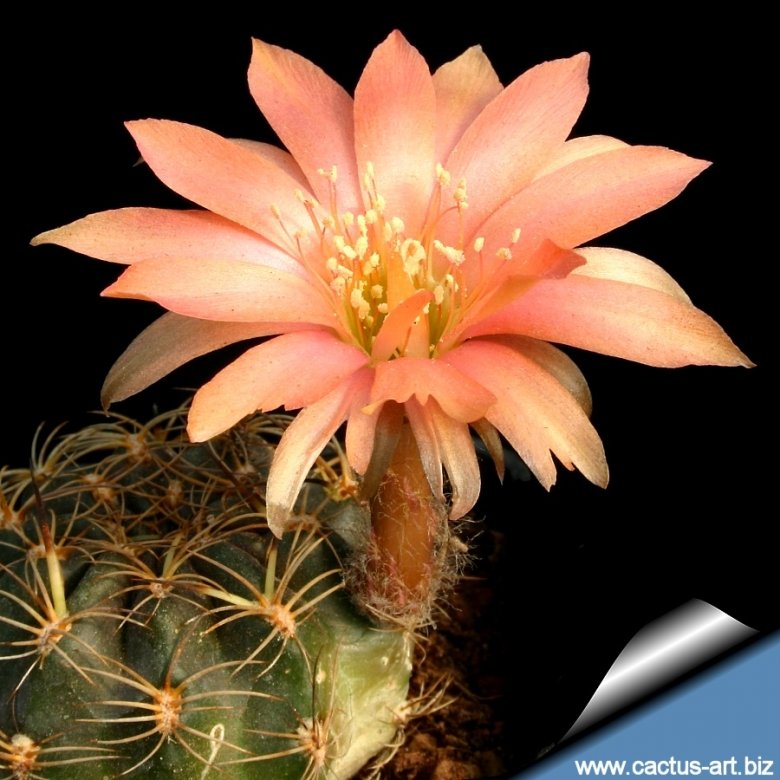
Flowers: From the basal portion of the stem, ca. 5 cm long and 4-8 cm broad, outer petals somewhat overlapping and violet-violet-pink to purple sharpened, with yellowish throats, Stamens more or less to the stylus bent. Red, yellow, white or intermediate colours are also common in habitat and in cultivation, too.
Origin and Habitat
Northern Bolivia. The var. corbula (Herrera) is found near Cuzco and Ocongate.
Cultivation and Propagation
It is a summer-growing species that offers no cultivation difficulties. Water regularly in summer (but do not overwater). It needs good drainage and very porous soil. Keep rather dry in winter. Feed with a high potassium fertilizer in summer. It is quite frost-resistant if kept dry (hardy to -12° C). In summer it needs bright exposure, full sun or half shade.
Propagation: Sow directly after last frost, or by offsets.
Source: Lobivia corbula, LLIFLE - Encyclopedia of living forms, CC-BY-SA, retrieved 2026-10-25.
Cultivars and forms (1)
Subspecies (1)
Gallery