Publication: Kakteen Südamerika 1: 263. 1979
Description
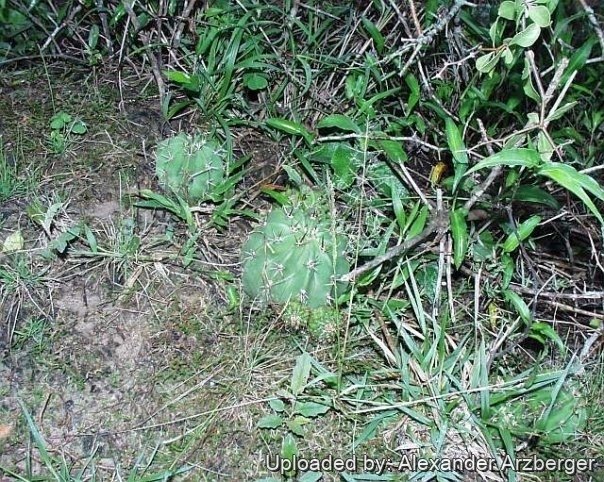
Echinopsis rhodotricha var. brevispina is a globular or shortly columnar species that produces splendid white trumpet-shaped flowers with long brown-woolly tube. The key difference by which this variety was separated, namely the presence of shorter stems less than 40 cm tall, and smaller areoles bearing fewer (2-8) and shorter spines only 4-15 mm long, seems entirely spurious, and appears to fall within the natural variation of Echinopsis rhodotricha and it should be synonymized with the latter. It is at most a race of Echinopsis rhodotricha, but it still has a value for a collector because they identify plants with particular characters.
The following description is based on Echinopsis rhodotricha var. brevispina F.Ritter 1979 (Collector’s number referred here is FR 1205 West of Asunción, Chaco-i, Puente Hayes, Paraguay ).
Stems: Elongated 30-40 cm tall (up to 1.5 metres tall in var. rhodotricha)
Ribs: Vertical, very acute, crenate (clearly notched) 20-30 mm hight.
Areoles: 3-7 mm long, sunk in the ribs and bearing less felt.
Radilal spines: 2-8, subulate, 4-15 mm long (30-30 mm long in var. rhodotricha)
Central spine: Absent or 1, rarely 2-3, 10-20 mm long (10-50 mm long in var. rhodotricha).
Fruits: Red, with white woolly hair (hairs brownish-red in var. rhodotricha).
Seeds: Without striking differences.
Origin and Habitat
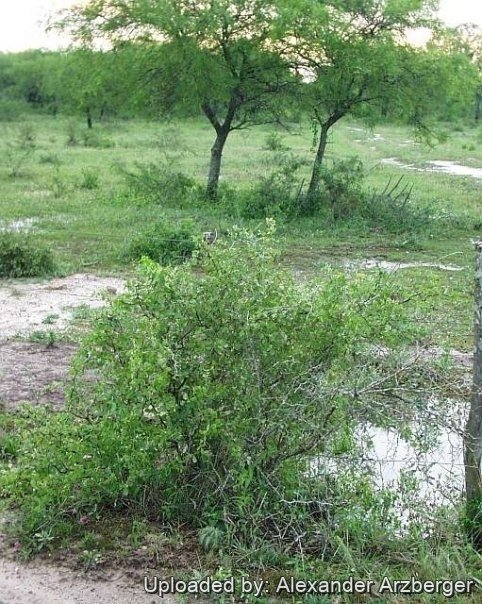
Echinopsis rhodotricha var. brevispina dwells in Chaco, West of Asunción, Central, Boquerón, and Concepción departments, Paraguay (Southern South America).
Altitude range: This species grows at low altitudes (around 70-100 metres above sea level)
Cultivation and Propagation
Echinopsis rhodotricha var. brevispina is a summer grower species that offers no cultivation difficulties. Water regularly in summer (but do not overwater ) needs good drainage and very porous soil, keep rather dry in winter. Feed with a high potassium fertilizer in summer. It is quite frost resistant if kept dry (hardy to -7° C). Need a bright exposure, full sun or half shade in summer.
Propagation: Direct sow after last frost, offsets.
Bibliography
Bibliography: Major references and further lectures
- Friedrich Ritter “Kakteen in Südamerika - Ergebnisse meiner 20jährigen Feldforschungen: Brasilien / Uruguay / Paraguay”, Volume 1 Selbstverl., 1979