Publication: Monatsschr. Kakteenk. 10: 147. 1900
Description
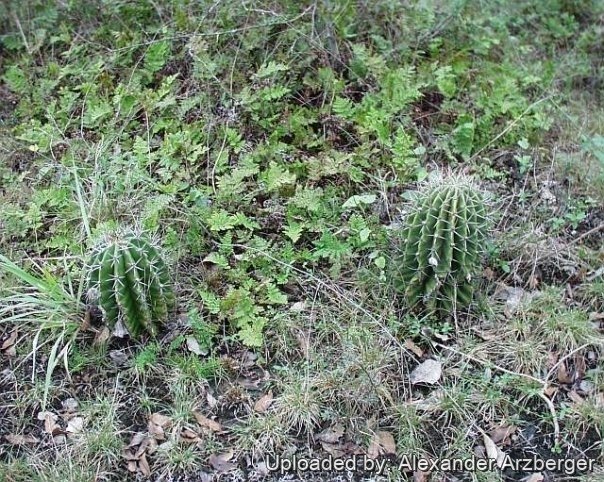
Echinopsis rhodotricha is a globular or columnar, cespitose cactus with 8 to 10 erect or ascending stems to 80 cm high with 8-13 ribs and 4-7 radial spines up to 2.5 cm long. Echinopsis rhodotricha blooms with slender white flowers, at the base of which there are dark scales with white, black and red, woolly hairs. Two subspecies are recognized, the nominate form and subsp. chacoana (Schütz) P.J.Braun & Esteves.
Stems: Branches erect or ascending, dull greyish green or light green, elongated, cylyndrical, apex slightly depressed, woolly, with some young spines, 30 to 80 cm high, 9-12 cm in diameter, or sometimes simple in cultivation.
Ribs: 8 to 13 (or more), rather low (.5-2 cm tall), a little sinuate rounded, with barely pronounced tubercles, separated by deep vertical grooves.
Areoles: 15 to 30 mm apart, lined with wool yellowish passing greyish white.
Radial spines: 4 to 7(-8), strong, erect, to 2 cm long, widely spreading, a little curved, yellowish with brown to blackish tips, later turning pale.
Central spine: One or wanting, 1 to 3.5 cm long, (usually shorter than the radials), more reddish brown somewhat bent upward.
Flowers: White 15-19 cm, 9 cm in diameter, long funnel-shaped, tubular produced from the tubular areoles. Ovary with many blackish scales and reddish brown wool. Tube light brown, woth with green scales and a mix of white, blackish brown and reddish wool. Outer perianth-segments lanceolate, white with a brown median strip. Inner perianth-segments white, subequal, oblong, acute. Throat light green. Stamens numerous, primary and secondary in one continuous ring with no separate throat-circle. Filaments white. Anthers cream. Stigma-lobes linear, 11, green.
Fruit: Ovoid, 4.5 × 2.5 cm, lined with reddish-brown wool.
Origin and Habitat
Argentina, Bolivia, Brazil (Mato Grosso do Sul), Paraguay (Chaco and Oriental regions) and Uruguay. This cactus forms colonies and is common and abundant where it occurs.
Type locality: Arroyo La Cruz, near San Salvador, Rio Tagatiyami, Paraguay.
Altitude range: It occurs at elevations from 0 to 500 metres above sea level.
Habitat and Ecology: It grows in grasslands and forests on sandy soils, in open sites with shrubs and low plants. In the Chaco region and Espinal in Uruguay this species is more frequent on alkaline soils. Echinopsiss rhodotricha is widely distributed, locally abundant and common, occurs in several protected areas and there are no major threats affecting it. However, livestock grazing may affect its habitat.
Cultivation and Propagation
Echinopsis rhodotricha is a summer grower species that offers no cultivation difficulties. Water regularly in summer (but do not overwater ) needs good drainage and very porous soil, keep rather dry in winter. Feed with a high potassium fertilizer in summer. It is quite frost resistant if kept dry (hardy to -7° C). Need a bright exposure, full sun or half shade in summer.
Propagation: Direct sow after last frost, offsets.
Bibliography
Major references and further lectures
-
Edward Anderson “The Cactus family” Timber Press, Incorporated, 2001
-
Hunt, D., Taylor, N. and Charles, G. (compilers and editors). “The New Cactus Lexicon.” dh Books, Milborne Port, UK. 2006
-
Oakley, L., Duarte, W. & Pin, A. 2013. Echinopsis rhodotricha. The IUCN Red List of Threatened Species 2013: e.T152091A596143. http://dx.doi.org/10.2305/IUCN.UK.2013-1.RLTS.T152091A596143.en. Downloaded on 17 July 2016.
-
Pin, A.B. and Simon, J. “Guía ilustrada de los Cactus del Paraguay”. SEAM/GReB, Asunción. 2004.
-
Guerke “Blühende Kakteen” 2. 1905
-
James Cullen, Sabina G. Knees, H. Suzanne Cubey “The European Garden Flora Flowering Plants: A Manual for the Identification of Plants Cultivated in Europe, Both Out-of-Doors and Under Glass” Cambridge University Press, 11 August 2011
-
J.G. Lambert Ir. A.I.Gx. “Cactus d’Argentine” 2ème édition Revue et complétée, Concordia-Roeselare., 1997
Cultivars and forms (4)
Gallery