Publication: Cactaceae Syst. Init. 16: 7 (11 Oct. 2003)
Description
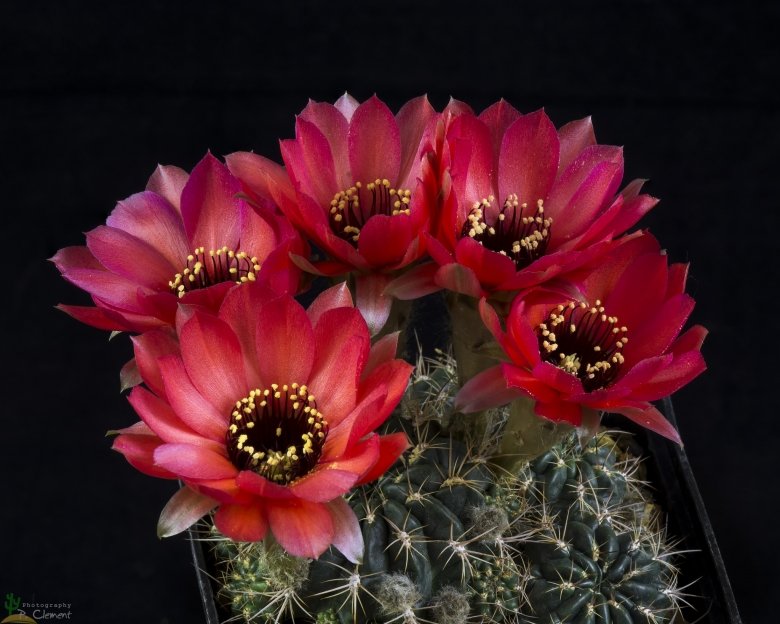
Echinopsis saltensis subsp. schreiteri (A.Cast.) M.Lowry , better known as Lobivia schreiteri, is a common attractive dwarf cactus and particularly is fun as it matures and flowers at an early age. This is a variable species, that has received several of unnecessary names, none deserving acceptance as shown by field studies (like many other cacti) and comprises slightly different regional or morphological forms as well as various cryptic allied species. But where each form is linked to others by populations of plants with intermediate characteristics. E. saltensis subsp. schreiteri is a small-growing cactus with small clustering stems, deep-rooted, and partially buried in the ground. It form dense clusters or mats up to 30 cm wide and less than 3.5 cm tall (more in cultivation). The short-tubed flowers, about 3 cm long, are striped with bright red and purple and have reddish purple stamens.
Derivation of specific name: The epithet honours the Argentinian botanist R. Schreiter (fl. 1927).
Root: Taproots large and woody.
Stems: Individual stems, globose to elongate, dark green or bluish green, 1.5-3 cm in diameter and up to 3.5 cm tall. Apex depressed, woolly.
Ribs: 9-14, continuous, rounded, and weakly sinuous.
Areoles: Oval, whitish to grey, about 1.5 × 2.5 mm.
Central spine: Usually absent, rarely one to 2 cm long.
Radial spines: 6 to 8 fine, curving, spreading outward and upward, whitish, 0.5-1 cm long. Young spines light brown, becoming straw yellow.
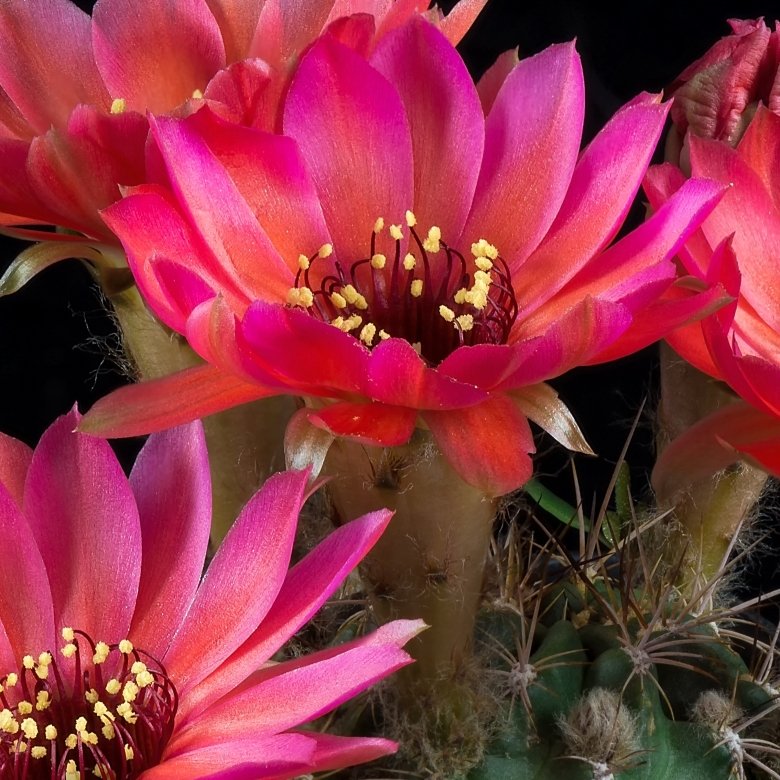
Flowers: On side of plants nearly at ground level, funnelform, purplish red with darker throats, to 3(-4.5) cm long and 3(-3.8) cm in diameter. Pericarpel 5 mm long. Tube 1.5 cm long, bright green outside with loosely hairy elongated scales with a slightly brownish tip. Wool white mixed with a little black. Outer perianth-segments orange-red with a olive green central line. Inner-perianth-segments spatulated, red and purple, tip sharp mucronate. Throat blackish purple. Stamens in two series with reddish purple or violet filaments. Anthers light yellow. Style and stigmas yellowish green.
Origin and Habitat
Echinopsis saltensis subsp. schreiteri is found in the area between Tucuman and Salta in north-western Argentina.
Cultivation and Propagation
This is a a much decorative frost hardy cactus easily found in cultivation. It is a summer grower species that offers no cultivation difficulties.
Soil: Use a very a particularly draining substratum, as it is very sensitive to rottenness when in presence of humidity and low temperatures and let the soil dry out between waterings, since it’s natural habitat is in volcanic soil, it has adapted to more acidic conditions.
Repotting: Repot in the spring, when their roots become cramped. Generally, they should be repotted every other year in order to provide fresh soil. After repotting, do not water for a week or more. Needs a large pot to accommodate a large root system.
Water: In summer, during the vegetative period, it must be regularly watered, but allowing the substratum to completely dry up before irrigating again (but do not overwater ); in winter, it’s to be kept dry. Preferable not to water on overcast days, humid days or cold winter days.
Hardiness: It is a quite frost resistant cactus, hardy to -5° C (- 10° C if very dry). However in cultivation it is better not to expose it to temperatures lower than -0° C, even if in an aerated and protected location, in order to avoid the formation of anti-aesthetic spots on the epidermis. In presence of high atmospheric humidity avoid any frost as it is particularly sensitive to root rot.
Exposure: Outside full sun or afternoon shade, inside needs bright light, and some direct sun, but, as a former mountain dweller, does not care for extremely high temperatures in summer.
Use: It is suitable for small “desert” gardens, in association with other xerophytes. Where the open air cultivation is not possible due to the climate, it is to be cultivated in pot in order to shelter it in winter.
Propagation: By seeds and by cuttings, provided left drying up well, in summer.
Bibliography
Major references and further lectures
-
J.G. Lambert Ir. A.I.Gx. “Cactus d’Argentine” 2ème édition Revue et complétée, Concordia-Roeselare., 1997
-
Curt Backeberg “Die Cactaceae: Handbuch der Kakteenkunde,” Volume 2 G. Fischer, 1959
-
James Cullen, Sabina G. Knees, H. Suzanne Cubey “The European Garden Flora Flowering Plants: A Manual for the Identification of Plants Cultivated in Europe, Both Out-of-Doors and Under Glass” Cambridge University Press, 11/Aug./2011
-
David Hunt, Nigel Taylor “The New Cactus Lexicon” DH Books, 2006
-
Edward F. Anderson “The Cactus Family” Timber Press, 2001
-
Walther Haage “Cacti as House Plants” Studio Vista, 1965
-
The National Cactus and Succulent Journal: The Official Journal of the National Cactus & Succulent Society, Volumes 35-37 National Cactus and Succulent Society, 1980
-
Supplement to Hortus, for the Five Current Years Including 1930 Macmillan, 1935
-
Urs Eggli, Leonard E. Newton “Etymological Dictionary of Succulent Plant Names.” Springer, Berlin/Heidelberg 2010.