Publication: Cact. Suc. Mex. 25(3): 65 (1980)
Description
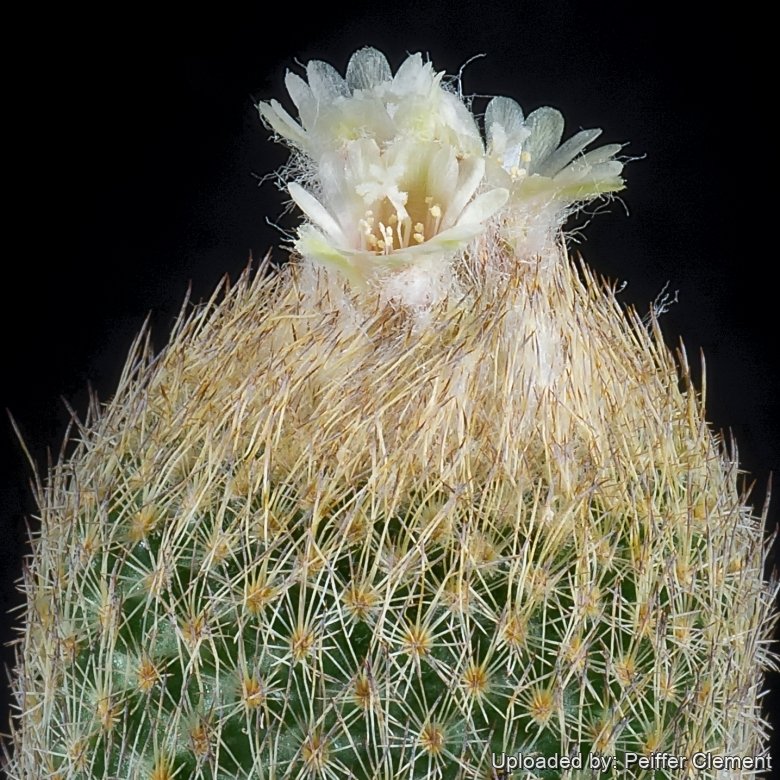
Epithelantha micromeris f. elongata best known as: Epithelantha pachyrhiza var. elongata is a different variety with a cylindrical body which is more elongated than Epithelantha micromeris and sits directly on a thick turnip-like root. The tip is the same as E. micromeris, while the elongated stem is similar to that of Epithelantha pachyrhiza but without a so very thin constriction between the stem and the turnip-like root. It grows quite unlike E. micromeris, in that it at first puts up a thin stem rather akin to Turbinicarpus krainzianus ssp. minimus before evidently broadening out to a wider head. Epithelantha pachyrhiza var. elongata is quite common in culture, while Epithelantha pachyrhiza var. pachyrhiza is quite rare, usually it is possible to find only the variety Epithelantha pachyrhiza var. elongata.
Origin and Habitat
Ramos Arispe, Coahuila, Mexico.
Cultivation and Propagation
Although regarded as a choice and difficult plant, in cultivation it is relatively easy, but very slow growing.. These plants need very coarse potting soil that drains well (rot prone).
Waterings should be rather infrequent, to keep the plant compact and not become excessively elongated or unnatural in appearance. If the plant becomes to much tall it will lean on a side because the thin neck cannot support the weight of the stem, to keep the plant erect one could either repot it into a deeper pot and bury part of the neck in gravel to give it some support or one could place a couple of nice stones/rocks either side of it to support it. The only trouble with burying the neck with white spined plants like Epithelantha is that the neck can act like a wick when you water and cause brown staining to the plant, watering from the bottom reduces this somewhat.
Frost Tolerance: Depending on the variety, it will take -5° C (or less) (Temperature Zone: USDA 8-11)
Sun Exposure: It requires strong sun to part sun to develop good spinal growth, but some summer shade in the hottest hours of the day is beneficial. Assure a good ventilation.
Propagation: It can be reproduced both by seeds and cuttings, but it is often grafted because difficult and slow to grow on its own roots. Older specimens shoot tillers from under tubercles, so they can be grafted, which is a much easier way of propagation than sowing. Young seedlings are tiny and they need several years to reach adult size, and require careful watering.
Bibliography
Major references and further lectures
-
Sybille & Klaus Breckwoldt in: “Kakteen und andere Sukkulenten”, Volume 55 Steinhart KG, 2004
-
Backbg. - “Cactus”, 9:39, 32 und 9:40, 62. 1954
Gallery