Publication: Eriosyce (Cactac.) gen. revis. & ampl. (Succ. Pl. Res., 1) 117 (1994)
Description
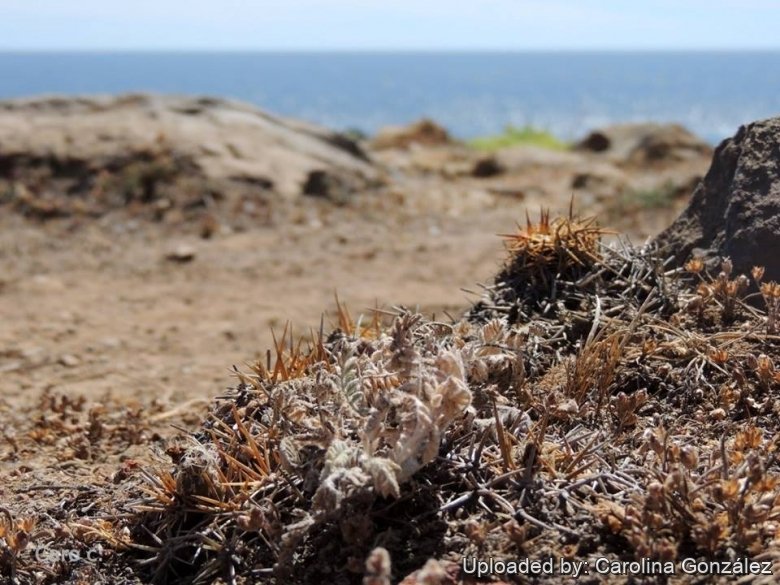
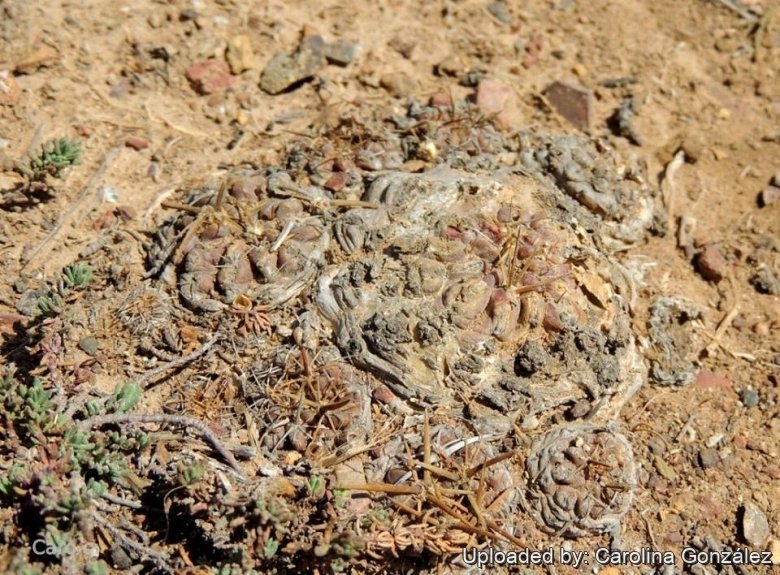
Eriosyce curvispina var. mutabilis (Ritter) Kattermann (firstly described as Pyrrhocactus horridus var. mutabilis F.Ritter by Ritter in 1980) is a local or morphological form of the widespread and variable Eriosyce curvispina. It forms clusters and has ribs divided into tubercles, outwards directed spines and yellow flowers. However the distinguishing characteristics of Eriosyce curvispina var. mutabilis, appear to fall within the natural variation of Eriosyce curvispina and it should be synonymized with the latter.
Stems: Frequently branching from basal areoles and forming little plantlets.
Spines: Strong, sharp-tipped, horn-coloured.
Flowers: Yellow with variable reddish midstripes.
Seed: 0.94-1.23 mm long 1-1.09 mm wide, ribbed, brown.
Origin and Habitat
Chile, North, South and East of Pto Pichidangui.
Cultivation and Propagation
Eriosyce curvispina var. mutabilis is an extremely xerophytic, summer-growing, species, adapted to very dry soils. Despite its provenance it is not particularly difficult to cultivate, but quite susceptible to over-waterings and rot prone if kept in a non-ventilated place.
Growth rate: Slow-growing.
Soil: It requires a very fast draining drying open mineral, sandy-gritty cactus compostso. Provide a very good drainage.
Exposure: It is suited for sunny-brightly exposure, but can tolerate light shade. However it will do its best only with lots of sun and become stressed with inadequate light which could result in poor growth and unnatural shape. It has a good heat tolerance.
Watering: Water regularly in summer, but do not over-water and keep it completely dry during winter. Mature individuals easily rot and die especially after transplanting so be extremely cautious with watering. Keep dry in winter or when night temperatures remain below 10° C. Water it less than average if in bigger pots.
Fertilization: Feed them once during the growing season with a fertilizer specifically formulated for cactus and succulents (high potash fertilizer with a dilute low nitrogen), including all micro nutrients and trace elements diluted to ½ the strength recommended on the label. They thrive in poor soils and need a limited supplies of fertilizer to avoid the plants developing excess vegetation, which is easily attacked by fungal diseases.
Special need: It is suited for airy exposures. Provide very good ventilation. Nearly all problems occur as a result of overwatering and poor ventilation, especially when weather conditions are dull and cool or very humid. They must have very dry atmosphere.
Hardiness: It likes warmth (recommended minimum winter temperature 5° C), but Hardy to at least -5°C (it can probably tolerate freezing temperatures down to -10° C for brief periods) It has a good heat tolerance.
Pests & diseases: These cacti may be attractive to a variety of insects, but plants in good condition should be nearly pest-free, particularly if they are grown in a mineral potting-mix, with good exposure and ventilation. Nonetheless, there are several pests to watch for.
- Red spiders: Red spiders may be effectively rubbed up by misting the plants from above.
- Mealy bugs: Mealy bugs occasionally develop aerial into the new leaves and flowers with disfiguring results, but the worst types develop underground on the roots and are invisible except by their effects.
- Scales, thrips and aphids: These insects are rarely a problem.
- Rot: Rot is only a minor problem if the plants are watered and “aired” correctly. If they are not, fungicides won’t help all that much.
Propagation: Usually propagated from seeds or graft. The seeds can be sown in pots of fine, well-drained sandy soil, any time during the spring when temperatures are warm. Cover the seeds with a fine layer of grit and water from below with a fungicide to prevent damping off. For the 1-2 weeks cover the pots with a sheet of glass/clear perspex to keep the humidity levels high. Remove the glass and replace it with light shade-cloth and mist once or twice a day for the next two weeks after which most seeds should have germinated. From then on mistings can be reduced to every second and then every third day as the little plants grow. The seedlings should not be disturbed until they are well rooted after which they can be planted separately in small pots. Sometimes it is grafted to avoid root rot problems as plants grafted on an hardy stock are easy to grow and no special skill is required.
Bibliography
Major references and further lectures
-
Fred Kattermann “Eriosyce (Cactaceae): The Genus Revised and Amplified” David Hunt, 1994
-
Pablo C. Guerrero, Pedro León-Lobos & Francisco A. Squeo. Ficha de antecedentes de especie “Eriosyce curvispina” Retrieved 06 January 2016 from: <http://www.mma.gob.cl/clasificacionespecies/fichas6proceso/fichas2010/Eriosycecurvispina\_P06R3\_RCE.pdf\>
-
BELMONTE E, L FAÚNDEZ, J FLORES, A HOFFMANN, M MUÑO Z & S TEILLIER “Categorías de conservación de las cactáceas nativas de Chile.” Boletín del Museo Nacional de Historia Natural 47: 69-89. 1998
-
HOFFMANN AE & AR FLORES “The conservation status of Chilean succulent plants: a preliminary assessment.” In: Red List of Chilean Terrestrial Flora (Benoit I
Ed). Pp 107-121. Corporación Nacional Forestal, Santiago, Chile. 1989
- HOFFMANN AE & HE WALTER “Cactáceas en la flora silvestre de Chile.”
2nd Edición. Fundación Claudio Gay, Santiago, Chile. 2004
- HUNT D, N TAYLOR & G CHARLES (Eds) “The new cactus Lexicon.” Vol. 1-2
DH books, Milborn Port, UK. 2006
-
KATTERMANN F, JM LÜTHY, RS WALLACE, D HUNT, N TAYLO R & D ZAPPI “Eriosyce (Cactaceae): The genus revised and amplified.” (1994) Hunt D & N Taylor (Eds). Succulent Plant Research Volume 1. David Hunt Press. Surrey, England.
-
LUEBERT F & P PLISCOFF “Sinopsis bioclimática y vegetacional de Chile.” Editorial Universitaria, Santiago. 2006