Publication: Eriosyce (Cactac.) gen. revis. & ampl. (Succ. Pl. Res., 1) 118 (1994)
Description
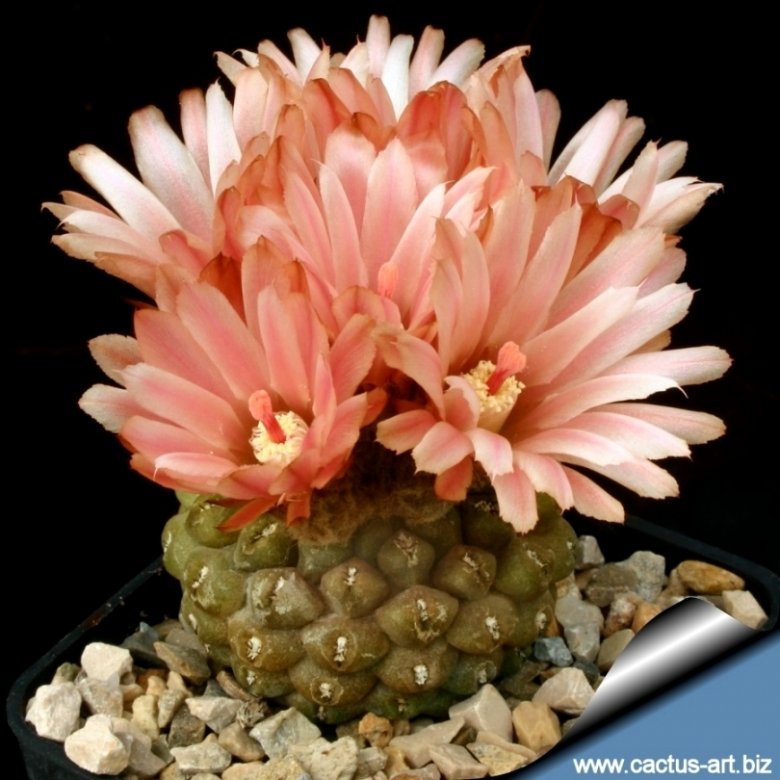
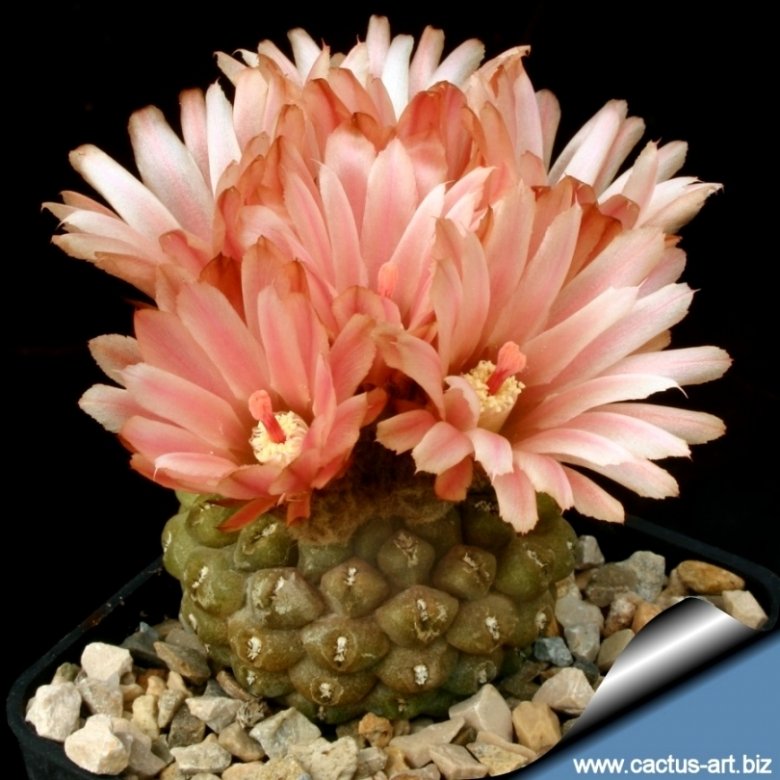
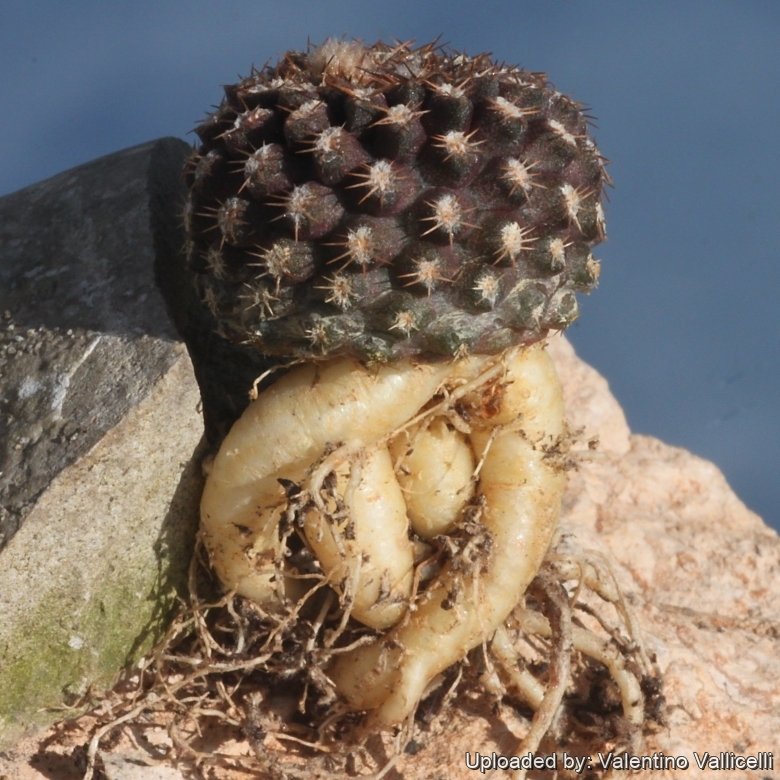
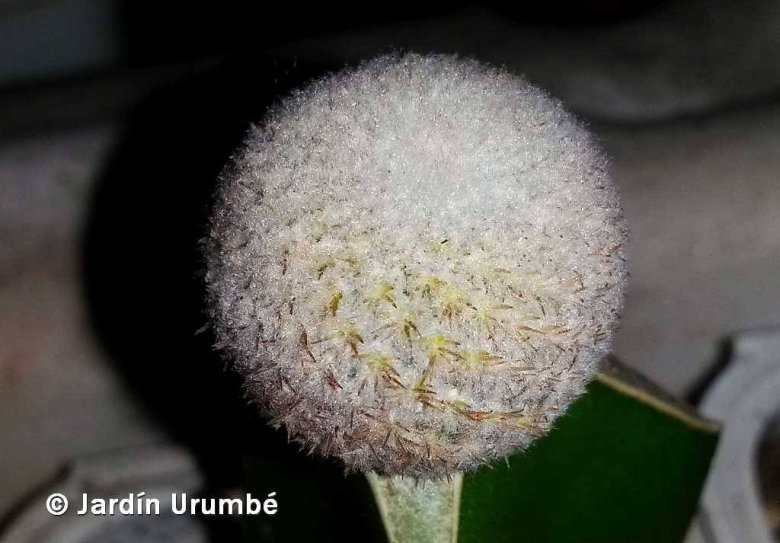
Eriosyce napina is a tiny geophyte, with a solitary spherical or flattened stem slowly growing atop a thick, underground taproot, with a constriction between the stem and the root, eventually becoming somewhat elongated in cultivation.
Stem: Slow growing, up to 3-5 cm across, 2-6 cm tall, ranging from green to brown, but more commonly with brown-olive-grey tones.
Tubercles: Larger than ssp. lembckei.
Areoles: Grey.
Spines: Very short black radials.
Roots: Forms a tuberous root system with (usually) a very large carrot-like root
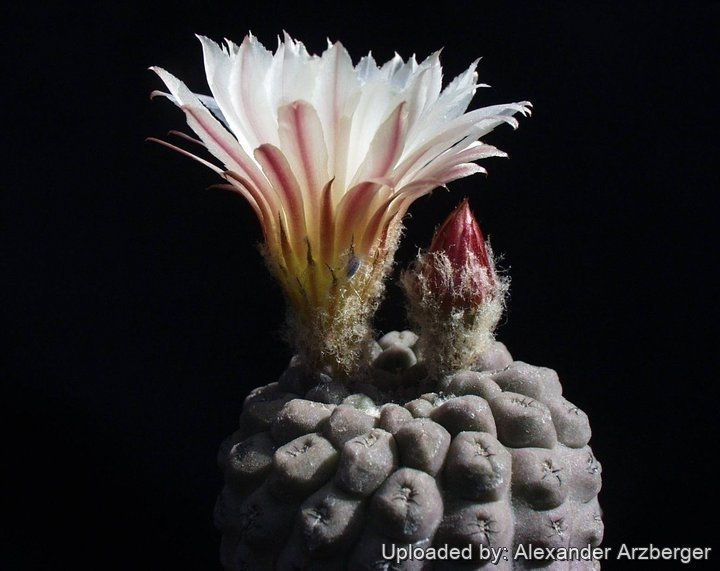
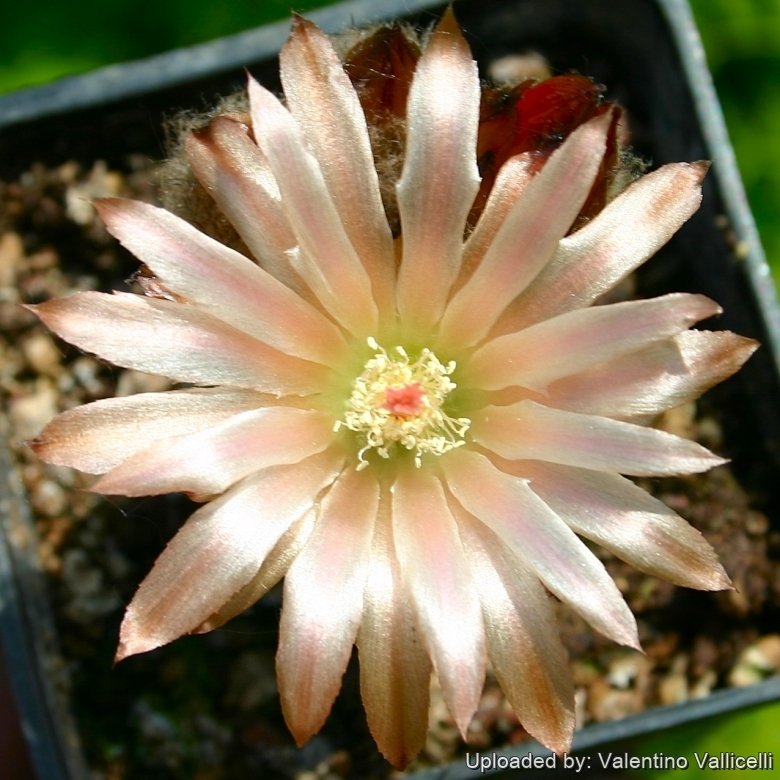
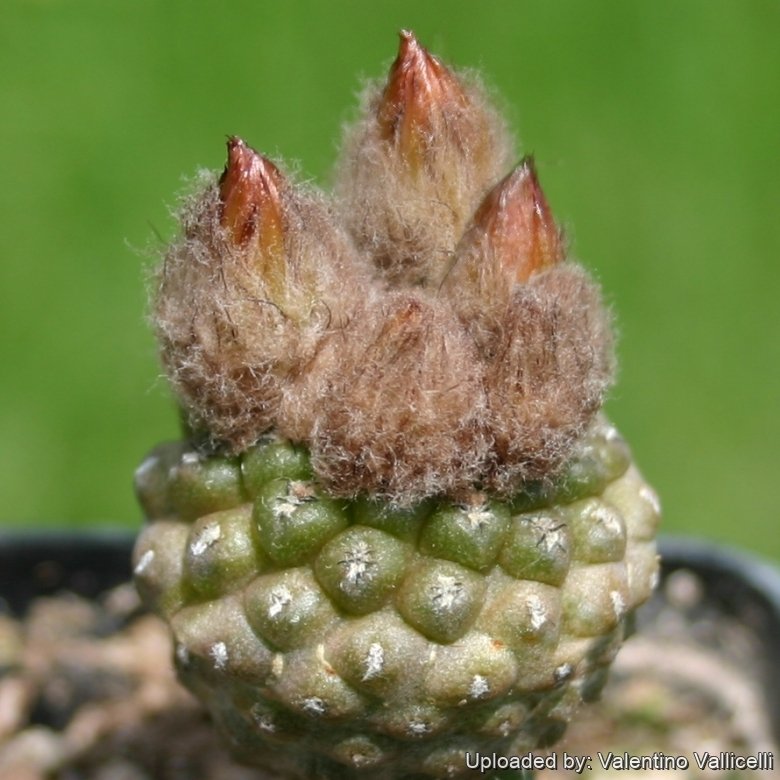
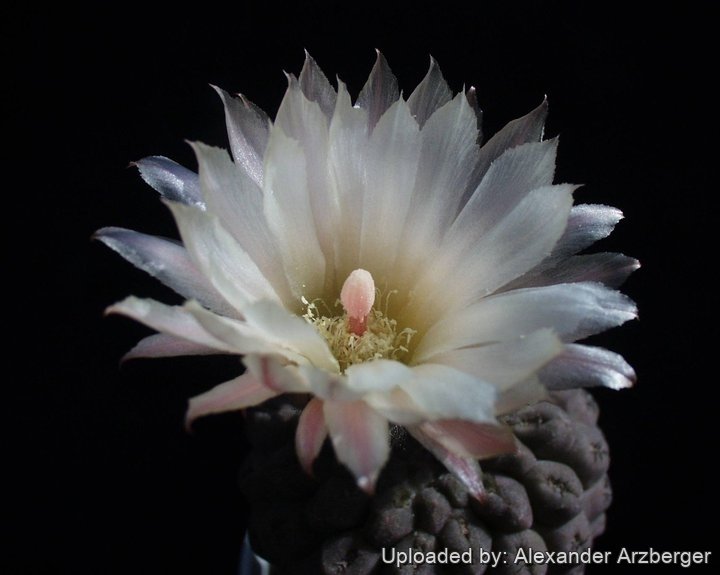
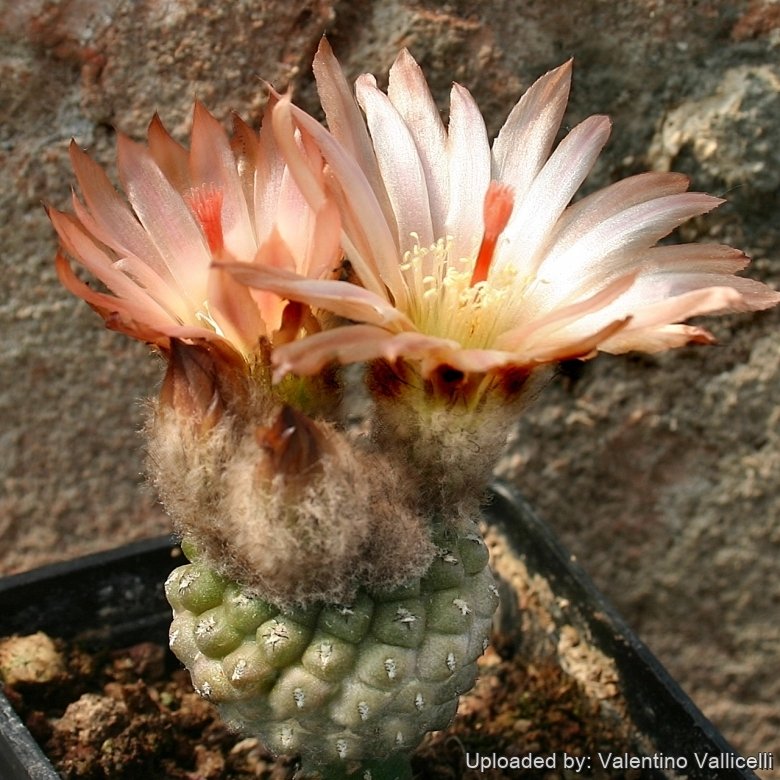
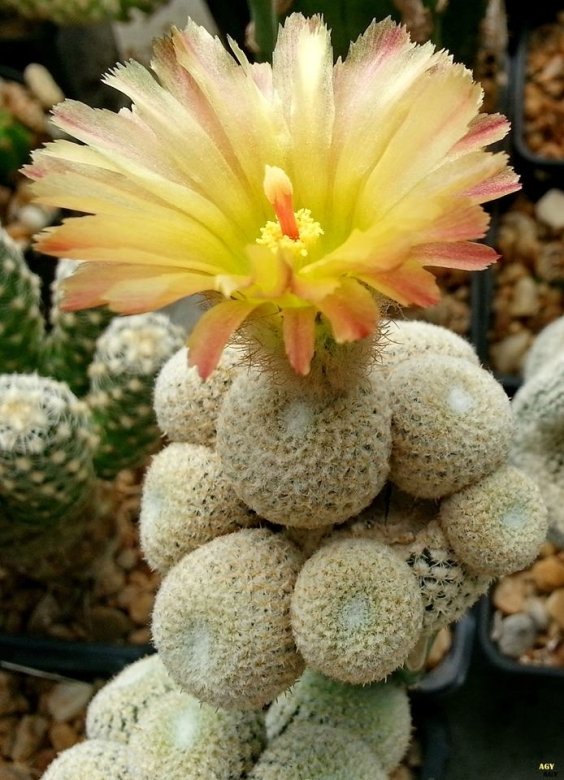
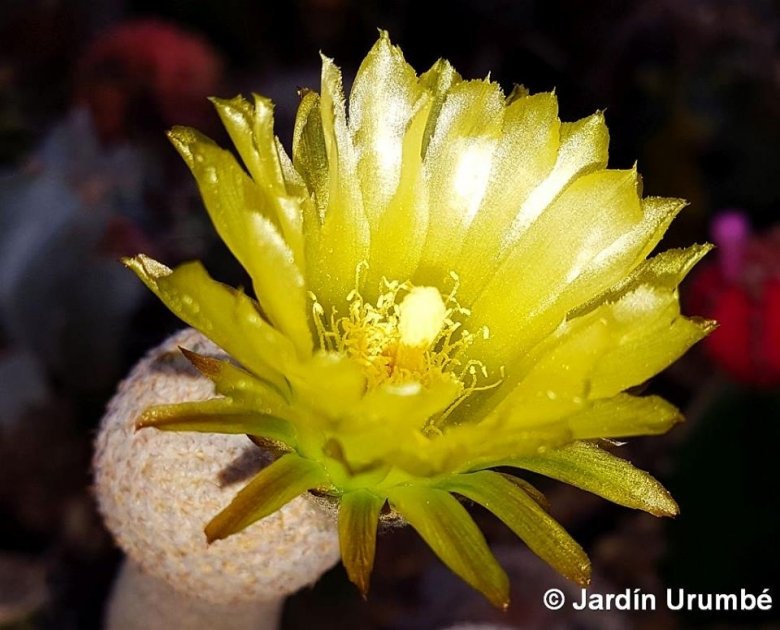
Flower: Approx 3,5 cm long, 4-6 cm in diameter, whitish, yellowish, pinkish to pale brick-red with a silky shine, buds densely hairy with brown wool.
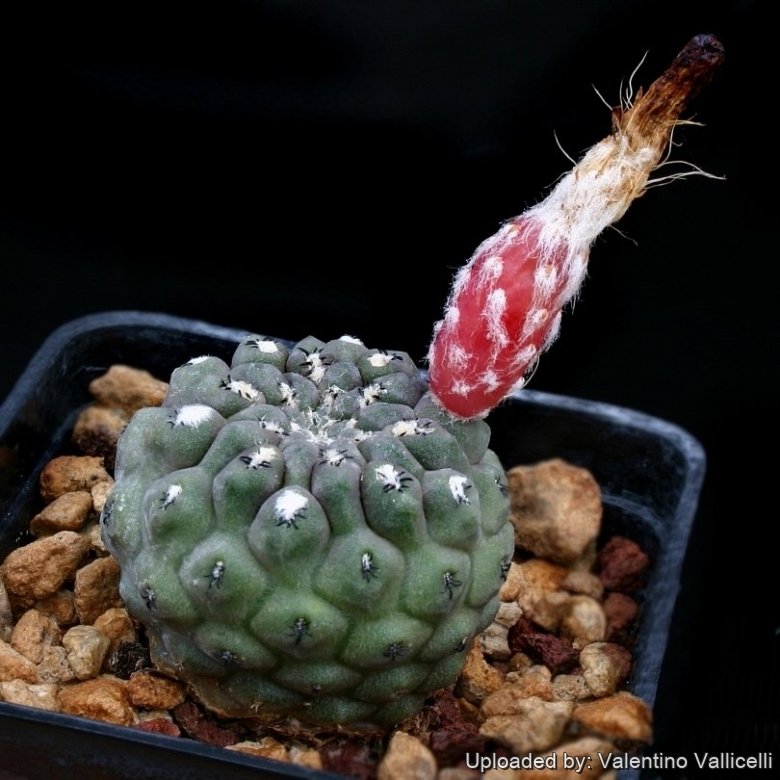
Fruits: Large, red, clavate, wrapped in white wool.
Blooming season: Flowers already when young, synchronised flowering of the whole plants takes place over one or two days, and they remain open for about three or four days. Blooms in late spring.
Origin and Habitat
From coastal Chile (Region III Atacama) South of Freirina in the Huasco valley (Atacama Desert)
Habitat: Eriosyce napina grows in one of the most arid areas in the world, among rocky crags and sand dunes in sandy-clayey soil in a vegetable formation called “Costal desert of Huasco,” a typical “desertic mattoral” that is just spectacular and impressive when it displays the phenomenon of the “flowering desert”.
Altitude around 200 m.
Cultivation and Propagation
It is a summer-growing species of relatively easy cultivation. This plant is extremely xerophytic and adapted to very dry soils. It has a thick taproot and is susceptible to over-watering if kept in a non ventilated place. This cactus continues to be, a particular prize among collectors.
Growth rate: Slow-growing.
Soil: Grow it in an open mineral, sandy-gritty cactus compost and provide a very good drainage. It needs deep pots to accommodate its taproot.
Exposure: It is suited for sunny-brightly exposure; can tolerate light shade and has a good heat tolerance. But it will do its best only with lots of sun and become stressed with inadequate light which could result in poor growth and unnatural shape.
Watering: Water in moderation, it prefer a completely dry place during winter. Mature individuals easily rot and die especially after planting so be extremely cautious with watering. Keep dry in winter or when night temperatures remain below 10° C. Water it less than average if in bigger pots.
Fertilization: Feed them once during the growing season with a fertilizer specifically formulated for cactus and succulents (high potash fertilizer with a dilute low nitrogen), including all micro nutrients and trace elements diluted to ½ the strength recommended on the label. They thrive in poor soils and need a limited supplies of fertilizer to avoid the plants developing excess vegetation, which is easily attacked by fungal diseases.
Special need: It is suited for airy exposures. Provide very good ventilation. Nearly all problems occur as a result of overwatering and poor ventilation, especially when weather conditions are dull and cool or very humid. They must have very dry atmosphere.
Hardiness: It likes warmth (recommended minimum winter temperature 5° C) But plants kept perfectly dry can easily survive to winter night temperatures below 0° C.
Pests & diseases: These cacti may be attractive to a variety of insects, but plants in good condition should be nearly pest-free, particularly if they are grown in a mineral potting-mix, with good exposure and ventilation. Nonetheless, there are several pests to watch for:
- Red spiders: Red spiders may be effectively rubbed up by misting the plants from above.
- Mealy bugs: Mealy bugs occasionally develop aerial into the new leaves and flowers with disfiguring results, but the worst types develop underground on the roots and are invisible except by their effects.
- Scales, thrips and aphids: These insects are rarely a problem.
- Rot: Eriosyce napina is especially prone to rot, therefore, underpot in a smaller container filled with very porous compost. However root rot is only a minor problem if the plants are watered and “aired” correctly. If they are not, fungicides won’t help all that much.
Propagation: Usually propagated from Seeds. (seldom produces offsets) or graft. The seeds can be sown in pots of fine, well-drained sandy soil, any time during the spring when temperatures are warm. Cover the seeds with a fine layer of grit and water from below with a fungicide to prevent damping off. For the 1-2 weeks cover the pots with a sheet of glass/clear perspex to keep the humidity levels high. Remove the glass and replace it with light shade-cloth and mist once or twice a day for the next two weeks after which most seeds should have germinated. From then on mistings can be reduced to every second and then every third day as the little plants grow. The seedlings should not be disturbed until they are well rooted after which they can be planted separately in small pots. Sometimes it is grafted to avoid root rot problems as plants grafted on an hardy stock are easy to grow and no special skill is required.
Bibliography
Major references and further lectures
-
Edward Anderson “The Cactus family” Timber Press, Incorporated, 2001
-
Nathaniel Lord Britton, Joseph Nelson Rose “Cactaceae: Descriptions and Illustrations of Plants of the Cactus Family” vol. 4 The Carnegie Institution of Washington, Washington 1923
-
James Cullen, Sabina G. Knees, H. Suzanne Cubey “The European Garden Flora Flowering Plants: A Manual for the Identification of Plants Cultivated in Europe, Both Out-of-Doors and Under Glass” Cambridge University Press, 11/Aug/2011
-
David R Hunt; Nigel P Taylor; Graham Charles; International Cactaceae Systematics Group. “The New Cactus Lexicon” dh books, 2006 ISBN 0953813444, 9780953813445
-
Fred Kattermann “Eriosyce (Cactaceae): The Genus Revised and Amplified” David Hunt, 1994
From llifle page Echinocactus mitis
Description
It is a very small perennial plant with a brown body slowly growing atop a thick, underground taproot. It is a dwarf form of Eriosyce napina.
Stem: About 3-5 cm across, 2-6 cm tall slow growing, spherical or flattened eventually becoming somewhat elongated in cultivation, with a constriction between the stem and the root, brown to dark purple-brown.
Tubercles: Larger than ssp. lembckei;
Radial spines: Very short brown to grey pressed flat against the stem.
Areoles: With grey felt becoming bare.
Roots: Forms a tuberous root system with (usually) a very large carrot-like root
Flower: Often larger than the plant itself from crown approx 3,5 cm long, 4-6 cm in diameter, pinkish with a silky shine ( but also white, pink, carmine, or brown) buds densely hairy with brown wool.
Fruits: Large, red, clavate, wrapped in white wool.
Blooming season: Flowers already when young, synchronised flowering of the whole plants takes place over one or two days, and they remain open for about three or four days. Blooms in late spring to summer.
Origin and Habitat
Atacama desert, coastal Chile (Region III Atacama)
Habitat: Eriosyce napina grows in one of the most arid areas in the world, among rocky crags and sand dunes in sandy-clayey soil in a vegetable formation called “Costal desert of Huasco,” a typical “desertic mattoral” that is just spectacular and impressive when it displays the phenomenon of the “flowering desert”
Altitude: around 200 m.
Cultivation and Propagation
This species has the fame to be difficult to grow, but it is really not so difficult. Whatever view one adopts, it is worth a place in every cactus collection. The only problem is that it is very slow growing and for its long root, necessitates a rather larger, or deeper at least, pot that one might expect for the size of plant. Like all thick-rooted species, it requires careful watering (rot sensitive), and patience to match its slow growth. During the winter rest, the plant may pull near the surface of the potting mix. Sometimes they are grafted to avoid root rot problems. Suited for sunny-bright exposure; they can tolerate light shade. They prefer airy exposures. They like warmth (recommended minimum winter temperature 5° C). But plant kept perfectly dry can easily survive in winter night temperatures below 0° C
Pests & diseases: Eriosyce napina is especially prone to rot, therefore, underpot in a smaller container filled with a very porous compost.
Propagation: Direct sow after last frost (it usually doesn’t produces offsets) or graft. Seeds can be sown in the spring or summer. The seedlings should not be disturbed until they are well rooted, after which they can be planted separately in small pots.
Source: Echinocactus mitis, LLIFLE - Encyclopedia of living forms, CC-BY-SA, retrieved 2026-10-25.
From llifle page Thelocephala challensis
Description
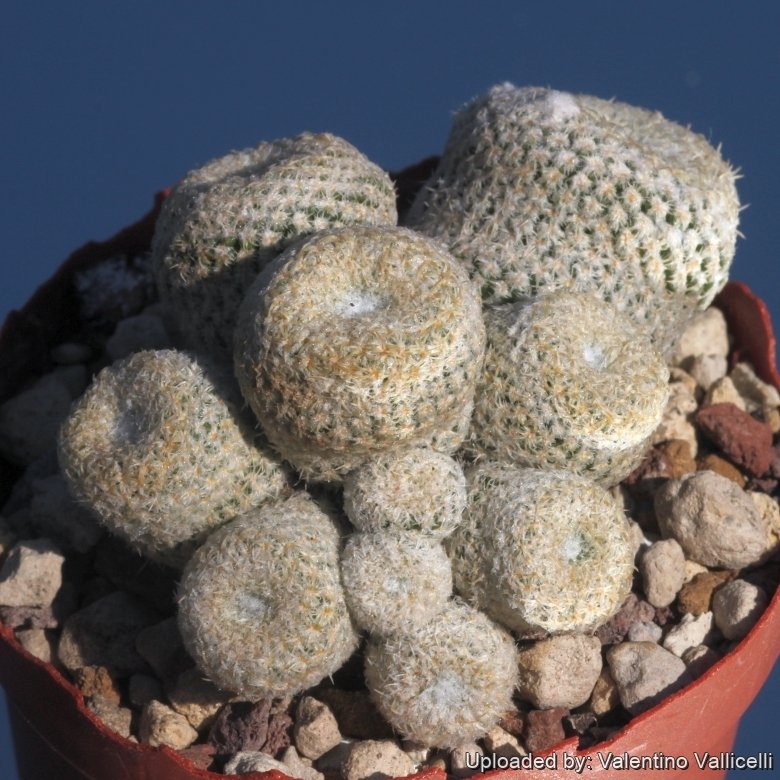
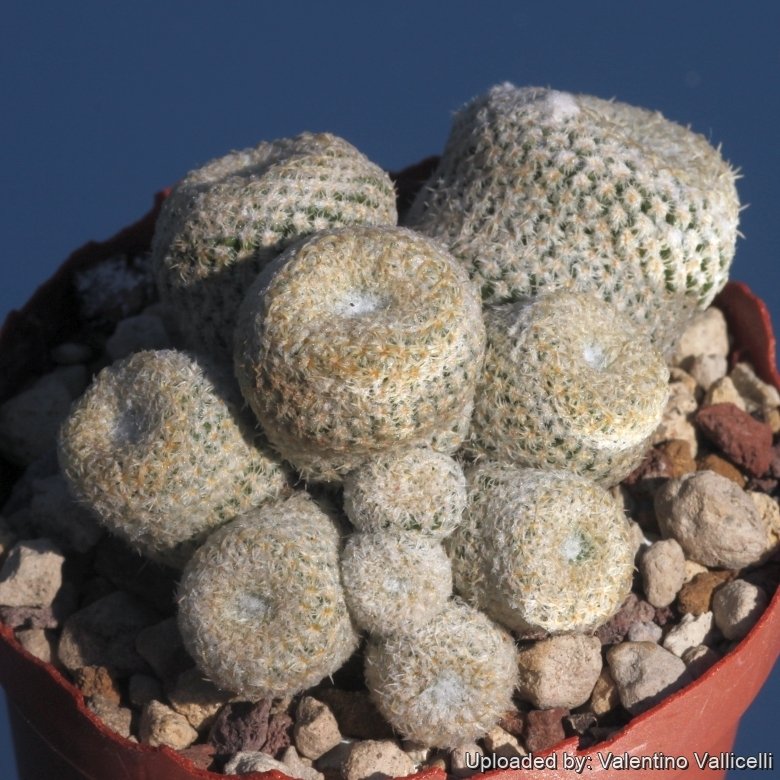
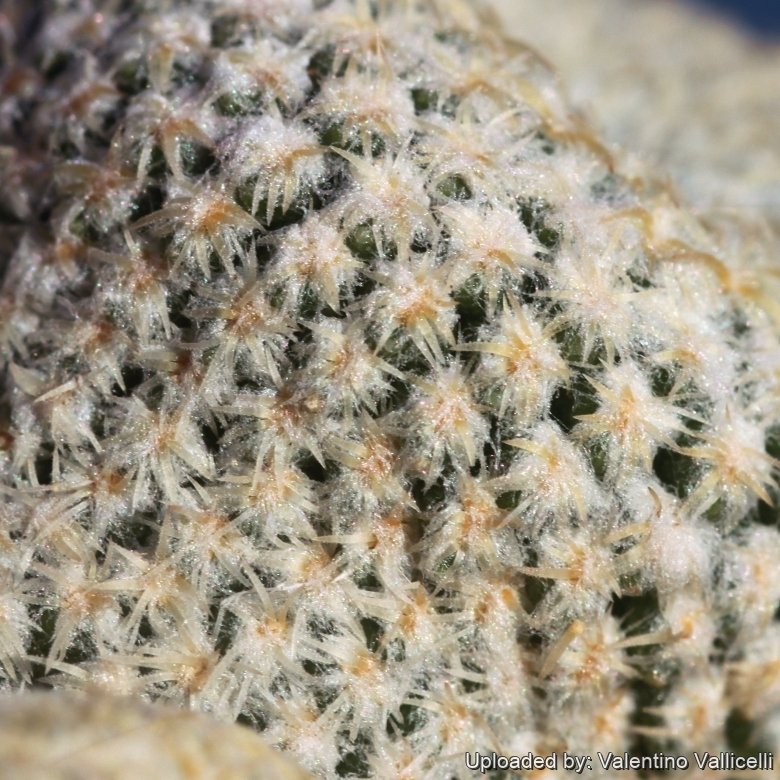
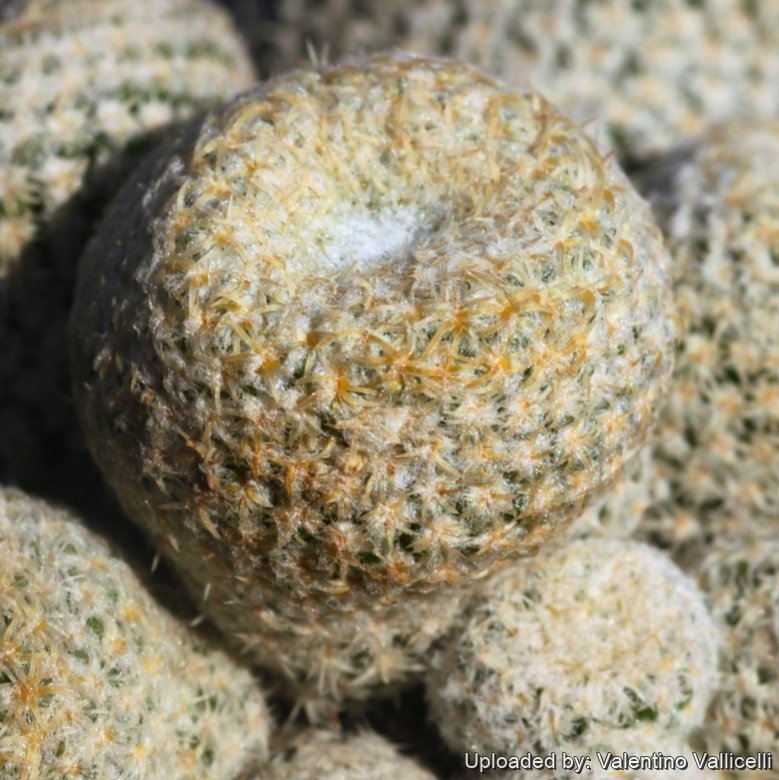
Eriosyce napina ssp. challensis (Thelocephala) is a marvellous tiny cactus similar to Eriosyce napina var. lembckei but with larger tubers and (maybe) larger spines. It appears white due to its very woolly areoles and addpressed spines that make it looks like an hairy Epithelantha. It is believed to be one of the most beautiful Eriosyce.
Root: It has a very large fleshy but firm taproot up to 20 cm long and 20-30 mm in diameter and sometimes branched with few shallow roots near the crown.
Stem: Solitary or clustered, globose to elongated eventually becoming somewhat cylindrical in cultivation with a constriction between the stem and the root, 15-30 mm diameter, 40 mm high with a depressed woolly apex extending laterally.
Tubercles: Less than 1 mm high and very closely arranged in a double spiral pattern.
Areoles: Round, not depressed, 1 mm in diameter, younger ones with white wool at the apex
Radial spines: 11-14, about 1 mm long, pectinate, curved towards the body, cream coloured some smaller and orange becoming greys-white as they ages.
Central spines: None.
Flowers: 1 to 3 at stems apex, diurnal, funnel-shaped, 25-30 mm long and 20 mm in diameter. Tepals 15 mm long and 3-4 mm wide, pale yellow with a reddish midrib. Pericarpel entirely covered with brown wool. Style, reddish, 18- 20 mm long. Stigma, reddish with 7-10 lobes 3-4 mm long. Stamens 7-15 mm long with yellow anthers.
Blooming season: Late spring. It blooms already when young, synchronised flowering of the whole plants takes place over one or two days, and flowers remain open for about three or four days.
Fruit: Rounded to elongate 9-11 mm in diameter and 10-20 mm in length. Completely covered in white wool and silk, and the wool near the base is beige to white. It dehisces (splits open) by a basal pore.
Seed: 1 mm in diameter, dark brown.
Origin and Habitat
Challe National Park (Southeast of Carrizal Bajo), IV Region, Chile
Altitude: They grow near the coast at about 165 to 290 metres of altitude.
Habitat: They are found in a small barren flat area on sandy soil with quartz gravel and stones with almost no other plants.
Ecology: The stems are partially or completely buried and invisible. It is only in wet years that these plants become visible as they absorb moisture and swell. The stems enlarge and bloom about 6-8 weeks after the rain. This only happens about twice a decade. Only few other succulents share the same habitat: Eulychnia acida, Eulychnia Philippi, Eriosyce odieri var. glabrescens and Copiapoa echinoides.
Source: Thelocephala challensis, LLIFLE - Encyclopedia of living forms, CC-BY-SA, retrieved 2026-10-25.
Cultivars and forms (11)
Subspecies (5)
Varieties (5)
Forms (1)
Gallery