Publication: Eriosyce (Cactac.) gen. revis. & ampl. (Succ. Pl. Res., 1) 118 (1994):.
Description
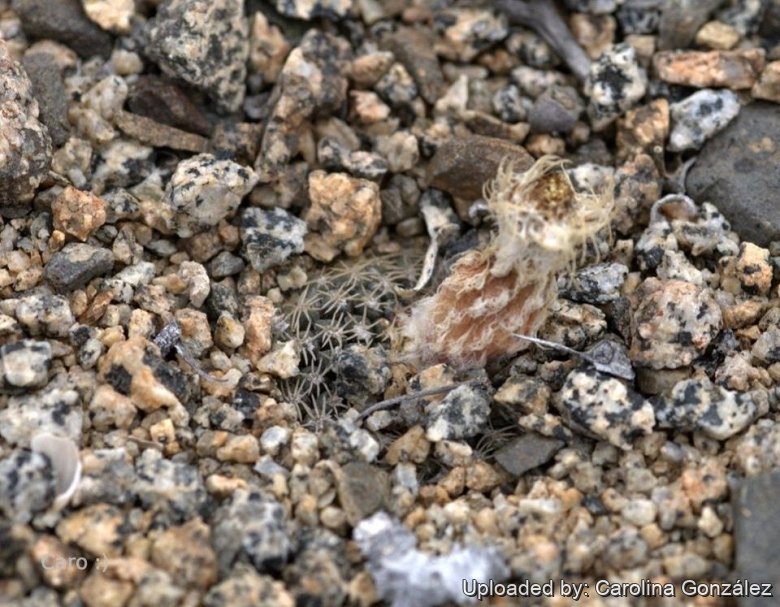
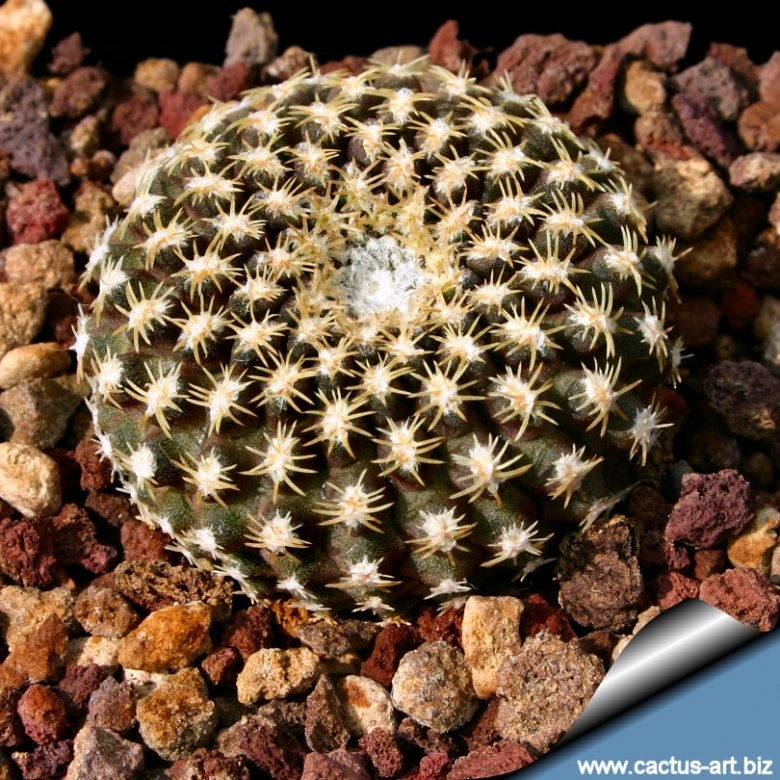
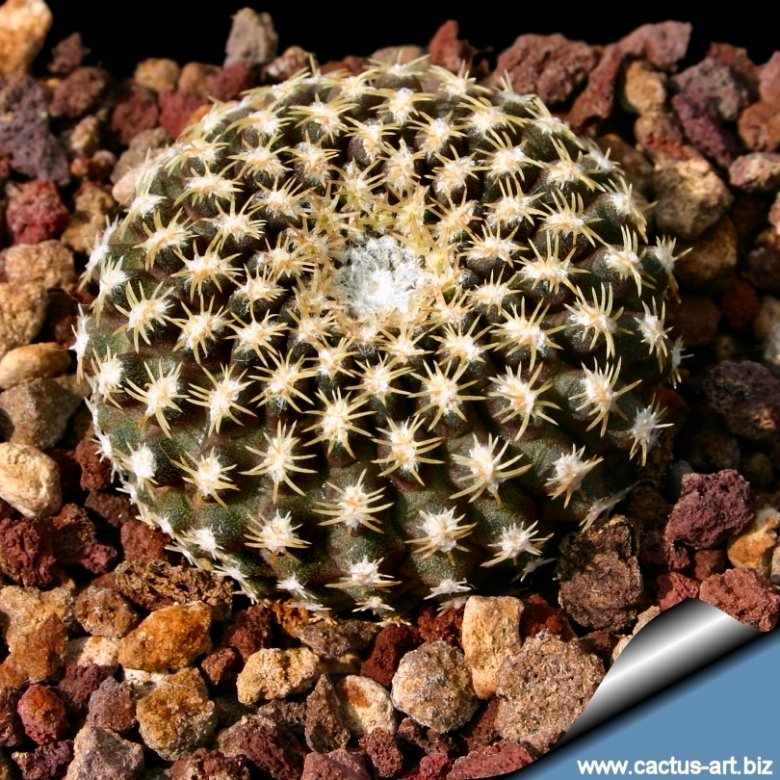
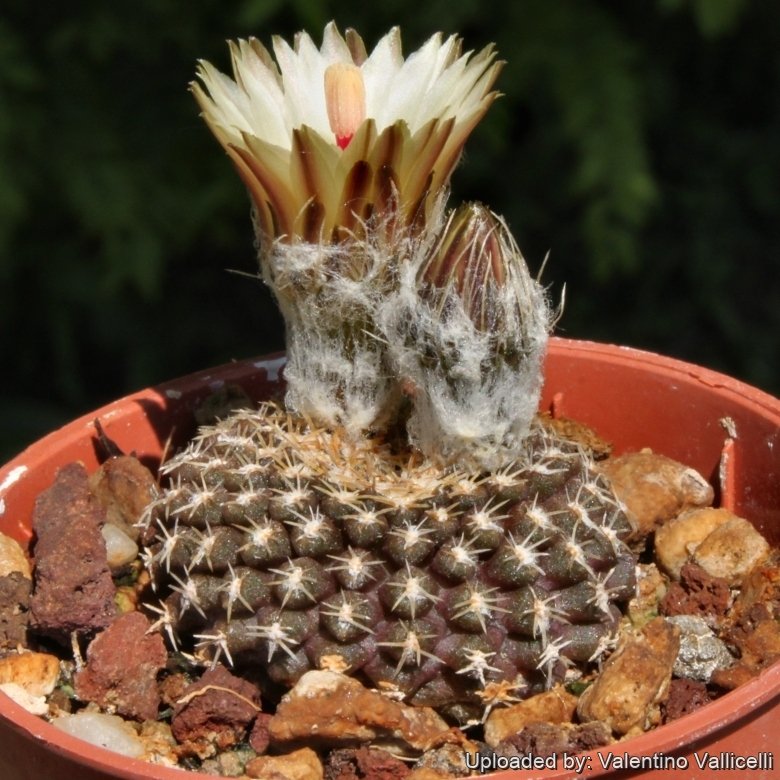
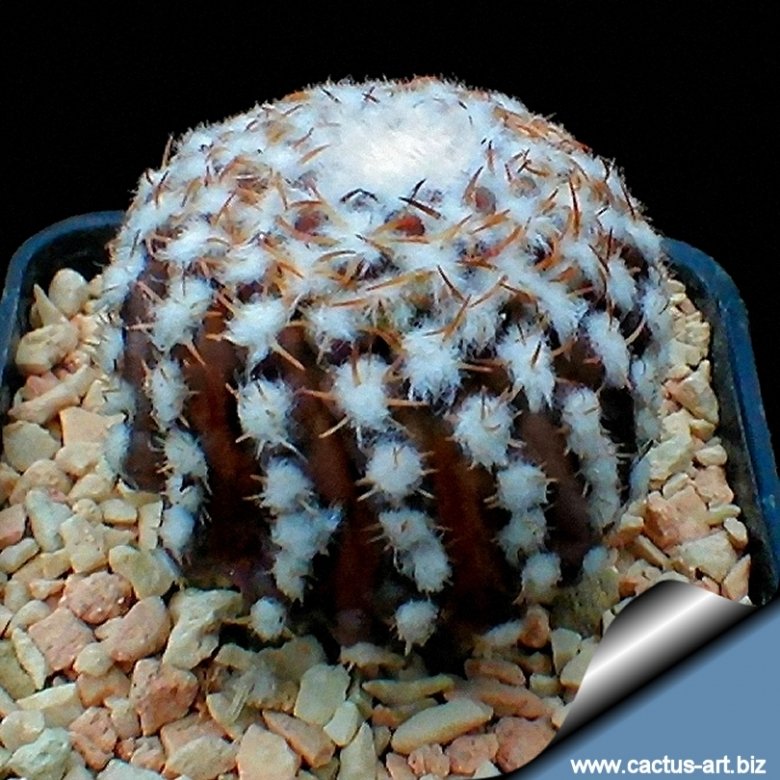
Eriosyce odieri is a greyish-green geophytic cactus that grow flat to the soil or often in time of drought, shrunken back into the ground. Often it acquires a reddish, purplish, brownish or almost blue-black colour due to sun exposure. Two subspecies are recognized, the nominate form and subsp. krausii (F.Ritter) Ferryman. Also included in the synonymy for this species is Thelocephala malleolata (F.Ritter) F.Ritter.
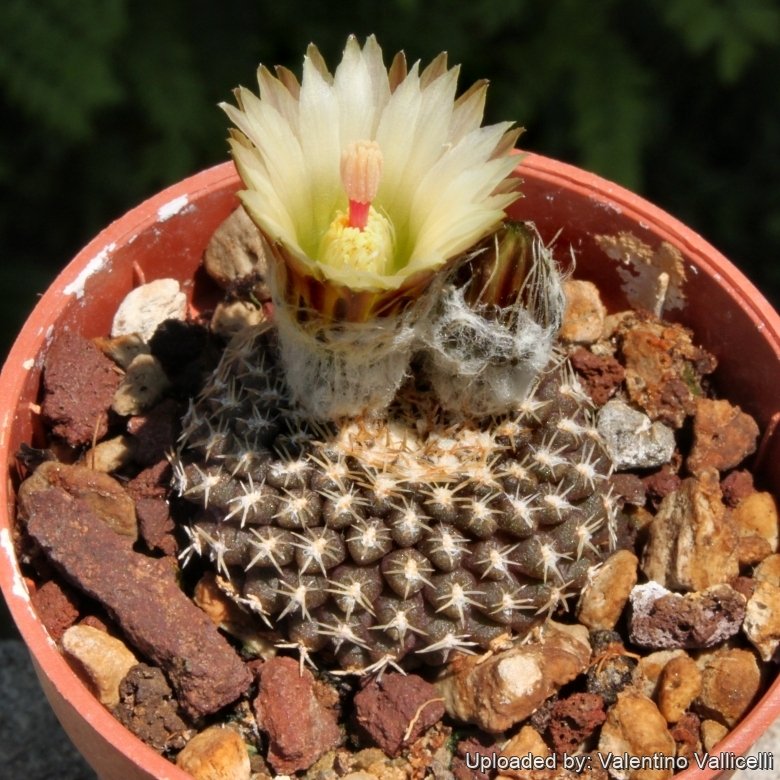
Stem: 3-5 cm in diameter, subglobular (flattened in the upper part) often spineless when old.
Ribs: 18-21 almost indistinguishable and tuberculate with the podaria arranged in helical lines. Mamilleae 4-6 mm in diameter.
Areoles: Sunken.
Radial spines: 6-12 approx 2-5mm long, spreading, flattened against the tubercles and pectinate, and not intertwining with those of the other areoles, yellowish, white or pale coffee coloured.
Central spine: Usually absent or 1 short.
Root: Massive tap root.
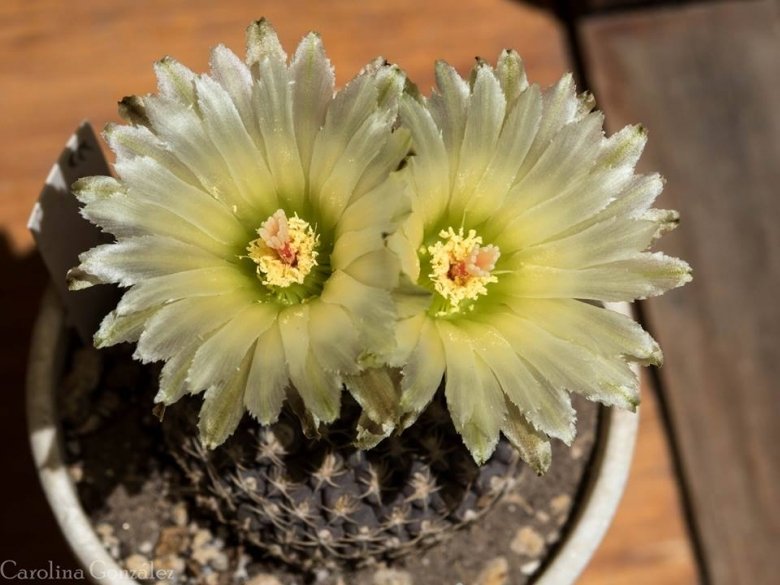
Flowers: Funnel form at the plant apex, that open during the hours of sun, pericarpel with small scales and wool, floral tube with abundant bristles, tepals pale coloured (whitish, yellow, pinkish or orangish)
Blooming season: It starts flowering when the stem reach 2 to 6 cm in diameter.
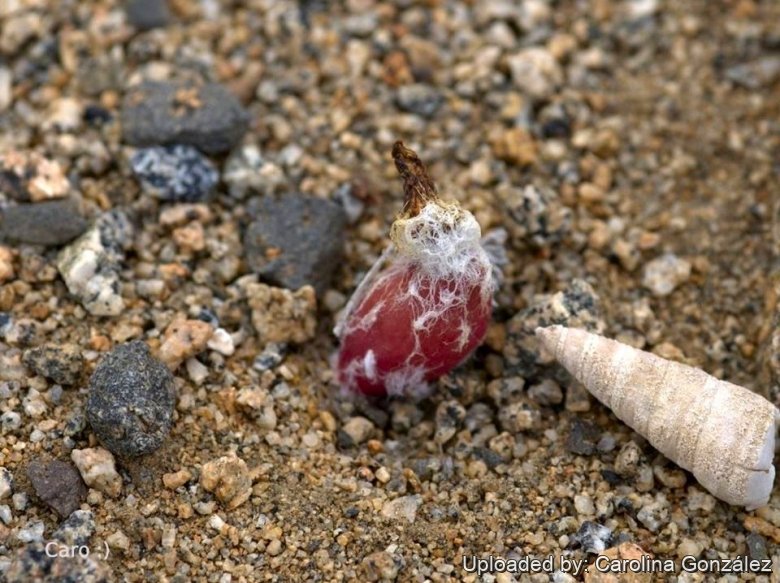
Fruits: Covered with rigid bristles in the upper portion. Dispersed by wind.
Remarks: There are several subspecies, variety and forms of this variable taxon, that differentiates for size, number of branches, number of tubercles, number and colour of the spines and for the size and colour of flowers:
Origin and Habitat
Eriosyce odieri is endemic to a small area ranging from Caleta Cifuncho (25°39’S-70°36’O), Antofagasta region, to the Copiapó Valley (27°15’S-70°55’O), Atacama Region. (extent of occurrence <10,000 km2), its presence in no more than 10 locations. This species is common in the southern, but rare in the northern portion of its range.
The variety odieri is only found in the habitat of Morro Copiapo (27° 9’S - 70°56’O) an solitary mountain alongside the sea 10 km south of Caldera.
The variety monteamargensis is found in the environment of Monte Amargo (27°21’S - 70°43’O) the old train station, 30 km sud-east of Caldera.
Altitude range: 0 to 500 metres above sea level.
Habitat: This species only occurs in the central northern coastal area of the Atacama desert in big valley and gully, on low costal flats and slopes in stony and very draining soil in areas where very little else grows. It’s a very drought tolerant species. Despite the lack of rain where it lives, the extreme aridity is attenuated by the frequent, often dense, coastal fogs. The fog tends to concentrate in the form of a cloud band It shows a recurrent pattern; usually it is overcast in the early mornings, the clouds dissipating during the late morning and returning during the late afternoons. Its seeds are dispersed by wind. This cactus is threatened by collection for ornamental purposes.
Cultivation and Propagation
The eriosyces have a thick taproot and are susceptible to over-watering. Sometimes they are grafted to avoid root rot problems. Suited for sunny-bright exposure; they can tolerate light shade. They like warmth (recommended minimum winter temperature 5° C). But plant kept perfectly dry can easily survive in winter night temperatures below 0° C (In our greenhouse there was no damage at -10° C for a few hours in the winter of 2002-2003 )
They prefer airy exposures. They also need a deep pot and good drainage, to accommodate its tap root. Keep dry in winter.
Pests & diseases: It is especially prone to rot, therefore, underpot in a smaller container filled with a very porous compost.
Propagation: Seeds or graft. Seeds can be sown in the spring or summer. The seedlings should not be disturbed until they are well rooted, after which they can be planted separately in small pots.
Bibliography
Major references and further lectures
-
Faundez, L. & Saldivia, P. 2013. Eriosyce odieri. The IUCN Red List of Threatened Species 2013: e.T152695A666993. http://dx.doi.org/10.2305/IUCN.UK.2013-1.RLTS.T152695A666993.en. Downloaded on 18 February 2016.
-
Fred Kattermann “Eriosyce (Cactaceae): The Genus Revised and Amplified” David Hunt, 1994
-
Hoffmann AE & HE Walter “Cactáceas en la flora silvestre de Chile.”
2nd Edición. Fundación Claudio Gay, Santiago, Chile. 2004
- KATTERMANN F, JM LÜTHY, RS WALLACE, D HUNT, N TAYLO R & D ZAPPI
“Eriosyce (Cactaceae): The genus revised and mplified.” (1994) Hunt
D & N Taylor (Eds). Succulent Plant Research Volume 1. David Hunt Press. Surrey, England.
-
Edward Anderson “The Cactus family” Timber Press, Incorporated, 2001
-
James Cullen, Sabina G. Knees, H. Suzanne Cubey “The European Garden Flora Flowering Plants: A Manual for the Identification of Plants Cultivated in Europe, Both Out-of-Doors and Under Glass” Cambridge University Press, 11/August /2011
-
David R Hunt; Nigel P Taylor; Graham Charles; International Cactaceae Systematics Group. “The New Cactus Lexicon” dh books, 2006
-
RITTER F “Kakteen in Südamerika” volume 3 Chile. Spangenberg. 1980
From llifle page Neoporteria reichii
Description
Very tall but relatively thin rarely if ever branching columnar cactus, but sometime it branch at the base producing a candelabra shape..
Stems: Columns up to 15 cm in diameter but up to 9 m or more tall. Green, grey green to glaucous green.
Central spines: Absent.
Radial spines: Neat cactus with generally 1 to maybe 3 (or five in young specimen) spines per areole. They are blackish to reddish-brown. As ages, spines tend to fall out and plant somewhat resembles a large Euphorbia candelabra.
Flowers: Nocturnal from the sides near the apex, and ruffled pink-red with a pale yellow centre. Plants starts flowering at about 120 cm in height.
Origin and Habitat
Mexico (San Luis Potosi, Tamaulipas, Veracruz)
Cultivation and Propagation
They are of easy culture and can grow 15-20 cm a year. They are cold intolerant. Make sure they are not exposed to freezing temperatures ( Hardy to -2°C) or they may die. They need a well drained soil mix. Water regularly in summer but allow to dry fully before watering again. During the winter months they should be rather kept dry. Since they are rapid growers, they need plenty of space for their roots. Repotting should be done every other year, or when the plant has outgrown its pot. Sun Exposure: Light shade when young, full sun later.
Propagation: From cuttings in spring (let them dry till the ends callous well). Then replant them in fresh cactus soil that is ever so slightly moist, and keep it that way till they root), or by Seeds (Seeds should be sown in a well-drained soil mix. Surface sowing is the best; seeds germinate in 14-28 days at 25° C .
Source: Neoporteria reichii, LLIFLE - Encyclopedia of living forms, CC-BY-SA, retrieved 2026-10-25.
Cultivars and forms (6)
Gallery