Publication: Bothalia 29(1): 41 (1999)
Description
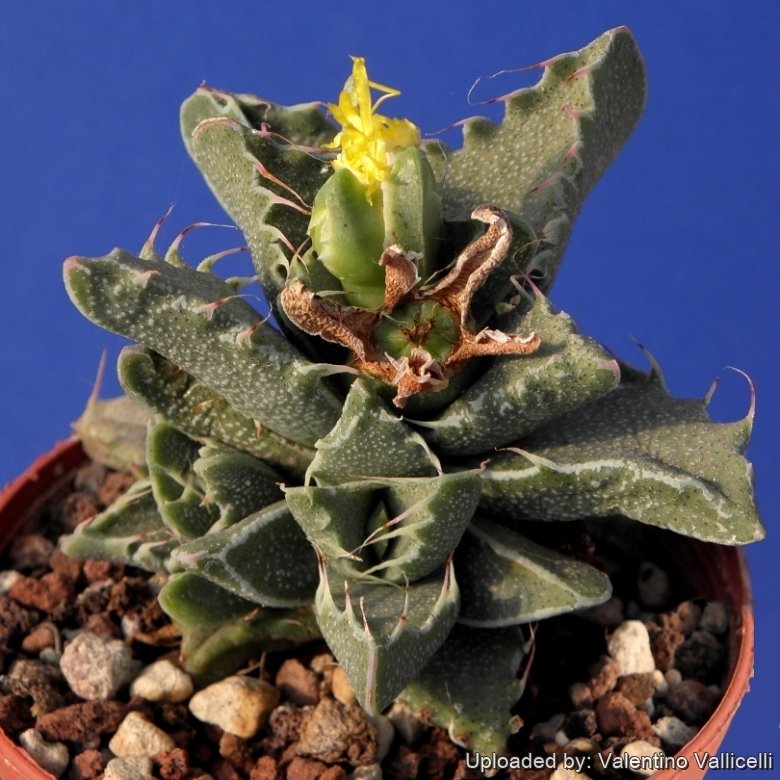
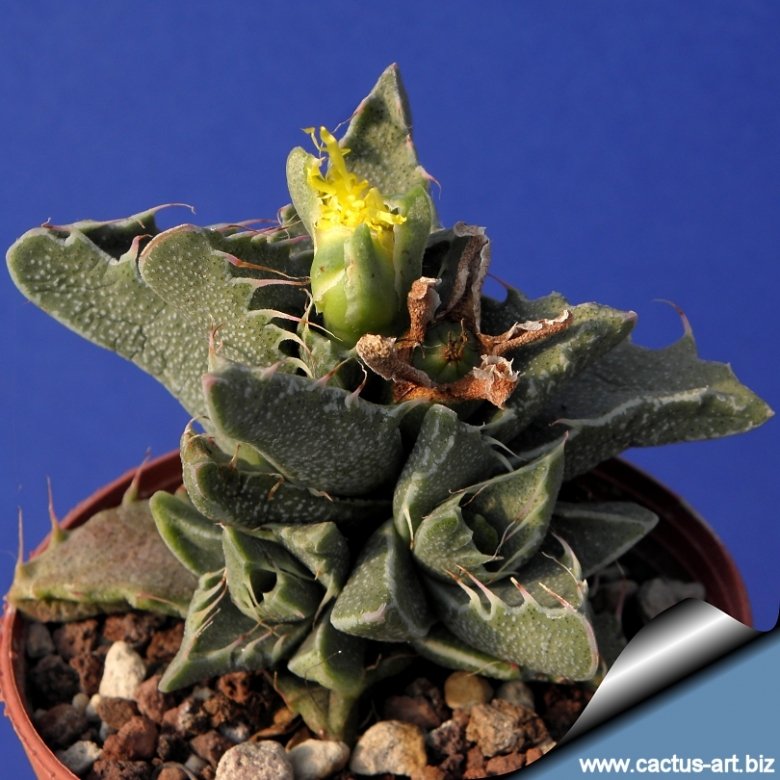
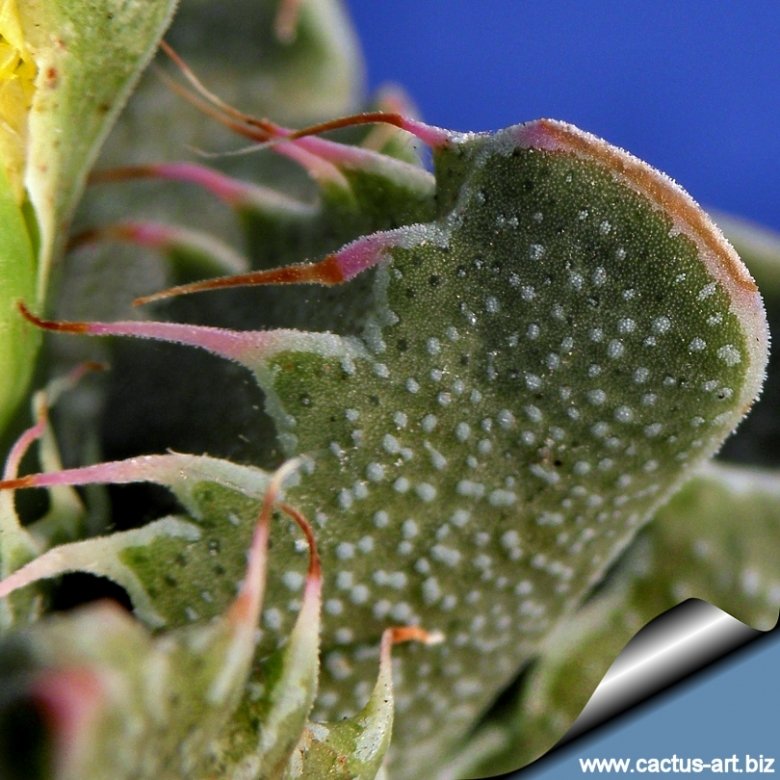
Faucaria felina subs. britteniae (Faucaria britteniae) is a compact succulent perennial rosette-succulent, usually stemless (but can builds short woody stems with age) clump-forming or shrubby becoming semi-globose with age. It has large yellow flowers 4-5 cm wide or wider, with purplish-pink undersides to the petals. Its ovate-triangular leaves up to about 5 cm long, have somewhat hollowed upper surfaces. Gray-green sprinkled with tiny dots of darker grey, they have white or reddish, horny bands along their edges and keels and margins with particularly prominent, long, recurved, hair-like teeth. Faucaria felina subsp. britteniae is unique in the genus because of the (partially) whitish grey epidermis. It is fairly popular amongst mesem collectors as it is free-flowering and grow relatively quickly.
Derivation of specific name: This member of the Euphorbiaceae family was given this name in honour of Lilian L. Britten (1886–1952), South African botanist at Rhodes University, RSA.
Stems: Up to 120 mm long.
Leaves: 30-55(-70) mm long, to 20-33 mm broad at the middle, tappering to 12-15 mm at the base. Fleshy, ovate-triangular to diamond-shaped, compressed at their apexes to form a strong chin. Keel sharp, forming a pronounced chin in almost rectangular arrangement as seen from the side. Margins and keel (partly) with a white or reddish band to 1 mm wide, with (3-)6-10(-13) teeth midway along each side, 3-5 mm broad at base 2.5-5 mm long, consisting of a broad, base and a long, sharp awn-shaped end with elevations and distant papillae. Epidermis with well-developed wax cover, thicker than in subsp. felina; uniform or partially whitish-green or greyish-green with numerous small greyish white dots, or dull green with white clearly visible dots.
Flowers: Large for genus 5-8 cm-wide, yellow, with purplish-pink undersides to the petals. Petals about 110-160. Stamens 260-350. Glands yellowish, green to brown.
Blooming season: Autumn to winter (in habitat March-August), occasionally throughout the year.
Fruits: Base very broadly bell-shaped, top with a high centre, 7-13 mm long, 9.5-13(-15) mm in diameter, 7-10 mm thick, easily falling off (tumble fruits).
Seeds: 1.4-1.6 mm long, 0.9-1.3 mm broad.
Taxonomic note. Faucaria felina subs. britteniae differs from Faucaria felina mainly in the basally broader and somewhat stouter leaves, in the keel meeting the upper leaf surface nearly at a right angle at the apex, and in the very numerous small dots, absent in F. felina.
Origin and Habitat
Albany, Grahamstown and Fort Beaufort Districts, Eastern Cape, South Africa.
Altitude range: 350-700 mm rainfall per annum.
Habitat and ecology: Faucaria felina subs. britteniae grows in Valley Bushveld and drier grass veld, in loamy flats or on slopes among stones in open grassy spots or under small bushes with a preference for north-facing slopes. Rainfall 350-500(-700) mm per annum. Series, pH 6.7-7.7.
Cultivation and Propagation
Faucarias are the good choice for anyone wanting to start growing succulents. They are quite hardy and can take a short period of light frost and in very dry warm regions these succulents make very impressive out door ground covers. They need full sun to light shade with a well-drained soil mix, but can tolerate a wide variety of soil types and growing locations as long as there is plenty of sun. The plants are well watered during the growing season and allowed to dry thoroughly before watering again and will tolerate some over watering, but the challenge is to help them keep their compact form and prevent elongation of the stem. During the winter months, the plants should be kept very dry, only watering enough to keep the leaves from shrivelling.
As house plants they tend to grow in fair weather and rest when temperatures are too hot or too cool.
Propagation: Faucaria is very easy to start from seed. Seeds germinate in 7-14 days at 21°C. Although they will start from cuttings, it is quite difficult to get them to root. If they start to rot there is usually part of the plant that can be removed and possibly rooted.
Bibliography
Major references and further lectures
-
Heidrun E. K. Hartmann “Aizoaceae F – Z” Springer, 2002
-
Thomas H. Everett “The New York Botanical Garden Illustrated Encyclopedia of Horticulture”, Volume 4, Courier Corporation, 1981
-
Ernst Van Jaarsveld, Ben-Erik Van Wyk, Gideon Smith “Succulents of South Africa: A Guide to the Regional Diversity” Tafelberg, 2000
-
James Cullen, Sabina G. Knees, H. Suzanne Cubey “The European Garden Flora Flowering Plants: A Manual for the Identification of Plants Cultivated in Europe, Both Out-of-Doors and Under Glass - Casuarinaceae to Aristolochiaceae” Cambridge University Press, 11/August/2011
-
Urs Eggli, Leonard E. Newton “Etymological Dictionary of Succulent Plant Names” Springer Science & Business Media, 29 June 2013
-
L.E. Groen and L.J.G. van Der Masen “Revision of the genus Faucaria (Ruschioideae: Aizoaceae) in South Africa” Bothalia 29.1: 35-58 (1999)
From llifle page Faucaria speciosa
Description
Faucaria specieosa (Syn: Faucaria felina subs. britteniae) is a local or morphological form of the very variable Faucaria felina with curious toothed leaves fitting together rather like the jaws of an animal. It is not easily separable by any significant character from the standard Faucaria felina, if not for a more glaucous colour, and a rough surface and for the geographical provenance.
Habit: It is a compact, little branched, perennial succulents forming compact, slow-growing, almost spherical mounds.
Stem Very reduced, tufted and developing a very short branched rhizomatous trunk with age.
Rosettes: Clumping, 4-6 leafed, each up to 12 cm in diameter.
Leaves: Up to 70 mm long, 5-20 mm broad, slender, spreading, rhomboidal, somewhat elongated, riangular in cross-section,tapering gradually, keel sharp, white forming a pronunced chin. Margins with 5-8 teeth in the upper half (rarely more or less); teeth broad, fleshy, curved, white or pink ending in papillate awns of 0,5 to 3 mm length. Faces of leaves glaucous grey-green, rough, wax cover thin, crystals in the outer walls in certain areas resulting in white dots.
Flowers: Daisy-like 3,5 cm in diameter with yellow petals.
Blooming season: Late autumn to winter.
Fruit: Base broadly bell-shaped, top with the valves often raised in the centre, 10-16 mm long, 9-11 mm in dameter.
Seeds: 1,4-1,5 mm broad.
Origin and Habitat
Albany, Eastern Cape Province, South Africa.
Bibliography
Major references and futher lectures
-
Doreen Court “Succulent Flora of Southern Africa” CRC Press, 01/giu/2000
-
Otto A. Leistner “Flora of southern Africa” 14: 194 1985
-
Jacobsen “Lexicon of succulent plants” Littlehampton Book Services Ltd. 1974
-
James Cullen, Sabina G. Knees, H. Suzanne Cubey “The European Garden Flora Flowering Plants: A Manual for the Identification of Plants Cultivated in Europe, Both Out-of-Doors and Under Glass” Cambridge University Press, 11/ago/2011
-
Dr J.P. Roux “Flora of South Africa” 2003
-
Domitilla Raimondo “Red list of South African plants 2009” South African National Biodiversity Institute, 2009
-
Werner Rauh “The Wonderful World of Succulents: Cultivation and Description of Selected Succulent Plants Other Than Cacti” Smithsonian Institution Press, 1984
-
Heidrun E. K. Hartmann “Illustrated Handbook of Succulent Plants: Aizoaceae F-Z” Springer, 2002
-
Ernst Van Jaarsveld, Ben-Erik Van Wyk, Gideon Smith “Succulents of South Africa: A Guide to the Regional Diversity” Tafelberg Publishers, Limited, 01/lug/2000
-
Gordon D. Rowley “The illustrated encyclopedia of succulents” Crown Publishers, 01/ago/1978
-
Clive Innes “Complete Handbook of Cacti and Succulents” Van Nostrand Reinhold Company, 01/dic/1981
-
George Gilbert Green “Cacti and succulents” Pitman Pub. Corp., 1953
Source: Faucaria speciosa, LLIFLE - Encyclopedia of living forms, CC-BY-SA, retrieved 2026-10-25.