Publication: Z. Sukkulentenk. ii. 177 (1926)
Description
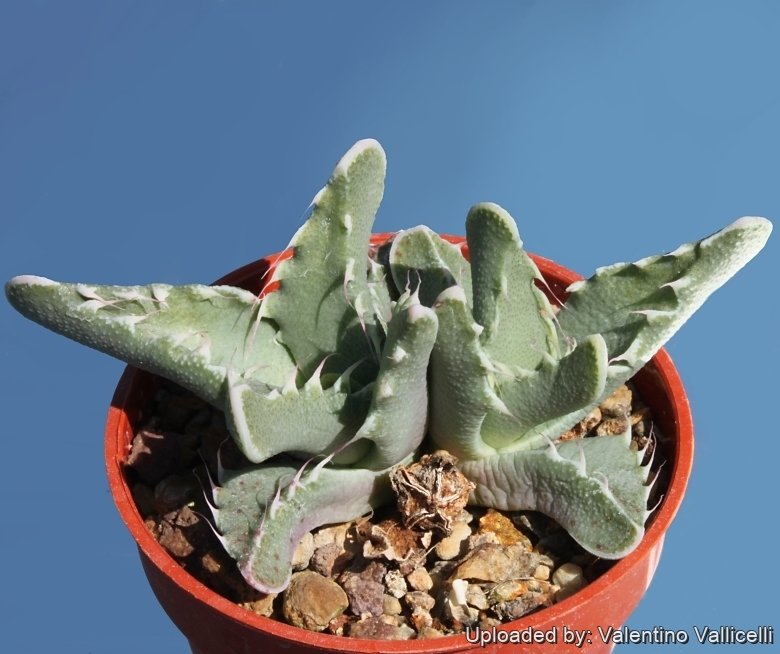
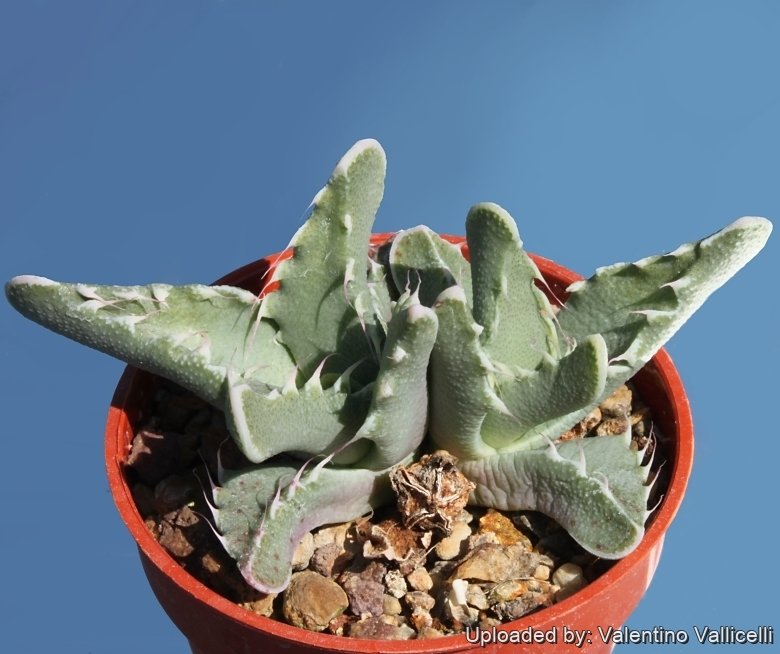
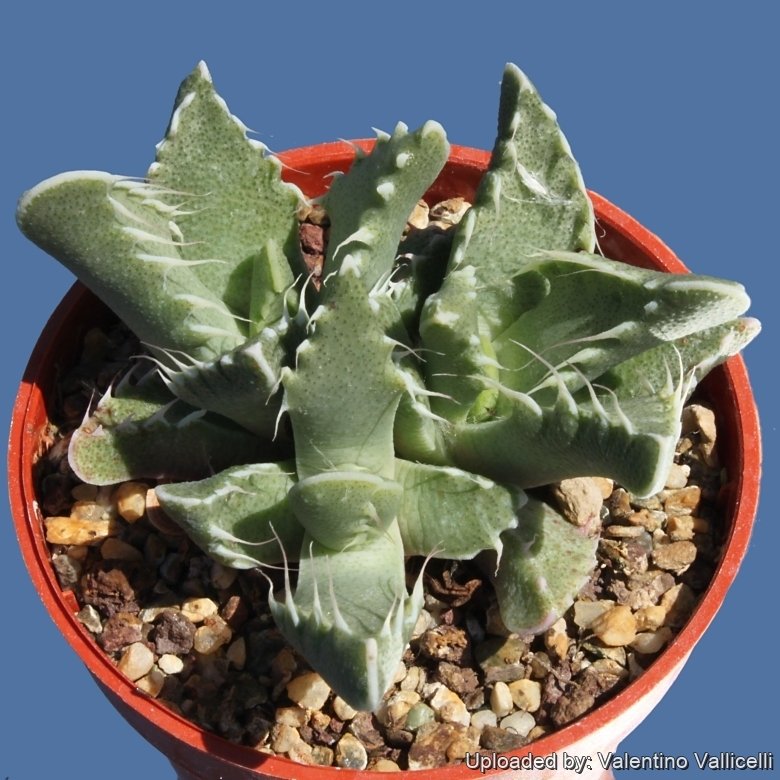
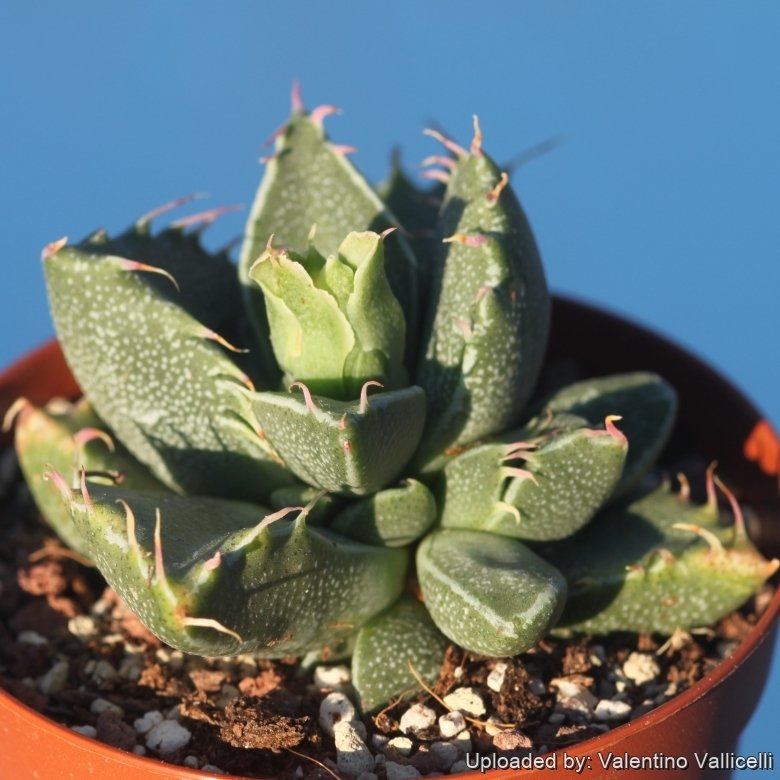
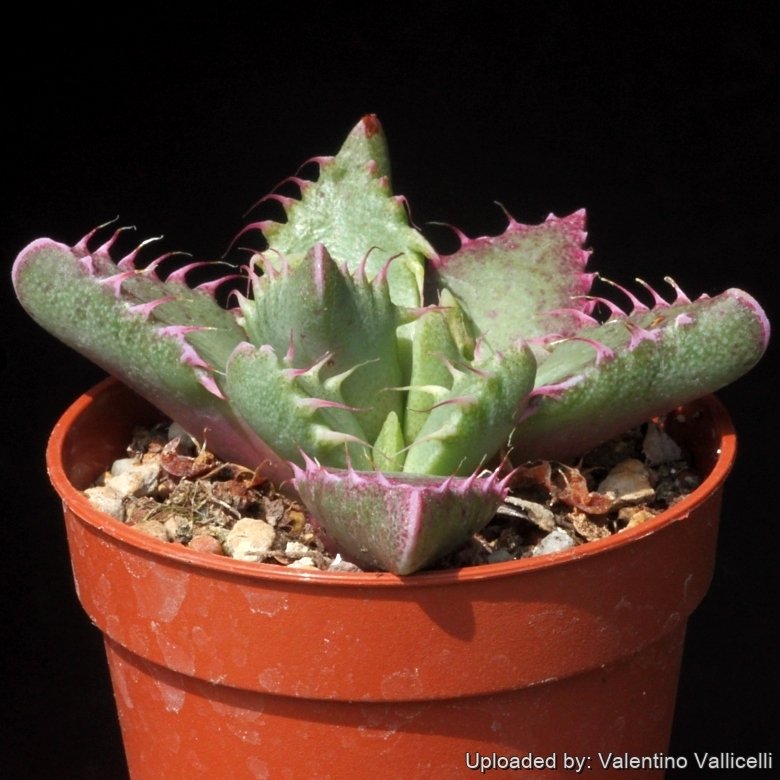
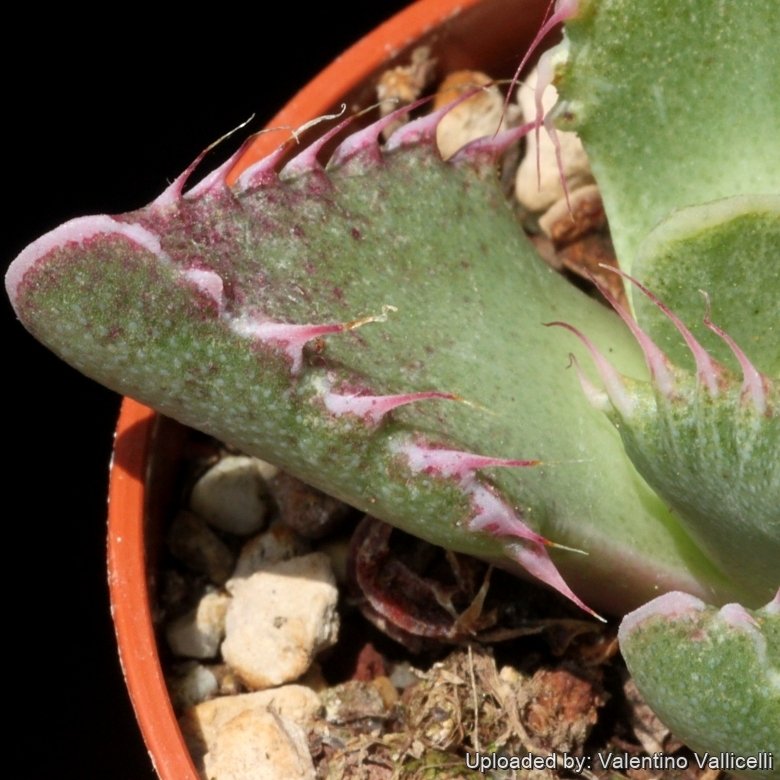
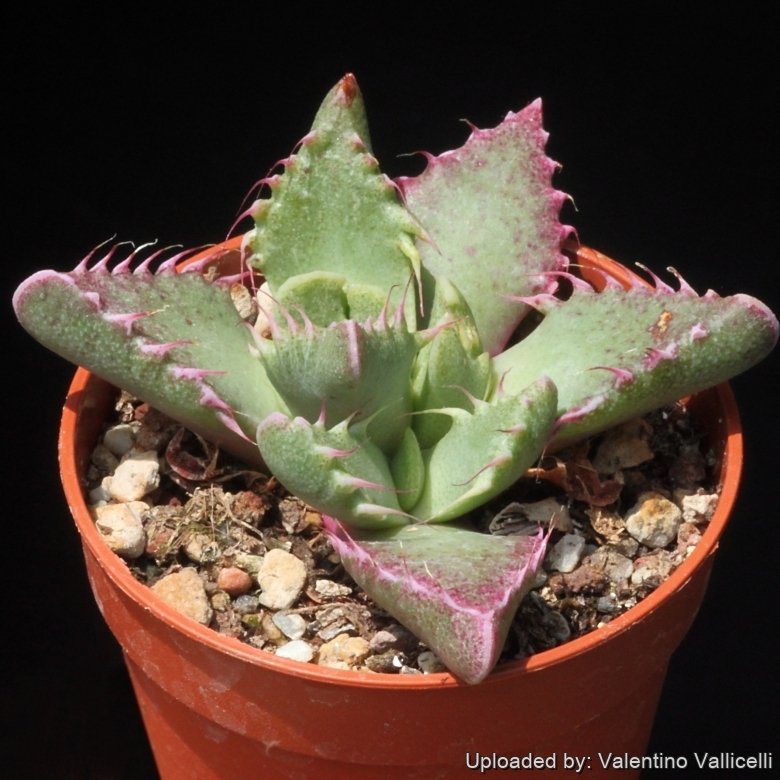
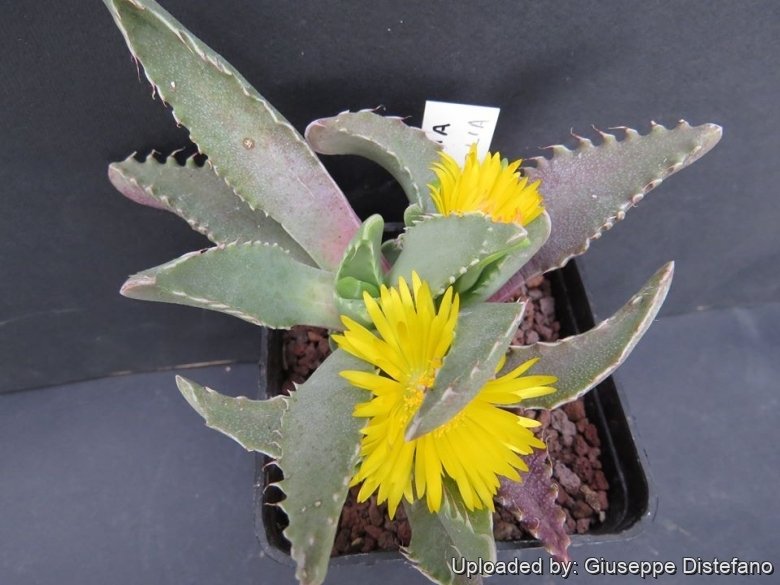
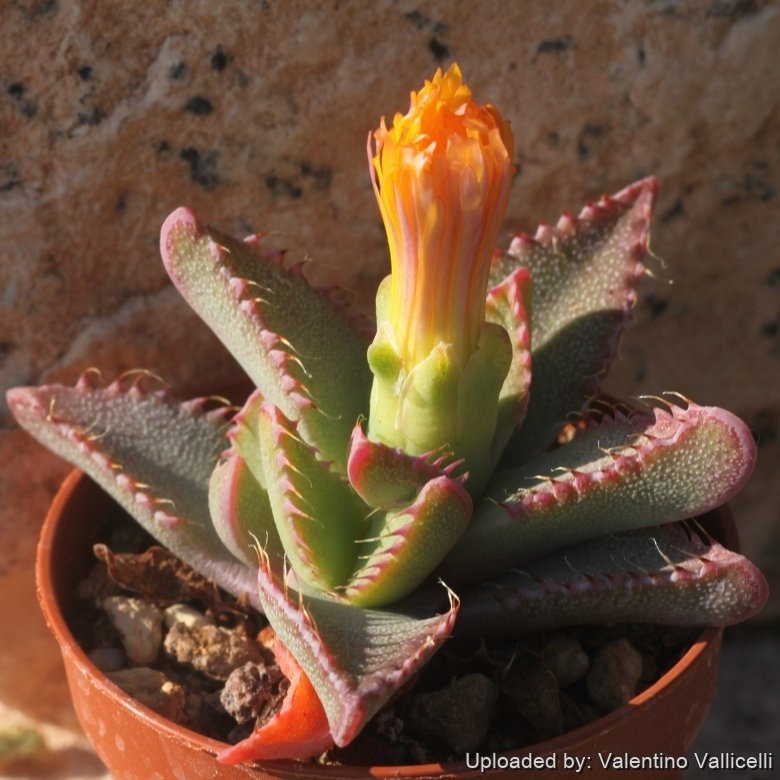
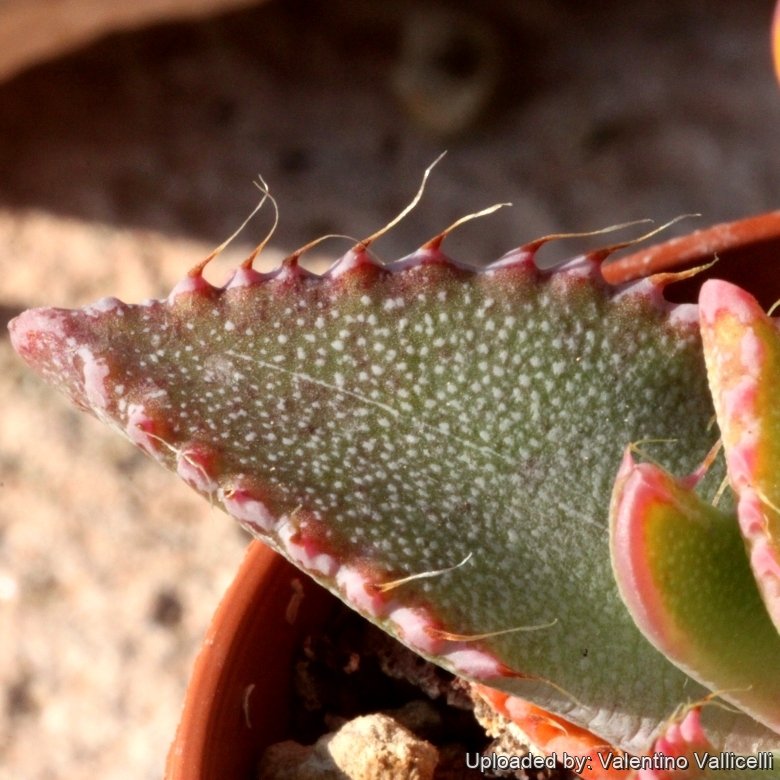
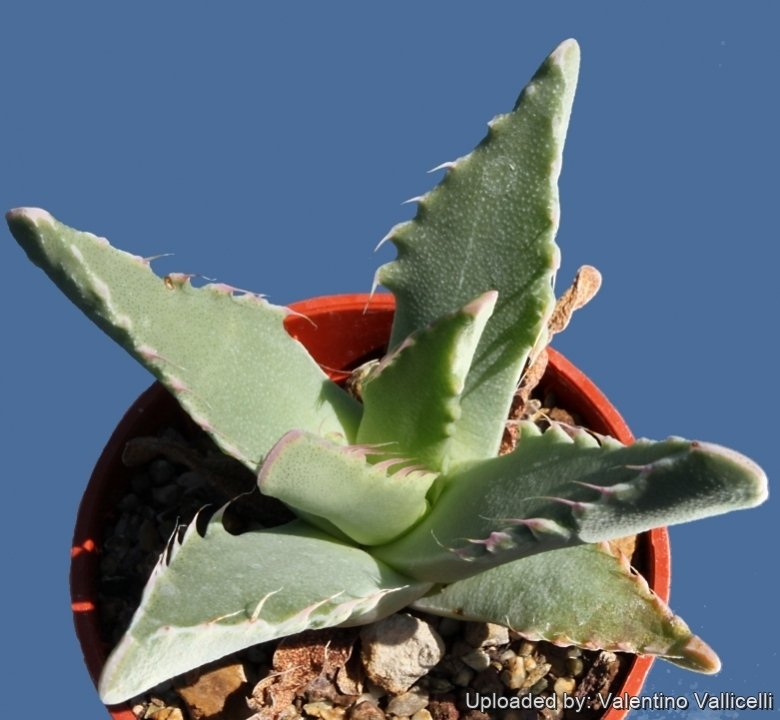
Faucaria felina is a compact leaf succulent forming unusual clumps of fleshy, boat-shaped, toothed leaves most similar to Faucaria britteniae, which grows further east. Although the variation in F. felina is great, as is reflected by the numerous synonyms, the species can be identified by the slender, spreading leaves with an oblique tip of the leaf. The lower number of teeth (which are shorter and not bristly) and the less conspicuous spotting separates the species from Faucaria tigrina, which also has more erect leaves. Most plants sold as Faucaria sp.’ are a form or another of F. felina. They all share a rough upper surface. The shape of the leaf varies from long to short triangular. The name felina refers to the likeness of the leaves to the claws of a cat. The recurved leaf tubercles have very broad bases and look like cat’s nails rather than teeth!
Stem Very reduced, tufted and developing a very short branched rhizomatous trunk with age.
Leaves: Up to 70 mm long, 5-20 mm broad, slender, spreading, rhomboidal, somewhat elongated, tapering gradually, keeled. Margins with 3-5 teeth in the upper half (rarely more or less); teeth broad, fleshy, curved, white or pink ending in papillate awns of 0,5 to 3 mm length. Faces of leaves dark green to grey-green smooth or with indistinct whitish-grey dots, wax cover thin, crystals in the outer walls in certain areas resulting in white dots.
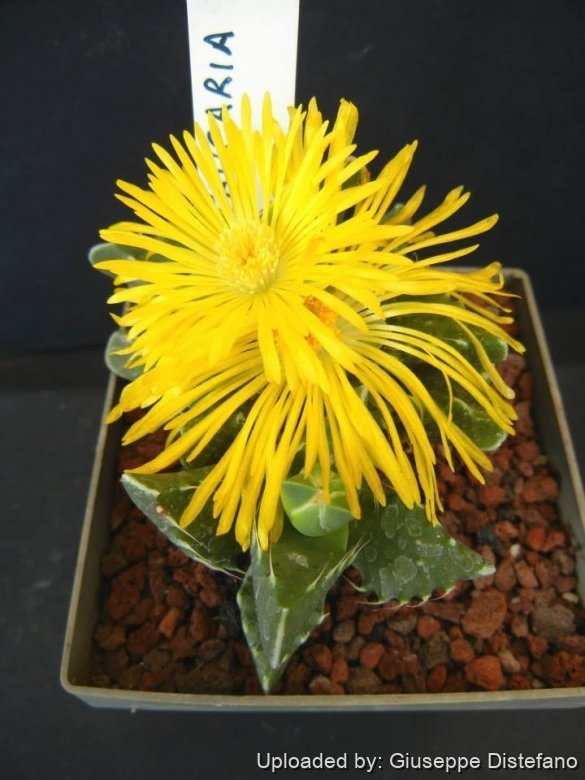
Flowers: Daisy-like up to 5 cm in diameter with 100-135 yellow to orange (or rarely white) petals, 210-320 stamens, glands green to brown; The flowers open only in full sunlight.
Blooming season: Late autumn to winter.
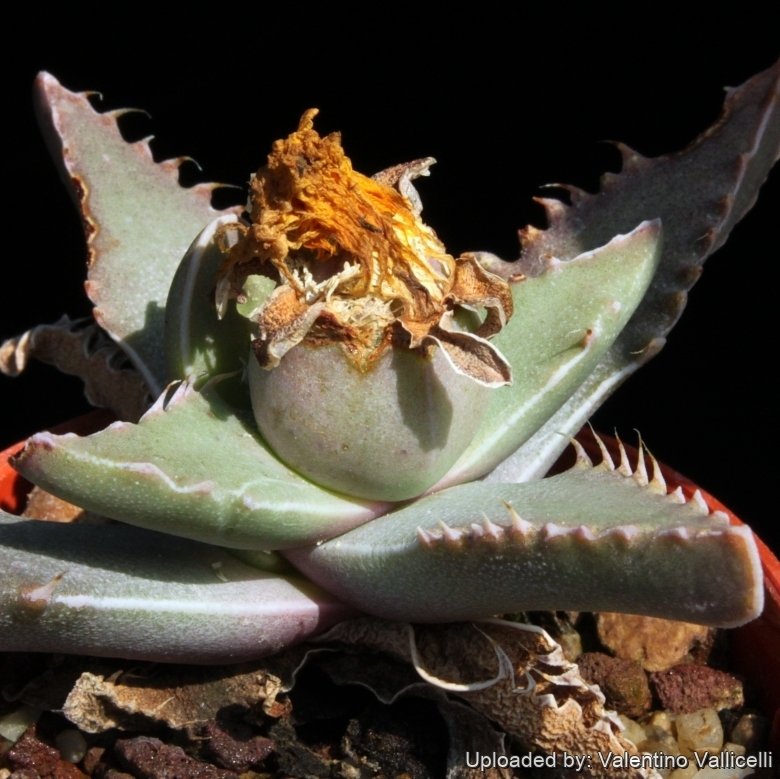
Fruit: Base broadly bell-shaped, top with the valves often raised in the centre, 10-16 mm long, 9-11 mm in diameter.
Seeds: 1,4-1,5 mm broad.
Origin and Habitat
South Africa. (Western districtsof Eastern Cape-Province to Eastern districts of Western Cape-Province)
Habitat: It grows mostly in fine grained soils in grassy or shrubby vegetation types, rain fall about 200-700 mm per annum mainly in March and November. This habitat is shared with succulent plants such as Haworthia cooperi, Haworthia gracilis, Euphorbia meloformis and Euphorbia gorgonis. It is not threatened.
Cultivation and Propagation
Faucarias are the good choice for anyone wanting to start growing succulents. They are quite hardy and can take a short period of light frost and in very dry warm regions these succulents make very impressive out door ground covers. As house plants they tend to grow in fair weather and rest when temperatures are too hot or too cool.
Exposition: They need full sun to light shade , it should be protected from too much exposure in Summer. They do not do well in full shade as they tend to etiolate, fall over and rot easily.
Soil: It likes a well-drained soil mix, but can tolerate a wide variety of soil types and growing locations as long as there is plenty of sun.
Fertilization: The plants are fertilized only once during the growing season with a balanced fertilizer diluted to ½ the recommended strength.
Watering: This species is native to a primarily summer rainfall area but in cultivation the plant can be watered year-round. The plants are well watered during the growing season and allowed to dry thoroughly before watering again and will tolerate some over watering, but the challenge is to help them keep their compact form and prevent elongation of the stem. During the winter months, the plants should be kept quite dry, only watering enough to keep the leaves from shrivelling.
Pest & diseases: Faucarias are sensitive to mealybugs.
Rot: Rot is only a minor problem with Faucaria if the plants are watered and “aired” correctly. If they are not, fungicides won’t help all that much. Care must be given in watering, keeping them warm and wet while growing, and cooler and dry when dormant.
Hardiness: Although the plants will survive mild frost if kept dry (hardy as low as -5° C) they should be protected from frost to prevent scarring. USDA 9b-12
Propagation: Faucaria is very easy to start from seed. Seeds germinate in 7-14 days at 21°C. Although they will start from cuttings, it is quite difficult to get them to root. If they start to rot there is usually part of the plant that can be removed and possibly rooted.
Bibliography
Major references and futher lectures
-
Heidrun E. K. Hartmann “Illustrated Handbook of Succulent Plants: Aizoaceae F-Z” Springer, 2002
-
Ernst Van Jaarsveld, Ben-Erik Van Wyk, Gideon Smith “Succulents of South Africa: A Guide to the Regional Diversity” Tafelberg Publishers, Limited, 01/lug/2000
-
Gordon D. Rowleyna anteriore “The illustrated encyclopedia of succulents” Crown Publishers, 01/ago/1978
-
Werner Rauh “The Wonderful World of Succulents: Cultivation and Description of Selected Succulent Plants Other Than Cacti” Smithsonian Institution Press, 1984
-
Clive Innes “Complete Handbook of Cacti and Succulents” Van Nostrand Reinhold Company, 01/dic/1981
-
George Gilbert Green “Cacti and succulents” Pitman Pub. Corp., 1953
From llifle page Faucaria candida
Description
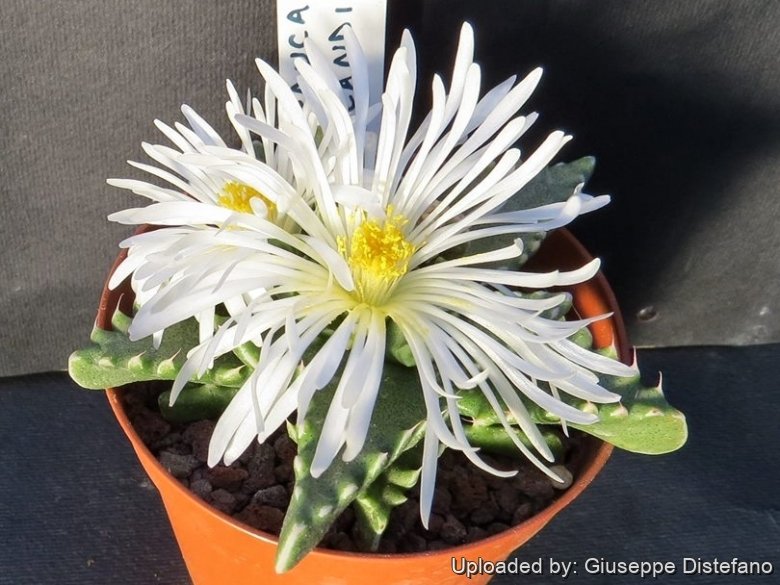
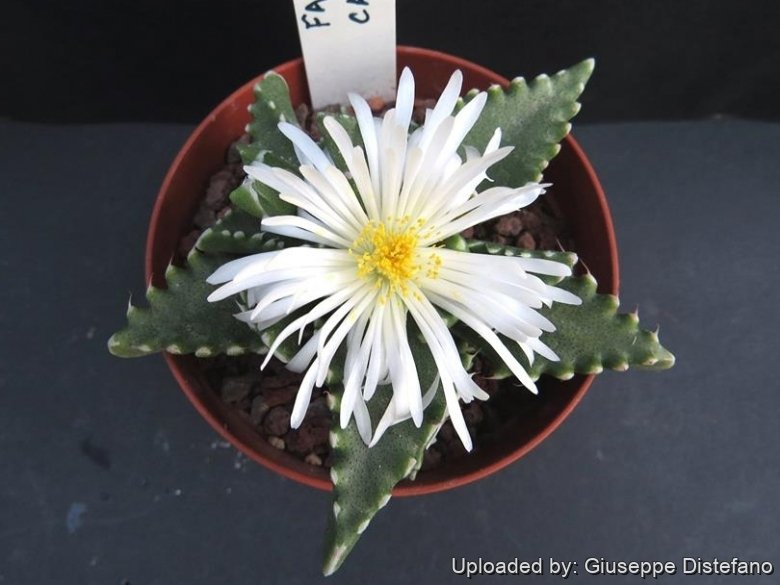
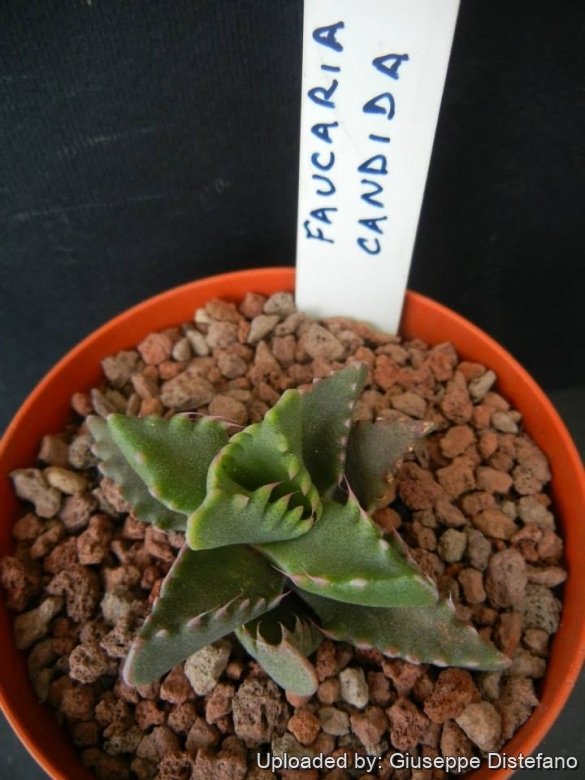
The seldom mentioned Faucaria candida is a distinctive form of Faucaria felina with white or pinkish-white buds followed by large white flowers, in this normally yellow-flowered genus. The foliage is also somewhat different from others being more or less uniform bright green without tubercles or pale speckling though the margins are lined with pale, recurved teeth and the leaf apex bears a white to pinkish keel. However the differences with standard F. felina are very minimal and most botanist agree on the fact that both should all be included in the F. felina, and the two plants are not readily distinguishable, if not for the colouration of the flowers and uniform unspotted leaves. The F. candida is now just a white flowered form of the very variable F. felina.
Habit: It is a compact leaf succulent forming unusual clumps of fleshy, boat-shaped, toothed leaves. Although the variation in F. felina is great, as is reflected by the numerous synonyms, the species can be identified by the slender, spreading leaves with an oblique tip of the leaf. The lower number of teeth (which are shorter and not bristly) and the less conspicuous spotting separates the species from Faucaria tigrina, which also has more erect leaves. The name felina refers to the likeness of the leaves to the claws of a cat. The recurved leaf tubercles have very broad bases and look like cat’s nails rather than teeth!
Stem Very reduced, tufted and developing a very short branched rhizomatous trunk with age.
Leaves: Up to 70 mm long, 5-20 mm broad, slender, spreading, rhomboidal, somewhat elongated, tapering gradually, keeled. Margins with 3-5 teeth in the upper half (rarely more or less); teeth broad, fleshy, curved, white or pink ending in papillate awns of 0,5 to 3 mm length. Faces of leaves green smooth, without tubercles or pale speckling, wax cover thin.
Flowers: Daisy-like up to 4 cm in diameter with 100-135 white petals, 210-320 stamens, glands green to brown; The flowers open only in full sunlight.
Blooming season: Late autumn to winter. The flowers open only in full sunlight.
Fruit: Base broadly bell-shaped, top with the valves often raised in the centre, 10-16 mm long, 9-11 mm in diameter.
Seeds: 1,4-1,5 mm broad.
Remarks: The even more rare Faucaria militaris is also a white flowered species.
Origin and Habitat
South Africa (Eastern Cape Province: Cradock)
Habitat: It grows in a primarily summer rainfall area in fine grained soils in grassy or shrubby vegetation types.
Bibliography
Major references and futher lectures
-
Doreen Court “Succulent Flora of Southern Africa” CRC Press, 01/giu/2000
-
Otto A. Leistner “Flora of southern Africa” 14: 194 1985
-
Jacobsen “Lexicon of succulent plants” Littlehampton Book Services Ltd. 1974
-
James Cullen, Sabina G. Knees, H. Suzanne Cubey “The European Garden Flora Flowering Plants: A Manual for the Identification of Plants Cultivated in Europe, Both Out-of-Doors and Under Glass” Cambridge University Press, 11/ago/2011
-
Dr J.P. Roux “Flora of South Africa” 2003
-
Domitilla Raimondo “Red list of South African plants 2009” South African National Biodiversity Institute, 2009
-
Werner Rauh “The Wonderful World of Succulents: Cultivation and Description of Selected Succulent Plants Other Than Cacti” Smithsonian Institution Press, 1984
-
Heidrun E. K. Hartmann “Illustrated Handbook of Succulent Plants: Aizoaceae F-Z” Springer, 2002
-
Ernst Van Jaarsveld, Ben-Erik Van Wyk, Gideon Smith “Succulents of South Africa: A Guide to the Regional Diversity” Tafelberg Publishers, Limited, 01/lug/2000
-
Gordon D. Rowley “The illustrated encyclopedia of succulents” Crown Publishers, 01/ago/1978
-
Clive Innes “Complete Handbook of Cacti and Succulents” Van Nostrand Reinhold Company, 01/dic/1981
Source: Faucaria candida, LLIFLE - Encyclopedia of living forms, CC-BY-SA, retrieved 2026-10-25.
From llifle page Faucaria cradockensis
Description
Faucaria cradockensis is a local or morphological form of the very variable Faucaria felina. Although the variation in F. felina is great, as is reflected by the numerous synonyms, the F. cradockensis can be identifed by the long leaves, with pink teeth on a jagged margin and no spots on the upper surface.
Habit: It is a compact, little branched, low growing perennial succulents forming unusual clumps.
Stem Very reduced, tufted and developing a very short branched rhizomatous trunk with age.
Leaves: Up to 70 mm long, 5-20 mm broad, slender, spreading, rhomboidal, somewhat elongated, tapering gradually, keeled. Margins with 5-8 teeth in the upper half (rarely more or less); teeth broad, fleshy, curved, white or pink ending in papillate awns of 0,5 to 3 mm length. Faces of leaves dark green to grey-green smooth or with indistinct whitish-grey dots, wax cover thin, crystals in the outer walls in certain areas resulting in white dots.
Flowers: Daisy-like up to 5 cm in diameter with 100-135 yellow to orange (or rararely white) petals, 210-320 stamens, glands green to brown; The flowers open only in full sunlight.
Blooming season: Late autumn to winter.
Fruit: Base broadly bell-shaped, top with the valves often raised in the centre, 10-16 mm long, 9-11 mm in dameter.
Seeds: 1,4-1,5 mm broad.
Chromosome number: Faucaria cradockensis, Faucaria bosscheana and Faucaria felina var. jamesii proved to have n = 9.
Origin and Habitat
Hill above Cradock, Somerset East Dist., Eastern Cape, South Africa
Bibliography
Major references and futher lectures
-
Doreen Court “Succulent Flora of Southern Africa” CRC Press, 01/giu/2000
-
Otto A. Leistner “Flora of southern Africa” 14: 194 1985
-
Jacobsen “Lexicon of succulent plants” Littlehampton Book Services Ltd. 1974
-
James Cullen, Sabina G. Knees, H. Suzanne Cubey “The European Garden Flora Flowering Plants: A Manual for the Identification of Plants Cultivated in Europe, Both Out-of-Doors and Under Glass” Cambridge University Press, 11/ago/2011
-
Dr J.P. Roux “Flora of South Africa” 2003
-
Domitilla Raimondo “Red list of South African plants 2009” South African National Biodiversity Institute, 2009
-
Werner Rauh “The Wonderful World of Succulents: Cultivation and Description of Selected Succulent Plants Other Than Cacti” Smithsonian Institution Press, 1984
-
Heidrun E. K. Hartmann “Illustrated Handbook of Succulent Plants: Aizoaceae F-Z” Springer, 2002
-
Ernst Van Jaarsveld, Ben-Erik Van Wyk, Gideon Smith “Succulents of South Africa: A Guide to the Regional Diversity” Tafelberg Publishers, Limited, 01/lug/2000
-
Gordon D. Rowley “The illustrated encyclopedia of succulents” Crown Publishers, 01/ago/1978
-
Clive Innes “Complete Handbook of Cacti and Succulents” Van Nostrand Reinhold Company, 01/dic/1981
-
George Gilbert Green “Cacti and succulents” Pitman Pub. Corp., 1953
Source: Faucaria cradockensis, LLIFLE - Encyclopedia of living forms, CC-BY-SA, retrieved 2026-10-25.
From llifle page Faucaria longifolia
Description
Faucaria longifolia is a local or morphological form of the very variable Faucaria felina with curious toothed leaves fitting together rather like the jaws of an animal. It is separable from the standard Faucaria felina for the long slender, greener leaves, keeled towards apex and with more numerous teeth.
Habit: It is a compact, little branched, perennial succulents forming compact, slow-growing, almost spherical mounds.
Stem Very reduced, tufted and developing a very short branched rhizomatous trunk with age.
Rosettes: Clumping, 4-6 leafed, each up to 12 cm in diameter.
Leaves: Up to 50 mm long, slender, spreading, rhomboidal, somewhat elongated, triangular in cross-section,tapering gradually, keel sharp, white forming a pronounced chin. Margins with several teeth in the upper half (usually more than ); teeth broad, fleshy, curved, white or pink ending in papillate awns of 0,5 to 3 mm length. Faces of leaves glaucous grey-green, rough, wax cover thin, crystals in the outer walls in certain areas resulting in white dots.
Flowers: Daisy-like 3,5 cm in diameter with yellow petals.
Blooming season: Late autumn to winter.
Fruit: Base broadly bell-shaped, top with the valves often raised in the centre, 10-16 mm long, 9-11 mm in diameter.
Seeds: 1,4-1,5 mm broad.
Origin and Habitat
Cape province, South Africa.
Cultivation and Propagation
Faucarias are the good choice for anyone wanting to start growing succulents. They are quite hardy and can take a short period of light frost and in very dry warm regions these succulents make very impressive out door ground covers. They need full sun to light shade with a well-drained soil mix, but can tolerate a wide variety of soil types and growing locations as long as there is plenty of sun. The plants are well watered during the growing season and allowed to dry thoroughly before watering again and will tolerate some over watering, but the challenge is to help them keep their compact form and prevent elongation of the stem. During the winter months, the plants should be kept very dry, only watering enough to keep the leaves from shrivelling.
As house plants they tend to grow in fair weather and rest when temperatures are too hot or too cool.
Propagation: Faucaria is very easy to start from seed. Seeds germinate in 7-14 days at 21°C. Although they will start from cuttings, it is quite difficult to get them to root. If they start to rot there is usually part of the plant that can be removed and possibly rooted.
Source: Faucaria longifolia, LLIFLE - Encyclopedia of living forms, CC-BY-SA, retrieved 2026-10-25.
From llifle page Faucaria lupina
Description
Faucaria lupina is a local or morphological form of the very variable Faucaria felina. It is a very ferocious-looking plant known as ‘Wolfs Jaws’ for the resemblance of the top pair of leaves to the gaping jaws of an animal. Although the variation in F. felina is great, as is reflected by the numerous synonyms, the F. lupina can be identifed by the silvery green, long, triangular leaves, with fierce-looking teeth along the upper margin. The flowers are yellow and open only in full sunlight in late fall to winter.
Habit: It is a compact, little branched, groundcover, perennial succulents.
Stem Very reduced, tufted and developing a very short branched rhizomatous trunk with age.
Leaves: Up to 70 mm long, 5-20 mm broad, slender, spreading, rhomboidal, somewhat elongated, tapering gradually, keeled and triangular in cross-section. Margins with 5-8 teeth in the upper half (rarely more or less); teeth broad, fleshy, curved, white or pink ending in papillate awns of 0,5 to 3 mm length. Faces of leaves dark green to grey-green smooth or with indistinct whitish-grey dots, wax cover thin, crystals in the outer walls in certain areas resulting in white dots.
Flowers: Daisy-like 3,5 cm in diameter with yellow petals.
Blooming season: Late autumn to winter.
Fruit: Base broadly bell-shaped, top with the valves often raised in the centre, 10-16 mm long, 9-11 mm in dameter.
Seeds: 1,4-1,5 mm broad.
Origin and Habitat
Uitenhage, Eastern Cape Province, South Africa.
Bibliography
Major references and futher lectures
-
Doreen Court “Succulent Flora of Southern Africa” CRC Press, 01/Jun/2000
-
Otto A. Leistner “Flora of southern Africa” 14: 194 1985
-
Jacobsen “Lexicon of succulent plants” Littlehampton Book Services Ltd. 1974
-
James Cullen, Sabina G. Knees, H. Suzanne Cubey “The European Garden Flora Flowering Plants: A Manual for the Identification of Plants Cultivated in Europe, Both Out-of-Doors and Under Glass” Cambridge University Press, 11/Aug/2011
-
Dr J.P. Roux “Flora of South Africa” 2003
-
Domitilla Raimondo “Red list of South African plants 2009” South African National Biodiversity Institute, 2009
-
Werner Rauh “The Wonderful World of Succulents: Cultivation and Description of Selected Succulent Plants Other Than Cacti” Smithsonian Institution Press, 1984
-
Heidrun E. K. Hartmann “Illustrated Handbook of Succulent Plants: Aizoaceae F-Z” Springer, 2002
-
Ernst Van Jaarsveld, Ben-Erik Van Wyk, Gideon Smith “Succulents of South Africa: A Guide to the Regional Diversity” Tafelberg Publishers, Limited, 01/Jul/2000
-
Gordon D. Rowley “The illustrated encyclopedia of succulents” Crown Publishers, 01/Aug/1978
-
Clive Innes “Complete Handbook of Cacti and Succulents” Van Nostrand Reinhold Company, 01/Dec/1981
-
George Gilbert Green “Cacti and succulents” Pitman Pub. Corp., 1953
Source: Faucaria lupina, LLIFLE - Encyclopedia of living forms, CC-BY-SA, retrieved 2026-10-25.
Cultivars and forms (3)
Cultivars (1)
Gallery