Publication: Cact. Succ. J. (Los Angeles) 41: 128. 1969
Description
Ferocactus hamatacanthus subsp. sinuatus is a smaller version of Ferocactus hamatacanthus. The two subspecies are geographically separated at east and south of the Pecos River.
Habit: Solitary, or sparsely clumping.
Roots: Diffuse.
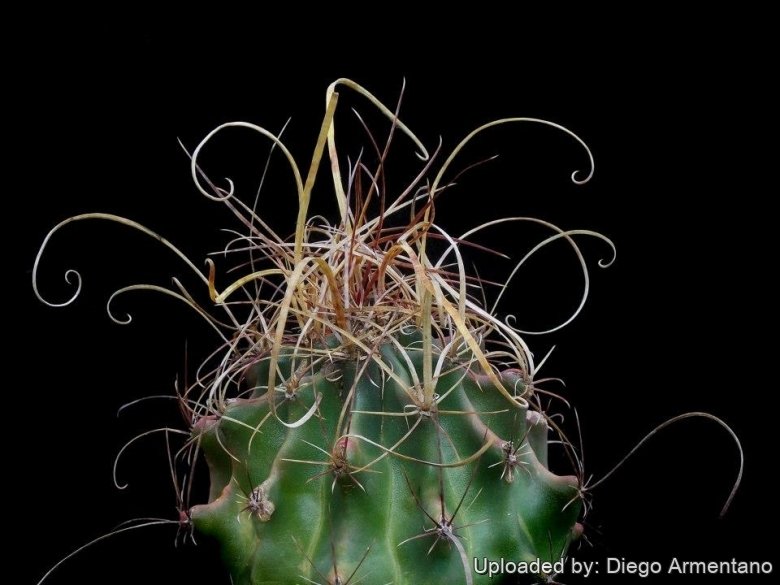
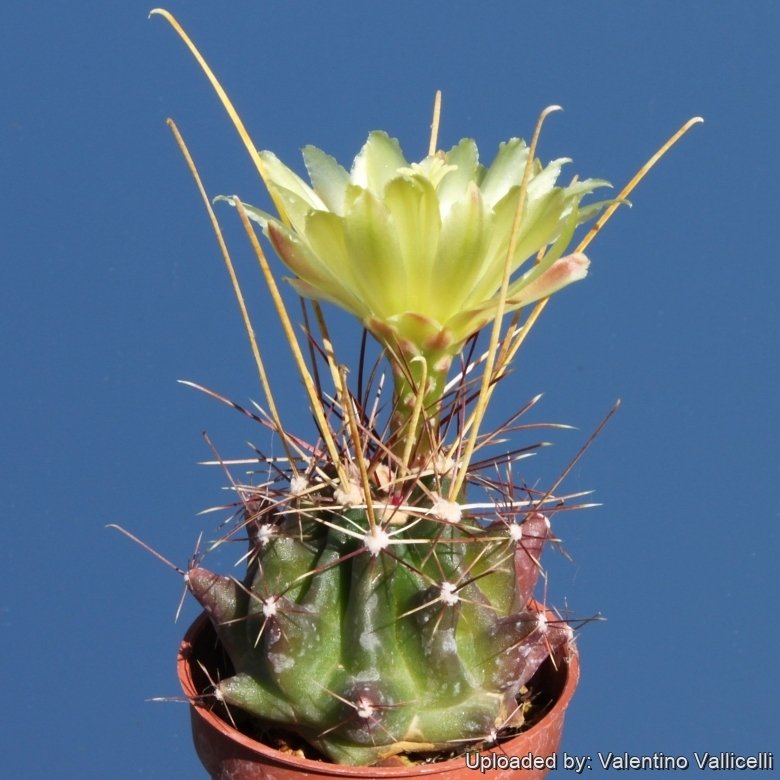
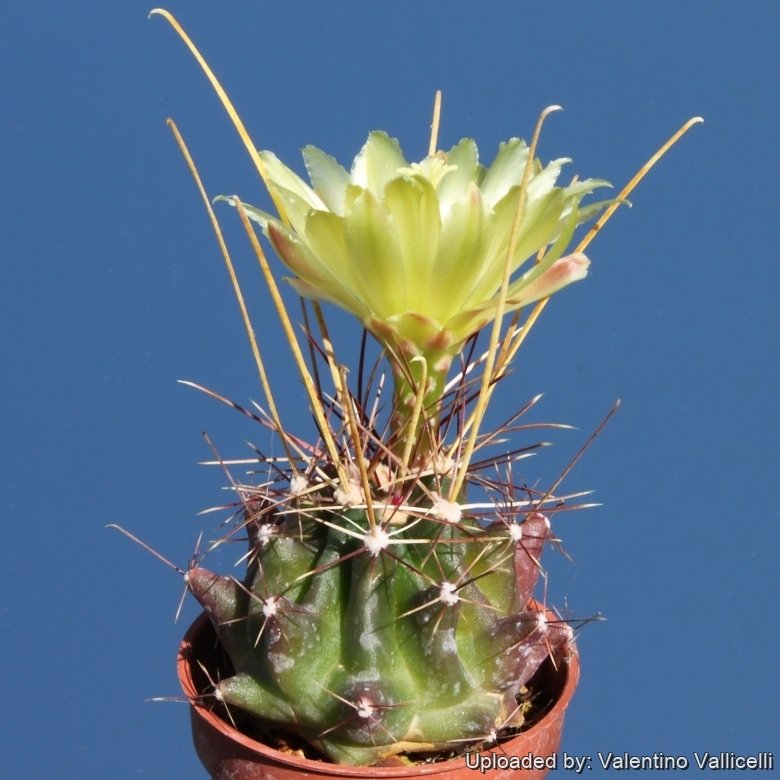
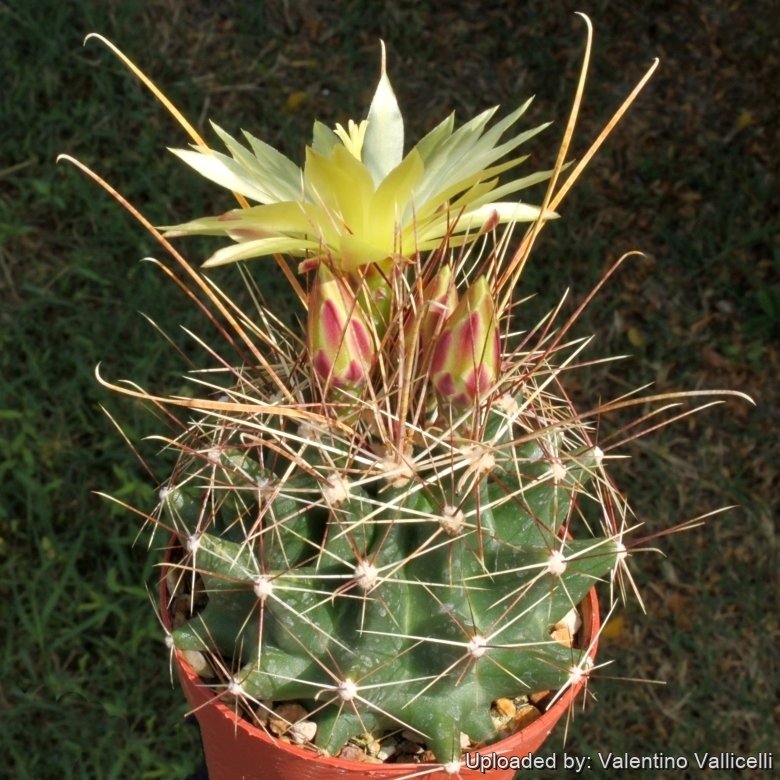
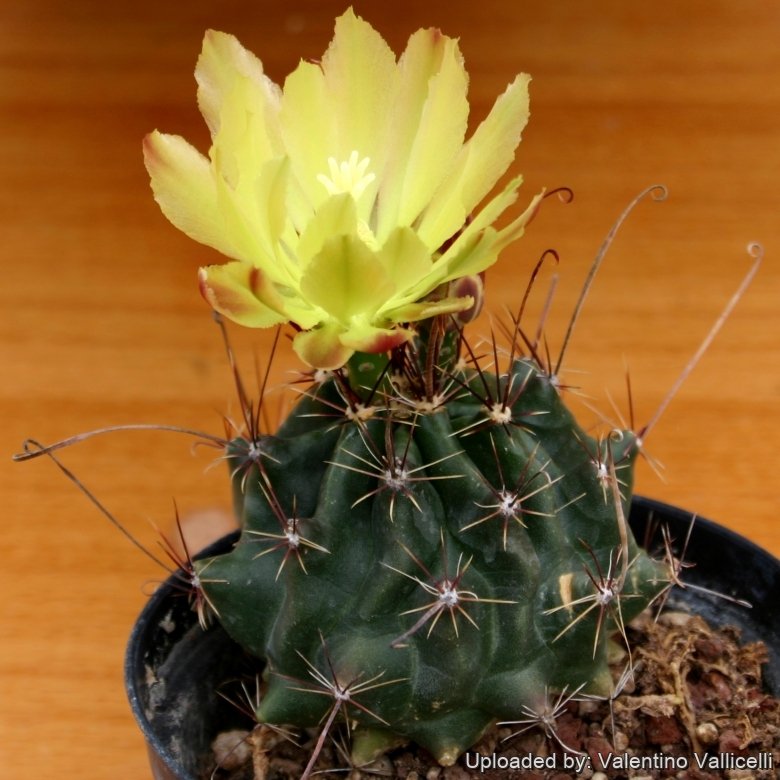
Stems: Spheric to ovoid, dark green to grey-green 10-30 cm tall, 7,5-20 cm across.
Ribs: typically 13 ( to 17), narrowly compressed, and acute at the crest, somewhat undulate to deeply crenate and slightly tuberculate.
Areoles: Circular to elliptic 1-3 cm apart, young ones with white, yellow or grey felt with elongated glands, 2 to 4 mm long between the flower and the spines; these at first are soft, but in age become hard and spine like.
Spines: 12-16 per areole.
Central spines: up to 4 per areole, yellow or straw coloured, terete or somewhat flattenedn curved or slightly hooked, principal central spine thin more or less flattened, 5-10 cm long, 0,4-3 mm broad, more or less flexible.
Radial spines: 8-12 terete, grey to reddish, especially near the stem apex upper ascending, lower descending, laterals appressed, 3,5-7,0 cm long.
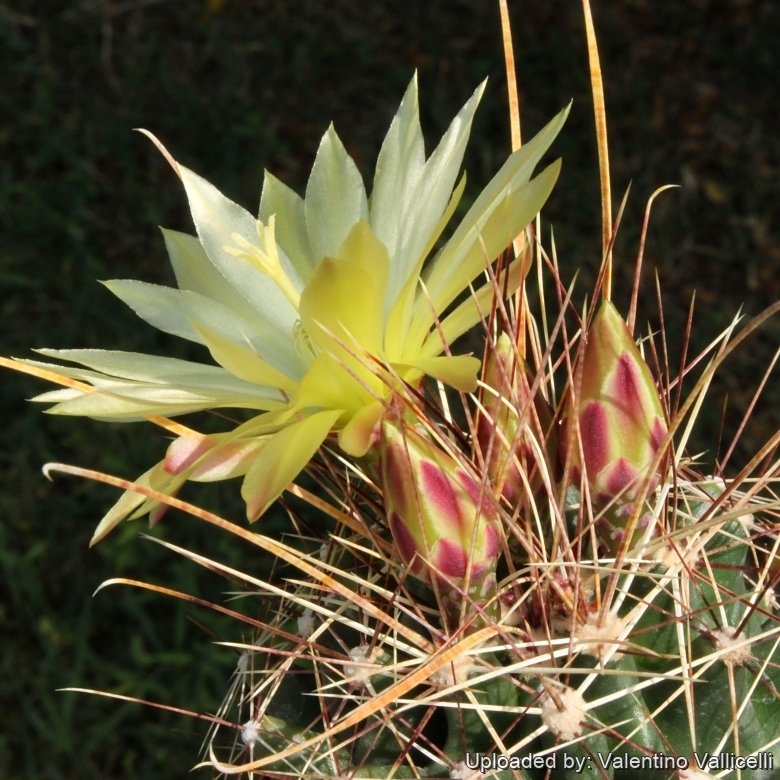
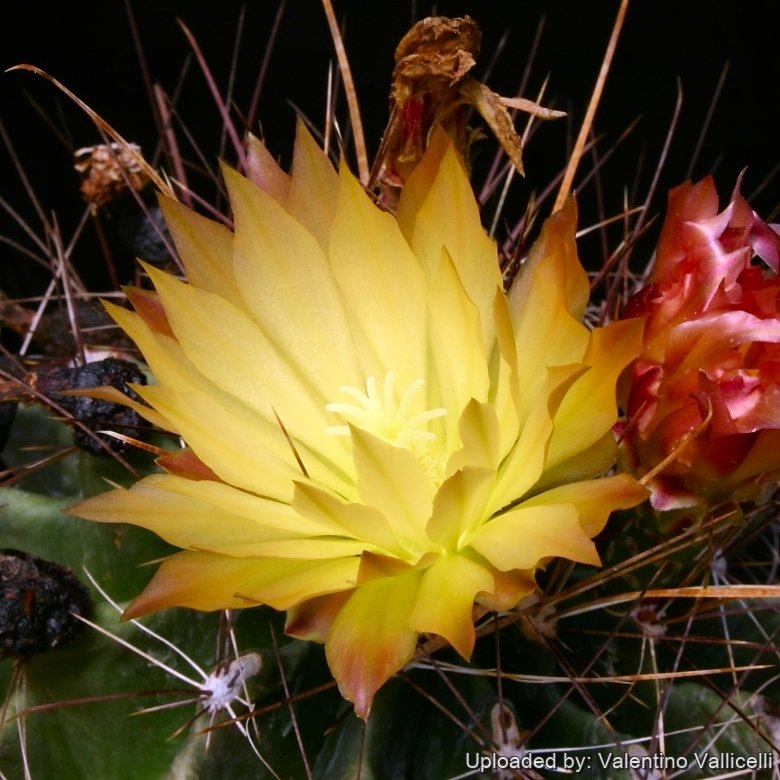
Flowers: Near apical in a ring, funnelform, pale yellow 6-7,5 long, 7-9 cm across. Filaments yellow to orange-yellow, anthers and pollen yellow. Stigma stigma yellow wit 8-10 lobes.
Blooming season: Late summer to autumn, flowers open midday, partially close at night, and reopen again for several days.
Fruits: Globose to elongate, 20-45 mm long, 10-35 mm in diameter, green, yellow-green, or olive becoming dark brownish red at maturity. The fruit of this species is unlike that of most other species of the genus; the skin is thin and the flesh juicy and edible.
Seeds: About 1 mm long, shiny black, pitted.
Blooming season: Early summer to autumn in succession.
Origin and Habitat
Ferocactus hatnatacanthus subsp. sinuatus replaces Ferocactus hatnatacanthusin more easterly habitats in Tamaulipan thorn scrub front the Pecos River east and south through Eagle Pass to the brush-lands near Brownsville, North-east to the edge of the Hill County near Camp Wood, and on West past the Devil River, and adjacent Mexico East of Sierra Madre Oriental.
Altitude: 0-500 metres above sea level.
Cultivation and Propagation
This species is easy and well worth growing. Require little care once they have reached a nice flowering size. It is suited for any rich, well drained soil in full sun throughout the year (But do better with some light shade in summer).
Pot culture: Grows best in a well-drained container filled with a porous cactus soil mixture that doesn’t contain too much humus. To insure robust plants water and fertilize during the aestival growth cycle, this plant need plenty of water (indicatively to about once a week) But needs to be avoided wetting the bodies of these plants while they are in sunlight. A wet cactus in the sun light can cause sun burning which can lead to scares or even fungal infections and death. Care must be taken to prevent sooty mould forming on the sugary secretions from near the areoles.
Frost Tolerance: In winter keep completely dry at 5°C this usually aids in maintaining a healthier plant, but it is hardy to -7°C.
Propagation:n: Seeds or cutting. Seeds are the typical way of reproducing. These cacti will easily grow from seeds and some from cuttings. Seeds can be sown in the spring or summer in well-drained pots of soil for cacti and sow the seeds thinly on top. Cover them with a bit of fine quartz grit. Moisten and lay a piece of glass across the top. The pots should be set in a warm greenhouse until they start to sprout after which the glass should be progressively removed so they can receive full light and air. It isn’t good to keep the glass over the seedlings. The seedlings well developed can be planted separately in small pots.
Cuttings made from pieces of the stem of any size can be detached and laid aside for a few days to allow a protective “skin” to form over the cut. They can then be planted in pots. Place them in a spot where they’ll receive sun and do not water until the soil becomes fairly dry. After a while the soil can be moistened regularly but never kept constantly saturated.
Bibliography
Major references and further lectures
-
Edward Anderson “The Cactus family” Timber Press, Incorporated, 2001
-
James Cullen, Sabina G. Knees, H. Suzanne Cubey “The European Garden Flora Flowering Plants: A Manual for the Identification of Plants Cultivated in Europe, Both Out-of-Doors and Under Glass” Cambridge University Press, 11/Aug/2011
-
David R Hunt; Nigel P Taylor; Graham Charles; International Cactaceae Systematics Group. “The New Cactus Lexicon” dh books, 2006
-
Urs Eggli, Leonard E. Newton: “Etymological Dictionary of Succulent Plant Names” Springer, Berlin/Heidelberg 2010
-
N. L. Britton, J. N. Rose: “The Cactaceae. Descriptions and Illustrations of Plants of the Cactus Family.” Volume III, The Carnegie Institution of Washington, Washington 1922
-
Brian Loflin, Shirley Loflin “Texas Cacti: A Field Guide” Texas A&M University Press, 26/Oct/2009
-
Albert Michael Powell, James F. Weedin “Cacti of the Trans-Pecos and Adjacent Areas” Texas Tech University Press, 2004
-
Del Weniger “Cacti of Texas and Neighboring States: A Field Guide” University of Texas Press, 1984
Gallery