Publication: Cactaceae (Britton & Rose) 3: 144. 1922 [12 Oct 1922]
Description
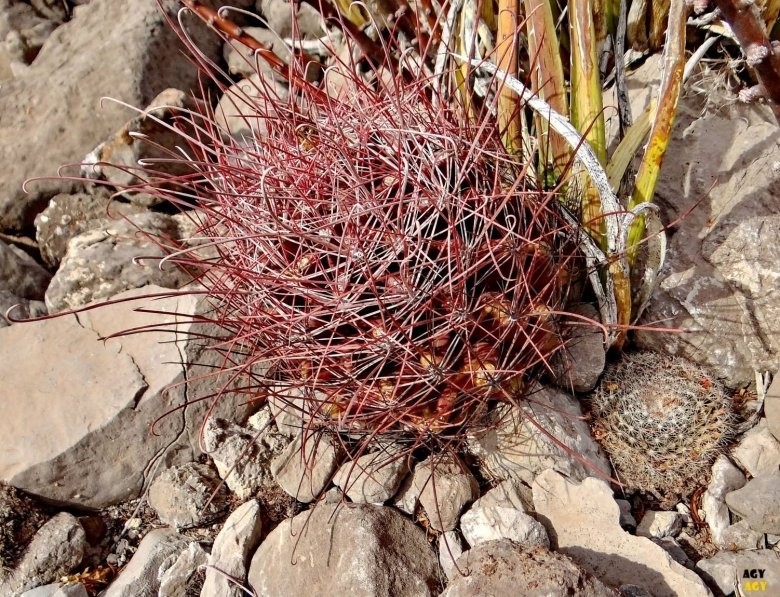
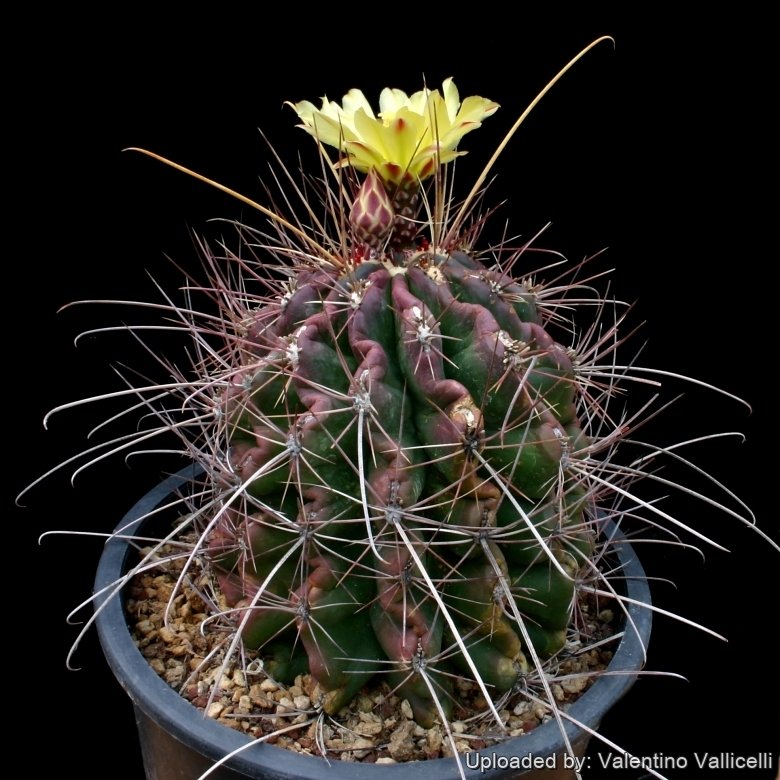
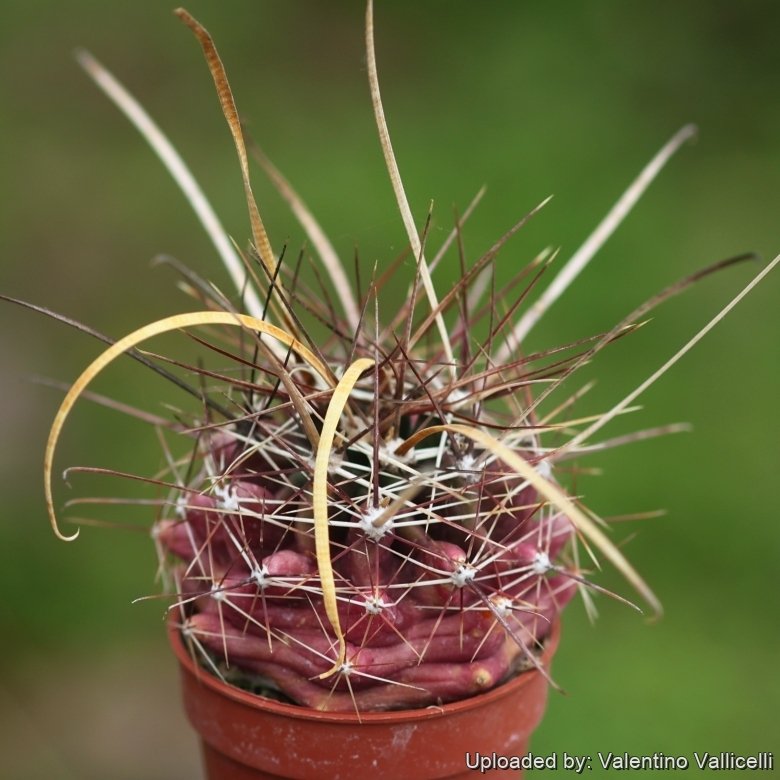
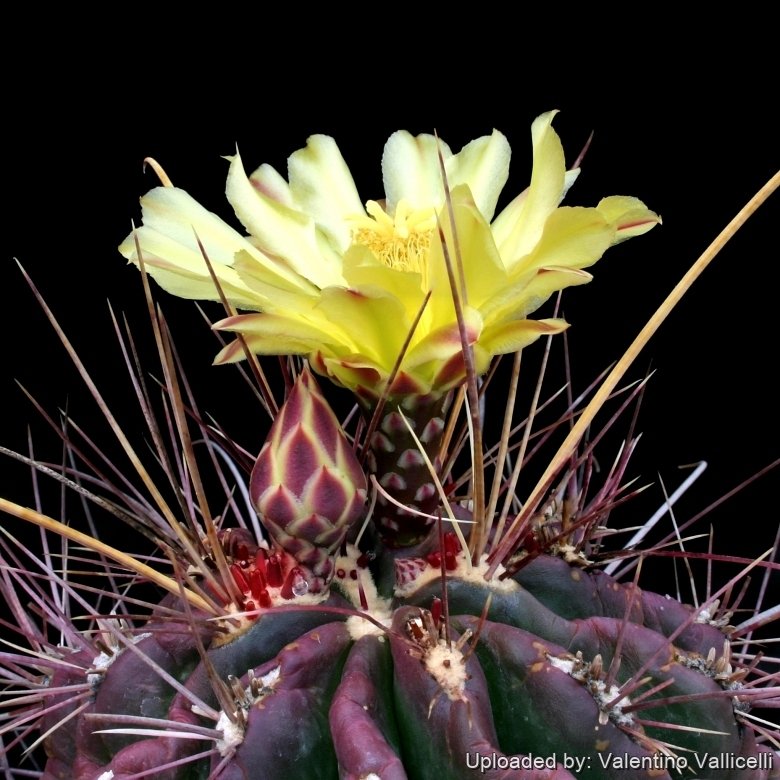
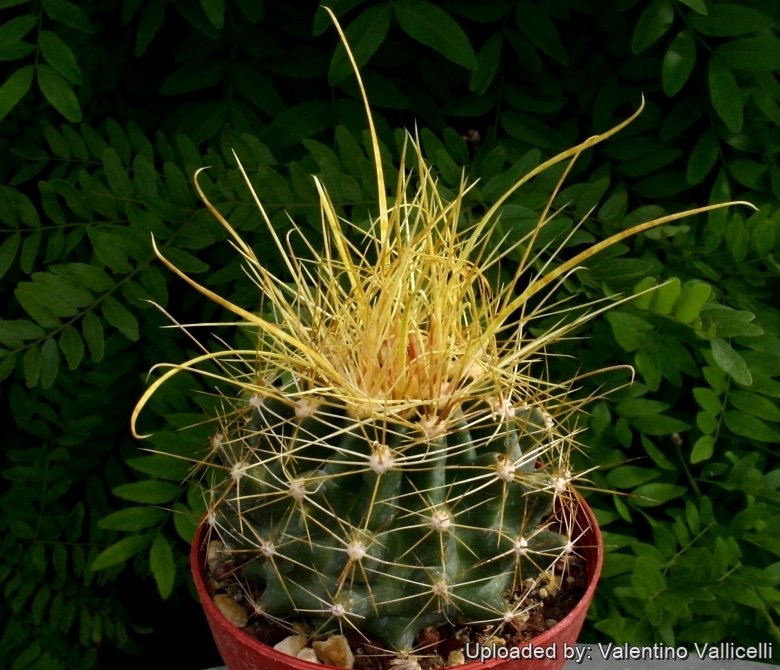
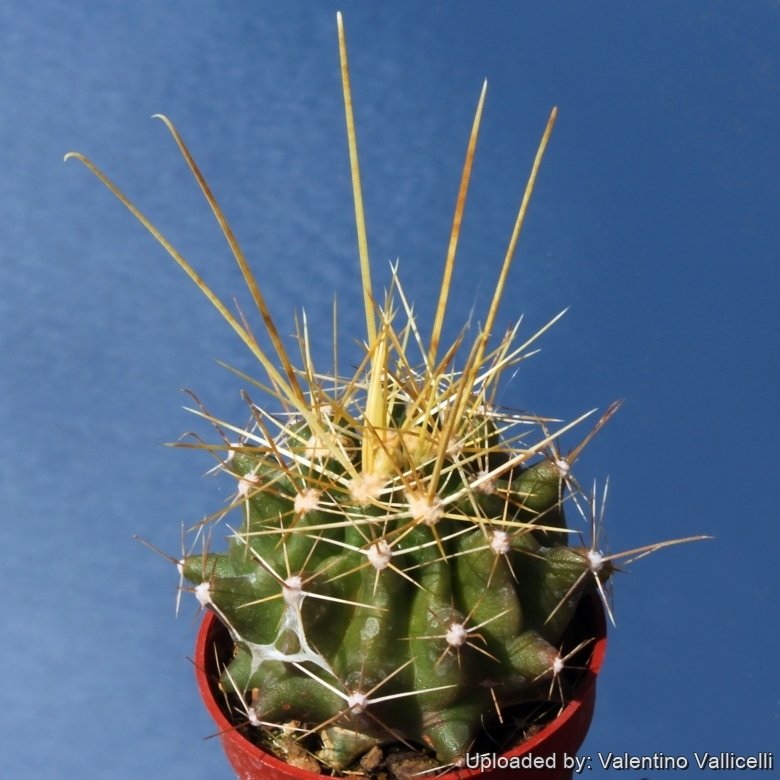
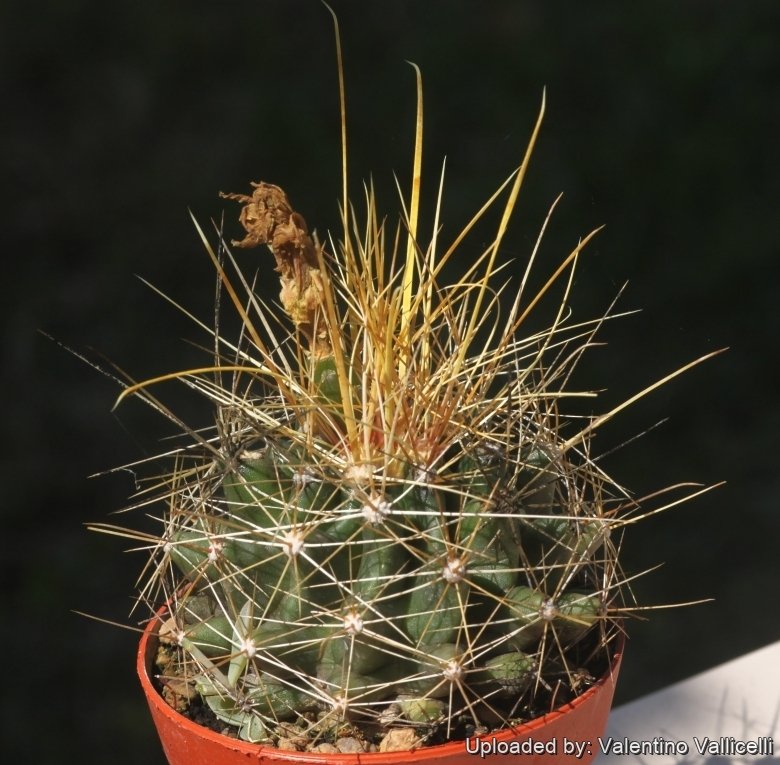
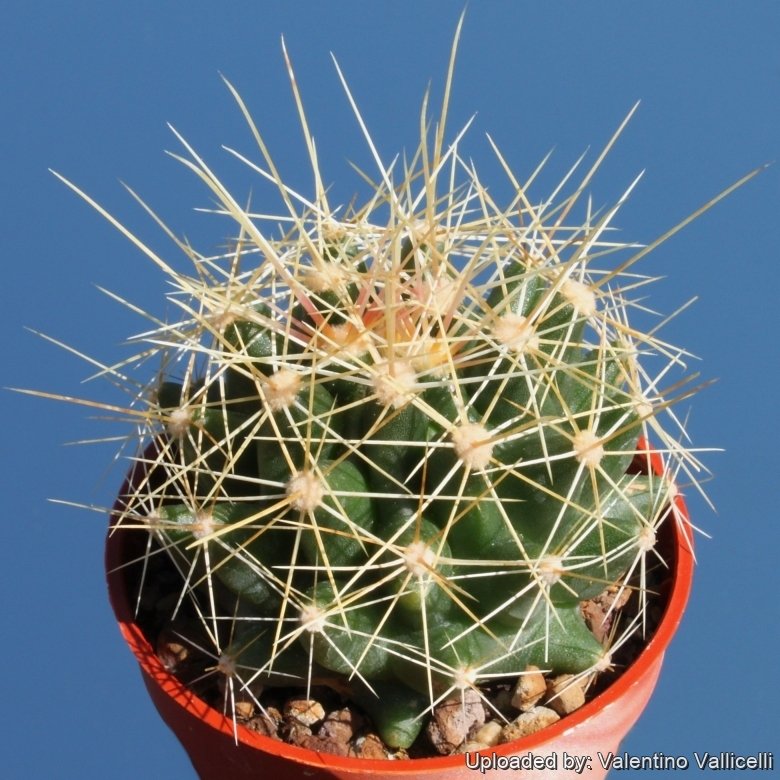
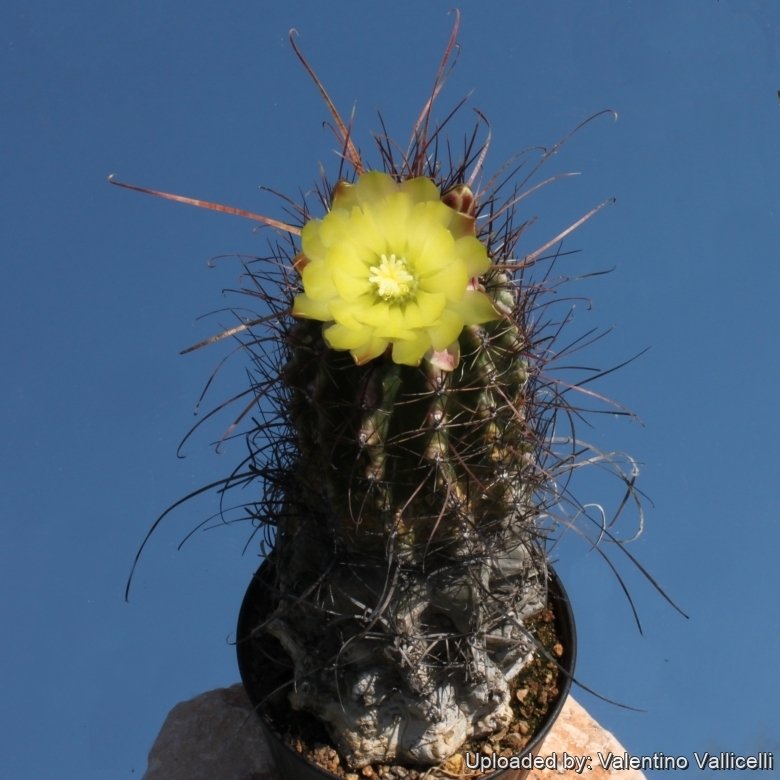
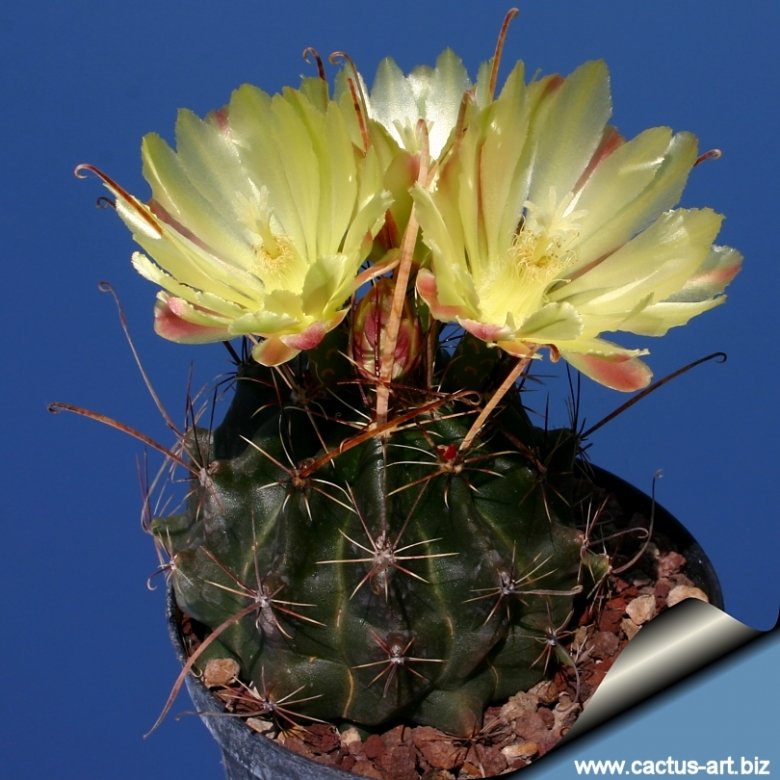
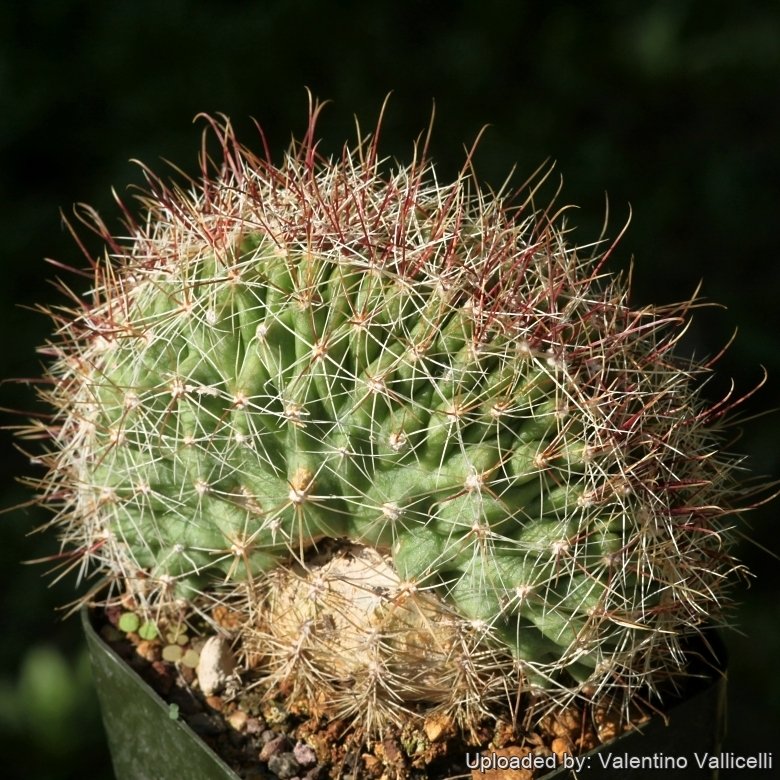
Ferocactus hamatacanthus (a.k.a. Turk’s head) is a medium sized barrel cactus with spines somewhat variable in number, diameter, and position, depending on origin.
Habit: Solitary, or double or triple branched after injury, occasionally even uninjured plants may form clusters with more than tree heads, particularly plants growing in rock crevices.
Stem: Hemispherical or spherical, becoming oblong or cylindrical, dark green to grey-green, up to 60 cm high (exceptionally near 90 cm high) and 5-30 cm in diameter partially obscured, mostly by interlacing radial spines.
Roots: Diffuse.
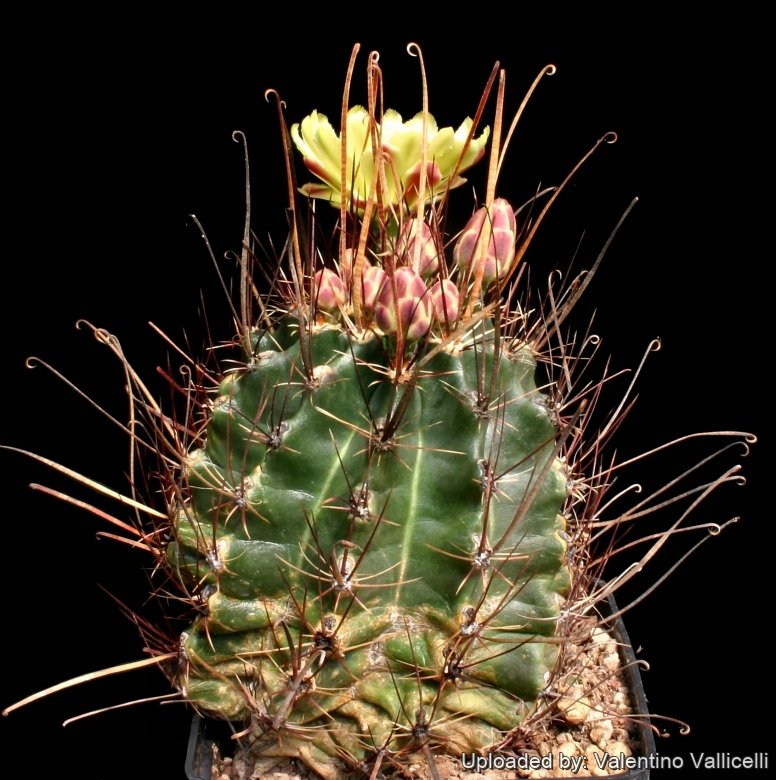
Ribs: 10-13, sometimes 17, rounded but not compressed at the crest, ofyten poorly defined, large, 2,5-5 cm high and thick and divided into rounded tubercles with areoles on tops.
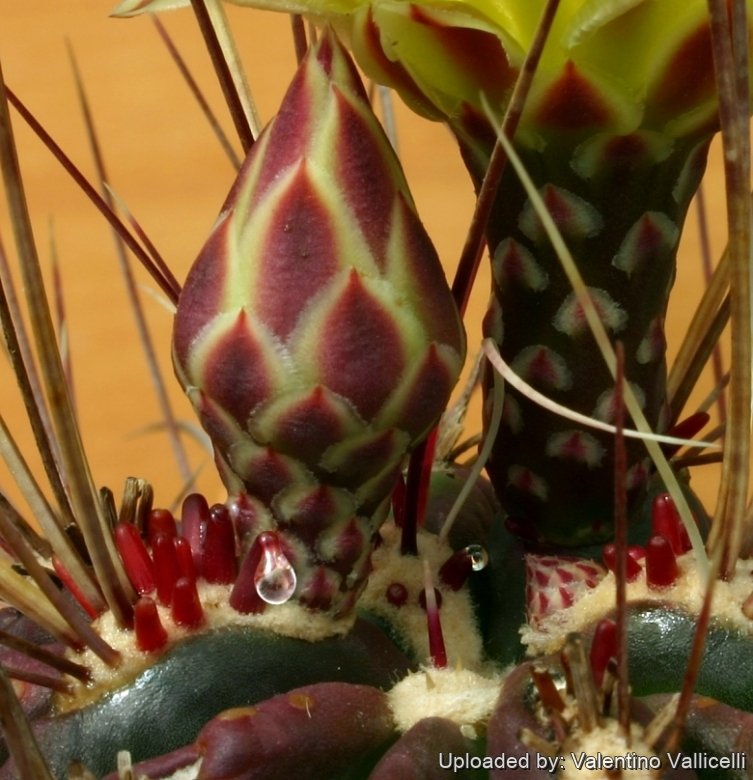
Areoles: Large circular to elliptic, 1 to 3 cm apart with felted grooves running inward and upward with white, yellowish or grey wool in younger areoles. Between the flower and the spines in each areole there are some elongated glands, 2 to 4 mm long, these at first are soft, but in age become hard and spine like.
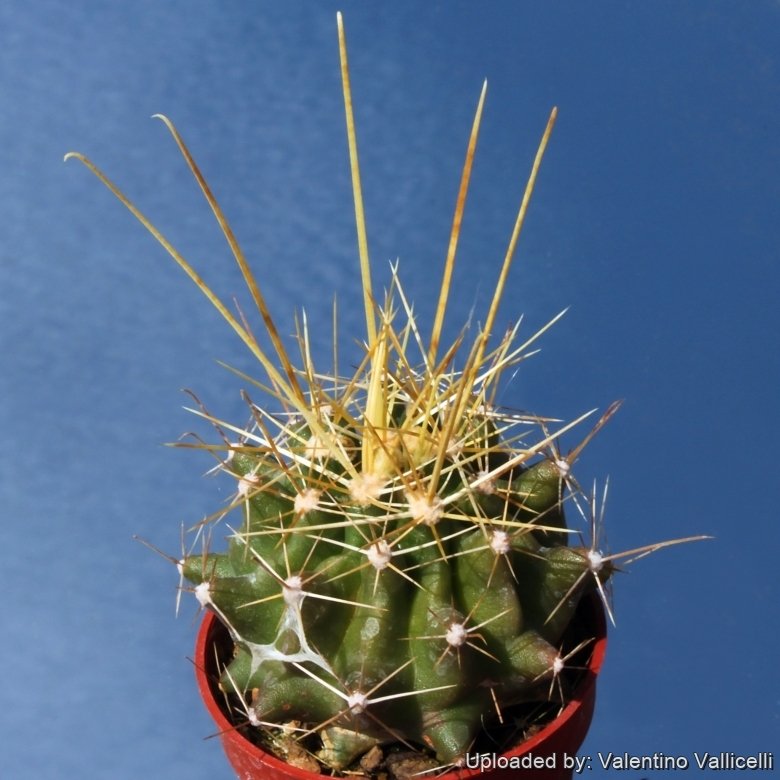
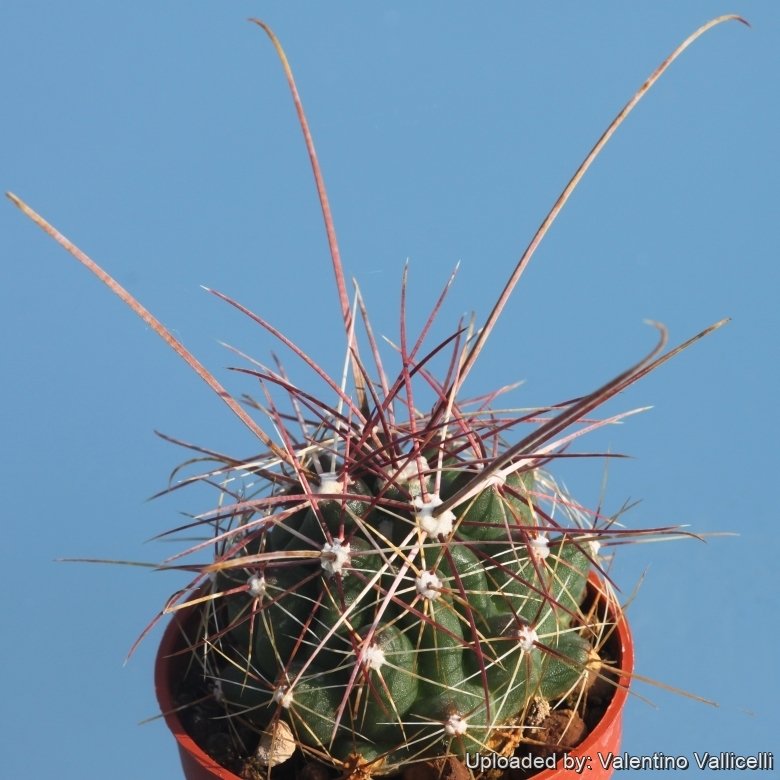
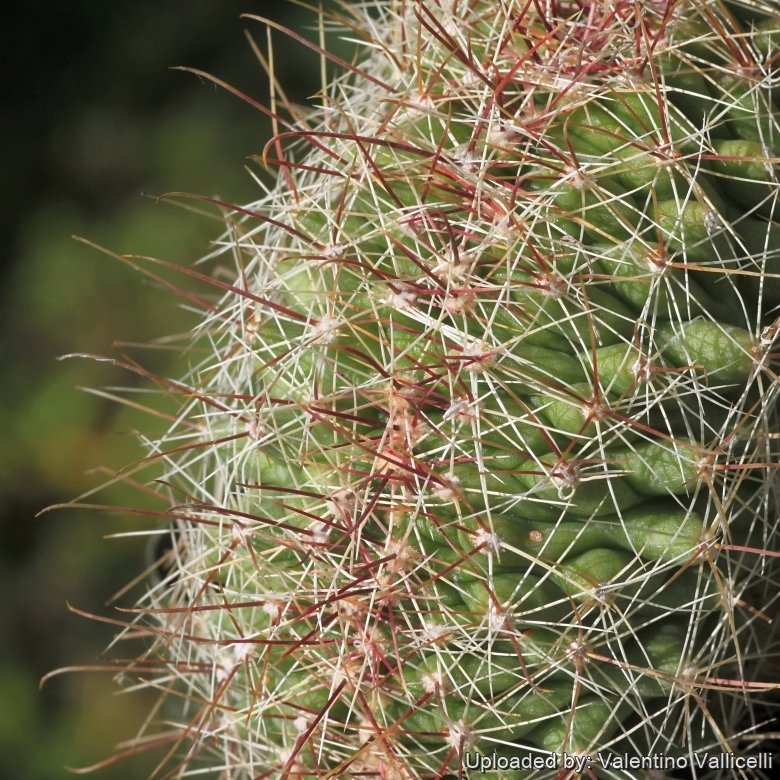
Spines: Somewhat variable in number, diameter, and position, mostly brownish red brownish, reddish or a mixture of red spines and yellowish, especially near the stem apex, sometime indistinctly annulate and often variegated, turning grey as they ages. In some plants, particularly on the upper one-half or one-third of the stems, the collective dominant colour of the spines is red. The areoles of immature plants have fewer and shorter central and radial spines than is typical in adult areoles.
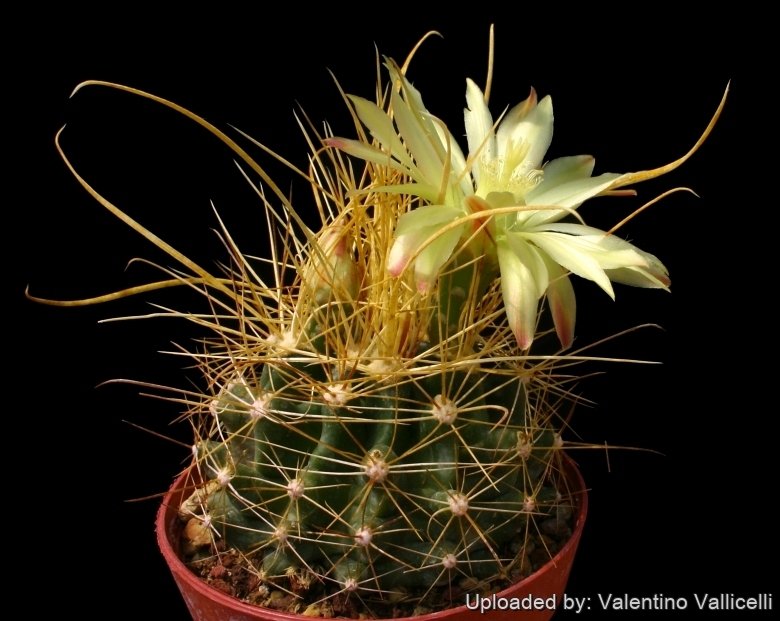
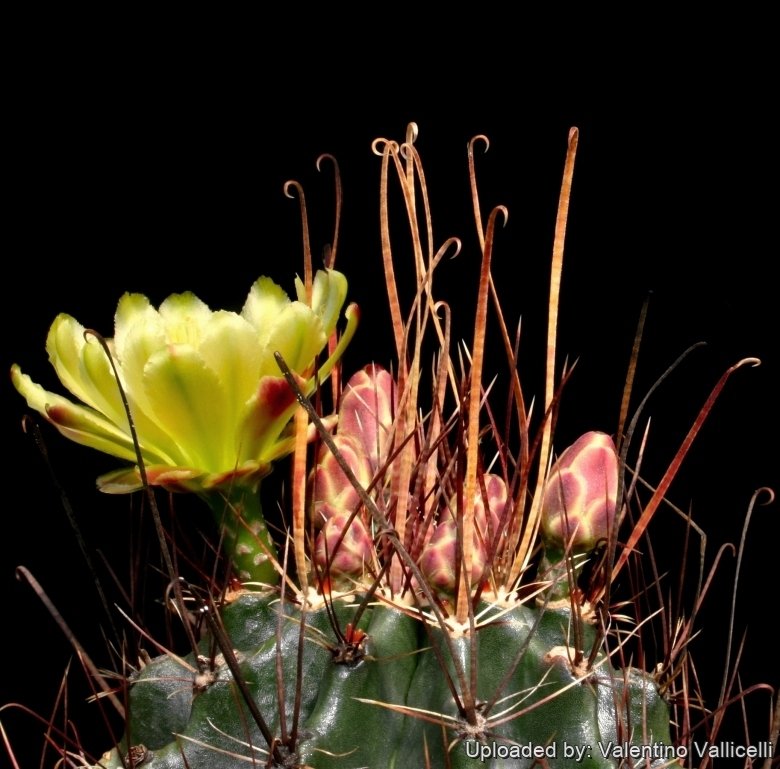
Central spines: 4 to 8, elongated, stiff, terete, round, angled, or somewhat flattened in cross section, usually less than 8 cm long, but sometimes 15 cm long, curved backward to hooked at apex, sometimes twisted.
Radial spines: About 8-14(-20), acicular, terete, somewhat compressed or angled, relatively stout and stiff or somewhat thin and flexible, or even sinuate, 5 to 8 cm long, upper ascending, lower descending, laterals appressed.
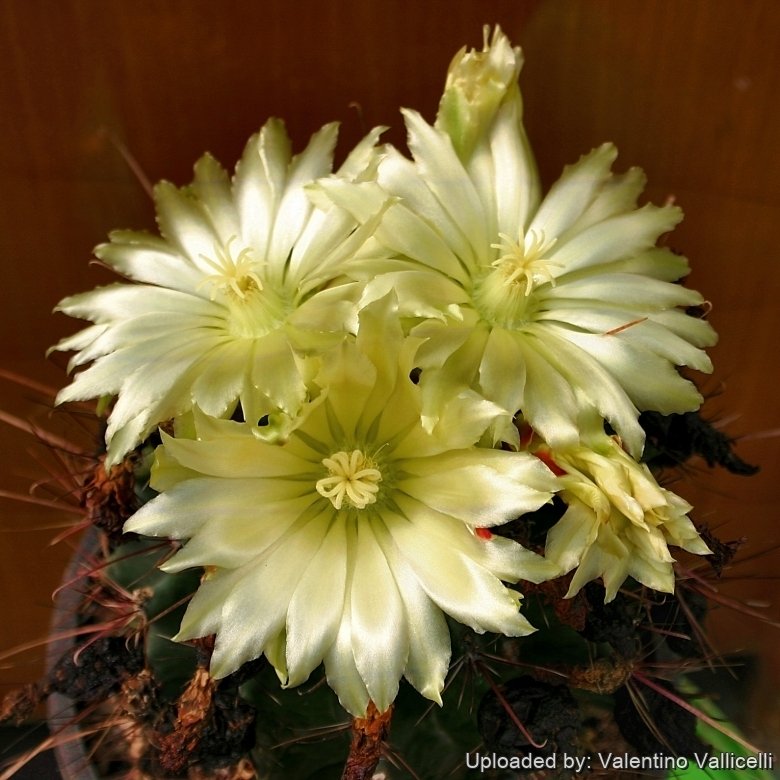
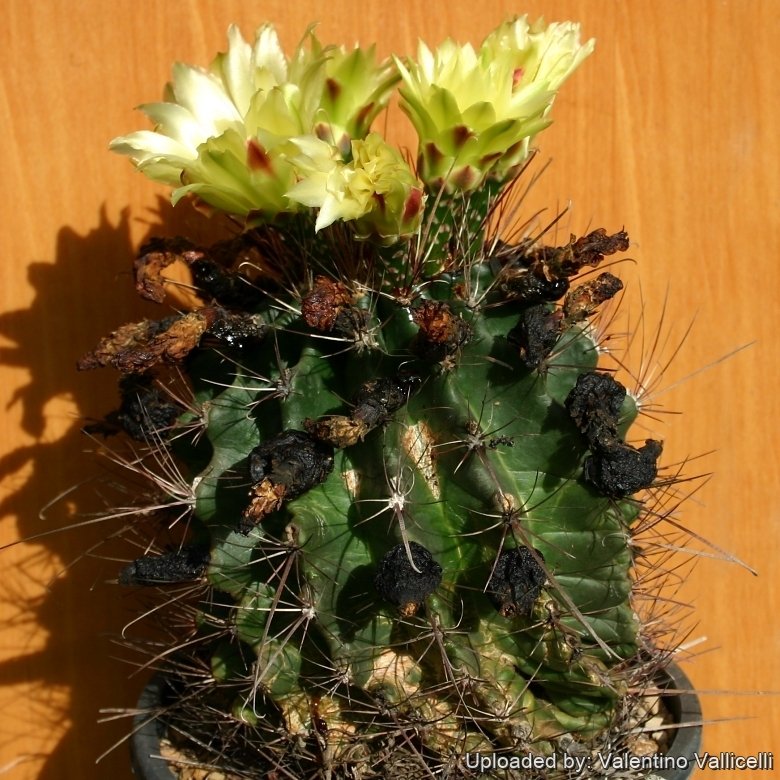
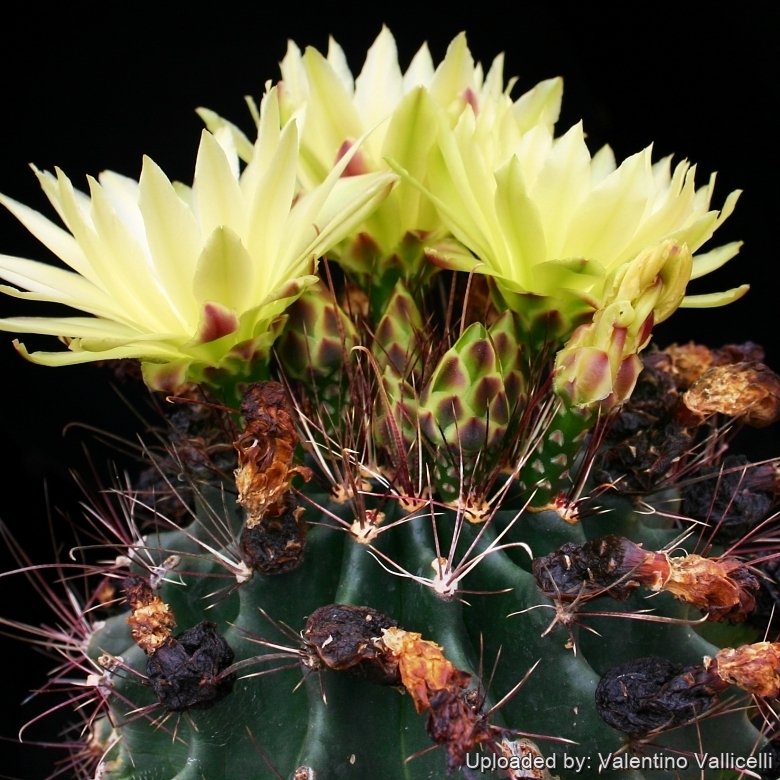
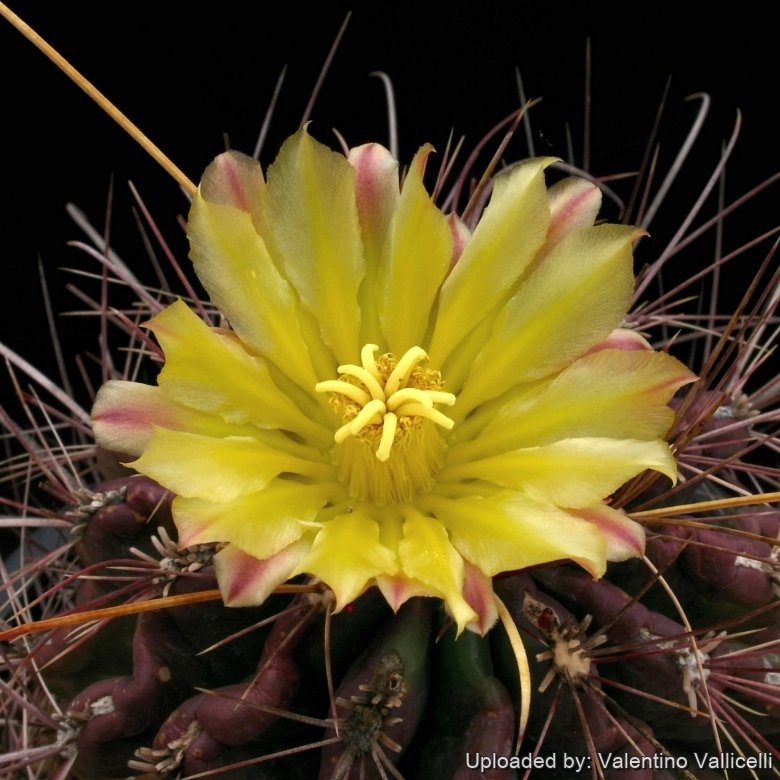
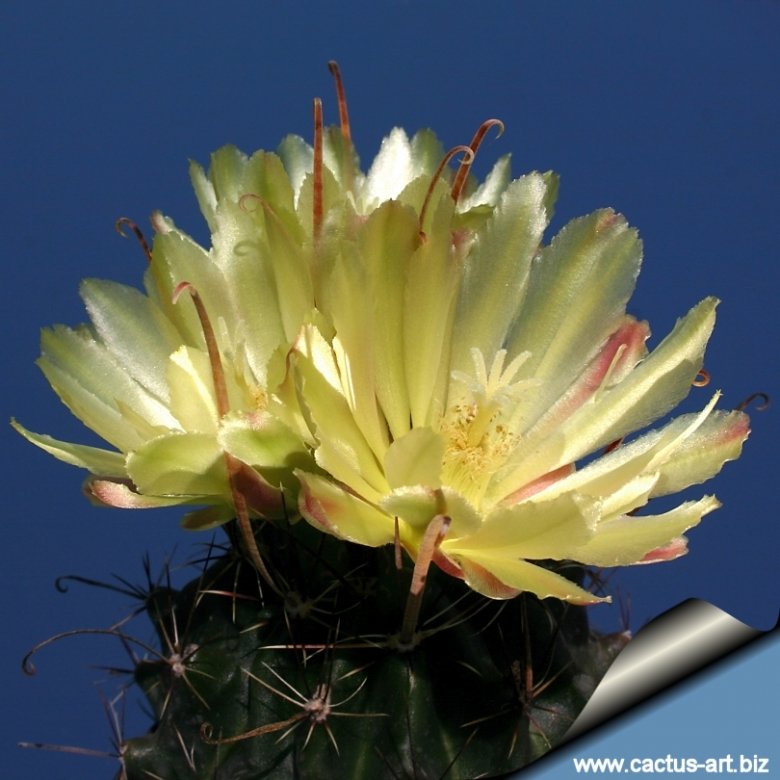
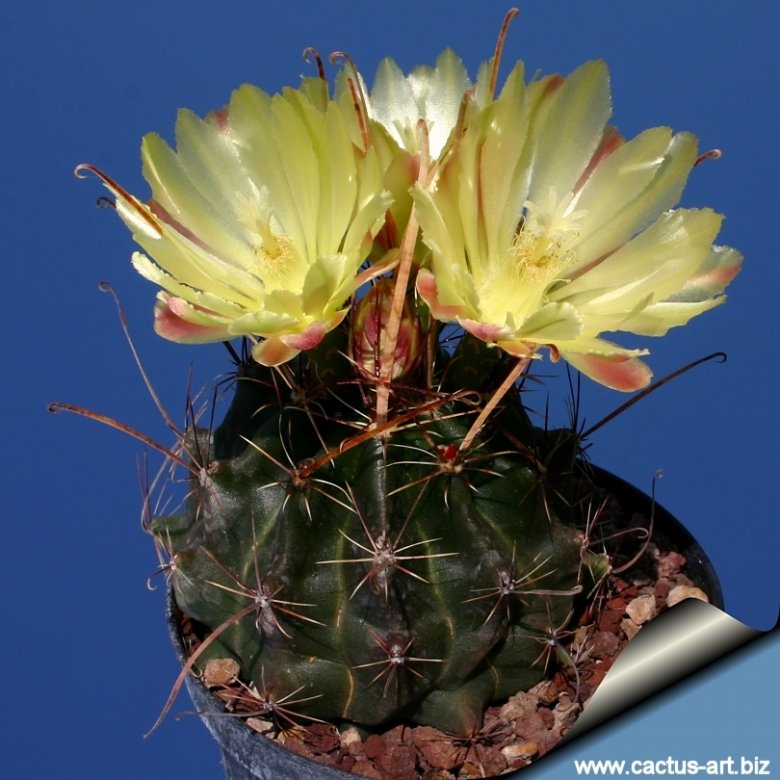
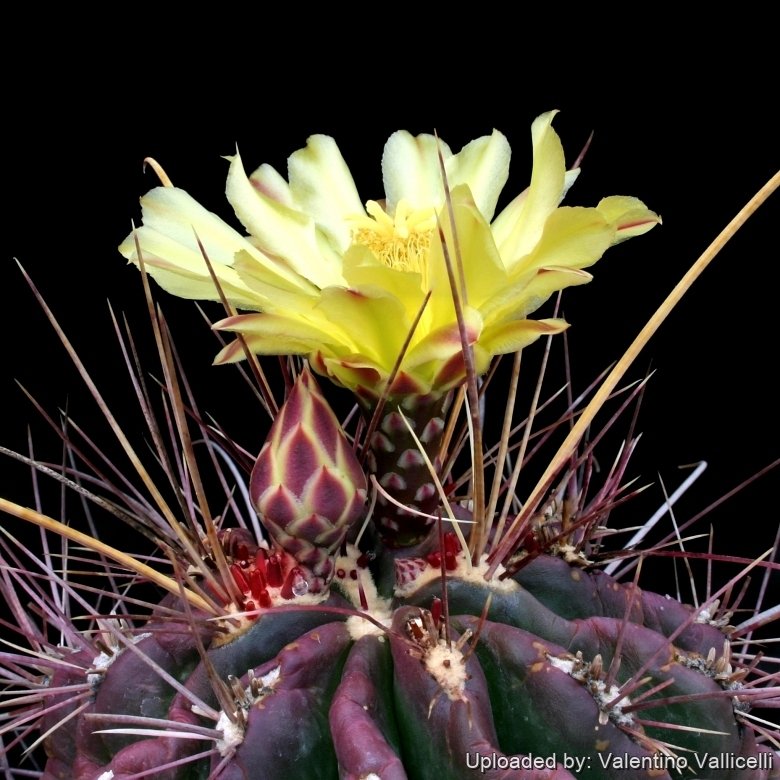
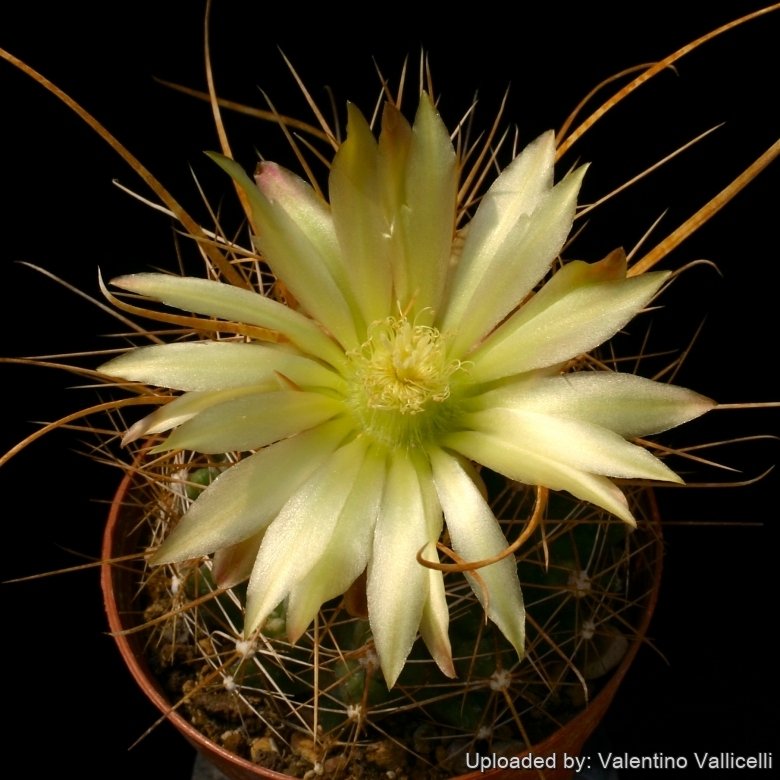
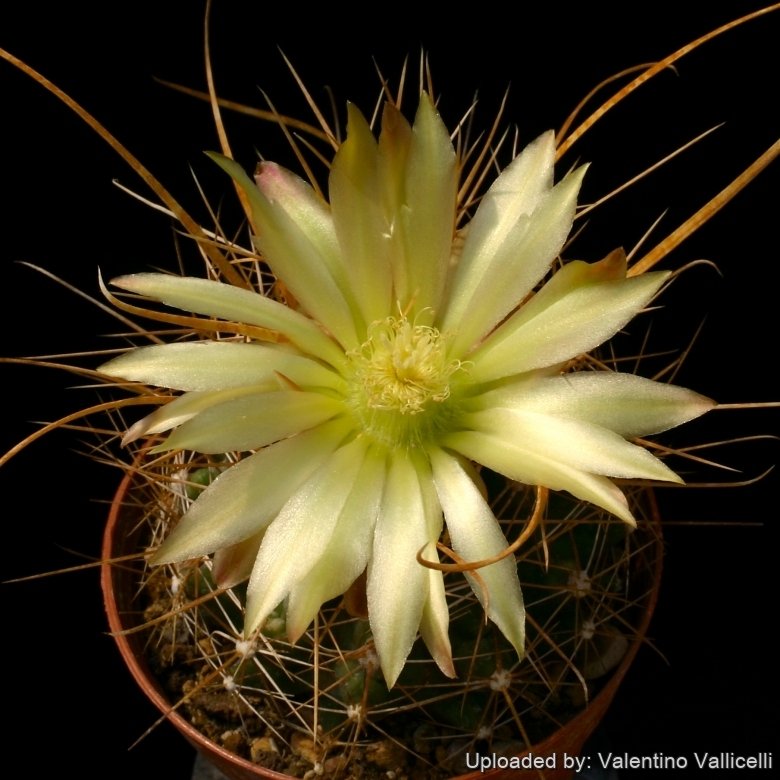
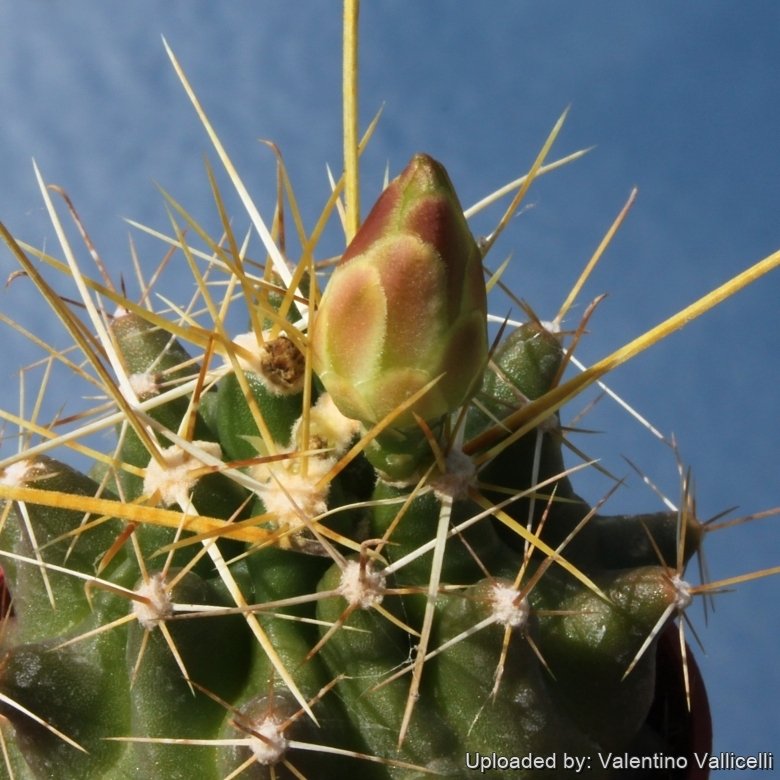
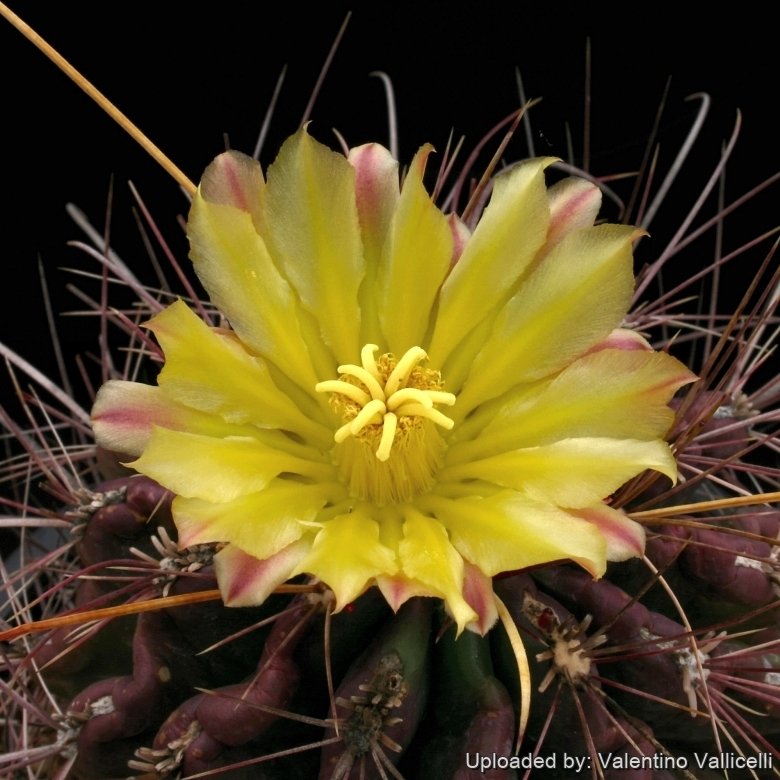
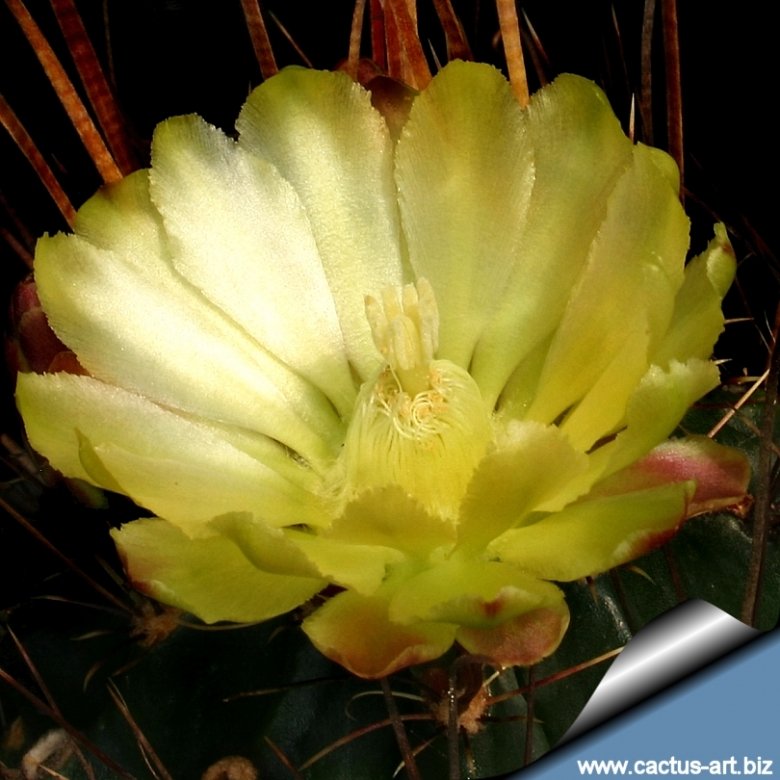
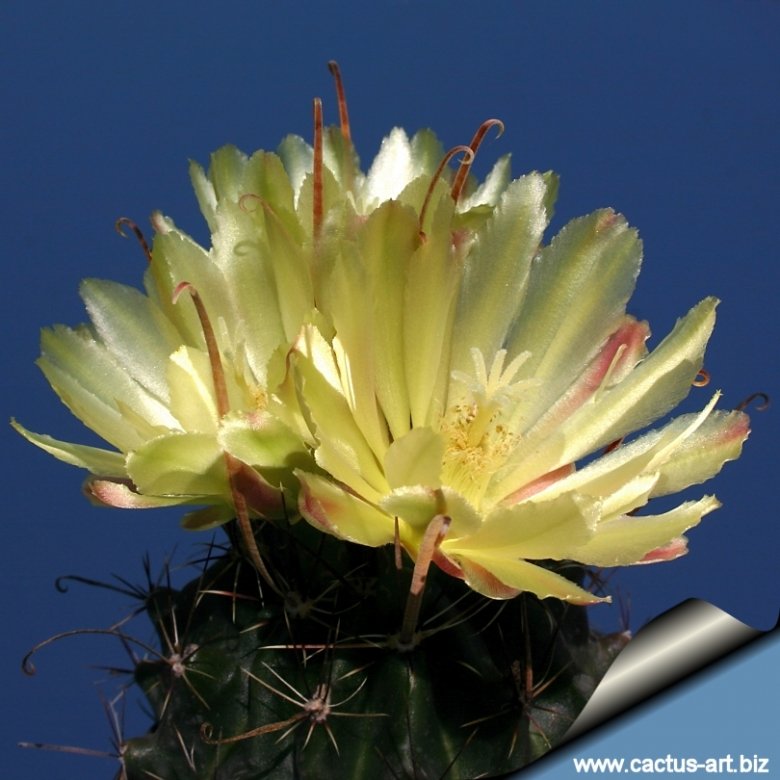
Flowers large: Near apical in a ring, funnelform with well-developed floral tubes, (6-)7-8(-10) cm long, 6-8 cm in diameter, glossy, mostly yellow with a pale green throat, in some forms scarlet within. Pericarpel surface with 10-40 small, triangular scales with greenish-yellow, fringed margins. Filaments yellow to orange-yellow, anthers and pollen yellow. Stigma stigma yellow longer than stamens, with 8-14 lobes curved and twisted 4,5-6 mm long. The flowers are scented.
Blooming season: Late summer to autumn, flowers open midday, partially close at night, and reopen again for several days. Plants starts blooming when stems reach 15 cm high or less.
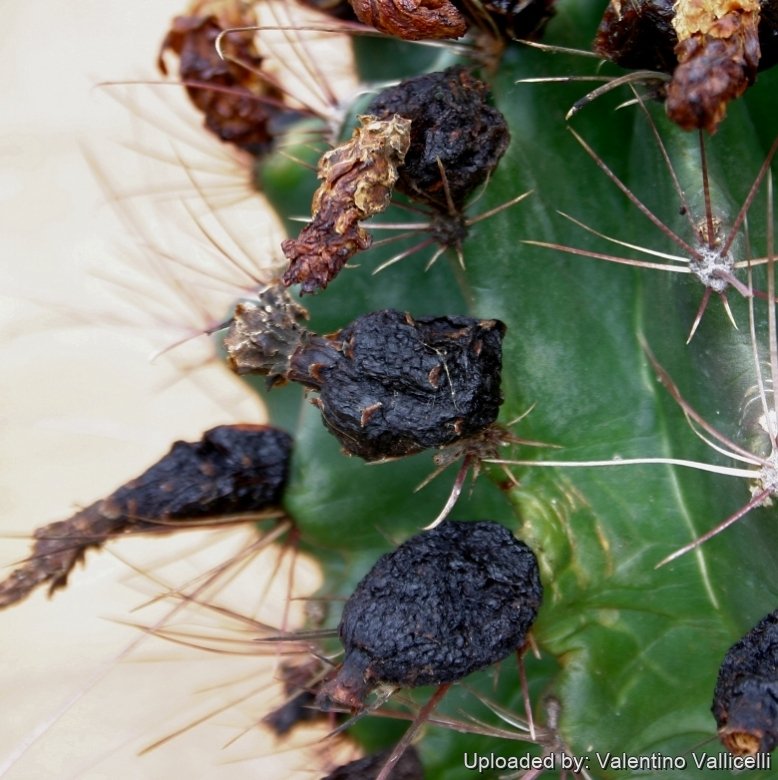
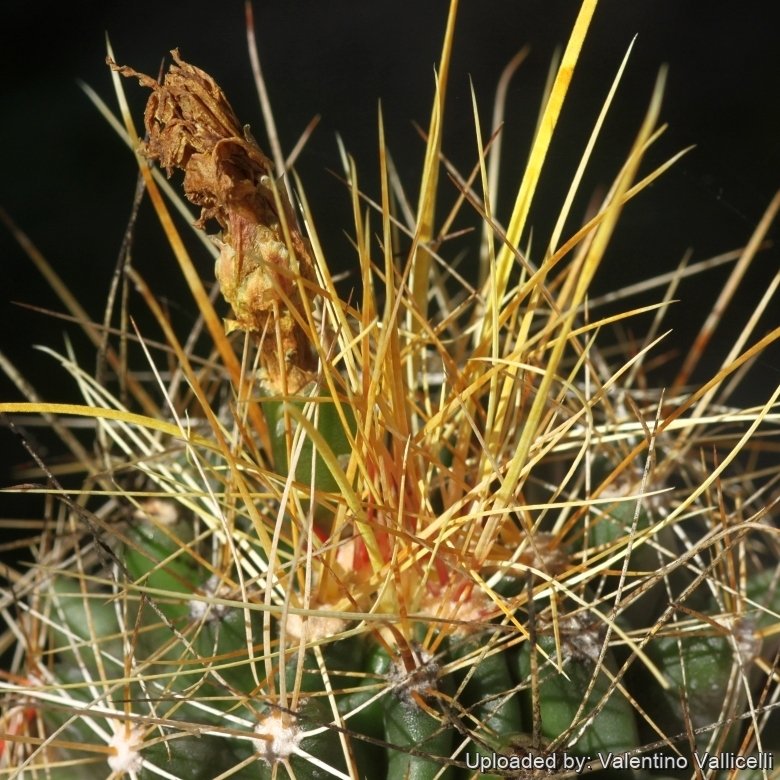
Fruit: Egg shaped, 2 to 5 cm. long, 2,5-3 cm in diameter fleshy, greenish yellow, green to pinkish red, dark brown to drab-colored (not red) usually with a persistent floral remnant, and with 50-40 widely spaced scales on the surface. The fruit of this species is unlike that of most other species of the genus; the skin is thin and the white pulp, is juicy, sweet and edible. Mature fruits sometime splits open by the the rupturing of the fruits near the apex and the extrude the seeds in a liquid, but more the fruits are indehiscent and dries on the plant and do not dehisce via a basal pore. The fruits persist through the summer and autumn and mature in winter.
Seeds: Ovate, about 1-1,5 mm, shiny black, pitted , and with a basal-lateral hilum that is marked by a sharp, narrow hilum-micropylar rim.
Origin and Habitat
Southern Texas, New Mexico, and northern Mexico.
Altitude: 700-200 metres above sea level.
Habitat: Plants occur mainly in the Chihuahuan Desert from the lowest desert up to the wooded mountains in the limestone mesas and alluvial valleys, often among shrubs and in crevices of rocks. Often growing along with several species of xerophytes and succulents, comprising: Echinocereus pectinatus, Echinocereus stramineus, Epithelantha micromeris, Echeveria coccinea, Dasylirion acrotrichum, Yucca treculeana, Yucca treculeana, Larrea tridentata, Parkinsonia aculeata, Escobaria chihuahuensis, Coryphantha durangensis, Agave stricta, Agave lechuguilla, Myrtillocactus geometrizans, Neoloydia conoidea, Echinocactus platyacanthus, Jatropha spathulata, Opuntia macrocentra, Opuntia imbricata, Opuntia engelmannii… and many others.
Cultivation and Propagation
Ferocactus hamatacanthus is a summer grower species not too difficult in a greenhouse, although grows quite slowly.
Soil: Use mineral well permeable substratum with little organic matter (peat, humus), plants may become too elongated if compost is too rich.
Repotting: They need to be repotted frequently, but when they reach 10 cm in diameter grow them slowly, and adopt a new repotting period, using intervals of every 2-3 years. Additionally grow them under drier conditions or with stronger sunlight. Use pot with good drainage.
Fertilization: It grows much faster with a low nitrogen content fertilizer in spring and summer. Potassium helps maintaining the plants compact and healthy.
Watering: Requires careful watering to keep plant compact. Water sparingly from March till October, the thin, fibrous roots suffer if there is humidity, therefore the plant should be watered only when the surrounding terrain is dry. Keep dry as soon as the temperature starts dropping in October and keep it perfectly dry in winter at temperatures from 5 to 15 degrees centigrade.
Frost Tolerance: Hardy to at least -5°C for a short period but cannot tolerate long standing freezing temperature, and for an healthy cultivation ensure a minimum temperature of 5° C. USDA Hardiness Zone 9b and 11. It tends to rot in winter during the resting phase, if kept wet. In the rest period no high atmospheric humidity!!
Heat tolerance: Good heat tolerance, but in warmer climates it should be protected from excessive heat and too much sun sun in summer.
Sun Exposure: Light shade to full sun, its colour tends to richer and darker when grown in light shade.
Uses: It is an excellent plant for container growing. It always looks good and stays relatively small.
Food uses: Buds, called cabuches, of Ferocactus hamatacanthus are commercially harvested and canned.
Pests & diseases: It may be attractive to a variety of insects, but plants in good condition should be nearly pest-free, particularly if they are grown in a mineral potting-mix, with good exposure and ventilation. Nonetheless, there are several pests to watch for:
- Red spiders: Red spiders may be effectively rubbed up by watering the infested plants from above.
- Mealy bugs: Mealy bugs occasionally develop aerial into the new growth among the wool with disfiguring results, but the worst types develop underground on the roots and are invisible except by their effects.
- Scales: Scales are rarely a problem.
- Rot: Rot is only a minor problem with cacti if the plants are watered and “aired” correctly. If they are not, fungicides won’t help all that much. To prevent rottenness it is also advisable to surround its root neck by very rough sand or grit, this help a fast water drainage.
Propagation: Usually propagated from Seeds. (seldom produces offsets). Sow the seeds in spring in a well-aerated compost at a temperatures of 22-24°C . Stand the pots in water, moisten thoroughly and drain. Scatter and press lightly the seed onto the top of the compost. But do not cover the small seeds with compost. Secure a polythene bag around the pot or cover the container with glass or and place in a warm shaded place. If possible, germinate in a propagator. Some seedlings may appear within a week or 10 days others will take longer. At lower temperatures, germination usually takes considerably longer. Once germination has taken place, remove gradually the glass or plastic and move into a good light but not in direct sun. If the young plants are exposed to too much sun, or the compost dries out, they may stop growing and often turn red; once they stop, it is often difficult to persuade them to start growing again. Never let the pots dry out-but don’t saturate them either. A sodden compost is as harmful as a dry one. The seedling growth is rapid.
Bibliography
Major references and further lectures
-
Edward Anderson “The Cactus family” Timber Press, Incorporated, 2001
-
James Cullen, Sabina G. Knees, H. Suzanne Cubey “The European Garden Flora Flowering Plants: A Manual for the Identification of Plants Cultivated in Europe, Both Out-of-Doors and Under Glass” Cambridge University Press, 11/Aug/2011
-
David R Hunt; Nigel P Taylor; Graham Charles; International Cactaceae Systematics Group. “The New Cactus Lexicon” dh books, 2006
-
Urs Eggli, Leonard E. Newton: “Etymological Dictionary of Succulent Plant Names” Springer, Berlin/Heidelberg 2010
-
N. L. Britton, J. N. Rose: “The Cactaceae. Descriptions and Illustrations of Plants of the Cactus Family.” Volume III, The Carnegie Institution of Washington, Washington 1922
-
Brian Loflin, Shirley Loflin “Texas Cacti: A Field Guide” Texas A&M University Press, 26/Oct/2009
-
Albert Michael Powell, James F. Weedin “Cacti of the Trans-Pecos and Adjacent Areas” Texas Tech University Press, 2004
-
Del Weniger “Cacti of Texas and Neighboring States: A Field Guide” University of Texas Press, 1984
From llifle page Brittonia davisii
Description
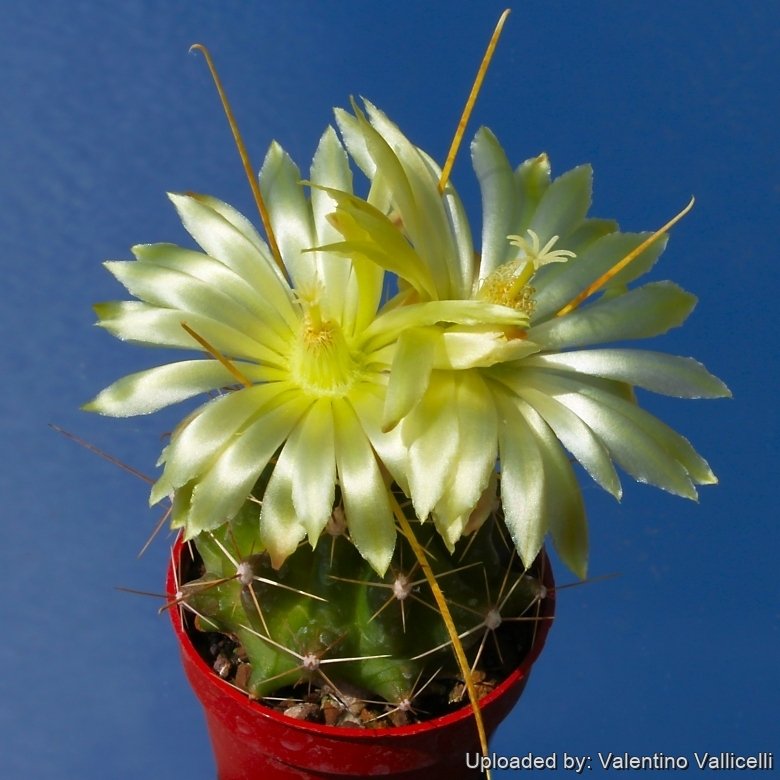
Ferocactus hamatacanthus var. davisii is one of the many geografical form of the widespread and morphologically variable Ferocactus hamatacanthus. Many of its morphological and geographical variant was early classified as different independent species, but nowadays all this plant are considered part of a multiform species, where each form is linked to others by populations of plants with intermediate characteristics. Ferocactus hamatacanthus var. davisii has very clear (almost white) and very shining flowers.
Habit: Solitary, or sparsely clumping.
Stems: Spheric to ovoid, dark green 10-30 × 7.5-20 cm.
Ribs: typically 13 ( to 17), undulate to deeply crenate, tuberculate.
Areoles: 1-3 cm apart, young ones with yellow felt.
Spines: 12-16 per areole; Central spines up to 4 per areole, curved or slightly hooked, principal central spine thin more or less flattened, 5-10 cm long and 0,4-3 mm across, more or less flexible.
Flowers: White to very pale yellow with a typical silky shine, 6-7,5 long and 7-9 cm in diameter. Stigma lobes 8-10.
Fruits: Green, yellow-green, or olive, 20-45 long and 10-35 mm across.
Seeds: About 1 mm.
Blooming season: Early summer to autumn in succession.
Origin and Habitat
Tamaulipas, Mexico.
Cultivation and Propagation
This species is easy and well worth growing. Require little care once they have reached a nice flowering size. Hamatocactus sinuatus is suited for any rich, well drained soil in full sun throughout the year (But do better with some light shade in summer). Pot culture: grow best in a well-drained container filled with a porous cactus soil mixture that doesn’t contain too much humus. To insure robust plants water and fertilize during the aestival growth cycle, this plant need plenty of water (indicatively to about once a week) But needs to be avoided wetting the bodies of these plants while they are in sunlight. A wet cactus in the sun light can cause sun burning which can lead to scars or even fungal infections and death. Care must be taken to prevent sooty mould forming on the sugary secretions from near the areoles.
Frost Tolerance: In winter keep completely dry at 5°C this usually aids in maintaining a healthier plant, but it is hardy to -7°C.
Propagation: Seeds or cutting. Seeds are the typical way of reproducing. These cacti will easily grow from seeds and some from cuttings. Seeds can be sown in the spring or summer in well-drained pots of soil for cacti and sow the seeds thinly on top. Cover them with a bit of fine quartz grit. Moisten and lay a piece of glass across the top. The pots should be set in a warm greenhouse until they start to sprout after which the glass should be progressively removed so they can receive full light and air. It isn’t good to keep the glass over the seedlings. The seedlings well developed can be planted separately in small pots.
Cuttings made from pieces of the stem of any size can be detached and laid aside for a few days to allow a protective “skin” to form over the cut. They can then be planted in pots. Place them in a spot where they’ll receive sun and do not water until the soil becomes fairly dry. After a while the soil can be moistened regularly but never kept constantly saturated.
Source: Brittonia davisii, LLIFLE - Encyclopedia of living forms, CC-BY-SA, retrieved 2026-10-25.
From llifle page Echinocactus longihamatus
Description
Ferocactus hamatacanthus var. longihamatus is one of the many geographical form of the widespread and morphologically variable Ferocactus hamatacanthus. Many of its morphological and geographical variant was early classified as different independent species, but nowadays all this plant are considered part of a multiform species, where each form is linked to others by populations of plants with intermediate characteristics. Ferocactus hamatacanthus var. longihamatus has great rounded ribs composed of massive tubercles swelling around each areole and very long central spines, curved or slighly hooked.
Habit: Solitary, or sparsely clumping
Stems: Spheric to ovoid, dark green 10-30 × 7.5-20 cm.
Ribs: typically 13 ( to 17), undulate to deeply crenate, with massive tubercles swelling around each areole.
Areoles: 1-3 cm apart, young ones with yellow felt. The areolar gland are numerous bright red up to 1 cm long.
Spines: 12-16 per areole.
Central spines: Up to 4 per areole, very long, curved or slightly hooked, principal central spine thin more or less flattened, 5-10(-20) cm long, 0,4-3 mm, more or less flexible.
Flowers: Pale yellow 6-7,5 long, 7-9 cm in diameter; stigma lobes 8-10.
Fruits: Egg-shaped, green, yellow-green, or olive, 20-45 long and 10-35 mm in diameter.
Seeds: About 1 mm.
Blooming season: Early summer to autumn in succession.
Origin and Habitat
Durango, Mexico
Altitude: Around 1200 metres above sea level.
Cultivation and Propagation
This species is easy and well worth growing. Require little care once they have reached a nice flowering size. H. simuatus is suited for any rich, well drained soil in full sun throughout the year (But do better with some light shade in summer). Pot culture: grow best in a well-drained container filled with a porous cactus soil mixture that doesn’t contain too much humus. To insure robust plants water and fertilize during the aestival growth cycle, this plant need plenty of water (indicatively to about once a week) But needs to be avoided wetting the bodies of these plants while they are in sunlight. A wet cactus in the sun light can cause sun burning which can lead to scars or even fungal infections and death. Care must be taken to prevent sooty mould forming on the sugary secretions from near the areoles.
Frost Tolerance: In winter keep completely dry at 5°C this usually aids in maintaining a healthier plant, but it is hardy to -7°C.
Propagation: Seeds or cutting. Seeds are the typical way of reproducing. These cacti will easily grow from seeds and some from cuttings. Seeds can be sown in the spring or summer in well-drained pots of soil for cacti and sow the seeds thinly on top. Cover them with a bit of fine quartz grit. Moisten and lay a piece of glass across the top. The pots should be set in a warm greenhouse until they start to sprout after which the glass should be progressively removed so they can receive full light and air. It isn’t good to keep the glass over the seedlings. The seedlings well developed can be planted separately in small pots.
Cuttings made from pieces of the stem of any size can be detached and laid aside for a few days to allow a protective “skin” to form over the cut. They can then be planted in pots. Place them in a spot where they’ll receive sun and do not water until the soil becomes fairly dry. After a while the soil can be moistened regularly but never kept constantly saturated.
Source: Echinocactus longihamatus, LLIFLE - Encyclopedia of living forms, CC-BY-SA, retrieved 2026-10-25.
From llifle page Echinocactus flavispinus
Description
Ferocactus hamatacanthus var. flavispinus (a.k.a. Yellow Turk’s head) is one of the many form of the widespread and morphologically variable Ferocactus hamatacanthus. Many of its morphological and geographical variant was early classified as different independent species, but nowadays all this plant are considered part of a multiform species, where each form is linked to others by populations of plants with intermediate characteristics. Ferocactus hamatacanthus var. flavispinus has mostly yellow spines and is very similar if not the same as Hamatocactus sinuatus. In some plants, particularly on the upper one-half or one-third of the stems, the collective dominant colour of the spines is yellow.
Habit: It is a small to medium sized barrel cactus, solitary, or double or triple branched after injury.
Stem: Hemispherical or spherical, becoming oblong or cylindrical, dark green to grey-green, up to 60 cm high (exceptionally near 90 cm high) and 5-30 cm in diameter partially obscured, mostly by interlacing radial spines.
Roots: Diffuse
Ribs: 10-13, sometimes 17, rounded but not compressed at the crest, ofyten poorly defined, large, 2,5-5 cm high and thick and divided into rounded tubercles with areoles on tops.
Areoles: Large circular to elliptic, 1 to 3 cm apart with felted grooves running inward and upward with white, yellowish or grey wool in younger areoles. Between the flower and the spines in each areole there are some elongated glands, 2 to 4 mm long, these at first are soft, but in age become hard and spine like.
Spines: Somewhat variable in number, diameter, and position, mostly yellowish, especially near the stem apex, sometime indistinctly annulate and often variegated, turning grey as they ages. The areoles of immature plants have fewer and shorter central and radial spines than is typical in adult areoles.
Central spines: 4 to 8, elongated, stiff, terete, round, angled, or somewhat flattened in cross section, usually less than 8 cm long, but sometimes 15 cm long, curved backward to hooked at apex, sometimes twisted.
Radial spines: About 8-14(-20), acicular, terete, somewhat compressed or angled, relatively stout and stiff or somewhat thin and flexible, or even sinuate, 5 to 8 cm long, upper ascending, lower descending, laterals appressed.
Flowers large: Near apical in a ring, funnelform with well-developed floral tubes, (6-)7-8(-10) cm long, 6-8 cm in diameter, glossy, mostly yellow with a pale green throat, in some forms scarlet within. Pericarpel surface with 10-40 small, triangular scales with greenish-yellow, fringed margins. Filaments yellow to orange-yellow, anthers and pollen yellow. Stigma stigma yellow longer than stamens, with 8-14 lobes curved and twisted 4,5-6 mm long. The flowers are scented.
Blooming season: Late summer to autumn, flowers open midday, partially close at night, and reopen again for several days. Plants starts blooming when stems reach 15 cm high or less.
Fruit: Egg shaped, 2 to 5 cm. long, 2,5-3 cm in diameter fleshy, greenish yellow, green to pinkish red, dark brown to drab-colored (not red) usually with a persistent floral remnant, and with 50-40 widely spaced scales on the surface. The fruit of this species is unlike that of most other species of the genus; the skin is thin and the white pulp, is juicy, sweet and edible. Mature fruits sometime splits open by the the rupturing of the fruits near the apex and the extrude the seeds in a liquid, but more the fruits are indehiscent and dries on the plant and do not dehisce via a basal pore. The fruits persist through the summer and autumn and mature in winter.
Seeds: Ovate, about 1-1,5 mm, shiny black, pitted , and with a basal-lateral hilum that is marked by a sharp, narrow hilum-micropylar rim.
Source: Echinocactus flavispinus, LLIFLE - Encyclopedia of living forms, CC-BY-SA, retrieved 2026-10-25.
From llifle page Hamatocactus hamatacanthus var. papyracanthus
Description
Ferocactus hamatacanthus var. papyracanthus is one of the many geografical form of the widespread and morphologically variable Ferocactus hamatacanthus. Many of its morphological and geographical variant was early classified as different independent species, but nowadays all this plant are considered part of a multiform species, where each form is linked to others by populations of plants with intermediate characteristics. Ferocactus hamatacanthus var. papyracanthus has very long more or less papery central spines, flattened and often hooked to forms ringlets.
Habit: Solitary, or sparsely clumping.
Stems: Spheric to ovoid, dark green 10-30 long and 7,5-20 cm across.
Ribs: Typically 13 ( to 17), undulate to deeply crenate, tuberculate.
Areoles: 1-3 cm apart , young ones with yellow felt.
Spines: 12-16 per areole.
Central spines: 4 per areole, apically hooked or almost twist into ringlets, principal central spine flattened, 5-10 cm long 1,3-3 mm across, more or less papery.
Flowers: Pale yellow 6-7,5 long, 7-9 cm broad; stigma lobes 8-10.
Fruits: Green, yellow-green, or olive, 20-25 × 10-15 mm.
Seeds: About 1 mm.
Blooming season: Early summer to autumn in succession. Seedlings start flowering at the age of 4-6 years.
Cultivation and Propagation
This species is easy and well worth growing. Require little care once they have reached a nice flowering size. H. papyracanthus is suited for any rich, well drained soil in full sun throughout the year (But do better with some light shade in summer). Pot culture: grow best in a well-drained container filled with a porous cactus soil mixture that doesn’t contain too much humus. To insure robust plants water and fertilize during the aestival growth cycle, this plant need plenty of water (indicatively to about once a week) But needs to be avoided wetting the bodies of these plants while they are in sunlight. A wet cactus in the sun light can cause sun burning which can lead to scars or even fungal infections and death. Care must be taken to prevent sooty mould forming on the sugary secretions from near the areoles.
Frost Tolerance: In winter keep completely dry at 5°C this usually aids in maintaining a healthier plant, but it is hardy to -7°C.
Propagation: Seeds or cutting. Seeds are the typical way of reproducing. These cacti will easily grow from seeds and some from cuttings. Seeds can be sown in the spring or summer in well-drained pots of soil for cacti and sow the seeds thinly on top. Cover them with a bit of fine quartz grit. Moisten and lay a piece of glass across the top. The pots should be set in a warm greenhouse until they start to sprout after which the glass should be progressively removed so they can receive full light and air. It isn’t good to keep the glass over the seedlings. The seedlings well developed can be planted separately in small pots.
Cuttings made from pieces of the stem of any size can be detached and laid aside for a few days to allow a protective “skin” to form over the cut. They can then be planted in pots. Place them in a spot where they’ll receive sun and do not water until the soil becomes fairly dry. After a while the soil can be moistened regularly but never kept constantly saturated.
Source: Hamatocactus hamatacanthus var. papyracanthus, LLIFLE - Encyclopedia of living forms, CC-BY-SA, retrieved 2026-10-25.
From llifle page Hamatocactus hamatocanthus f. cristata
Description
The typical Ferocactus hamatacanthus is a medium sized barrel cactus with hooked spines somewhat variable in number, diameter, and position, depending on origin.
Crested form: These plants produce crests (fan shaped shoots). Crested specimens are often grafted on stronger species, called the stock, that can be any number of different columnar cactus.
Origin and Habitat
Garden origin. The original natural habitat of this species is Southern Texas, New Mexico, and northern Mexico.
Cultivation and Propagation
It is not too difficult in a greenhouse, although grows quite slowly. It is usually seen as a grafted plant but can grow on its own roots too.
Soil: Use a mineral well permeable soil with little organic matter (peat, humus).
Exposure: They need a good amount of light shade to full sun this help to keep the plants healthy, although slow growth.
Watering: Water sparingly from March till October (weekly during summertime, if the weather is sunny enough), with a little fertilizer added. Less or no water during cold winter months, or when night temperatures remain below 10° to prevent root loss. It is sensitive to overwatering (rot prone).
Fertilization: Feeding may not be necessary at all if the compost is fresh then, feed in summer only if the plant hasn’t been repotted recently. Do not feed the plants from September onwards as this can cause lush growth which can be fatal during the darker cold months.
Hardiness: Keep perfectly dry in winter at temperatures from 5 to 15 degrees centigrade. (but it is relatively cold resistant and hardy to -5° C, or possibly colder for short periods) In the rest period no high atmospheric humidity!! (Temperature Zone: USDA 9-11)
Crested growth: Unlike ‘monstrose’ varieties of plants, where the variation from normal growth is due to genetic mutation, crested growth can occur on normal plants. Sometimes it’s due to variances in light intensity, or damage, but generally the causes are unknown. A crested plant may have some areas growing normally, and a cresting plant that looks like a brain, may revert to normal growth for no apparent reason. If you have any of the crested part left you need to remove the normal growth and leave the crested part behind this will need to be done regularly.
Propagation: Grafting or cuttings. Plants are usually grafted onto column-shaped cacti but proved to be able to produce their own roots if degrafted. Cuttings will take root in a minimum temperature of 20° C (but better in hot weather). Cuttings of healthy shoots can be taken in the spring and summer. Cut the stem with a sharp, sterile knife, leave the cutting in a warm, dry place for a week or weeks (depending on how thick the cutting is) until a callus forms over the wound. Once the callus forms, the cutting may be inserted in a container filled with firmed cactus potting mix topped with a surface layer of coarse grit. They should be placed in the coarse grit only; this prevents the cut end from becoming too wet and allows the roots to penetrate the rich compost underneath. The cuttings should root in 2 to 6 weeks. Large crested piece must be placed on the soil surface without burying the plant base down in the soil.
Source: Hamatocactus hamatocanthus f. cristata, LLIFLE - Encyclopedia of living forms, CC-BY-SA, retrieved 2026-10-25.
Cultivars and forms (8)
Subspecies (1)
Varieties (5)
Gallery