Publication: Cactaceae (Britton & Rose) 3: 210. 1922 [12 Oct 1922]
Description
Frailea pygmaea as the name implies (“pygmaeus” meaning dwarf), is a very small cactus that lives half buried in the ground. Most of the plants in habitat are single headed unless they are damaged.
Notes Frailea pygmaea has a wide distribution and is very variable with some forms having heads no wider than one or two centimetres. In accordance with the variability of the species, many names have been created for different forms, some of them correctly published but the majority invalid and nowadays considered as synonyms.
Root: Long tuberose, inversely conical 2-3 cm wide.
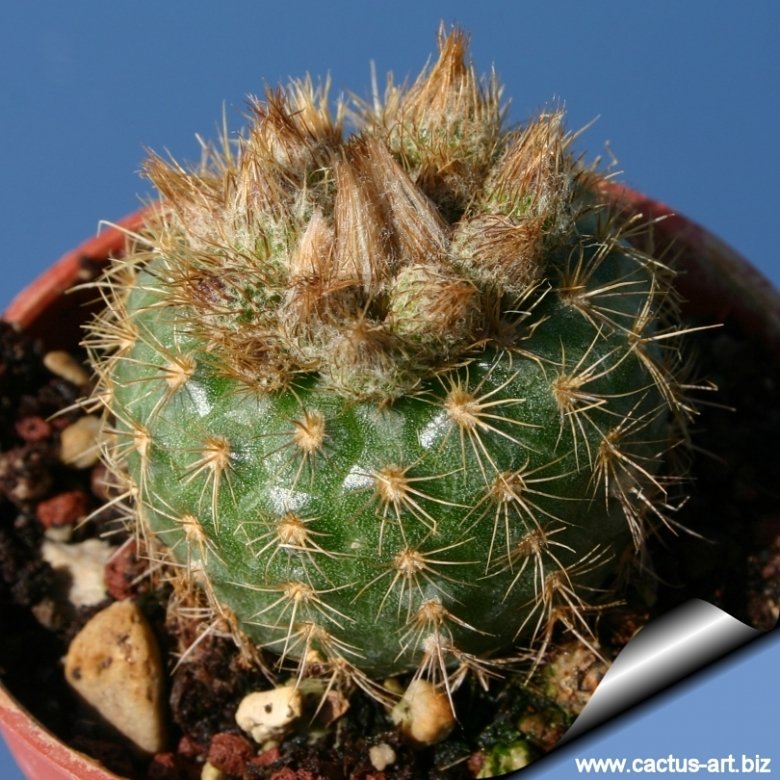
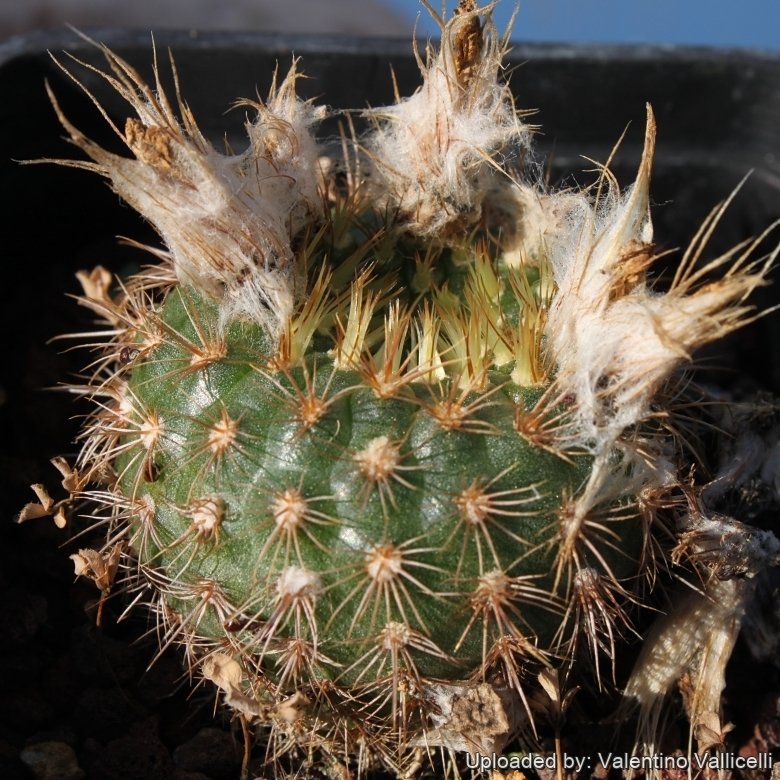
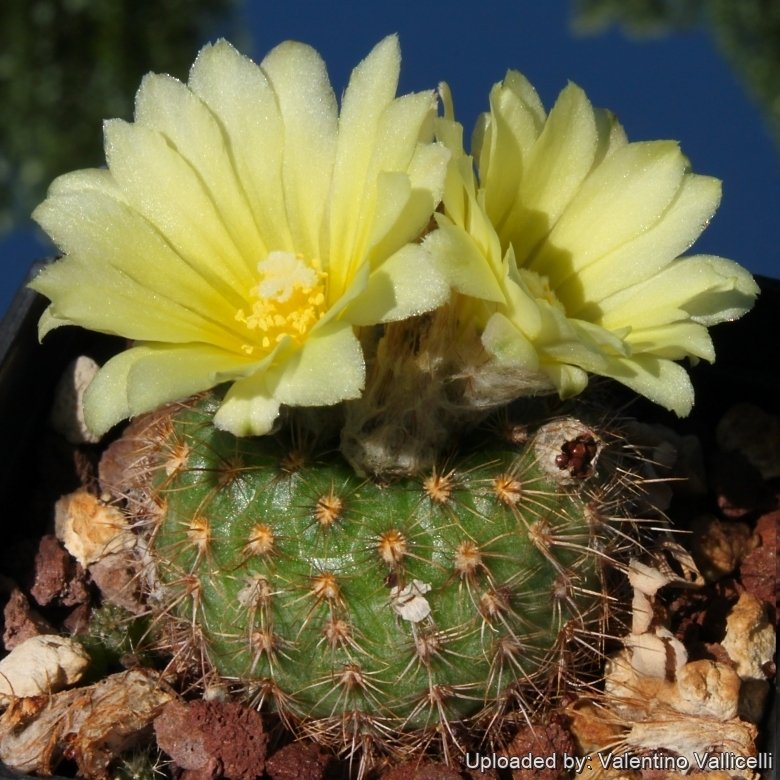
Stem: Typical F. pygmaea has a flattened, light green to dull green body, depressed at the crown, with a turbinate base, 1 to 3 cm in diameter. Some forms have distinctive dark crescent-shaped marks below the areoles.
Ribs: 13-21 ribs, quite flat divided by transverse depression into tiny tubercles (more noticeable when the body is dehydrated).
Areoles: At first with witish or slight yellow wool.
Spines: 6-10 quite fine, short, bristly, setaceous, glassy, white radial spines, 1-4 mm long, adpressed and rarely also one or two small central spines. They are straight or slightly curved. Some forms have longer white spines that are basally orange yellow in colour while other have yellow spines and wool.
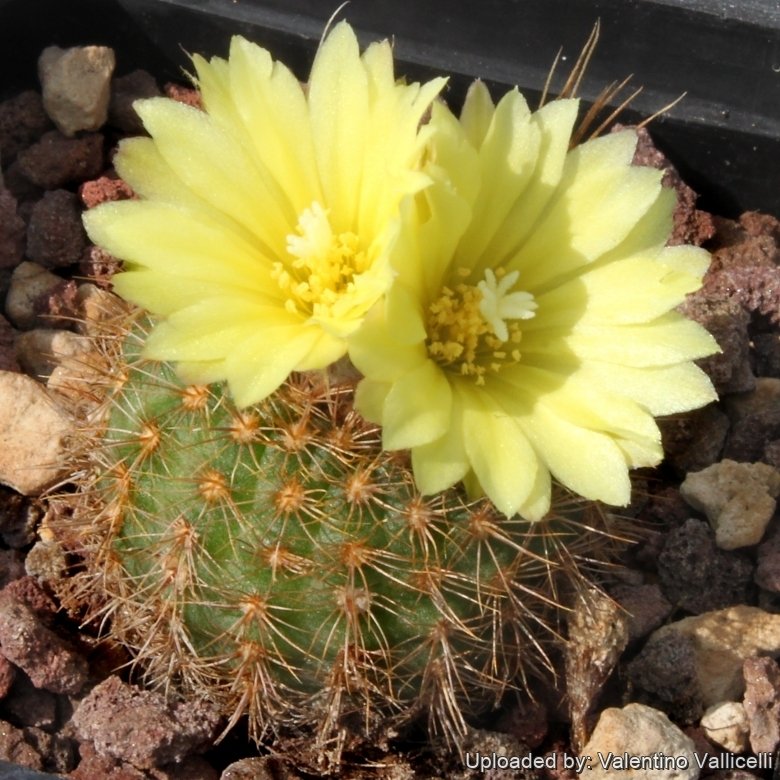
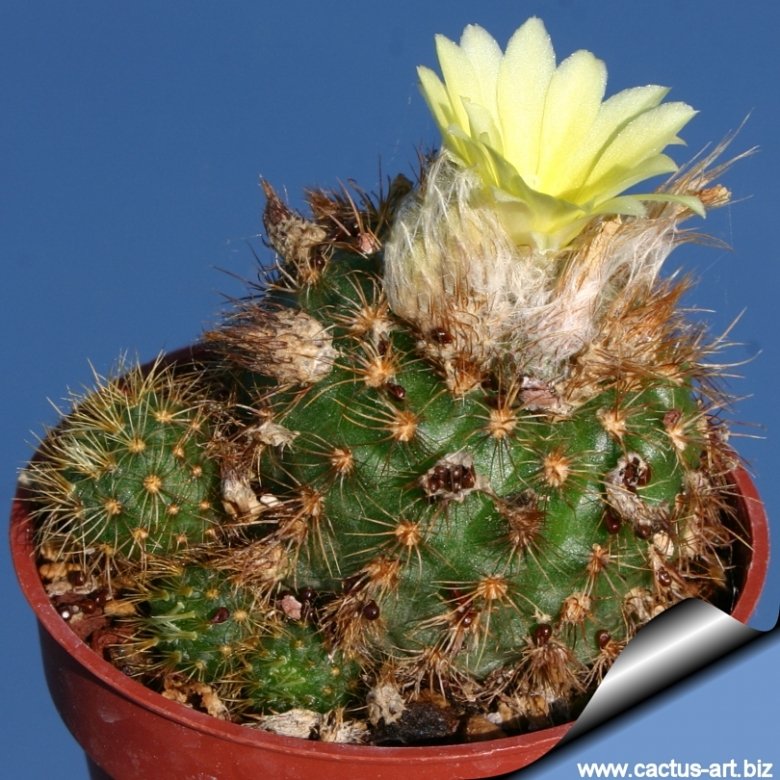
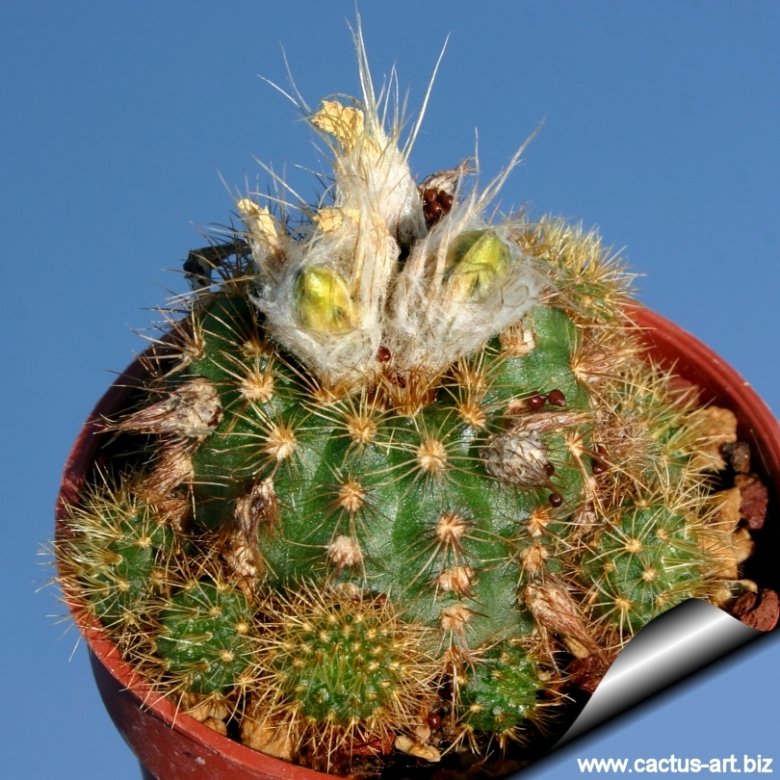
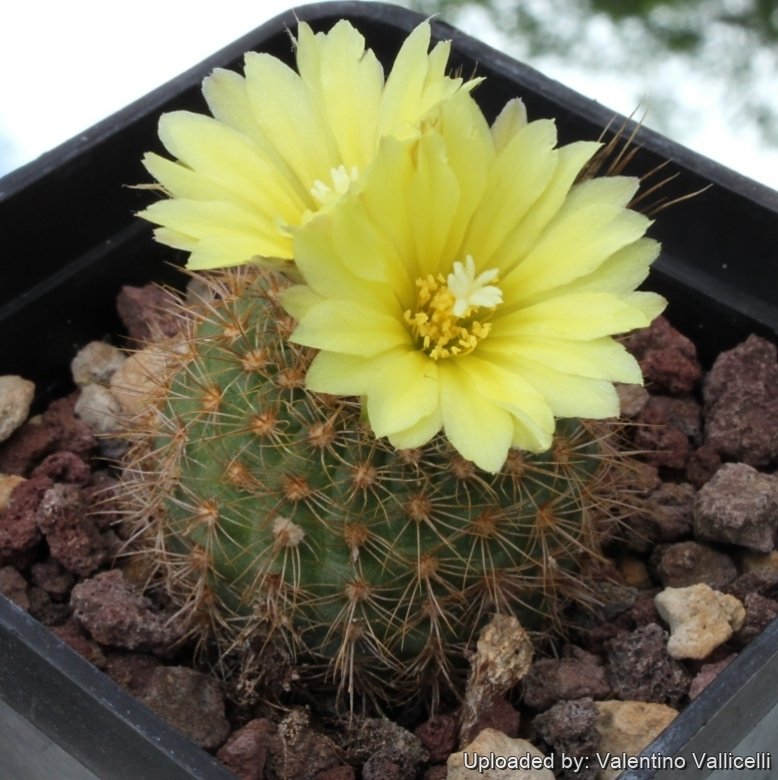
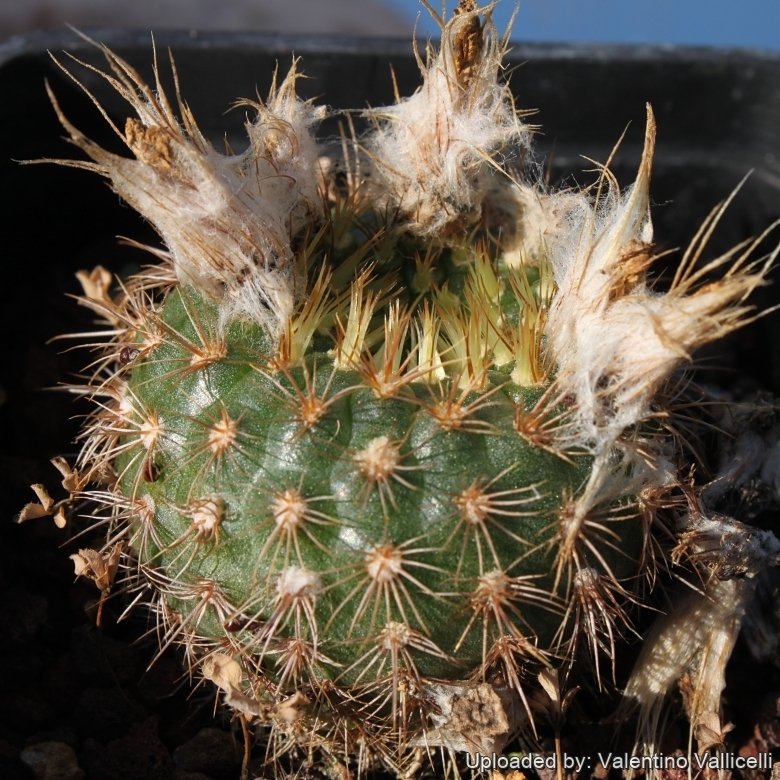
Flowers: Arising from the crown from a very woolly bud, often cleistogamous, 2 to 2.5 cm, up to 3 cm diameter, pale yellow, with dense, whitish to rose-colored pubescence outside. Inner perianth-segments lanceolate, acute, yellow; filaments and style white; stigma-lobes yellowish. But don’t be disappointed when the easily produced buds fail to open. Fraileas are cleistogamous meaning that their flowers produce seed without even opening. Without the need for pollination, hence the buds rarely reach full bloom and remain closed. They will open only in great heat in the hottest, brightest, afternoon sun, if at all.
Blooming season: Hottest part of summer.
Fruit: Dry indehiscent that detach easily, pear-shaped, 1,5 cm tall, 1 cm in diameter, with short matted hairs and with a pointed head of bristles. The fruit wall is thick, membranous, fragile and it opens by a basal pore to release the seeds that are promptly harvested by ants.
Seeds: Elm shaped, 2 mm long, shining, black with large oblong hilum nearly as long as the body.
Origin and Habitat
Frailea pygmaea is marginally distributed in Argentina (Entre Ríos) and Brazil (Rio Grande do Sul), and in all of Uruguay.
Altitude: This species occurs at elevations between 0 and 400 metres above sea level.
Habitat and Ecology: Frailea pygmaea usually grows in the crevices of rocky outcrops, between the pebbles near these outcrops or in grassy, gravelly areas where the thin soil depth minimizes any competition from other plants. It is sparsely distributed, but abundant in some areas where it is found. It grows on rocky outcrops and stony fields in pampa grasslands, a habitat that has a very high potential to be used for agriculture, often in association with other cacti like Notocactus ottonis, Notocactus scopa v. xicoi and Wigginsia sp. The major threats to this species are grazing and cattle trampling, agriculture, forestry of Eucalyptus, invasive grasses and fire.
Cultivation and Propagation
Frailea pygmaea is a summer grower species relatively easy to grow. Characteristically, during the dry season plants retract completely under the ground both in the wild and in cultivation too.
Growth rate: Fraileas are relatively short-lived plants, only lasting few years (rarely more than 10-15 years in cultivation) and, possible annuals in habitat! In fact they reseed readily around the base of the mother plant from self-set seed if kept reasonably moist during warm weather. It is a good idea to keep restarting them from seed; what looks like a healthy big plant may suddenly die of old age without warning.
Soil: Use mineral well permeable substratum with little organic matter (peat, humus), plants may become too elongated if compost is too rich.
Repotting: Re-pot every 2 years. Use pot with good drainage.
Fertilization: It grows much faster with a low nitrogen content fertilizer in spring and summer. Potassium helps maintaining the plants compact and healthy.
Watering: Requires careful watering to keep plant compact. Water sparingly from March till October, the thin, fibrous roots suffer if there is humidity, therefore the plant should be watered only when the surrounding terrain is dry. Keep dry as soon as the temperature starts dropping in October and keep it perfectly dry in winter at temperatures from 5 to 15 degrees centigrade.
Hardiness: They need a minimum temperature of 5-10° C (but occasionally temperatures of a few degrees below 0° are not dangerous if kept on the dry side prior to, and during, cold weather). It tends to rot in winter during the resting phase, if kept wet. In the rest period no high atmospheric humidity!!
Sun Exposure: Light shade to full sun, its colour tends to richer and darker when grown in light shade. In a shaded position the plants grow faster, but are not flat shaped and dark coloured.
Uses: It is an excellent plant for container growing. It always looks good and stays small.
Pests & diseases: It may be attractive to a variety of insects, but plants in good condition should be nearly pest-free, particularly if they are grown in a mineral potting-mix, with good exposure and ventilation. Nonetheless, there are several pests to watch for:
- Red spiders: Red spiders may be effectively rubbed up by watering the infested plants from above.
- Mealy bugs: Mealy bugs occasionally develop aerial into the new growth among the wool with disfiguring results, but the worst types develop underground on the roots and are invisible except by their effects.
- Scales: Scales are rarely a problem.
- Rot: Rot is only a minor problem with cacti if the plants are watered and “aired” correctly. If they are not, fungicides won’t help all that much. To prevent rottenness it is also advisable to surround its root neck by very rough sand or grit, this help a fast water drainage.
Propagation: With fresh harvested seeds or (rarely) by grafting. Fraileas set seed (when well grown) and grow easily from seed. In fact, they are reported to set seed even if the flower doesn’t open. This self-fertilization is called cleistogamy. Seedlings dislike strong light and dry conditions and need to be repotted frequently during the first few years. However, old plants become senile and have a tendency to succumb to disease and a weak root system. At this stage, as is well known, they die suddenly. So, after they reach about 4-5 cm in diameter grow them slowly, and adopt a new repotting period, using intervals of every 3-4 years. Additionally grow them under drier conditions or with stronger sunlight. But plants are sometine grafted to accelerate growth, but the grafted plants are typical rather tall growing, compared with plants on their own roots that are usually more flat to the ground.
Bibliography
Major references and further lectures
-
Edward Anderson “The Cactus family” Timber Press, Incorporated, 2001
-
James Cullen, Sabina G. Knees, H. Suzanne Cubey “The European Garden Flora Flowering Plants: A Manual for the Identification of Plants Cultivated in Europe, Both Out-of-Doors and Under Glass” Cambridge University Press, 11/Aug/2011
-
David R Hunt; Nigel P Taylor; Graham Charles; International Cactaceae Systematics Group. “The New Cactus Lexicon” dh books, 2006
-
Marlon C Machado. “Fascinating Frailea, Part 1: General impressions.” Cactus World (BCSS) Volume 25 No. 1 March 2007
-
Marlon C Machado.”Fascinating Frailea, Part 2: Review of the species from Rio Grande do Sul.” Cactus World (BCSS) Volume 25 No. 2 June 2007
-
Larocca, J., Machado, M. & Duarte, W. 2013. Frailea pygmaea. In: IUCN 2013. IUCN Red List of Threatened Species. Version 2013.2. <www.iucnredlist.org>. Downloaded on 15 February 2014.
From llifle page Astrophytum aureispinum
Description
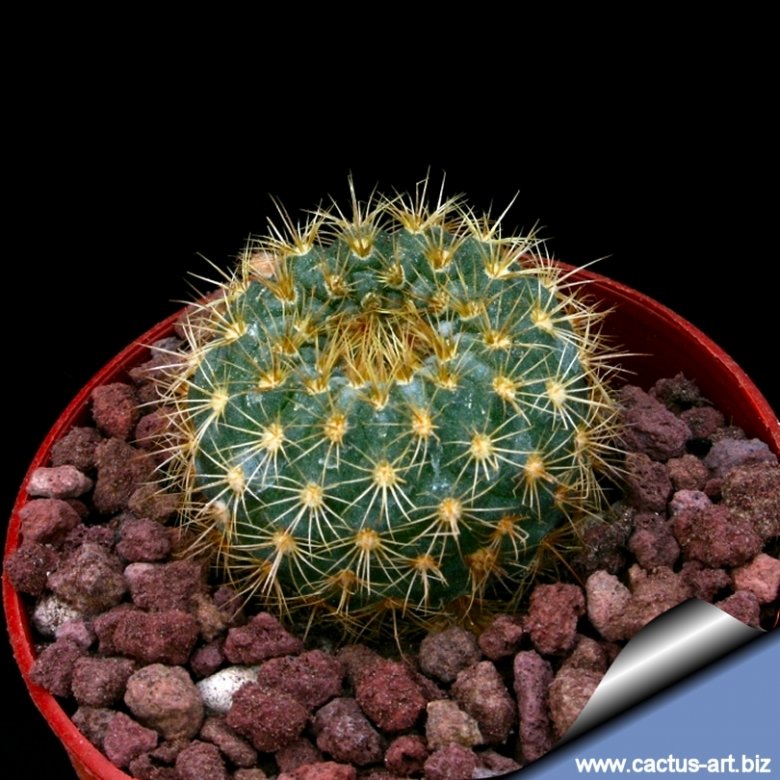
Frailea pygmaea subs. aureispina firstly described as Frailea aureispina by Friederic Ritter in 1970, is a very small cactus with shortly cylindrical stems covered by golden-yellow spines. It is usually included within (as a synonym of) Frailea pygmaea. However, this taxon is the one that least resembles Frailea pygmaea, the dark felted areoles are similar to the areoles of Frailea phaeodisca, and the yellow to orange spines are noticeably stronger than those normally found in F. pygmaea.
Note: In the area North of Quarai where Frailea aureispina grows, no other forms of F. pygmaea grow, but Frailea schilinzkyana (Frailea perumbilicata) is quite common. This latter species also has strong spines, which vary from yellow to dark brownish in colour, but other than in these characteristics it does not resemble F. aureispina. It is possible that F. aureispina is not related to F. pygmaea at all, its characteristics being the result of natural hybridization between F. phaeodisca and F. schilinzkyana (F. perumbilicata), both of both of which grow nearby. This is just a hypothesis, but clearly this is a plant that needs to be studied in more detail.
Stems: Cylindrical, bright green, 15-25 mm thick, 3-5 cm high, solitary.
Root: Napiform.
Ribs: 13-18, 0.5-1 mm tall, dissolved in round tubercles, only 0.5-1 mm high.
Areoles: On the tubercles, 0.8 mm long, 0,5 mm wide, with reddish-brown felt, later naked, 1-1,5 mm apart.
Spines: Pale to orange yellow with a reddish-brown base.
Radial spines: 10-13, 3-4 mm long, acicular, usually straight, all around the areole, spreading sideways or partly erected.
Central spines: Absent, or 1-2, protruding, not longer than radials, similar in colour or brownish.
Flowers: Apical, 4 cm long, and over 4 cm wide when fully open, pericarpel 7 mm long, 4 mm thick above, tapering below, tawny brown with small narrow reddish scales, dense grey wool, and reddish-brown fine bristles. Nectaries absent. Flowers tube 8 mm long, 10 mm wide above, pale yellow internally, externally yellowish-green covered as the ovary. Filaments pale yellow, red at base, set up to 2 mm below the upper edge of the tube. Anthers pale yellow. Stylus about 2 cm long, pale yellow, the lowest 2 mm united with the tube with c. 6 pale yellow stigma-lobes 6-7 mm long. Petals 22 mm long, 3-4 mm wide, greenish yellow.
Seeds: Cap-shaped, nearly black, shining, light, 1,5 mm long, 2 mm wide.
Origin and Habitat
North of Quarai, Rio Grade do Sul. Field number: FR 1386
Habitat and ecology: The cactus grows on rocky outcrops and stony fields in pampa grasslands. Frailea aureispina, grows together with Frailea castanea.
Source: Astrophytum aureispinum, LLIFLE - Encyclopedia of living forms, CC-BY-SA, retrieved 2026-10-25.
From llifle page Astrophytum dadakii
Description
Frailea pygmaea as the name implies (“pygmaeus” meaning dwarf), is a very small cactus that lives half buried in the ground. Most of the plants in habitat are single headed unless they are damaged.
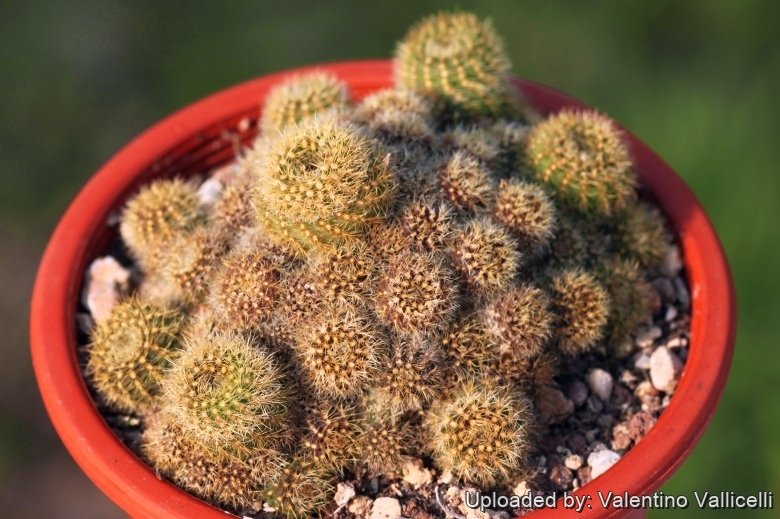
The “dadakii” form is globular, depressed on top, with about 12 ribs. It branches profusely from the base forming soon dense clumps. The spines are all radial, usually 8, brownish passing to white, curved backwards and twisted.
Root: Long tuberose, inversely conical 2-3 cm wide.
Stem: Typical F. pygmaea has a flattened, light green to dull green body, depressed at the crown, with a turbinate base, 1 to 3 cm in diameter. Some forms have distinctive dark crescent-shaped marks below the areoles.
Ribs: 13-21 ribs, quite flat divided by transverse depression into tiny tubercles (more noticeable when the body is dehydrated).
Areoles: At first with witish or slight yellow wool.
Spines: 6 -10 quite fine, short, bristly, setaceous, glassy, white radial spines, 1- 4 mm long, adpressed and rarely also one or two small central spines. They are straight or slightly curved. Some forms have longer white spines that are basally orange yellow in colour while other have yellow spines and wool.
Flowers: Arising from the crown from a very woolly bud, often cleistogamous, 2 to 2.5 cm, up to 3 cm diameter, pale yellow, with dense, whitish to rose-colored pubescence outside. Inner perianth-segments lanceolate, acute, yellow; filaments and style white; stigma-lobes yellowish. But don’t be disappointed when the easily produced buds fail to open. Fraileas are cleistogamous meaning that their flowers produce seed without even opening. Without the need for pollination, hence the buds rarely reach full bloom and remain closed. They will open only in great heat in the hottest, brightest, afternoon sun, if at all.
Blooming season: Hottest part of summer.
Fruit: Dry indehiscent that detach easily, pear-shaped, 1,5 cm tall, 1 cm in diameter, with short matted hairs and with a pointed head of bristles. The fruit wall is thick, membranous, fragile and it opens by a basal pore to release the seeds that are promptly harvested by ants.
Seeds: Elm shaped, 2 mm. long, shining, black with large oblong hilum nearly as long as the body.
Origin and Habitat
Widespread over a wide area in Brazil, Uruguay and Argentina.
Habitat & ecology: Grows often in mountainous region in scattered but numerous populations, and it is often quite common. Usually it is found in the crevices of rocky outcrops, between the pebbles near these outcrops or in grassy, gravelly areas where the thin soil depth minimizes any competition from other plants. It is often found growing together with Frailea gracillima and Frailea castanea. The rain fall are quite frequent and often abundant.
Cultivation and Propagation
Grow them in rich, porous soil and let them dry out between waterings. These plants need a minimum temperature of 5-10° C (but occasionally temperatures of a few degrees below 0° are not dangerous)
Sun Exposure: They enjoy full sun but in a shaded position the plants grow faster, but are not flat shaped.
Characteristically, during the dry season plants retract completely under the ground both in the wild and in cultivation too. This plant is short living (It does not live long - about 10-15 years).
Propagation: With fresh harvested seeds.
Notes
Frailea pygmaea has a wide distribution and is very variable with some forms having heads no wider than one or two centimetres. In accordance with the variability of the species, many names have been created for different forms, some of them correctly published but the majority invalidly and nowadays considered as synonyms.
Source: Astrophytum dadakii, LLIFLE - Encyclopedia of living forms, CC-BY-SA, retrieved 2026-10-25.
Cultivars and forms (6)
Gallery