Description
The typical Gymnocalycium anisitsii subs. damsii, (best know as Gymnocalycium damsii), is a plump species with somewhat rounded ribs. It is a very free-flowering cactus and may be solitary or freely offsetting.
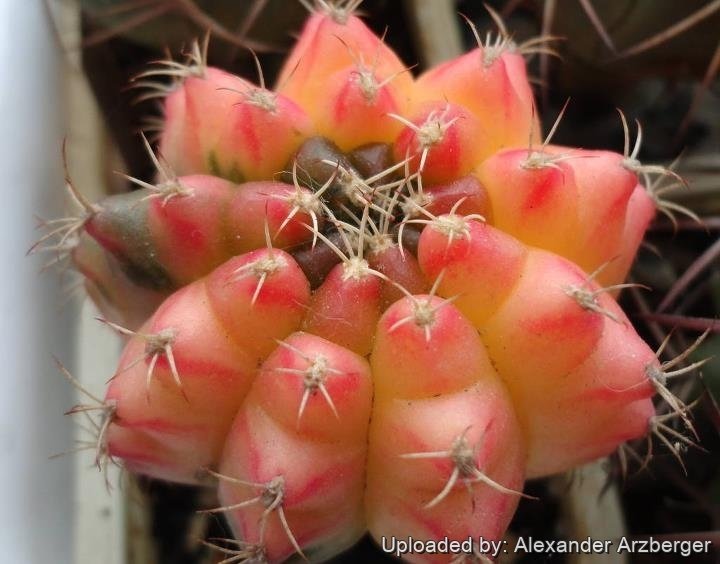
Variegated form: Variegated Gymnocalycium anisitsii subs. damsii are cultivated for their beautiful stem that have sectors, patches or stripes of different colours, yellow, pink, red, purple and green. There are several forms of variegation. The extent and nature of the variegation can vary, and sometimes the plant will return to the green form. In others it is stable and does not change under normal conditions. Flowers are produced only on the crown of mature specimens. Variegated specimens are sometime grafted on stronger species, called the stock, that can be any number of different columnar cactus.
Origin and Habitat
Garden origin. The natural species comes from Bolivia, Paraguay and Brazil.
Cultivation and Propagation
Gymnocalyciums are very gratifying plants, their culture is easy and their flowering is abundant if we give them a well drained relatively rich substrate (if possible not limestone). Water regularly in summer (but do not overwater ) keep rather dry in winter, need frequent repottings and a very luminous exposure but avoid direct exposure to the sun rays. This species is particularly easy and accommodating, seldom suffer of cryptogamic diseases. Feed with a high potassium fertilizer in summer. Hardy as low as -5° C (or less) if kept dry.
Special cares for variegated forms: In the summer it is best to avoid direct sun during the hottest hours of the day (but they benefits from morning sun, that helps to produce strong and colourful spines). In case of cultivation in a sunny place it is best to plant with the variegated spot facing north-east, so it gets the least amount of direct sunlight as possible.
Propagation: Usually by Seeds (Seeds should be sown in a well-drained soil mix. Surface sowing is the best; seeds germinate in 14-28 days at 25° C, or from cuttings in spring (let them dry till the ends callous well). Then replant them in fresh cactus soil that is ever so slightly moist, and keep it that way till they root). The grafting is useless (excluded the cultivars completely deprived of chlorophyll), it does not bring anything concrete
Gallery