Publication: Succulenta (Netherlands) 74(3): 131 (1995)
Description
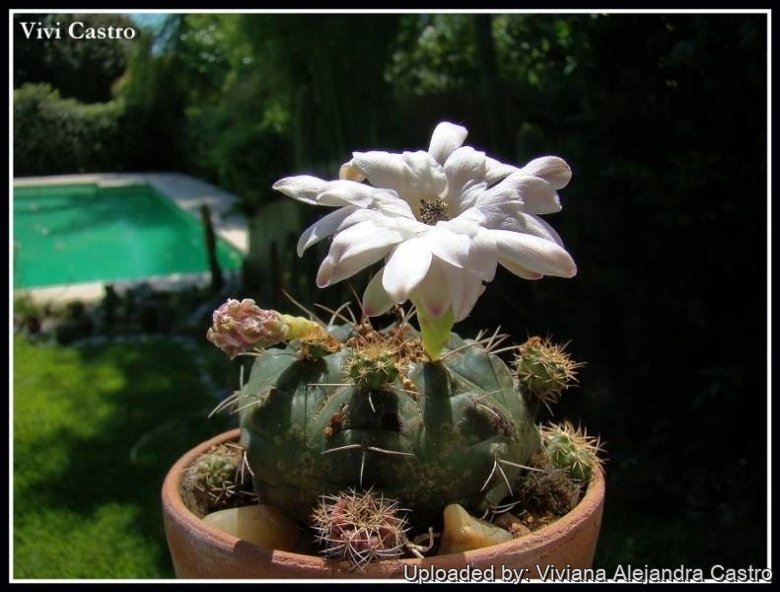
Gymnocalycium anisitsii subs. multiproliferum (Gymnocalycium damsii var. multiproliferum) is one of the morphological or geographical form of the widespread and pretty variable Gymnocalycium anisitsii. This particular form distinguishes for its neat appearance and heavily branched habit, it produces pups like mad! A single stems produces dozen of small offshoots, almost one from each areolae. These offshoots come off at the minimal touch, and take root nearby readily forming dense colonies. Due to its ease of propagation it is becoming common in cultivation.
Stems: In cultivation the stems grows up to 10 cm tall, 8-10 cm in diameter (but usually they are much smaller in habitat) olive green to bronze and highly decorative. It produces small offshoots, almost one from each arele.
Tubercles: Rounder and scarcely raised.
Spines: Nearly useless in terms of defence.
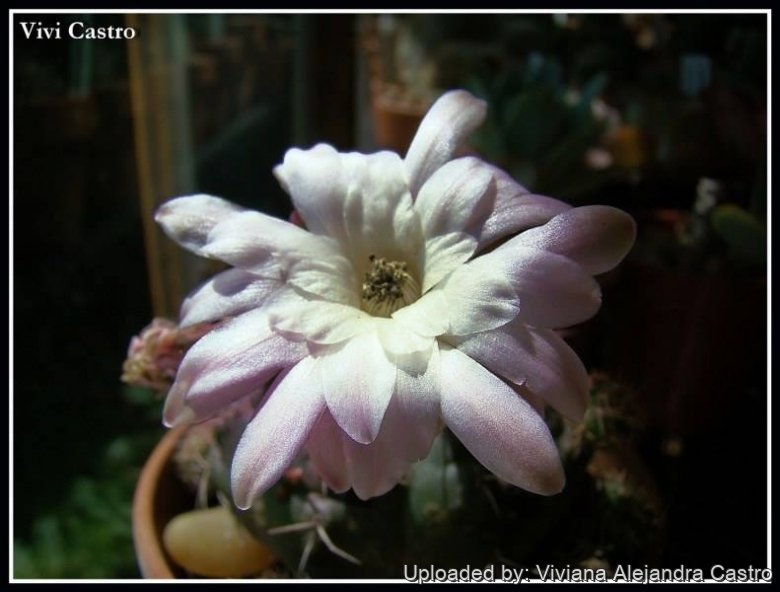
Flowers: From the centre, funnel form, white to pale pink, up to 6 cm long. External tepals greenish whit reddish margins, internal tepals white to light pinkish. Tube thin.
Blooming season: It produces flowers almost continuously during the year.
Fruits: Oblong, reddish at maturity.
Origin and Habitat
Gymnocalycium anisitsii subs. multiproliferum grows in the southern Brazil.
Habitat and ecology: This species grows in a loamy soil, under scrubs and small trees, mostly in a light shadow. In times of drought often the plants retracts and appear almost completely buried in the ground. The population seems very healthy and the plants are very numerous. In the same area it is possible to find a rich variety of cacti comprising: Stetsonia coryne, Monvillea sp., Cleistocactus baumannii, Opuntia sp., Echinopsis sp. and Frailea melitae.
Cultivation and Propagation
Gymnocalycium anisitsii subs. multiproliferum is a summer grower species that offers no cultivation difficulties. Water regularly in summer (but do not overwater ) Keep this plant almost dry in winter at a minimum temperature of 0°C, prefer relatively rich substrate and low pH compost (if possible not limestone) otherwise growth will stop altogether. Feed with a high potassium fertilizer in summer. It is quite frost resistant if kept dry (hardy to -5° C) This plant needs plenty of space for its roots, repotting should be done every other year or when the it has outgrown its pot. This species is particularly easy and accommodating, seldom suffer of cryptogamic diseases.
Sun Exposure: Light shade. It may tolerate bright situations but is likely to suffer from sun scorch or stunted growth if over exposed to direct sunlight during the hottest part of the day in summer.
Propagation: Seeds cuttings.
Bibliography
Major references and further lectures
-
Edward Anderson “The Cactus family” Timber Press, Incorporated, 2001
-
James Cullen, Sabina G. Knees, H. Suzanne Cubey “The European Garden Flora Flowering Plants: A Manual for the Identification of Plants Cultivated in Europe, Both Out-of-Doors and Under Glass” Cambridge University Press, 11/Aug/2011
-
David R Hunt; Nigel P Taylor; Graham Charles; International Cactaceae Systematics Group. “The New Cactus Lexicon” dh books, 2006
-
N. L. Britton, J. N. Rose “The Cactaceae. Descriptions and Illustrations of Plants of the Cactus Family.” Volume 4, The Carnegie Institution of Washington, Washington 1923
-
Curt Backeberg “Die Cactaceae: Handbuch der Kakteenkunde” Gustav Fischer Verlag, Stuttgart New York 1982–1985
-
Pin, A. & Oakley, L. 2013. Gymnocalycium anisitsii. In: IUCN 2013. IUCN Red List of Threatened Species. Version 2013.2. <www.iucnredlist.org>. Downloaded on 17 January 2014.
-
E. W Putnam “GYMNOCALYCIUMS: A Guide for Growers” National Cactus & Succulent Society. Handbook No. 5. 1978