Publication: Gymnocalycium 6(3): 102 (1993)
Description
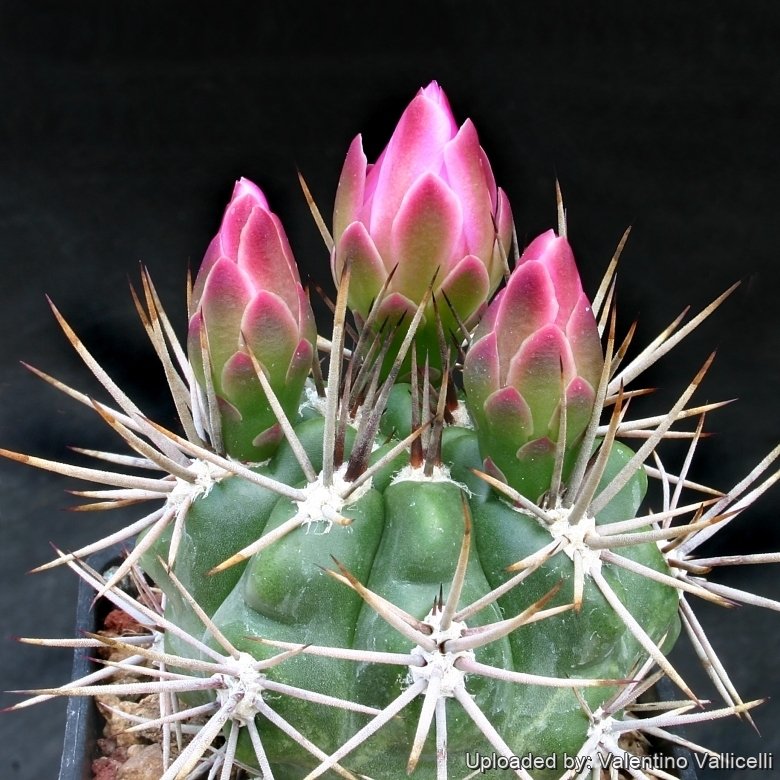
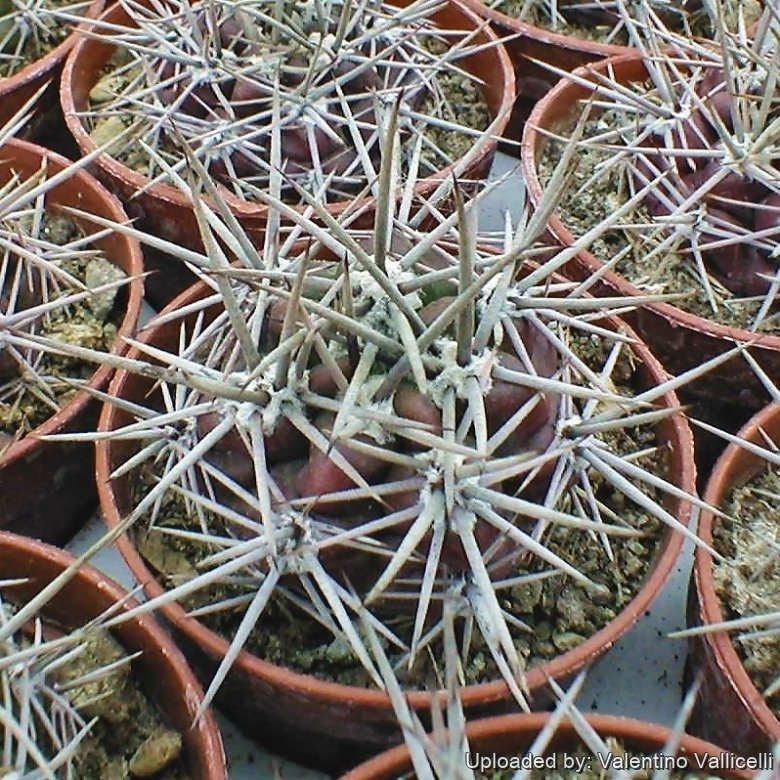
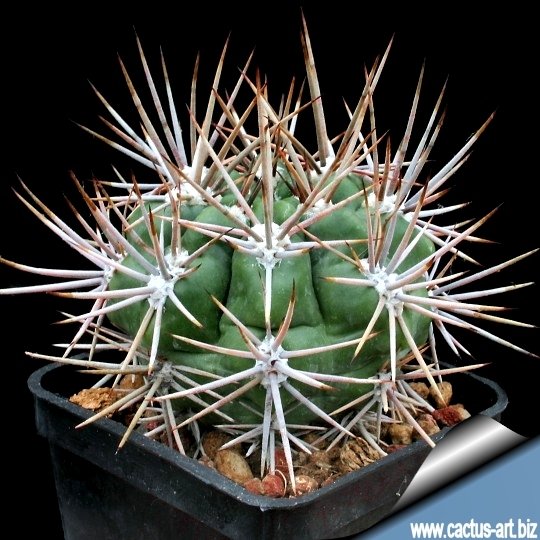
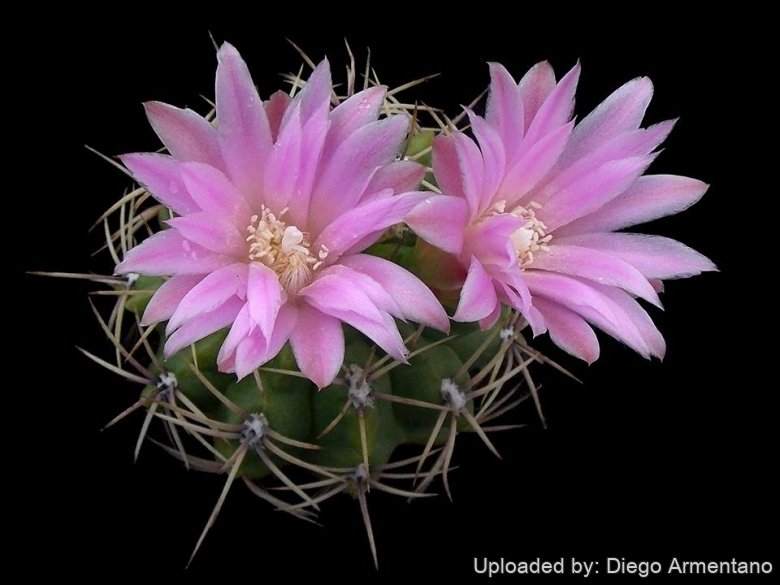
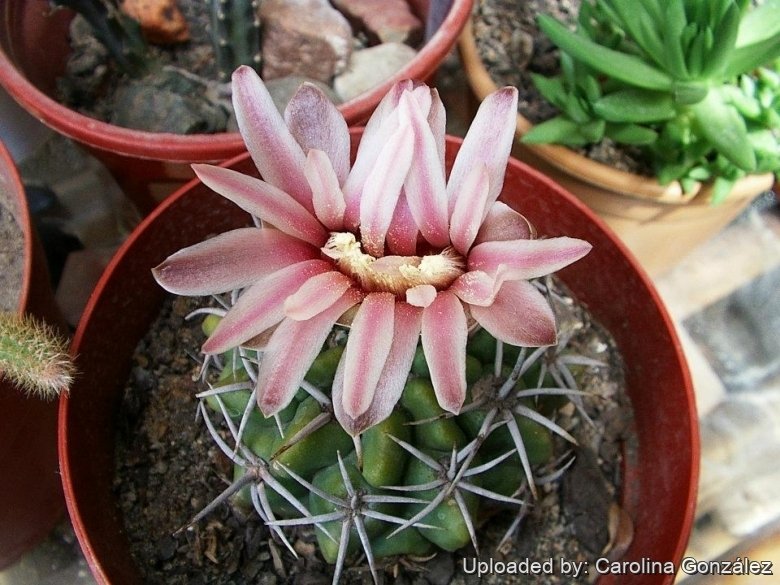
Gymnocalycium monvillei subs. horridispinum, best known in cultivation as G. horridispinum, is a very distinctive (usually) solitary geophytic cactus. It is recognisable at a glance, due to its strong, outstanding spine formation, and is among the few gymnocalycium species which can be fairly reliably identified from their general appearance, without recourse to flower-dissection seed studies or other methods. The spines are metallic grey with brownish tips, stout, strong and sharp. While most gymnocalycium species have flattened to almost spherical stems Gymnocalycium monvillei subs. horridispinum develops in age a somewhat columnar stem. The flower can be white with violet-pink edging to the petals, purple-pink or most often wholly pink. It is related to Gymnocalycium multiflorum.
Stem: Usually solitary, globular to cylindrical (the plants tending to grow columnar even when young), upright, 8-18 cm in diameter, 15-40 cm high. Apex depressed, little or not woolly, but strongly spined. Epidermis shiny dark green, grey-green or olive green.
Ribs: 10-15 deep, acute, broad, with pronounced conical ‘chins’ below the areoles.
Areoles: Ovate, 8-10 × 5-6 mm, yellowish white becoming pale grey in colour, with fine wool.
Spines: Stout, strong, sharp and impressive, spreading to erect. Young spines blackish brown more reddish at the base with brown to gray tips. (Reddish brown wet). Later metallic grey with brownish tips.
Radial spines: 9-12 (usually less in young plants) spreading, straight or slightly curved 2-3 (or more) cm long.
Central spines: 1 to 4, somewhat thicker and longer, the same color as the radial, erected or outward-pointing, 3-4(-5) cm long, straight or very slightly curved.
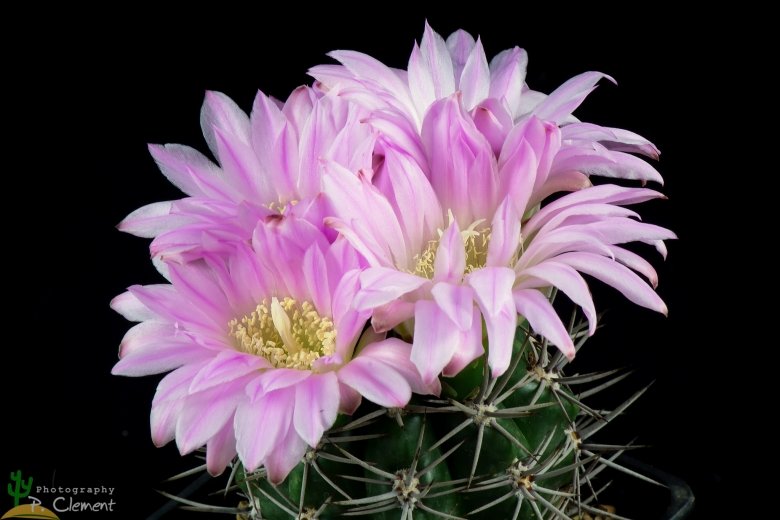
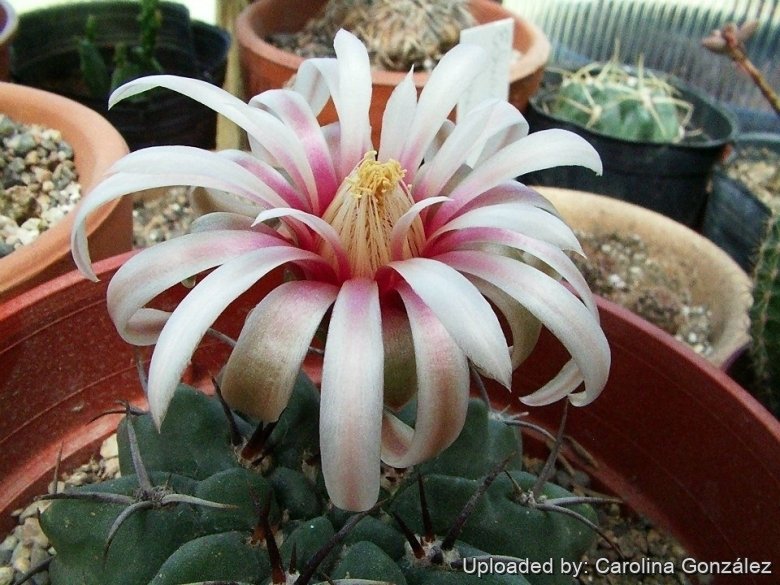
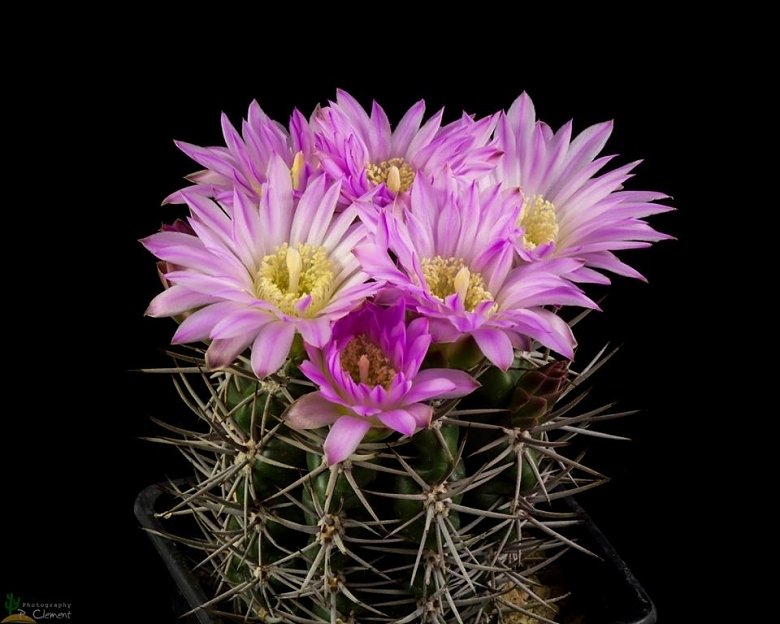
Flowers: Very showy, around the apex, funnel-shaped, they are some of the largest in this genus 6-7 cm long and wide, often growing larger than the plant, bright pink, occasionally, white with violet-pink edging to the petals or dark purple-pink. Pericarpel green with elongated red tipped scales scales gradually shifting to external tepals that are pink-purple with a greenish median strip. Internal tepals silky white or (usually) pinkish-lilac to pink with a pale pink throat. The flowers darken more or less after a day or two and take a purple tone. Filaments white; anthers bright yellow. Style white, stigma-lobes 8-10 lobes white.
Fruit: Ovoid, 15 × 20 mm, dark green, slightly reddish when ripe.
Seeds: Microsemineum type, 0.5 × 1 mm; testa black, finely warty; hilum elongate oblique.
Origin and Habitat
Gymnocalycium monvillei subs. horridispinum comes from Salcasate in the Cordoba province of Argentina and was first described by Gerhart Frank in 1963. It is also found between taninga and Chepes. It seems rare.
Altitude range: 700 - 1200 metres above sea level.
Cultivation and Propagation
It is a summer-growing species very easy to grow, these plants offer no cultivation difficulties. Needs moderate to copious in summer (but do not over-water), keep rather dry in winter.
Hardy as low as -5° C (or less) if kept dry. Feed with a high potassium fertilizer in summer. Needs light shade.
Propagation: Seeds (seldom produces offsets)
Bibliography
Major references and further lectures
-
E. W Putnam “Gymnocalyciums: Handbook No. 5.” National Cactus And Succulent Society, Smart & Co. (Printers) Ltd., Brackley, Northants. 1978
-
J.G. Lambert ”Cactus d’Argentine” 2ème édition Revue et complétée 1997
-
Cactus and Succulent Journal of Great Britain, Volumi 41-43 Cactus and Succulent Society of Great Britain, 1979
-
Edward F. Anderson “The Cactus Family” Timber Press, 2001
-
James Cullen, Sabina G. Knees, H. Suzanne Cubey “The European Garden Flora Flowering Plants: A Manual for the Identification of Plants Cultivated in Europe, Both Out-of-Doors and Under Glass” Cambridge University Press, 11/Aug./2011
-
David Hunt, Nigel Taylor “The New Cactus Lexicon” DH Books, 2006
Gallery