Publication: Repert. Spec. Nov. Regni Veg. Sonderbeih. C 24, taf. 94. 1935 Werd. Bluhende Kakt. & suk. Pflanzen
Description
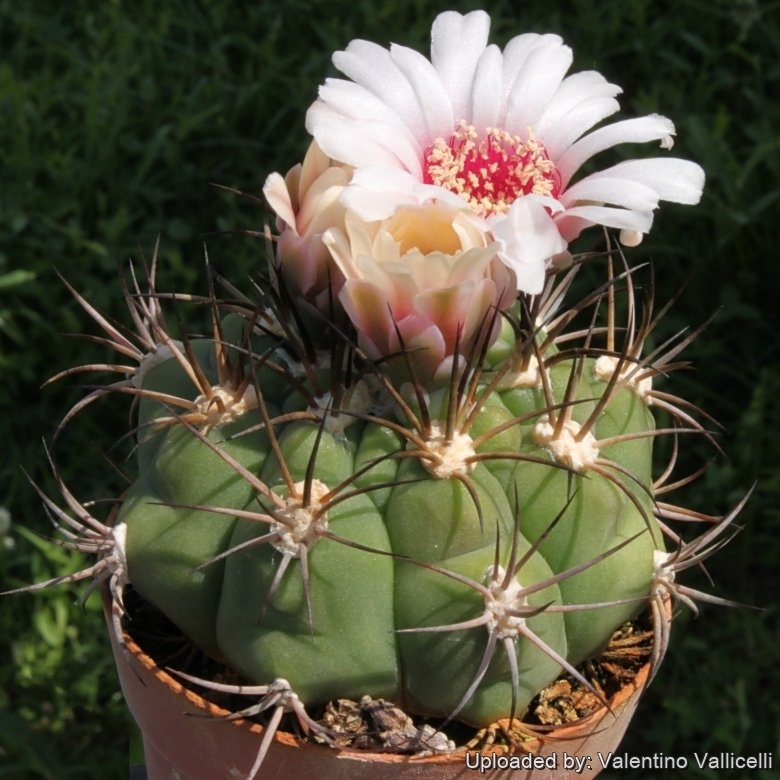
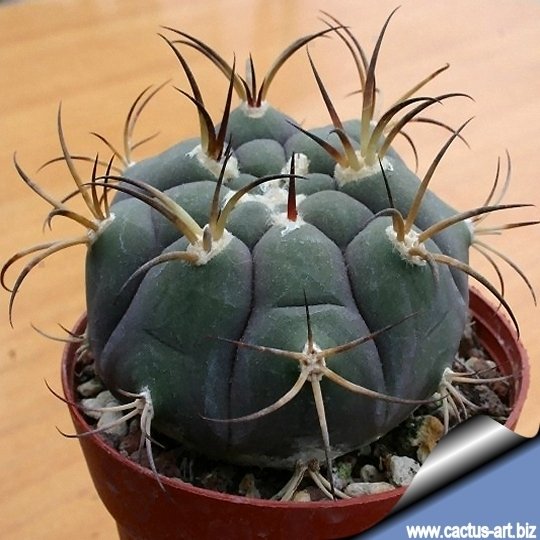
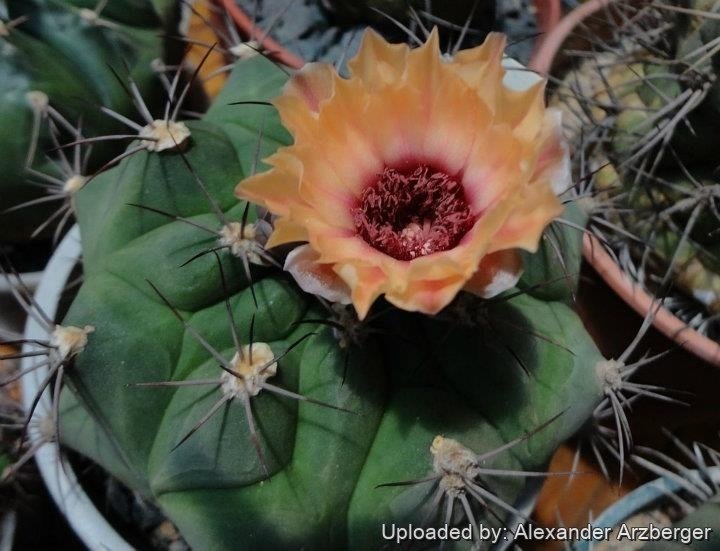
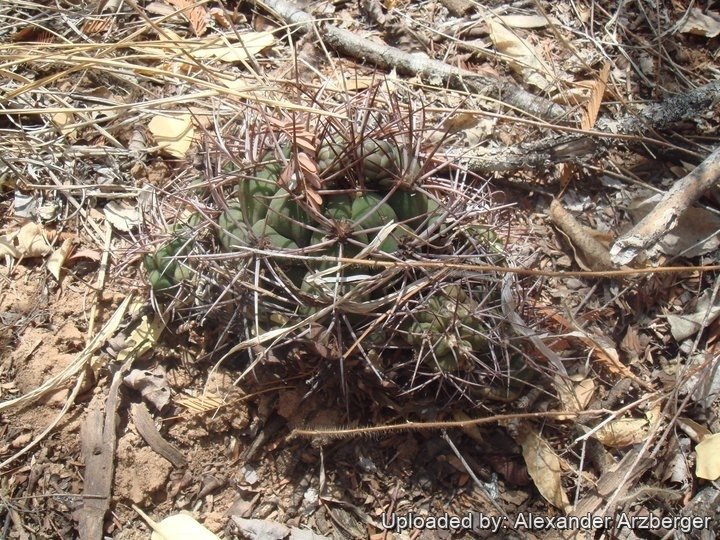
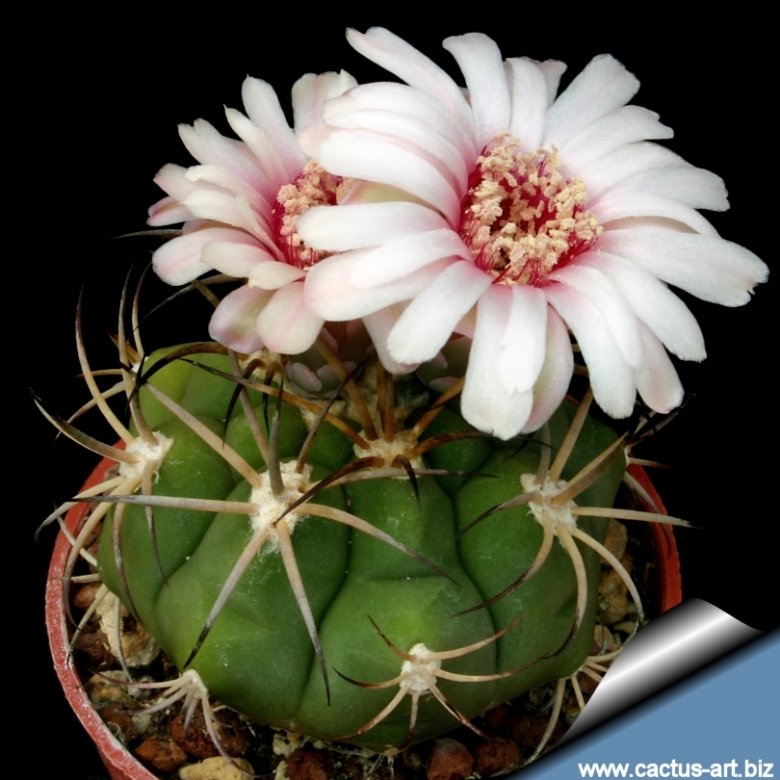
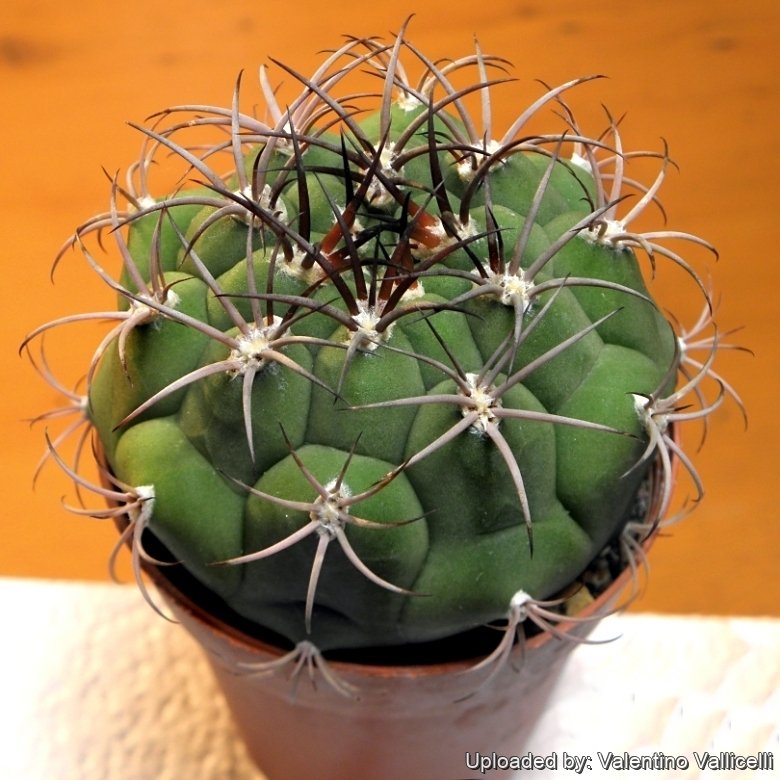
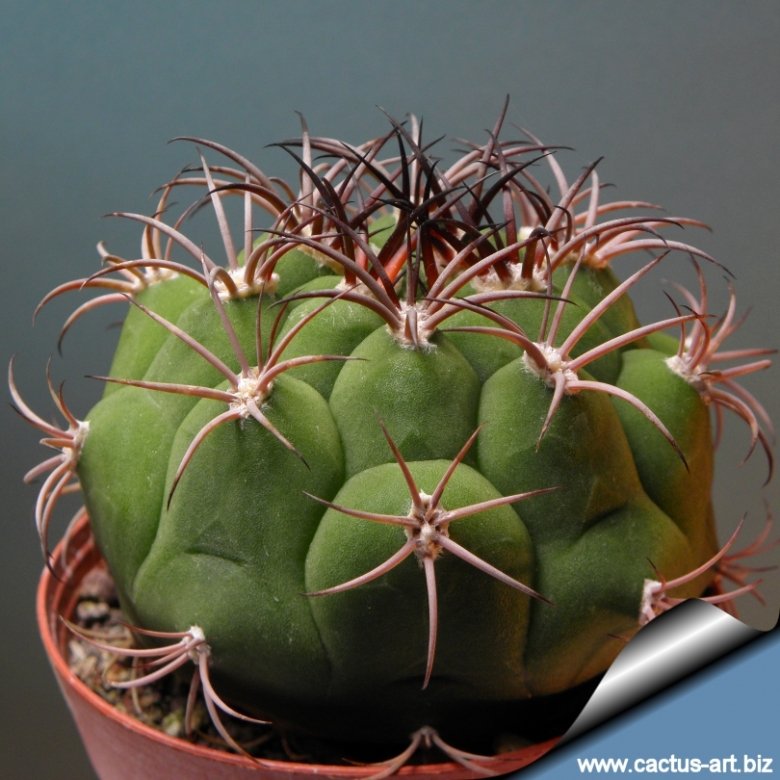
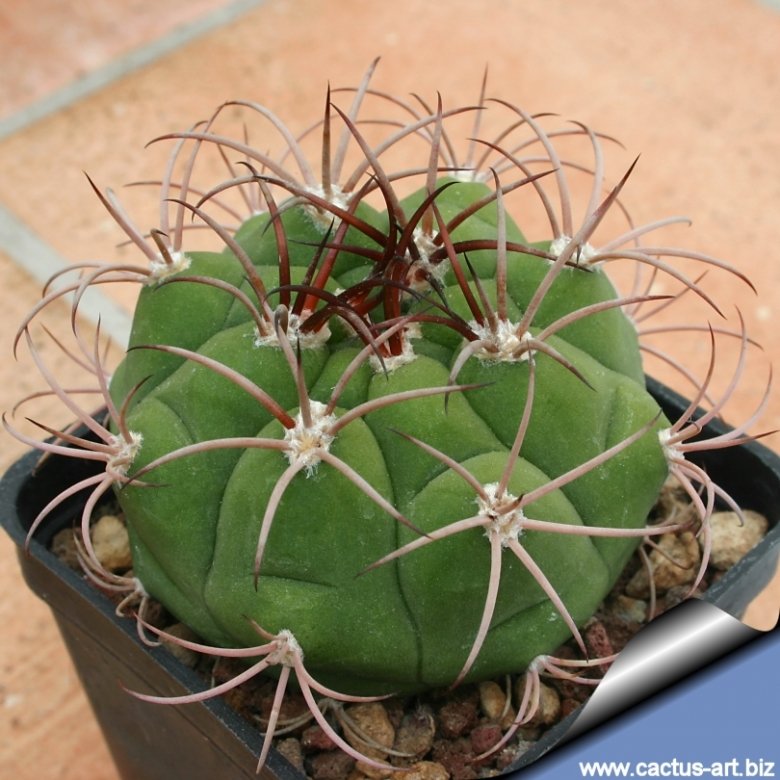
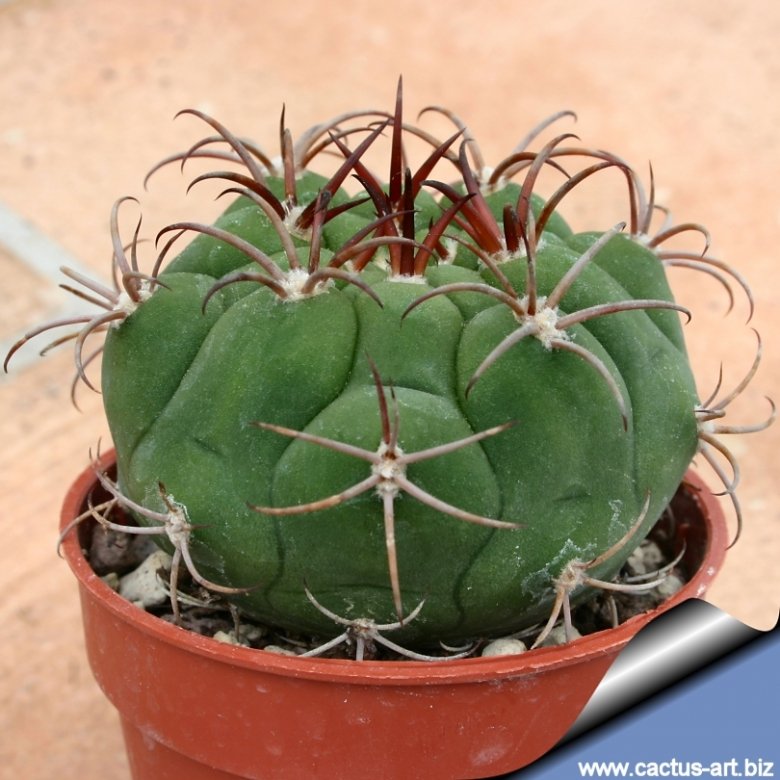
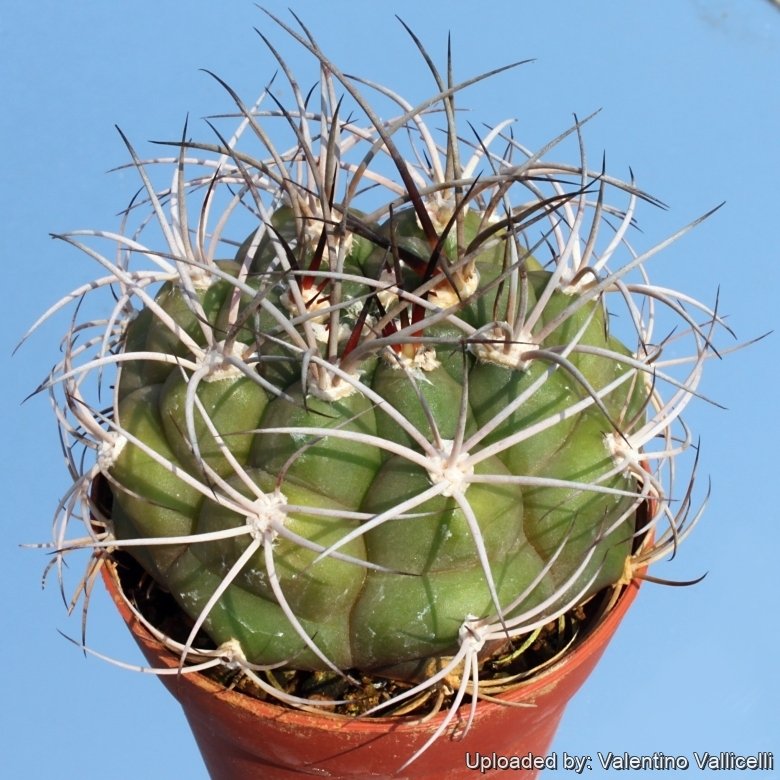
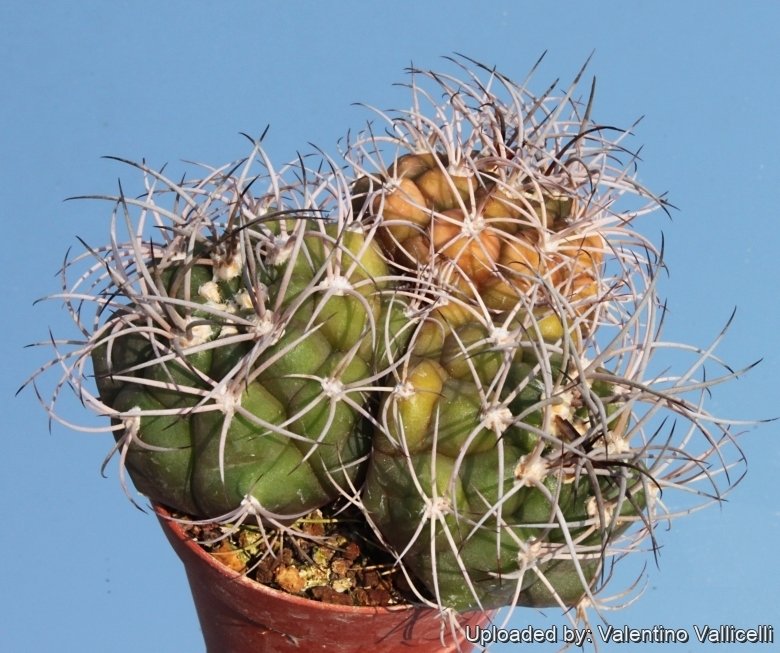
Gymnocalycium pflanzii is a solitary or slowly clustering cactus, with peculiar spine clusters characteristically bent backward in a distinctive fashion.
Stem: Flattened-globose, 10-15 (25) cm in diameter, 10cm tall pale green, to olive green that can tinge of orangish purple in full sun. The epidermis has a velvety appearance. The apex is slightly depressed and woolly.
Ribs: 10 to 12 thick, large, divided into polygonal rounded (not chinned) tubercles, separated by arched furrows.
Roots: Fibrous
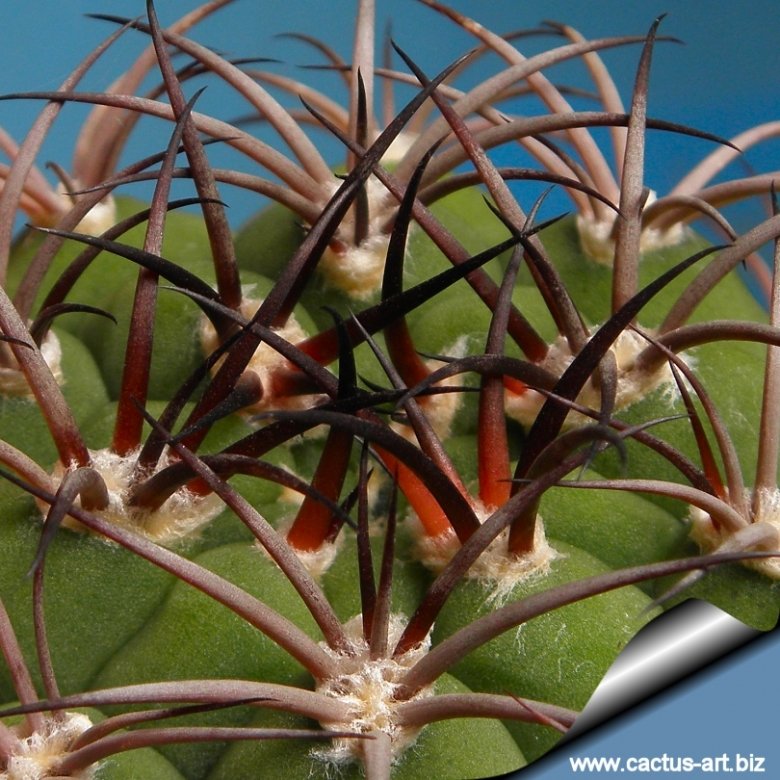
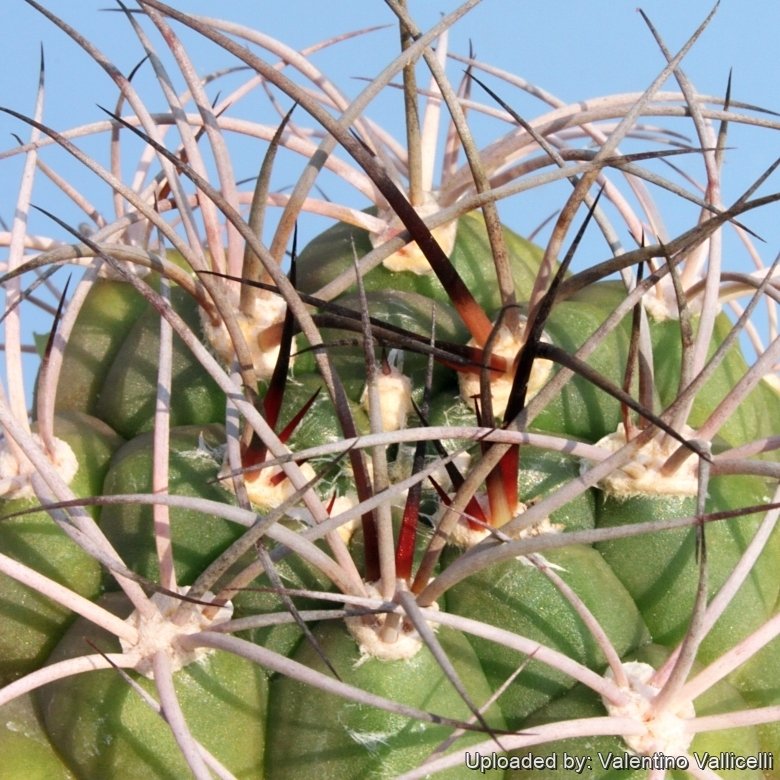
Areoles: Large long, oval 10 by 14 mm broad, with cream-yellowish wool, then blackish dismantling with time.
Spines: Strong, very stiff, bent backward, initially blackish with a brown base then becoming grey-pinkish to whitish brown with black point.
Radial spines: (5-)7-9 up to 25 mm long
Central spines:One (or two) of the same length.
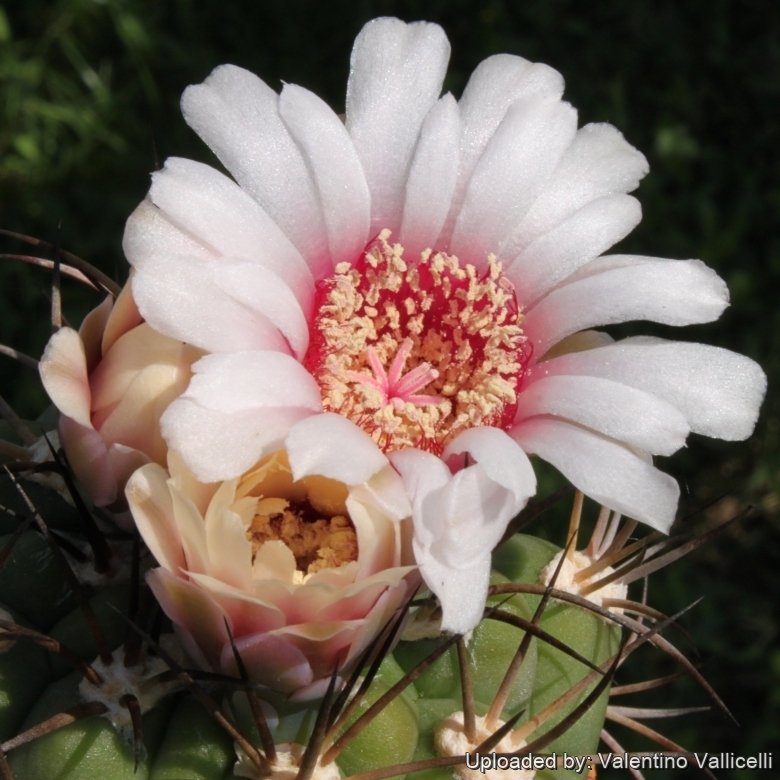
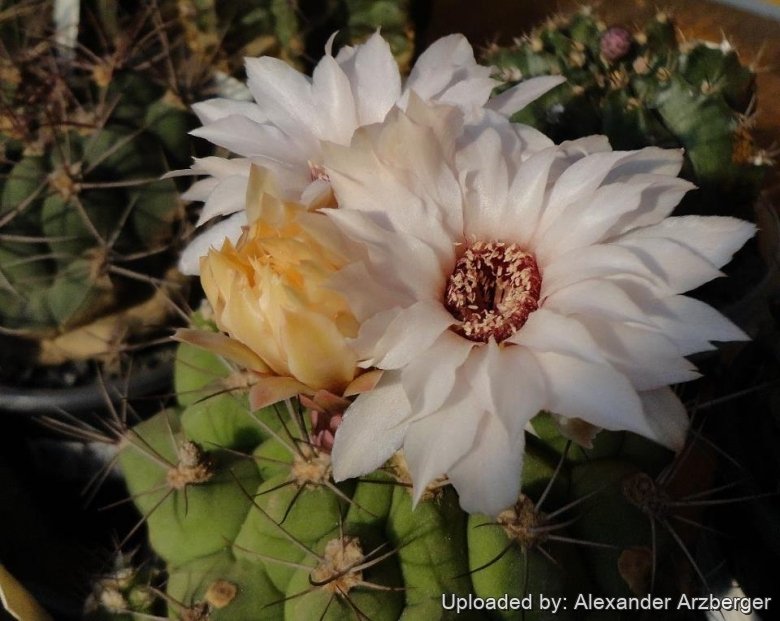
Flowers: Infundibuliform near the apex, diameter and height 45-50 mm. Pericarpell dull green very short. External tepals spatulate, slightly bent outward , white with brownish green midrib. Inner tepals intern narrower, spatulate and slightly denticulate, white with carmine/pink purplish throat. Style carmine with carmine pink 10-12 lobes. Pollen yellow.
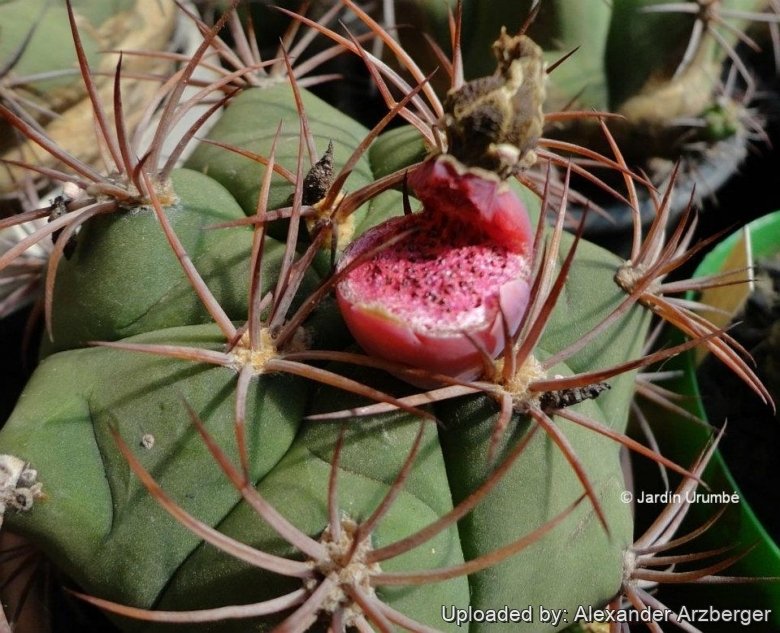
Fruits: Globose of approximately 2 cm of diameter, becoming red carmine with maturity. Pulp intense cherry-red.
Seeds: Microsemineum type, section pirisemineum, very small (0,6 X 0,4 mm), testa reddish shining and smooth.
Remarks: It is a very variable species with a wide distribution and several controversial varieties, forms and subspecies has been described. Of them only three or four has been recognized: subsp. argentinense H.Till & W.Till from Gonzales, Salta, Argentina, subsp. zegarrae (Cárdenas) G.J.Charles and subsp. dorisie coming from Tarija, Bolivia.
Origin and Habitat
South-east of Bolivia(Cochabamba, Chuquisaca, Potosí, Santa Cruz and Tarija), North-West of Paraguay (Alto Paraguay and Boquerón) and North of Argentina (Provinces of Salta, Jujuy and Tucumán)
Altitude: It can be found at elevations of 500 to 2,500 metres above sea level.
Habitat: Grows often semi-buried in in deep rich sandy soil, rather in sunny rocky areas, on slopes or under spiny shrubs in the sotobosque, at the border and clearings of the dry Chaco forest. Gymnocalycium pflanzii has a wide range, is abundant and the threats that affect part of its range are minor. Subsistence farming, agriculture and goat grazing are minor threats to the species in parts of its wide range.
Cultivation and Propagation
Gymnocalycium are very gratifying plants, their culture is easy and their flowering is abundant if we give them a well drained relatively rich substrate (if possible not limestone).
Growth rate: It is a relatively rapidly growing and easily flowering species.
Soils: It likes very porous standard cactus mix soil. Prefer a low pH compost, avoid substrata rich in limestone; otherwise growth will stop altogether.
Repotting: This plant needs plenty of space for its roots, repotting should be done every other year or when the it has outgrown its pot. Use pot with good drainage.
Watering: Needs moderate to copious waterings in summer, but do not overwater (Rot prone), keep dry in winter at a minimum temperature of 0°C.
Fertilization: Feed with a high potassium fertilizer in summer.
Hardiness: Reputedly resistant to frost if kept on the dry side prior to, and during, cold weather (hardy to -12 C ° C, or less for short periods), but for safe cultivation it is best to avoid freezing temperatures.
Exposition: The plant tolerates extremely bright situations but enjoys filtered sunlight or afternoon shade, inside it needs bright light, and some direct sun. Tends to bronze in strong light, which encourages flowering and heavy spine production, but is likely to suffer from sun scorch or stunted growth if over exposed to direct sunlight during the hottest part of the day in summer.
Uses: It is an excellent plant for container growing. It always looks good and stays small. It look fine in a cold greenhouse and frame or outdoor in a rockery.
Pests & diseases: It may be attractive to a variety of insects, but plants in good condition should be nearly pest-free, particularly if they are grown in a mineral potting-mix, with good exposure and ventilation. Nonetheless, there are several pests to watch for:
- Red spiders: Red spiders may be effectively rubbed up by watering the plants from above.
- Mealy bugs: Mealy bugs occasionally develop aerial into the new growth among the wool with disfiguring results, but the worst types develop underground on the roots and are invisible except by their effects.
- Scales: Scales are rarely a problem.
- Rot: This species is particularly easy and accommodating, seldom suffer of cryptogamic diseases. Rot it is only a minor problem with gymnocalyciums if the plants are watered and “aired” correctly. If they are not, fungicides won’t help all that much.
Propagation: Usually by Seeds.. Seeds germinate in 7-14 days at 21-27° C in spring, remove gradually the glass cover as soon the plants will be well rooted (ca 1-2 weeks) and keep ventilated, no full sun for young plants! The grafting is useless (excluded the cultivars deprived of chlorophyll), it does not bring anything concrete.
Bibliography
Major references and further lectures
-
David R Hunt; Nigel P Taylor; Graham Charles; International Cactaceae Systematics Group. “The New Cactus Lexicon” dh books, 2006
-
Edward Anderson “The Cactus family” Timber Press, Incorporated, 2001
-
James Cullen, Sabina G. Knees, H. Suzanne Cubey “The European Garden Flora Flowering Plants: A Manual for the Identification of Plants Cultivated in Europe, Both Out-of-Doors and Under Glass” Cambridge University Press, 11/Aug/2011
-
Demaio, P., Lowry, M., Ortega-Baes, P., Perea, M. & Trevisson, M. 2013. Gymnocalycium pflanzii. In: IUCN 2013. “IUCN Red List of Threatened Species.” Version 2013.2. <www.iucnredlist.org>. Downloaded on 17 February 2014.
From llifle page Gymnocalycium lagunillasense
Origin and Habitat
Bolivia (Western South America, Southern America)
Source: Gymnocalycium lagunillasense, LLIFLE - Encyclopedia of living forms, CC-BY-SA, retrieved 2026-10-25.
From llifle page Gymnocalycium marquezii
Description
Gymnocalycium marquezii is a solitary or slowly clustering cactus, with peculiar spine clusters characteristically bent backward in a distinctive fashion. It is very similar in structure to Gymnocalycium pfanzii var. riograndense but has shark mat type skin, dark coppery red stem and dark spines.
Stem: Flattened-globose,10-15 (25)cm in diameter, 10 cm tall, pale green, to olive green that can tinge of orangish purple in full sun. The epidermis has a velvety appearance. The apex is slightly depressed and woolly.
Ribs: 10 to 12 thick, large, divided into polygonal rounded (not chinned) tubercles, separated by arched furrows.
Roots: Fibrous
Areoles: Large long, oval 10x14 mm, with cream-yellowish wool, then blackish dismantling with time.
Spines: Strong, very stiff, bent backward, initially blackish with a brown base then becoming grey-pinkish to whitish brown with black point.
Radial spines: (5-)7-9 up to 25 mm long
Central spines: One (or two) of the same length.
Flowers: Infundibuliform near the apex, diameter and height 45-50mm. Pericarpell dull green very short. External tepals spatulate, slightly bent outward , white with brownish green midrib. Inner tepals intern narrower, spatulate and slightly denticulate, white with carmine/pink purplish throat. Style carmine with carmine pink 10-12 lobes. Pollen yellow.
Fruits: Globose of approximately 2 cm of diameter, becoming red carmine with maturity. Pulp intense cherry-red.
Seeds: Microsemineum type, section pirisemineum, very small (0.6 X 0.4mm), testa reddish shining and smooth.
Notes: G. marquezii
Origin and Habitat
Bolivia: Tarija, Entre Rios, “near Angosto de Villa Montes”
Cultivation and Propagation
Gymnocalycium are very gratifying plants, their culture is easy and their flowering is abundant if we give them a well drained relatively rich substrate (if possible not limestone).
Growth rate: It is a relatively rapidly growing and easily flowering species.
Soils: It likes very porous standard cactus mix soil. Prefer a low pH compost, avoid substrata rich in limestone; otherwise growth will stop altogether.
Repotting: This plant needs plenty of space for its roots, repotting should be done every other year or when the it has outgrown its pot. Use pot with good drainage.
Watering: Needs moderate to copious waterings in summer, but do not overwater (Rot prone), keep dry in winter at a minimum temperature of 0°C.
Fertilization: Feed with a high potassium fertilizer in summer.
Hardiness: Reputedly resistant to frost if kept on the dry side prior to, and during, cold weather (hardy to -12 C ° C, or less for short periods), but for safe cultivation it is best to avoid freezing temperatures.
Exposition: The plant tolerates extremely bright situations but enjoys filtered sunlight or afternoon shade, inside it needs bright light, and some direct sun. Tends to bronze in strong light, which encourages flowering and heavy spine production, but is likely to suffer from sun scorch or stunted growth if over exposed to direct sunlight during the hottest part of the day in summer.
Uses: It is an excellent plant for container growing. It always looks good and stays small. It look fine in a cold greenhouse and frame or outdoor in a rockery.
Pests & diseases: It may be attractive to a variety of insects, but plants in good condition should be nearly pest-free, particularly if they are grown in a mineral potting-mix, with good exposure and ventilation. Nonetheless, there are several pests to watch for:
- Red spiders: Red spiders may be effectively rubbed up by watering the plants from above.
- Mealy bugs: Mealy bugs occasionally develop aerial into the new growth among the wool with disfiguring results, but the worst types develop underground on the roots and are invisible except by their effects.
- Scales: Scales are rarely a problem.
- Rot: This species is particularly easy and accommodating, seldom suffer of cryptogamic diseases. Rot it is only a minor problem with gymnocalyciums if the plants are watered and “aired” correctly. If they are not, fungicides won’t help all that much.
Propagation: Usually by Seeds.. Seeds germinate in 7-14 days at 21-27° C in spring, remove gradually the glass cover as soon the plants will be well rooted (ca 1-2 weeks) and keep ventilated, no full sun for young plants!
Bibliography
Major references and further lectures
-
Curt Backeberg “Die Cactaceae: Handbuch der Kakteenkunde” Gustav Fischer Verlag, Stuttgart New York 1982–1985
-
Edward Anderson “The Cactus family” Timber Press, Incorporated, 2001
-
James Cullen, Sabina G. Knees, H. Suzanne Cubey “The European Garden Flora Flowering Plants: A Manual for the Identification of Plants Cultivated in Europe, Both Out-of-Doors and Under Glass” Cambridge University Press, 11/Aug/2011
-
David R Hunt; Nigel P Taylor; Graham Charles; International Cactaceae Systematics Group. “The New Cactus Lexicon” dh books, 2006
Source: Gymnocalycium marquezii, LLIFLE - Encyclopedia of living forms, CC-BY-SA, retrieved 2026-10-25.
From llifle page Gymnocalycium millaresii
Description
This is a very slow growing plant with an external layer of epidermal cell of Ortegocactus macdougallii that cover a second inner layer of tissues of Opuntia humifusa like a glove. The plant colour is the unmistakable grey-blue metallic tone of the Ortegocactus, but the plant shape is that of a minuscule Opuntia with small irregular cladodes up to 3-5 cm of length. This plant is quite unstable and have a tendency to revert to common Opuntia shoots.
Remarks: A graft-chimaeras can be given their own genus name (which is a combination of the two constituent generic names) preceded by a + sign. + Ortegopuntia derives from the combination of Ortegocactus and Opuntia.
Origin and Habitat
Garden origin (Nursery produced cultivar) Chimerical cultivar between Ortegocactus macdougalii and Opuntia compressa. Found and selected in the Cactus Art Nursery in the spring 2004 by Valentino Vallicelli.
Cultivation and Propagation
The plant seems of easily cultivation, the main difficulty is to eliminate the shoots that revert to the Opuntia type, it is advisable to water the plant moderately, in fact over-feeding and over-watering may enhance the growth of the more vigorous Opuntia tissues causing the reversion. This is a particularly slow growing plant (like Ortegocactus) and needs a sunny and warm exposure, and possibly winter temperature not less than 5-10° C. and good air ventilation.
Notes
Chimaeras of plants belonging to the Cactaceae family are very rare and quite unusual in cultivation. The first chimera + Hylocalycium (Hylocereus undatus + Gymnocalycium mihanovichii forma rubra “cv. Red Hibotan”, was described in cactus & succ .J. of America 1987 61- 4 2,
Recently some other chimerical cactus have been signalled in internet for example:
+ Myrtillocalycium (Myrtillocactus geometrizans + Gymonocalycium cv. Red Hibotan )
Gymnocalycium mihanovichii v. fleischerianum + Echinopsis tubiflora.
Gymnocalycium mihanovichii v. fleischerianum + Hylocereus guatamalensis
Ariocarpus retusus + Echinopsis eyriesii
Chimeras-graft appear more frequently among Ariocarpus sp. than among any other genus on stock of either Echinopsis sp. or Myrtillocactus geometrizans.
In some ornamental plants chimaeras may be the result of lengthwise implanting and sophisticated techniques, a possible methods include cutting the stem at the midpoint and combining the lobes of stock and scion. It is supposed that the miscellaneous tissues in the joint point can accrete and give life to an adventitious new plant “chimera”. But - as we know - nobody till now has succeeded to make cacti chimera on purpose. Circumstances which cause the chimera to appear include huge numbers of grafts.
Source: Gymnocalycium millaresii, LLIFLE - Encyclopedia of living forms, CC-BY-SA, retrieved 2026-10-25.
From llifle page Gymnocalycium riograndense
Description
Gymnocalycium pflanzii var. riograndense is a single headed, flattened globular cactus, with peculiar spine clusters characteristically bent backward in a distinctive fashion and with short tubed flowers with bluish-red centres. This species is characterized by a marked variability in the length and shape of the spines that resemble the long leg of a spider and is hard to tell it apart from the other similar Gymnocalycium pflanzii forms and varieties.
Stem: Flattened-globose, up to 20 cm in diameter, 10 cm tall pale green, to olive green that can tinge of orangish purple in full sun. The epidermis has a velvety appearance. The apex is slightly depressed and woolly.
Ribs: 10 to 12 thick, large, divided into polygonal rounded (not chinned) tubercles, separated by arched furrows.
Roots: Fibrous
Areoles: Large long, oval 10x14 mm, with cream-yellowish wool, then blackish dismantling with time.
Spines: Strong, very stiff, bent backward, initially blackish with a brown base then becoming grey-pinkish to whitish brown with black point.
Radial spines: (5-)7-9 up to 25 mm long
Central spines:One (or two) of the same length.
Flowers: Infundibuliform near the apex, diameter and height 45-50mm. Pericarpell dull green very short. External tepals spatulate, slightly bent outward , white with brownish green midrib. Inner tepals intern narrower, spatulate and slightly denticulate, white with carmine/pink/bluish/purplish throat. Style carmine with carmine pink 10-12 lobes. Pollen yellow.
Fruits: Globose of approximately 2 cm of diameter, becoming red carmine with maturity. Pulp intense cherry-red.
Seeds: Microsemineum type, section pirisemineum, very small (0.6 X 0.4 mm), testa reddish shining and smooth.
Remarks: Gymnocalycium pflanzii is a very variable species with a wide distribution and several controversial varieties, forms and subspecies has been described and it has received many names.
Origin and Habitat
Tarija, Chuquisaca, Santa Cruz, Bolivia
Altitude: 900-2500 metres above sea level.
Habitat: It grows often in deep, rich soil, rather in sunny rocky areas, on slopes or under spiny shrubs in the drier parts of the Inter-andean valleys (Rio Grande drainage system), dominated by a columnar cactus forests, known as cardonales. Cacti commonly represented in this forests include Cleistocactus parviflorus, Cleistocactus samaipatanus, Corryocactus pulquinensis. Harrisia tetracantha, Neoraimondia herzogiana, Opuntia cochabamhensis, Pereskia diaz-romeroana. and Pereskia weberiana, Lepismium ianthothele, Samaipaticereus corroanus, Yungasocereus inquisivensis, Echinopsis caineana, Echinopsis comarapana, Echinopsis obrepanda, Parodia mairanana, and Espostoa guentheri.
Bibliography
Major references and further lectures
-
Sara Oldfield “Cactus and succulent plants: status survey and conservation action plan” IUCN, 1997
-
Edward Anderson “The Cactus family” Timber Press, Incorporated, 2001
-
James Cullen, Sabina G. Knees, H. Suzanne Cubey “The European Garden Flora Flowering Plants: A Manual for the Identification of Plants Cultivated in Europe, Both Out-of-Doors and Under Glass” Cambridge University Press, 11/Aug/2011
-
David R Hunt; Nigel P Taylor; Graham Charles; International Cactaceae Systematics Group. “The New Cactus Lexicon” dh books, 2006
-
N. L. Britton, J. N. Rose “The Cactaceae. Descriptions and Illustrations of Plants of the Cactus Family.” Volume 4, The Carnegie Institution of Washington, Washington 1923
-
Curt Backeberg “Die Cactaceae: Handbuch der Kakteenkunde” Gustav Fischer Verlag, Stuttgart New York 1982–1985
Source: Gymnocalycium riograndense, LLIFLE - Encyclopedia of living forms, CC-BY-SA, retrieved 2026-10-25.
Cultivars and forms (8)
Varieties (5)
Forms (1)
Gallery