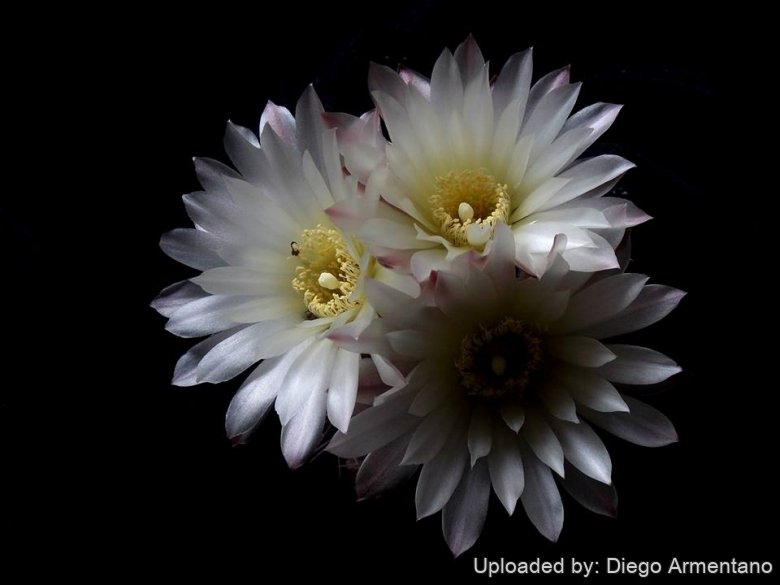
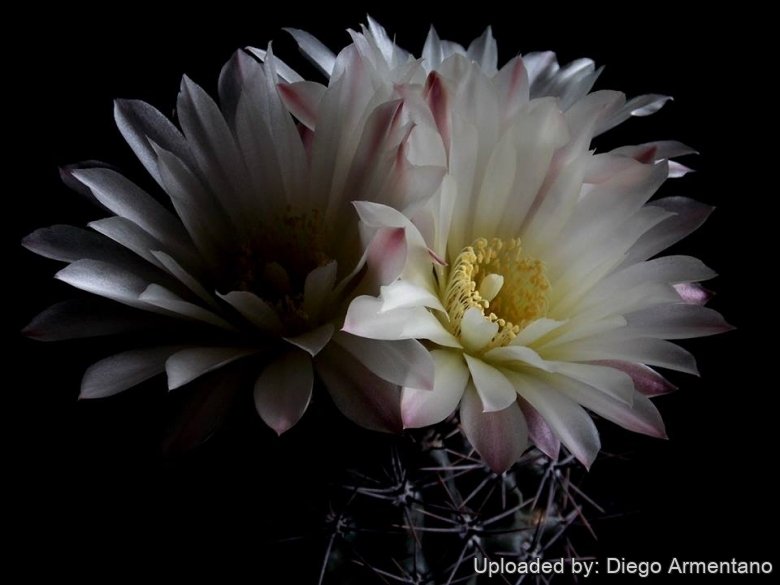
Publication: Darwiniana 24: 441. 1982
Description
This subspecies differs from the type species by a larger number of spines: 9-14 radial spines arranged in 3-6 pairs, occasionally with an additional poorly developed pair in the upper part of the areola. Central spines 1-5, straight, weakly developed in young specimens, about 2.5 cm long on mature plants. However the distinguishing characteristics of Gymnocalycium platense var. ventanicola, appear to fall within the natural variation of Gymnocalycium platense and most authors have dismissed ventanicola as perhaps not worthy of even varietal status, but it still has a value for a collector because they identify plants with particular characters.
Similar species: It is close to Gymnocalycium gibbosum (DC) Pfeiff which is distinguished by its olive green or slightly purple spherical stem, thinner spines, and rather large flowers with smaller receptacles.
Origin and Habitat
This taxon is relatively common in rocky areas and exposed parts in the higher parts of the Sierra de la Ventana, Buenos Aires, Argentina.
Cultivation and Propagation
Gymnocalycium platense var. ventanicola is very easy to grow, these plants offer no cultivation difficulties.
Watering Needs: Moderate to copious in summer, keep dry in winter.
Frost Tolerance: Quite frost resistant if kept dry -10° C (Temperature Zone: USDA 8-10).
Cultural Practices: Feed with a high potassium fertilizer in summer.
Sun Exposure: Full sun to light shade.
Propagation: Seeds (seldom produces offsets).
Bibliography
Major references and further lectures
- Till H., Armerhauser H., Till W. “Neourdnung der Gattung Gymnocalycium – Teil II.” Gymnocalycium 21 (Sonderheft). P 815-838 (2008)