Publication: Syn. Pl. Succ. 92.
Description
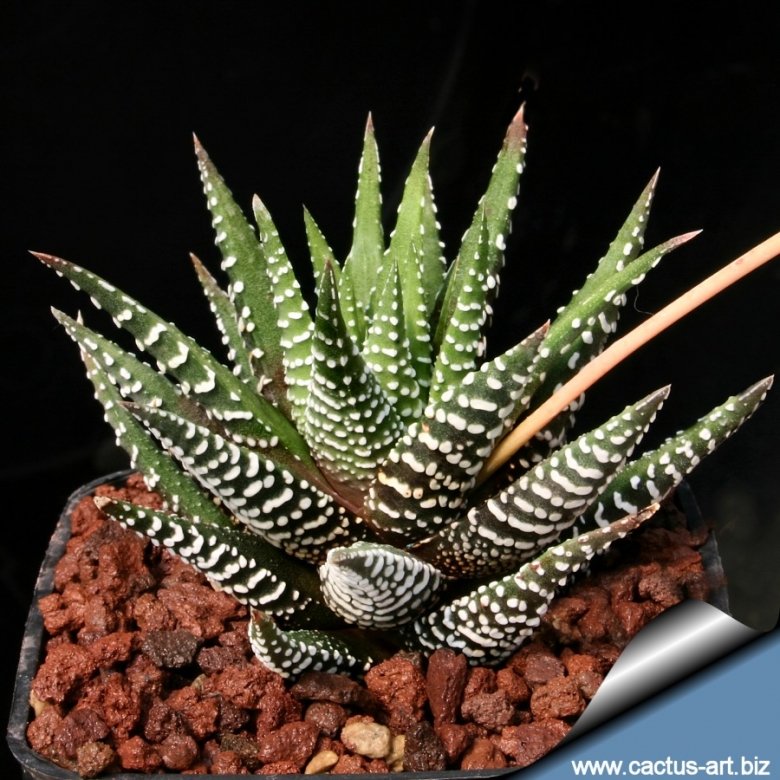
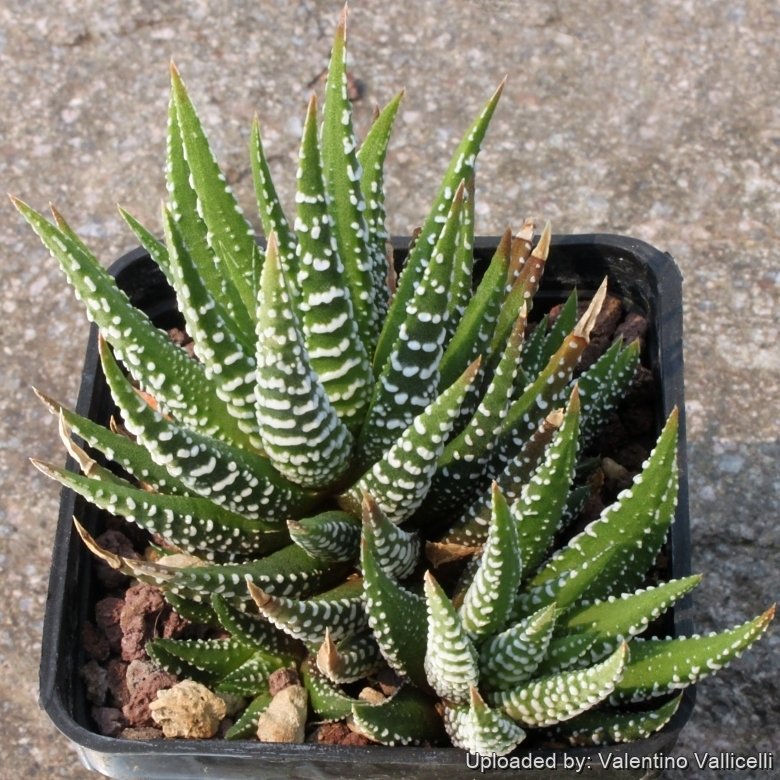
It is a low growing and almost stemless clustering perennial-succulent. It is easily recognizable by the white pearly warts that densely cover the dark-green leaves. It can eventually form large mat-like clumps and is one of the most common species in cultivation. It is very variable, comes in many varieties and forms ranging from solid green with only few tiny white bumps to heavily white horizontal banded forms, and also individual clump that has broad, heavy horizontal stripes will sometimes throw off a pup with just bumps, or some will be smoother, knobbier, etc., and vice-versa. One problem with Gasteria is that there are so many hybrids between species, seedling variability and differences between juvenile and adult plants, that it becomes almost impossible to distinguish many forms from one another. Particularly the name “attenuata” is used for wildly different forms and can cause confusion.
Rosettes: Almost stemless, 6-12cm diameter, 6-13(25) cm tall, heavily clumping.
Leaves: Dark green, concave, slender, pointed and strikingly banded or spotted with white (hence the common name zebra plant). Tubercles are “patterned” on the upper surface of the leaves. The lower surface of the leaves have transverse bands of tubercles
Flowers: Relatively inconspicuous white-greenish.
Bloom time: Can be ever blooming if you snip off each bloom when it dies.
Origin and Habitat
Hankey to the Fish River, Eastern Cape, South Africa.
Habitat: It grows often under bushes, seeking a little shade from the fierce sun in the Bushveld and dry Karroid scrub community.
Cultivation and Propagation
They are of easy cultivation, which makes them a good houseplant, and can be an excellent subject for the beginning succulentophile (it can grow easily on window sills, verandas and in miniature succulent gardens where they are happy to share their habitat with other smaller succulent plants, or in outdoor rockeries). The plant needs light shade to shade, but will take full sun part of the day. (with some sun exposure the leaf develops a nice reddish tint and remains compact) They are tolerant of a wide range of soils and habitats, but prefer a very porous potting mix to increase drainage. During the hot summer months, the soil should be kept moist but not overly wet. The plants are fertilized only once during the growing season with a balanced fertilizer diluted to ½ the recommended strength. During the winter months, water only when the soil becomes completely dry.
Propagation: Haworthia are easily propagated by the removal of offshoots or by leaf cuttings in spring or summer. To propagate by leaf cuttings, remove a leaf and let it lie for about one month, giving the wound time to heal. Then lay the leaf on its side with the basal part buried in the soil. This leaf should root within a month or two, and small plants will form at the leaf base. They can also be grown from seed.
From llifle page Haworthia clariperla
Description
Hawothia attenuata is extremely variable and comes in many varieties, some are solid green with only few tiny white smooth or knobby tubercles, while on the contrary, other are banded with white horizontal transverse lines.
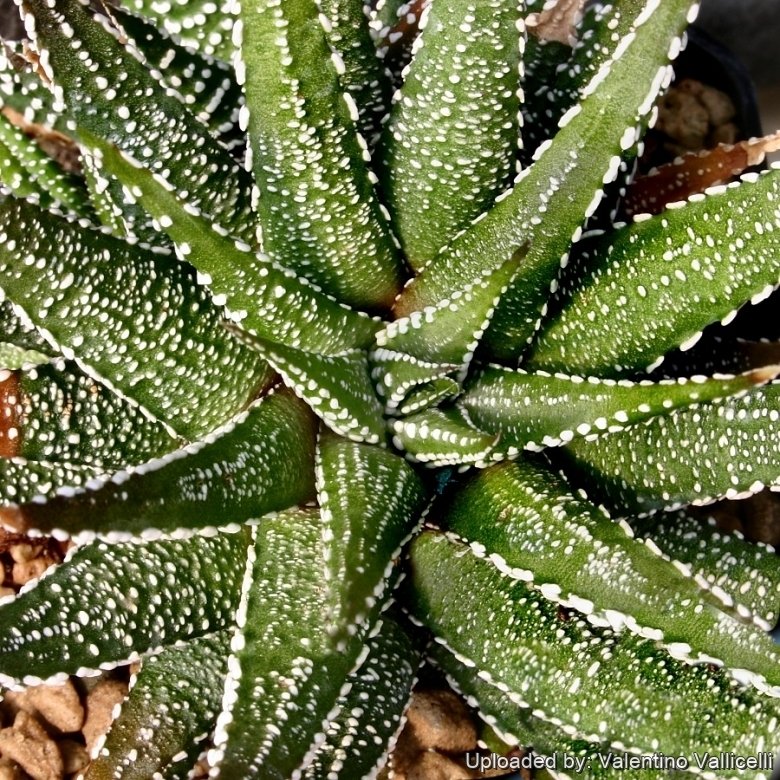
The Forma clariperla distinguishes for its leaves that are evenly covered with many large, pearly white, separate tubercles that are usually scattered, or only vaguely arranged in stripes on the back or along the margins. It is a low growing and almost stemless clustering perennial-succulent that can eventually form large mat-like clumps and is one of the most common species in cultivation.
Rosettes: Almost stemless, 6-12 cm diameter, 6-13(25) cm tall, heavily clumping.
Leaves: Dark green, concave, slender, pointed and strikingly spotted with white pearly tubercles. Tubercles are scattered on the upper surface of the leaves. The lower surface of the leaves may have no-confluent bands of tubercles.
Flowers: Relatively inconspicuous tubular white-greenish, with spreading petals.
Bloom time: Spring to summer, but it can be ever blooming if you snip off each bloom when it dies.
Origin and Habitat
Hankey to the Fish River, Eastern Cape, South Africa.
Habitat: It often grows under bushes, seeking a little shade from the fierce sun in the Bushveld and dry Karroid scrub community.
Cultivation and Propagation
Haworthia are of easy cultivation and relatively low maintenance, which makes them a good houseplant, and can be an excellent subject for the beginning succulentophile (they can grow easily on window sills, verandas and in miniature succulent gardens where they are happy to share their habitat with other smaller succulent plants, or in outdoor rockeries). Haworthias are winter growers and are dormant in the hottest summer months.
Growth rate: They are relatively fast-growing plants that offsets freely to form small clusters quickly.
Soil: They are tolerant of a wide range of soils and habitats, but prefer a very porous potting mix to increase drainage. A non-acid soil is ideal. You can grow a plant in a 10-15 cm pot for years and have perfectly happy plants. For best results, use a shallow pot.
Exposition: The plant needs light shade to shade, but will take full sun part of the day. (with some sun exposure the leaf develops a nice reddish tint and remains compact).
Watering: During the hot summer months, the soil should be kept moist but not overly wet. During the winter months, water only when the soil becomes completely dry. Wet soil quickly causes root and stem rot, especially during chilly winter months. No water should ever be allowed to stand around the roots. Low ambient humidity is always needed.
Fertilization: The plants are fertilized only once during the growing season with a balanced fertilizer diluted to ½ the recommended strength.
Hardiness: Although the plant will survive mild frost if kept dry (hardy as low as -5° C) it should be protected from severe cold and prolonged frost conditions.
Rot: Rot is only a minor problem with Haworthia if the plants are watered and “aired” correctly. If they are not, fungicides won’t help all that much. Care must be given in watering, keeping them warm and wet while growing, and cooler and dry when dormant.
Remarks: Haworthias are best planted in a shaded and airy part of the greenhouse, and not too close to the glass roof or sides of the house as the plants can overheat during hot spells.
Propagation: Haworthia are easily propagated by the removal of offshoots or by leaf cuttings in spring or summer. To propagate by leaf cuttings, remove a leaf and let it lie for about one month, giving the wound time to heal. Then lay the leaf on its side with the basal part buried in the soil. This leaf should root within a month or two, and small plants will form at the leaf base. They can also be grown from seed.
Source: Haworthia clariperla, LLIFLE - Encyclopedia of living forms, CC-BY-SA, retrieved 2026-10-25.