Publication: Cat. Dammann & Co. 59: 4, 7, fig, 6, l892
Description
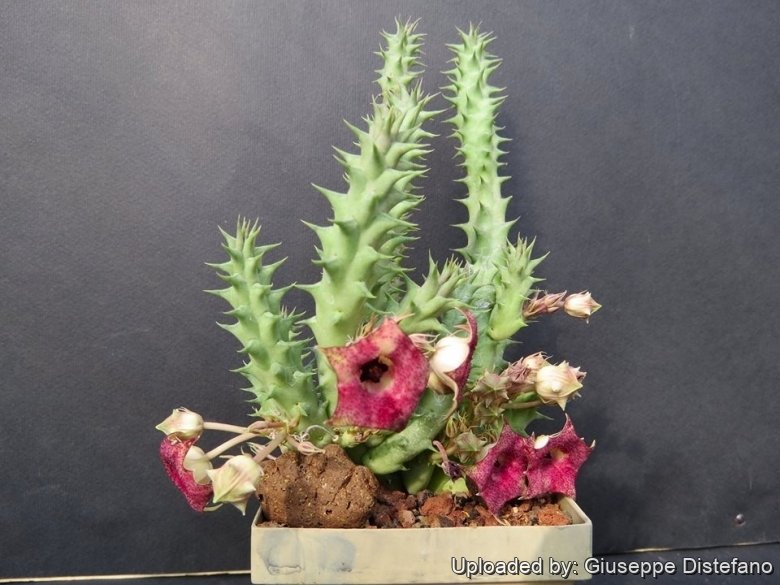
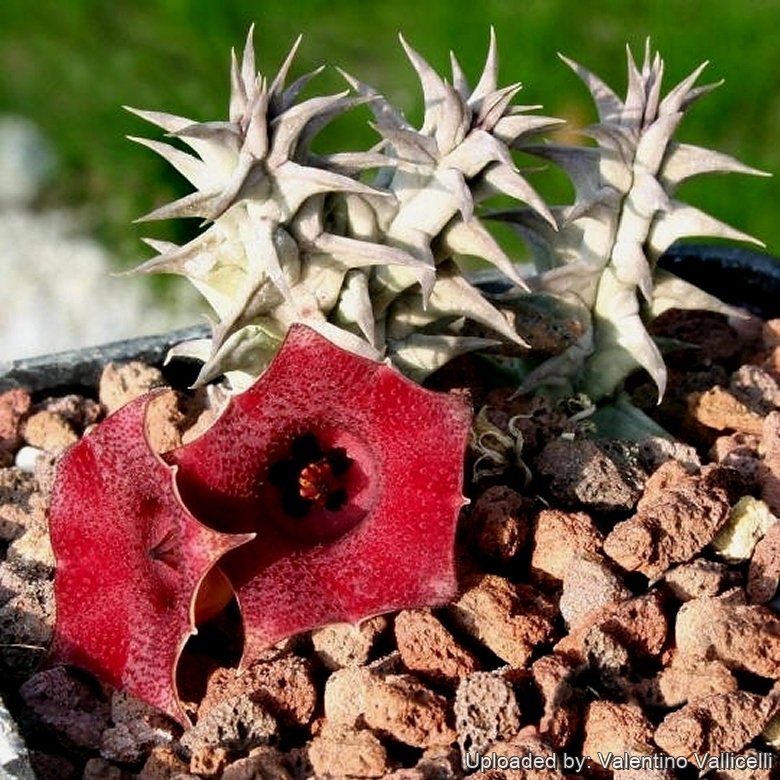
Huernia macrocarpa is an easily flowered succulent species. In autumn it produces bell-shaped, white-haired, mostly dark purple flowers with recurved petal tips, it is however very variable in colour and size of flowers.
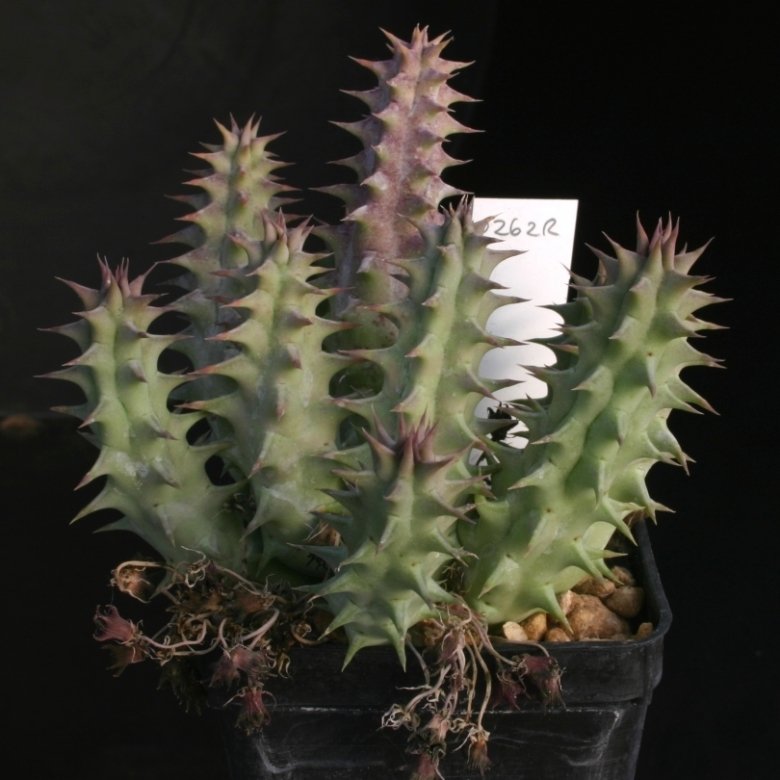
Habit: Clump-forming perennial succulent, it forms small clumps of basally branching stems spreading sideways or trailing and will rapidly fill an entire pot.
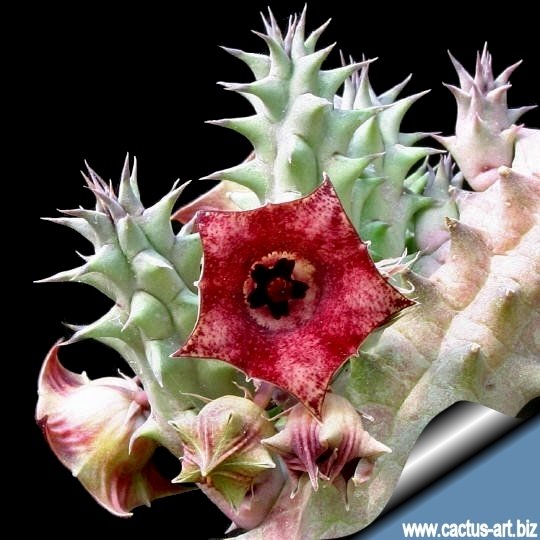
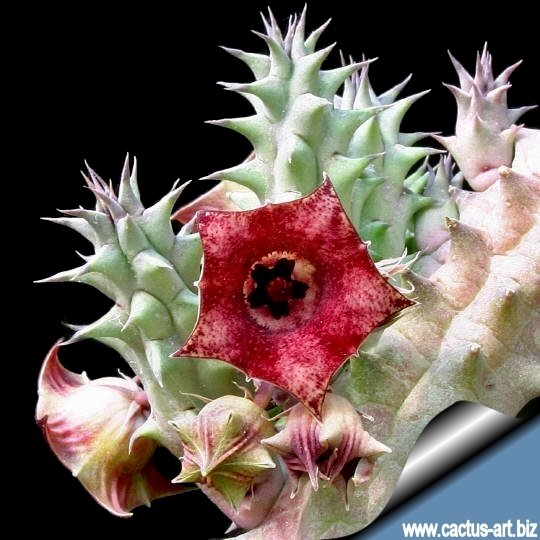
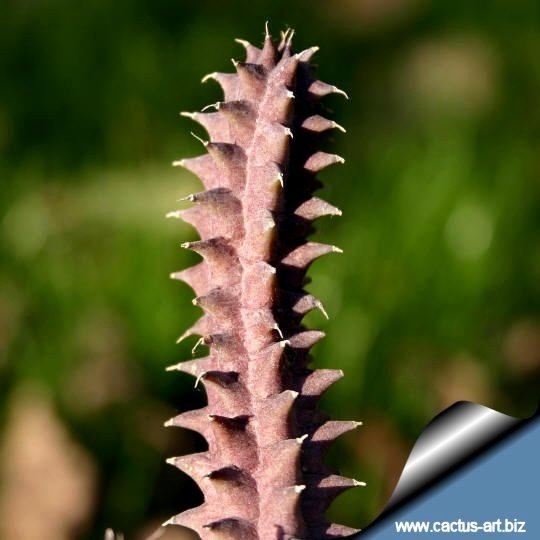
Stem: 4 to 25 cm long, mut mostly about the length of a finger (rarely growing taller than 20 cm), fleshy, green or glaucous, cylindrical just at the base then quadrangular or pentangular, angles coarsely toothed.
Teeth: Fleshy, conical-subulate, acute, recurved, spinescent at the apex, 7-8 mm long, 3-4 mm thick at the base, separated by 6-8 mm wide sinuses along the stem angles.
Leaves: Inconspicuous, short-lived, deciduous.
Flower: 1 to several from the base of young stems, facing outwards or nodding, typical 5 lobed.
Pedicel: 5 mm long, pale green glabrous.
Sepals: 10 mm long, 1mm long at the base, gradually tapering to a very fine hairlike point, glabrous.
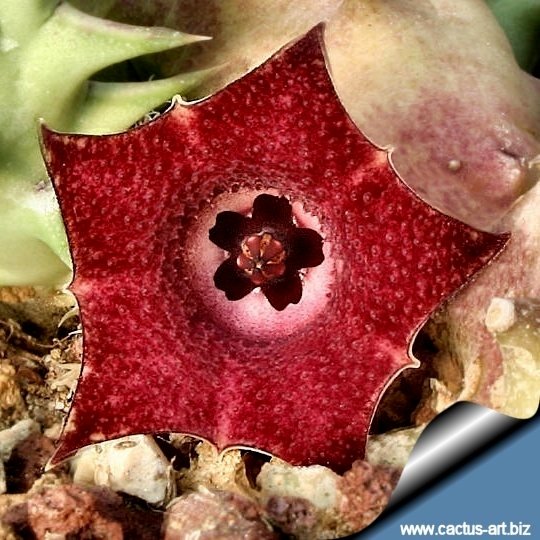
Corolla: Campanulate, somewhat more than 1 cm Long, and 2 cm at the greatest diameter. Lobes Broadly triangular, acute, whit an intermediate point hardly 1 mm long in the flat sinuses between; outside greenish-yellow, prominently 5-nerved, minutely papillate, glabrous; inside everywhere except in lower portion of tube covered with little bristle-like processes becoming smaller toward the apex of the lobes, brownish red or black purple, with purple transverse ground on creamy-yellow ground, marked with deep purplish-crimson.
Tube: Broadly Campanulate, about 7 mm deep.
Lobes: 6 mm long, 7 mm broad, slightly spreading, deltoid, acuminate, not ciliate.
Outer corona: Very shortly 5-lobed, velvety purplish-crimson; lobes transversely oblong, emarginated.
Inner corona: Lobes broad at the base, tapering to a subobtuse point, very minutely pubescent, connivent and rising slightly above the anthers, purplish whit yellow knobs at the base.
Pollinia: Yellowish.
Blooming season: July-October.
Fruit: Typical twin seed horns (follicles), cream-coloured, mottled dark-purple, 4-17 cm long, 4-10 mm in diameter, narrowly fusiform, acute, erect with woody peduncle up to 5,5 cm long, and often don’t appear until a year later.
Origin and Habitat
This plant came from Ethiopia but the members of the enlarged complex ”macrocarpa” has a ample distribution encompassing Sudan, Eritrea, Ethiopia, Saudi Arabia and Yemen.
Habitat: Grows on granite rocks.
Cultivation and Propagation
Not difficult to grow. Huernia require moderately watering through the growing season but enjoy plenty of water and some fertiliser in hot weather, this helps them to flower freely. Water more sparingly in winter according to temperatures. But, as with most asclepiads, it is unwise to leave them wet in cold weather.
Frost Tolerance: It is usually recommended to overwinter them in warm conditions (at 10 deg) but despite the African origin they seem to grow well and flower without the extra heat which one might have thought necessary and occasional temperature near 0 deg. are tolerated if kept dry.
Potting medium: Since roots are quite shallow, use a cactus mix or add extra perlite or pumice to regular soil potting soil. A gritty, very free-draining compost is suitable, and clay pots help the plants to dry out between watering.
Pest and diseases: Huernia species vary in their susceptibility to rotting, but are generally fairly easy to grow, especially if kept pest-free. They are very susceptible to stem and root mealy bugs, and damage from these may well initiate fungal attack. If you do have problems with a stem or with basal rotting, you can reliably isolate the healthy parts, dry them off, and re-root them in moist compost.
Propagation: Easiest with stem cuttings. Allow cuttings to dry a day before planting. Stems must be laid (Not buried) on gritty compost and will then root from the underside of the stems. It can also be increased from seeds sowing in spring in moist, sandy peat moss. Barely cover seeds. Seeds germinate quickly.
Notes
The species H. macrocarpa is now a complex grouping of plants that has recently been expanded to include amongst others Huernia arabica, Huernia penzigii, Huernia macrocarpa v. schweinfurthii, and Huernia macrocarpa v. cerasina.
Bibliography
Major refrerences and further lectures
-
A.C.White & B.Sloane “Stapelieae” ( White & Sloane) ed. 2 3: 855 Abbey San Encino Press, 1937
-
James Cullen, Sabina G. Knees, H. Suzanne Cubey “The European Garden Flora Flowering Plants: A Manual for the Identification of Plants Cultivated in Europe, Both Out-of-Doors and Under Glass” Cambridge University Press, 11/ago/2011
-
Focke Albers, Ulrich Meve “Illustrated Handbook of Succulent Plants: Asclepiadaceae” Volume 4 Springer, 2002
-
American Horticultural Society “The American Horticultural Society encyclopedia of garden plants” Macmillan, 30/November/1989
-
Wikipedia contributors. “Huernia macrocarpa.” Wikipedia, The Free Encyclopedia. Wikipedia, The Free Encyclopedia, 24 Oct. 2014. Web. 23 Jan. 2015.
From llifle page Huernia penzigii
Description
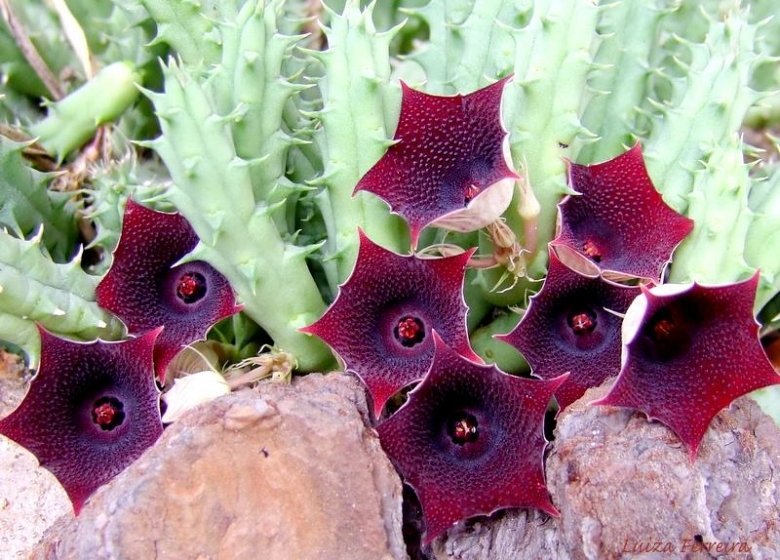
Huernia penzigii, also labelled Huernia macrocarpa var. penzigii, is a variable and ill-delined species differently assessed in different publications. According to Schumann, this plant is the same as Stapelia macrocarpa, A. Rich., but Huernia penzigii has bell-shaped flowers entirely of a uniform black-purple-red colour within. Corolla shallow bowl-shaped, about twice as wide as deep.
Stems: Erect or ascending, clumping 5-9 cm tall 12-16 mm thick, excluding the teeth, 5-angled. Teeth conical straight spreading 7-10 mm long, with elongated bristle tips.
Flowers: 1–5 in a fascicle at the base of the young stems, developing successively, inclined on stalks. Pedicels ca. 6 mm. long, glabrous. Sepals 8-12 mm long, lanceolate-subulate, spreading, glabrous. Corolla campanulate, 5-12 mm long, 12-18 mm in expanse, ca. 1 cm deep, black-purple to dark maroon with minute wart-like papillae within, otherwise glabrous, and not ciliate, pallid and rough outside. Corolla lobes 5, triangular, 5-7 mm long deltoid, slightly spreading. Outer corona lobes 5, transversely oblong, retuse or emarginate. Inner coronal-lobes 1.3-1.5 mm long, tapering from a swollen base, leaning inwards over the backs of the anthers, then erect, deltoid-subulate, with a transverse ridge behind at their base, glabrous, blackish-purple.
Origin and Habitat
Ethiopia.
Bibliography
Major references and further lectures
-
Bill Keen “CACTI AND SUCCULENTS: Step-by-Step to Growing Succes” Crowood, 18 October 2011
-
White & Sloane. “The Stapelicae”. Cdn 2. 3: 851-853 (1937) – as: H. macrocarpa
-
Excelsa Taxonomic Series 4: 108. 109 (1988)
-
James Cullen, Sabina G. Knees, H. Suzanne Cubey “The European Garden Flora Flowering Plants: A Manual for the Identification of Plants Cultivated in Europe, Both Out-of-Doors and Under Glass” Cambridge University Press, 11/August/2011
-
N. E. Brown. “Flora of Tropical Africa” Vol 4, Part 1, (1904)
-
Focke Albers, Ulrich Meve “Illustrated Handbook of Succulent Plants: Asclepiadaceae: Asclepiadaceae” Volume 4 Springer, 2002
Source: Huernia penzigii, LLIFLE - Encyclopedia of living forms, CC-BY-SA, retrieved 2026-10-25.
Cultivars and forms (4)
Gallery