Publication: [Basionym: Cheiridopsis vanbredai L. Bolus 1963]
Description
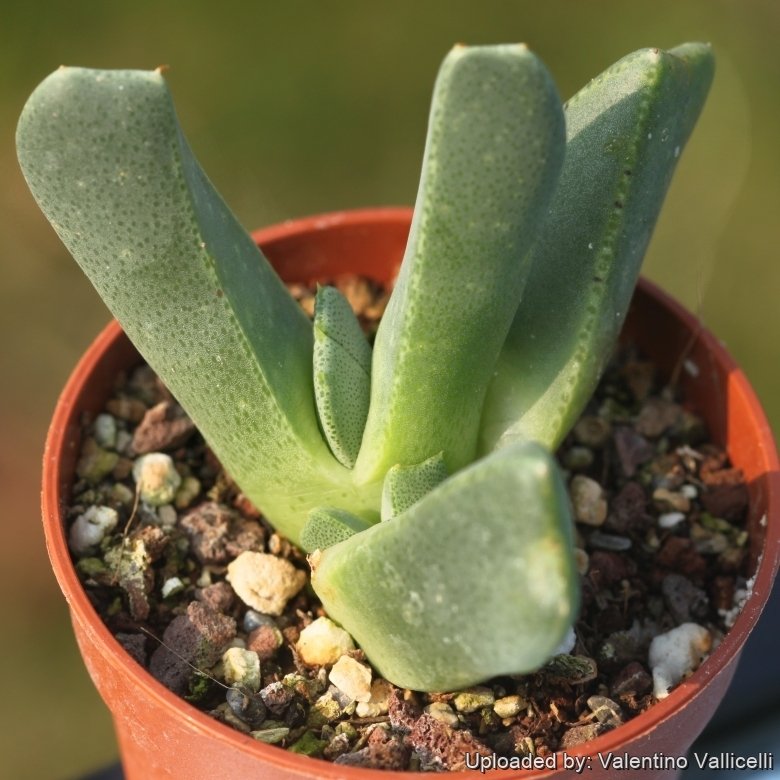
Ihlenfeldtia excavata f. vanbredai (Cheiridopsis vanbredai), is one of the varieties of Ihlenfeldtia excavata which is a somewhat variable taxon with several populations differing in flower colours and expression of teeth on the keels, some of these forms were early published as full species or as varieties, but these were too weak botanically to stand, so they are all combined in Ihlenfeldtia excavata. It is a compact plant whit few short branches, sometime growing sunken in the ground.
Leaves: Mucronate, whith excavated keel.
For more details see: Ihlenfeldtia excavata.
Origin and Habitat
Namaqualand, Northern Cape, South Africa.
Ecology: It is sympatric with Odontophorus herrei, and shows the same colour change.
Cultivation and Propagation
Ihlenfeldtia excavata f. vanbredai is most active from late winter until later spring and heading for summer dormancy, but in favourable growing conditions it keeps going over the summer too and doesn’t need particular care. It is relatively easy to grow.
Soil: Requires good drainage as it it is prone to root rot. It can grows outdoor in sunny, dry, rock crevices (protection against winter wet is required) It can also be cultivated in alpine house, in poor, drained soil.
Fertilization: It thrives in poor soils and seems sensitive to an excess of potassium.
Watering: Water minimally in summer, only when the plant starts shrivelling, water more abundantly when they are growing in the autumn and spring. Requires little water otherwise its epidermis breaks (resulting in unsightly scars).
Light: It needs a bright sunny or light shade exposure in winter, but keep cool and shaded in summer.
Hardiness: It prefer a very bright situation and will take a light frost (Hardy to -5°C) if it is in dry soil. USDA zones 9A – 11.
Uses: Container, rock garden.
Propagation: Seed in spring or (or rarely) cuttings. It is easily propagated by seed.
Notes
Ihlenfeldtia resemble Cheiridopsis species but the seed capsules resemble those of Titanopsis.
Bibliography
Major references and futher lectures
-
Klaus Kubitzki, Jens G. Rohwer, Volker Bittrich “Flowering Plants · Dicotyledons: Magnoliid, Hamamelid and Caryophyllid Families” Springer, 28/Jul/1993
-
Doreen Court “Succulent Flora of Southern Africa” CRC Press, 01/Jun/2000
-
Otto A. Leistner “Flora of southern Africa” 14: 194 1985
-
Jacobsen “Lexicon of succulent plants” Littlehampton Book Services Ltd. 1974
-
James Cullen, Sabina G. Knees, H. Suzanne Cubey “The European Garden Flora Flowering Plants: A Manual for the Identification of Plants Cultivated in Europe, Both Out-of-Doors and Under Glass” Cambridge University Press, 11/Aug/2011
-
Dr J.P. Roux “Flora of South Africa” 2003
-
Heidrun E. K. Hartmann “Illustrated Handbook of Succulent Plants: Aizoaceae F-Z” Springer, 2002
-
Ernst Van Jaarsveld, Ben-Erik Van Wyk, Gideon Smith “Succulents of South Africa: A Guide to the Regional Diversity” Tafelberg Publishers, Limited, 01/Jul/2000
-
Gideon Smith u.a. “Mesembs of the World: Illustrated Guide to a Remarkable Succulent Group.” Briza Publications 1998
-
Botanische Jahrbücher für Systematik, Pflanzengeschichte und Pflanzengeographie. 114:1 47, Leipzig 1992
Gallery