Publication: Bot. Jahrb. Syst. 114(1): 48. 1992 [16 Jun 1992]
Description
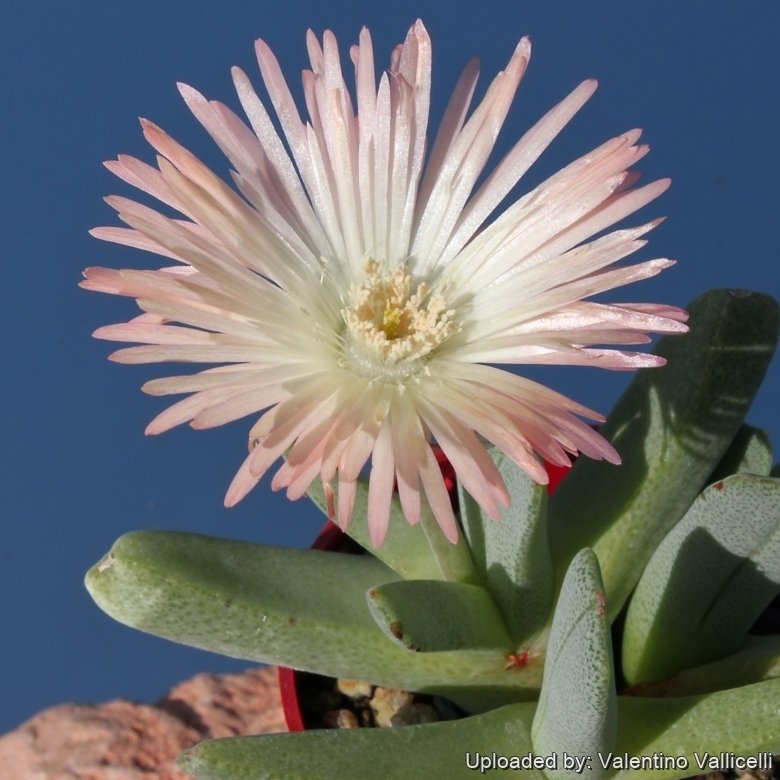
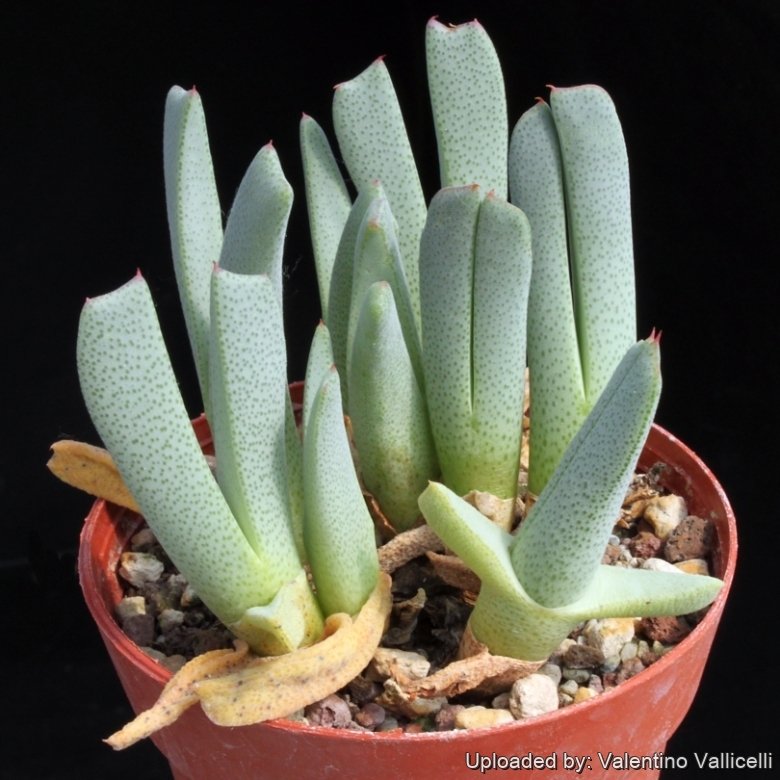
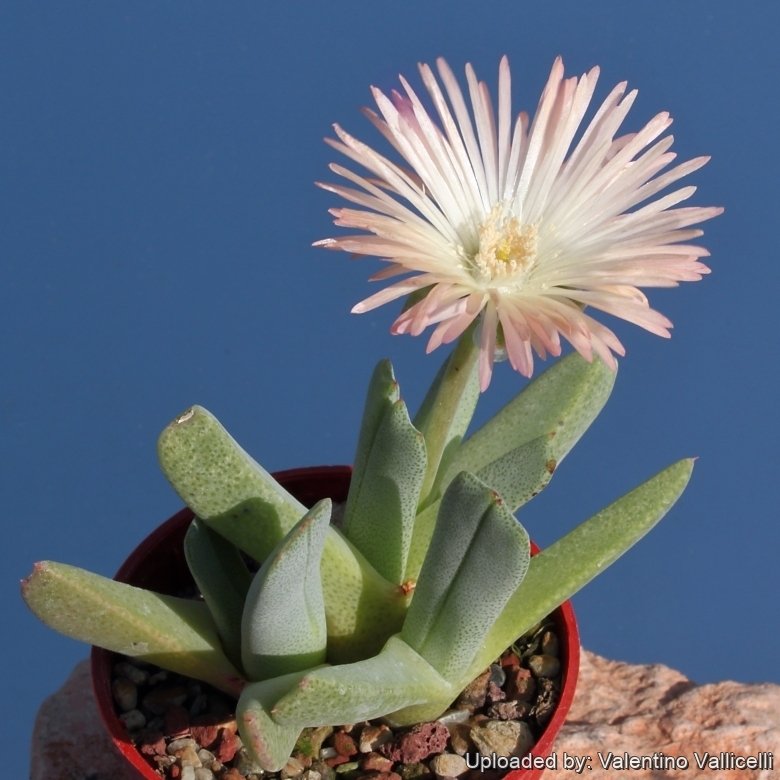
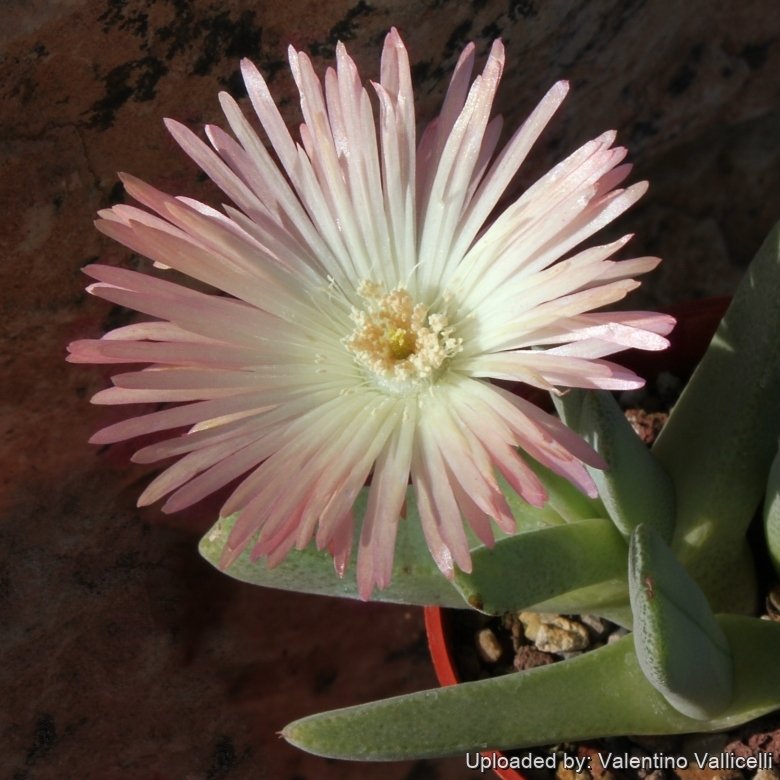
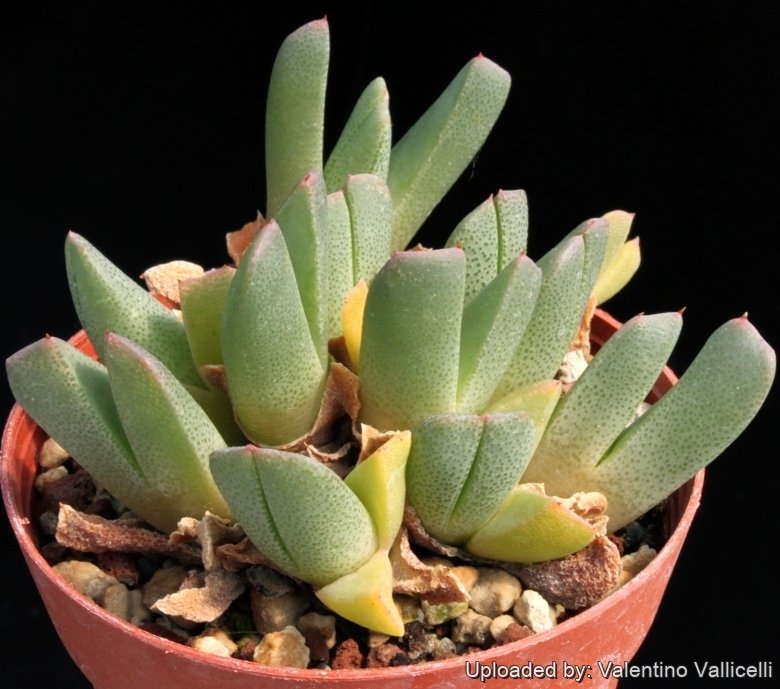
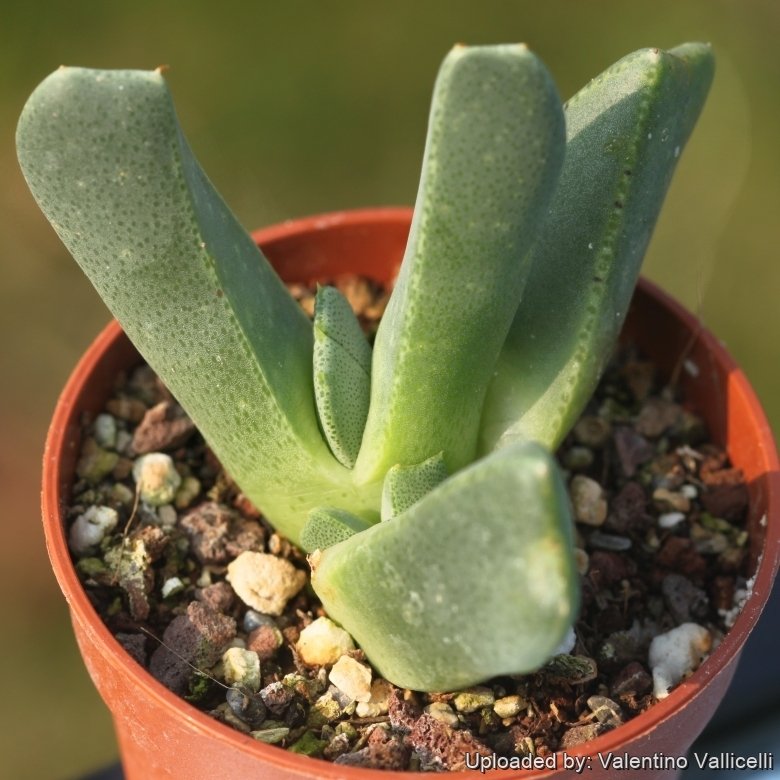
Ihlenfeldtia excavata is a compact succulent plant with few to up to 120 short branches, each with one (or two) pair of wedge-shaped leaves, keeled and laterally compressed, papillate and greyish, sometime growing sunken in the ground. The big white, buttercup-yellow or pink flowers are gorgeous. Populations differ in flower colours and expression of teeth on the keel. This species was included in Cheiridopsis until its removal from that genus (Hartmann 1988), separation was based on fruit characters.
Derivation of specific name: Latin “excavata”, hollowed, excavate; for the upper face of the leaves, which is concave near the leaf tip.
Leaves: Thick, mucronate, often with stout teeth on the excavated keel.
Flowers: Large, daisy-like, white, buttercup-yellow or pink in various shades, as for genus.
Fruits (capsules): 10-15-chambered, with a funnel-shaped base, bracteoles at base of pedicel.
Seeds: Elongate pear-shaped, 0.63-0.85 mm long.
Chromosome number: 2n = 18
Origin and Habitat
Northern Richtersveld (Lekkersing, Gamoep), Bushmanland, Northern Cape, South Africa.
Habitat and ecology: Ihlenfeldtia excavata occurs in the area between winter and summer rainfall, as does its presumable next relatives (i.e., Tanquana and Vanheerdea). Rain c. 125 mm per annum. This species is usually found in quartz gravel patches formed by a loose lag of very small, brilliant white to clear-quartz pebbles overlying a thin veneer of soil on the underlying bedrock. Ihlenfeldtia excavata grows in association with obligate quartz-field succulent such as: Conophytum angelicae, Ruschia inclusa, Fockea comaru, Hoodia alstonii, Adromischus nanus, Crassula deceptor, Avonia ruschii, Crassula namaquensis, Conophytum maughanii, Hereroa puttkameriana, Anacampseros karasmontana, Avonia quinaria subsp. alstonii, Avonia papyracea, Sarcostemma pearsonii, and many other. Ihlenfeldtia excavata is also found on calcrete outcrops together with Conophytum pubescens, Conophytum calculus subsp. vanzylii, Titanopsis hugo-schlecterii and other calcrete-lovers. Heavy livestock grazing reduces the number of flowers per individual plant. The population trend is stable.
Cultivation and Propagation
Ihlenfeldtia excavata is most active from late winter until later spring and heading for summer dormancy, but in favourable growing conditions it keeps going over the summer too and doesn’t need particular care. It is relatively easy to grow.
Soil: Requires good drainage as it it is prone to root rot. It can grows outdoor in sunny, dry, rock crevices (protection against winter wet is required) It can also be cultivated in alpine house, in poor, drained soil.
Fertilization: It thrives in poor soils and seems sensitive to an excess of potassium.
Watering: Water minimally in summer, only when the plant starts shrivelling, water more abundantly when they are growing in the autumn and spring. Requires little water otherwise its epidermis breaks (resulting in unsightly scars).
Light: It needs a bright sunny or light shade exposure in winter, but keep cool and shaded in summer.
Hardiness: It prefer a very bright situation and will take a light frost (Hardy to -5°C) if it is in dry soil. USDA zones 9A – 11.
Uses: Container, rock garden.
Propagation: Seed in spring or (or rarely) cuttings. It is easily propagated by seed.
Notes
Little Namaqualand.
Bibliography
Major references and futher lectures
-
Klaus Kubitzki, Jens G. Rohwer, Volker Bittrich “Flowering Plants · Dicotyledons: Magnoliid, Hamamelid and Caryophyllid Families” Springer, 28/Jul/1993
-
Doreen Court “Succulent Flora of Southern Africa” CRC Press, 01/Jun/2000
-
Otto A. Leistner “Flora of southern Africa” 14: 194 1985
-
Jacobsen “Lexicon of succulent plants” Littlehampton Book Services Ltd. 1974
-
James Cullen, Sabina G. Knees, H. Suzanne Cubey “The European Garden Flora Flowering Plants: A Manual for the Identification of Plants Cultivated in Europe, Both Out-of-Doors and Under Glass” Cambridge University Press, 11/Aug/2011
-
Dr J.P. Roux “Flora of South Africa” 2003
-
Heidrun E. K. Hartmann “Illustrated Handbook of Succulent Plants: Aizoaceae F-Z” Springer, 2002
-
Ernst Van Jaarsveld, Ben-Erik Van Wyk, Gideon Smith “Succulents of South Africa: A Guide to the Regional Diversity” Tafelberg Publishers, Limited, 01/Jul/2000
-
Gideon Smith u.a. “Mesembs of the World: Illustrated Guide to a Remarkable Succulent Group.” Briza Publications 1998
-
Botanische Jahrbücher für Systematik, Pflanzengeschichte und Pflanzengeographie. 114:1 47, Leipzig 1992
-
Steven A. Hammer “Dumpling and his wife: new views of the genus Conophytum” EAE Creative Colour Ltd., 2002
-
Burgoyne, P.M. 2006. “Ihlenfeldtia excavata (L.Bolus) H.E.K.Hartmann.” National Assessment: Red List of South African Plants version 2015.1. Accessed on 2015/12/18
-
Desmet, P. G. (2013). “Gamsberg Zinc Project: Vegetation Baseline and Impact Assessment” Report Draft 5. Report for ERM Southern Africa on behalf of Black Mountain Mining (Pty) Ltd/Vedanta Zinc International. 19 April 2013
-
“THE QUARTZ FIELDS OF SOUTHERN AFRICA: flora, phytogeography, vegetation, and habitat ecology” Inaugural - Dissertation zur Erlangung des Doktorgrades der Mathematisch-Naturwissenschaftlichen Fakultät der Universität zu Köln vorgelegt von Ute Schmiedel aus Helsinki / Finnland Köln 2002
-
Carolin Mayer (2010) “The impact of grazing on pollinators and pollination” In: Schmiedel, U., Jürgens, N. (eds.): Biodiversity in southern Africa 2: Patterns and processes at regional scale: 233–238. Göttingen & Windhoek: Klaus Hess Publishers
From llifle page Cheiridopsis albirosea
Description
Nice compact plant with sharp-bladed leaves and superb flowers. It has up to 11 branches, rarely growing sunken in the ground. It is active in autumn and winter.
Leaves: Mucronate, greysh-green.
Flowers: White shaded with pink.
Blooming season: Flowering in early spring.
Cultivation and Propagation
The Ihlenfeldtia excavata f. albirosea is a “winter” grower which is most active from late winter until later spring and heading for summer dormancy, but in favourable growing conditions it keeps going over the summer too and doesn’t need particular care. It is relatively easy to grow.
Soil: Requires good drainage as it it is prone to root rot. It can grows outdoor in sunny, dry, rock crevices (protection against winter wet is required) It can also be cultivated in alpine house, in poor, drained soil.
Fertilization: It thrives in poor soils and seems sensitive to an excess of potassium.
Watering: Water minimally in summer, only when the plant starts shrivelling, water more abundantly when they are growing in the autumn and spring. Requires little water otherwise its epidermis breaks (resulting in unsightly scars).
Light: It needs a bright sunny or light shade exposure in winter, but keep cool and shaded in summer.
Hardiness: It prefer a very bright situation and will take a light frost (Hardy to -5°C) if it is in dry soil. USDA zones 9A – 11.
Uses: Container, rock garden.
Propagation: Seed in spring or (or rarely) cuttings. It is easily propagated by seed.
Bibliography
Major references and futher lectures
-
Klaus Kubitzki, Jens G. Rohwer, Volker Bittrich “Flowering Plants · Dicotyledons: Magnoliid, Hamamelid and Caryophyllid Families” Springer, 28/Jul/1993
-
Doreen Court “Succulent Flora of Southern Africa” CRC Press, 01/Jun/2000
-
Otto A. Leistner “Flora of southern Africa” 14: 194 1985
-
Jacobsen “Lexicon of succulent plants” Littlehampton Book Services Ltd. 1974
-
James Cullen, Sabina G. Knees, H. Suzanne Cubey “The European Garden Flora Flowering Plants: A Manual for the Identification of Plants Cultivated in Europe, Both Out-of-Doors and Under Glass” Cambridge University Press, 11/Aug/2011
-
Dr J.P. Roux “Flora of South Africa” 2003
-
Heidrun E. K. Hartmann “Illustrated Handbook of Succulent Plants: Aizoaceae F-Z” Springer, 2002
-
Ernst Van Jaarsveld, Ben-Erik Van Wyk, Gideon Smith “Succulents of South Africa: A Guide to the Regional Diversity” Tafelberg Publishers, Limited, 01/Jul/2000
-
Gideon Smith u.a. “Mesembs of the World: Illustrated Guide to a Remarkable Succulent Group.” Briza Publications 1998
-
Botanische Jahrbücher für Systematik, Pflanzengeschichte und Pflanzengeographie. 114:1 47, Leipzig 1992
Source: Cheiridopsis albirosea, LLIFLE - Encyclopedia of living forms, CC-BY-SA, retrieved 2026-10-25.
From llifle page Cheiridopsis vanbredai
Description
Ihlenfeldtia excavata f. vanbredai (Cheiridopsis vanbredai), is one of the varieties of Ihlenfeldtia excavata which is a somewhat variable taxon with several populations differing in flower colours and expression of teeth on the keels, some of these forms were early published as full species or as varieties, but these were too weak botanically to stand, so they are all combined in Ihlenfeldtia excavata. It is a compact plant whit few short branches, sometime growing sunken in the ground.
Leaves: Mucronate, whith excavated keel.
For more details see: Ihlenfeldtia excavata.
Origin and Habitat
Namaqualand, Northern Cape, South Africa.
Ecology: It is sympatric with Odontophorus herrei, and shows the same colour change.
Cultivation and Propagation
Ihlenfeldtia excavata f. vanbredai is most active from late winter until later spring and heading for summer dormancy, but in favourable growing conditions it keeps going over the summer too and doesn’t need particular care. It is relatively easy to grow.
Soil: Requires good drainage as it it is prone to root rot. It can grows outdoor in sunny, dry, rock crevices (protection against winter wet is required) It can also be cultivated in alpine house, in poor, drained soil.
Fertilization: It thrives in poor soils and seems sensitive to an excess of potassium.
Watering: Water minimally in summer, only when the plant starts shrivelling, water more abundantly when they are growing in the autumn and spring. Requires little water otherwise its epidermis breaks (resulting in unsightly scars).
Light: It needs a bright sunny or light shade exposure in winter, but keep cool and shaded in summer.
Hardiness: It prefer a very bright situation and will take a light frost (Hardy to -5°C) if it is in dry soil. USDA zones 9A – 11.
Uses: Container, rock garden.
Propagation: Seed in spring or (or rarely) cuttings. It is easily propagated by seed.
Notes
Ihlenfeldtia resemble Cheiridopsis species but the seed capsules resemble those of Titanopsis.
Source: Cheiridopsis vanbredai, LLIFLE - Encyclopedia of living forms, CC-BY-SA, retrieved 2026-10-25.
Cultivars and forms (2)
Gallery