Description
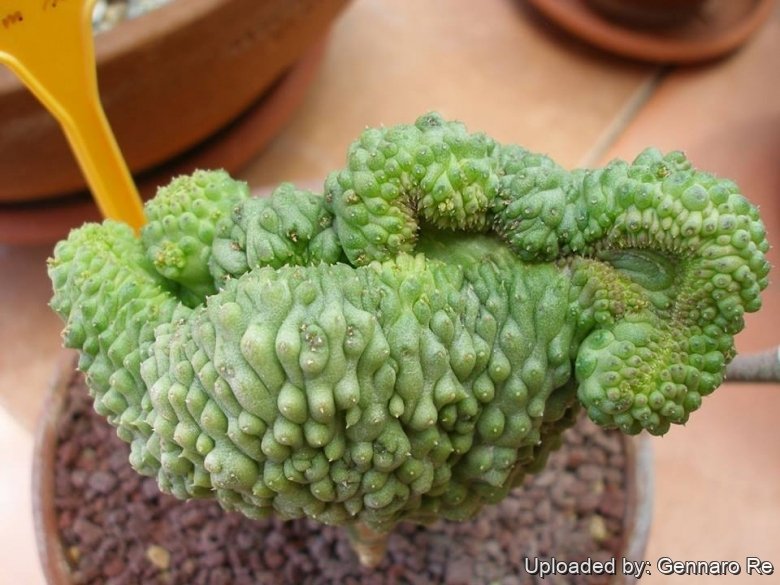
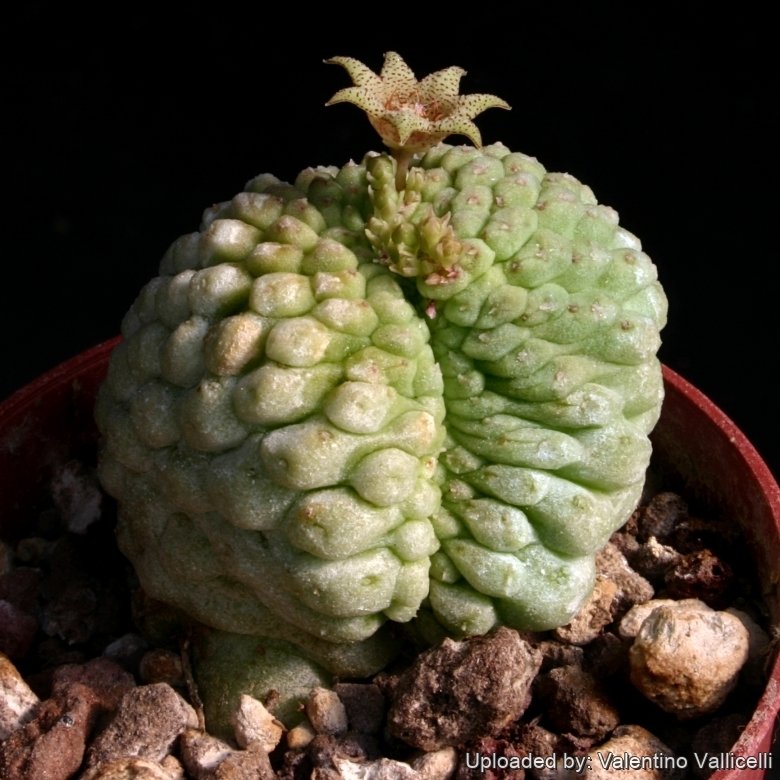
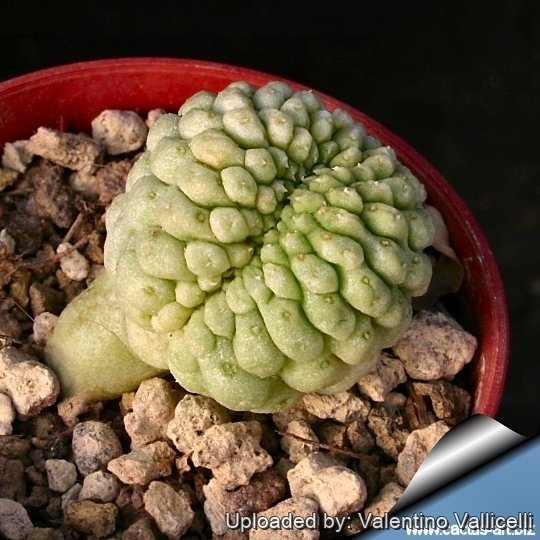
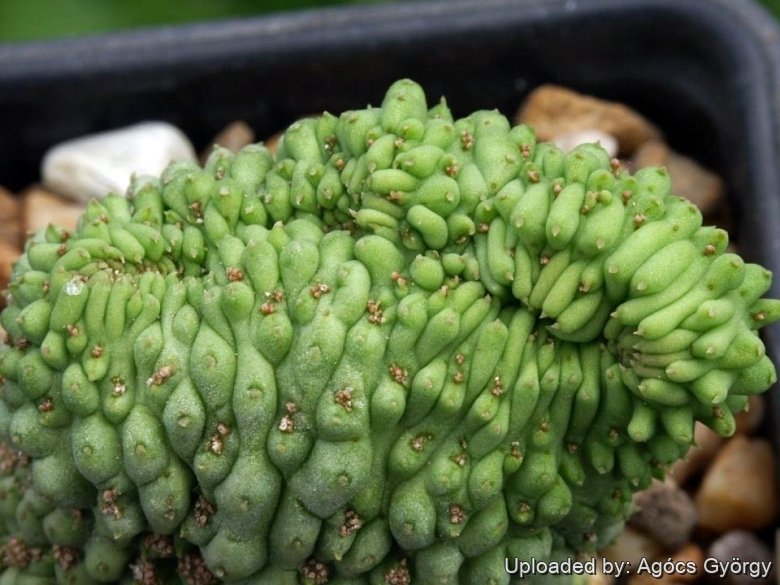
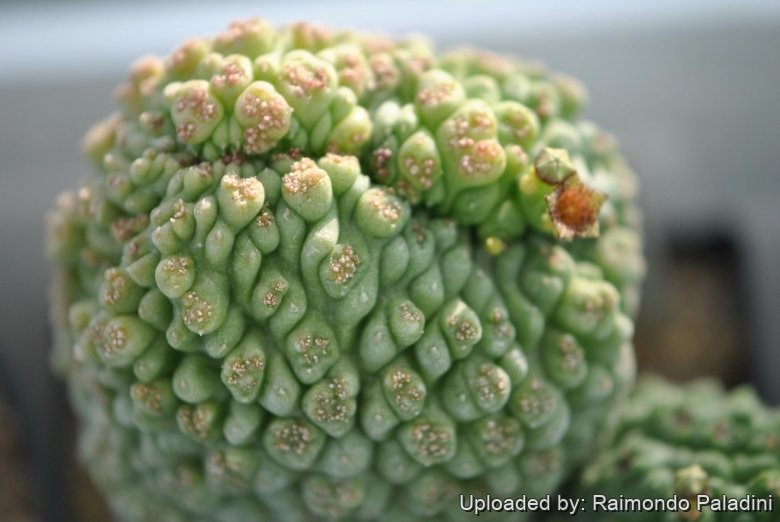
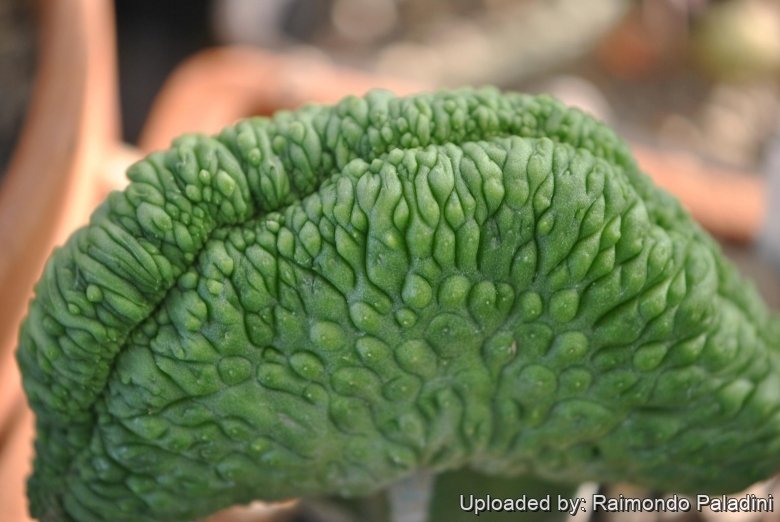
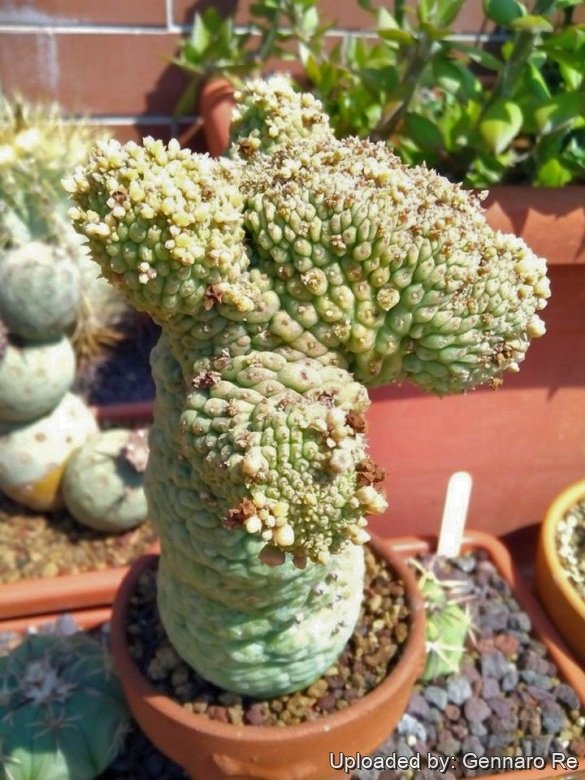
Larryleachia cactiforme is a small perennial stem succulent with a globular body tessellate with roughly pentangular, flat or depressed tubercles. This species is quite variable particularly in the colour of flowers. The crested form Larryleachia cactiformis var. cristata is very rare in cultivation and sought after by collectors, for its unique features.
Stem: Fan shaped, flattened on top, depressed centrally, green or light green or blue-green 20-60 mm thick; latex colourless.
Ribs: Indistinct ribs and tessellate with roughly pentangular, flat or depressed tubercles closely set together.
Leaves: Persistent, reduced to scales, in spirals or verticillate, sessile (and sunken), strongly adscending, 0,5-1 mm long.
Roots: Fibrous.
Flowers: Appear (usually) close to apex of stems in extra-axillary inflorescences 1 to 3 together on a tubercle apex, each about 6 to 10mm, in diameter, simple, sessile, fleshy, abaxially whitish cream, green, yellow to dull pinkish uniformly coloured or maculate with reddish, purple or maroon, adaxially white, cream, green or yellow, maculate, glabrous.
Blooming season: Flowers open synchronously in summer.
Remarks: This plant has a highly specialized pollination biology, that depends upon flies which are deceived, partially trapped and used as collectors of the pollinia which they transport to a cyathium (Flower) on another plant.
Origin and Habitat
Garden origin (Nursery produced cultivar)
Cultivation and Propagation
Water normally in the growing season, dry in the winter.
Summer: In the summer months they will grow well in partial shade.
Propagation: Seeds grafting.
Potting medium: Since roots are quite shallow, use a cactus mix or add extra perlite or pumice to regular soil potting soil. A gritty, very free-draining compost is suitable, and clay pots help the plants to dry out between watering.
Sun Exposure: Partial shade.
Bibliography
Major references and further lectures
-
Focke Albers, Ulrich Meve “Illustrated Handbook of Succulent Plants: Asclepiadaceae, Volume 4” Springer, 2002
-
James Cullen, Sabina G. Knees, H. Suzanne Cubey “The European Garden Flora Flowering Plants: A Manual for the Identification of Plants Cultivated in Europe, Both Out-of-Doors and Under Glass”Cambridge University Press, 11/ago/2011
-
Alain Campbell White, Boyd L. Sloane “The Stapelieae, Volume 3” Abbey San Encino Press, 1937
-
Werner Rauh “The Wonderful World of Succulents: Cultivation and Description of Selected Succulent Plants Other Than Cacti” Smithsonian Institution Press, 1984
-
Maurizio Sajeva, Mariangela Constanzo, Mariangela Costanz “The Illustrated Dictionary”
Cassell Illustrated, 1995
- Peter V. Bruyns “Stapeliads of southern Africa and Madagascar, Volume 1” Umdaus Press, 01/gen/2005
Gallery