Publication: Excelsa 17: 5 (1996)
Description
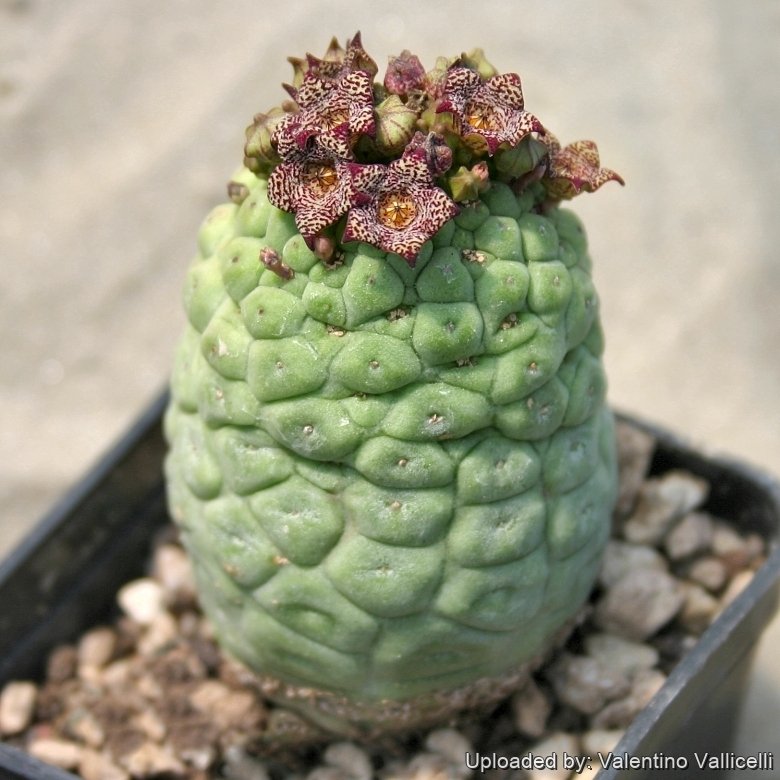
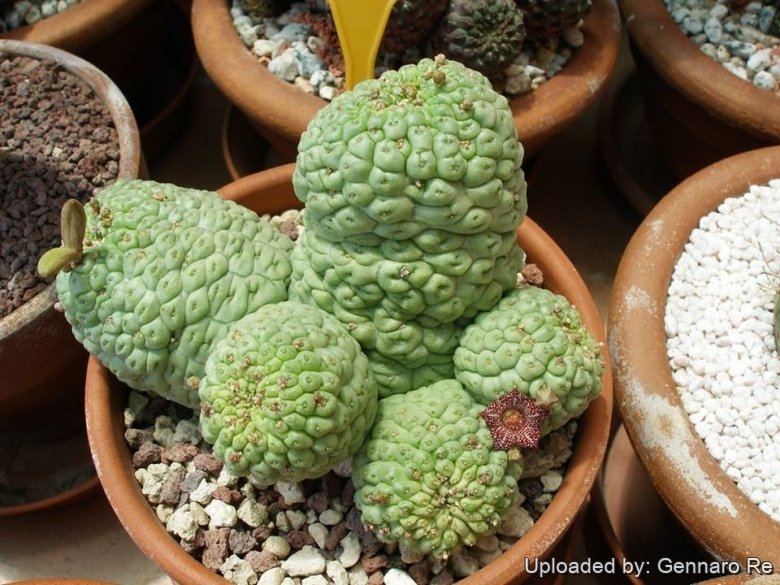
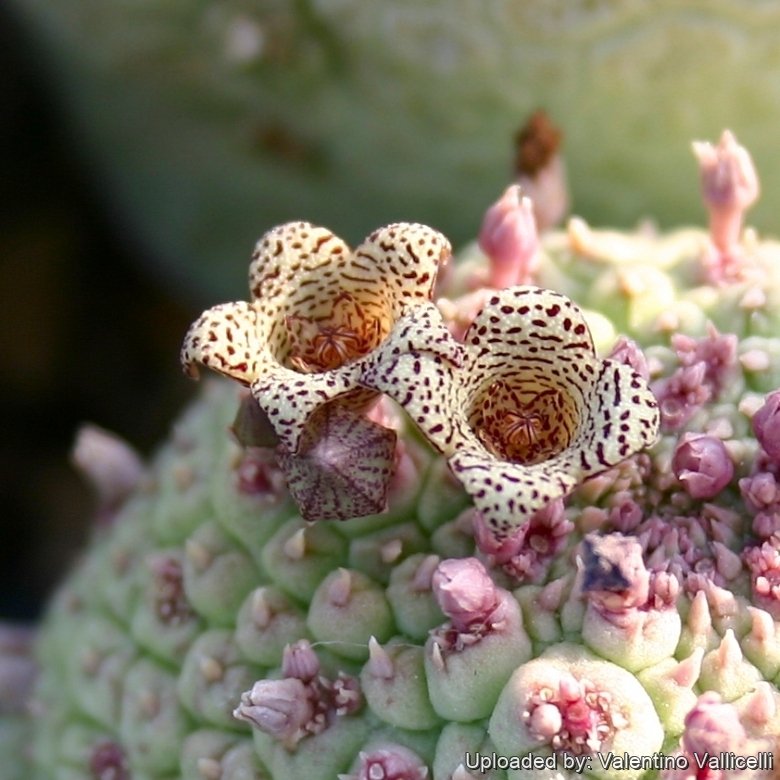
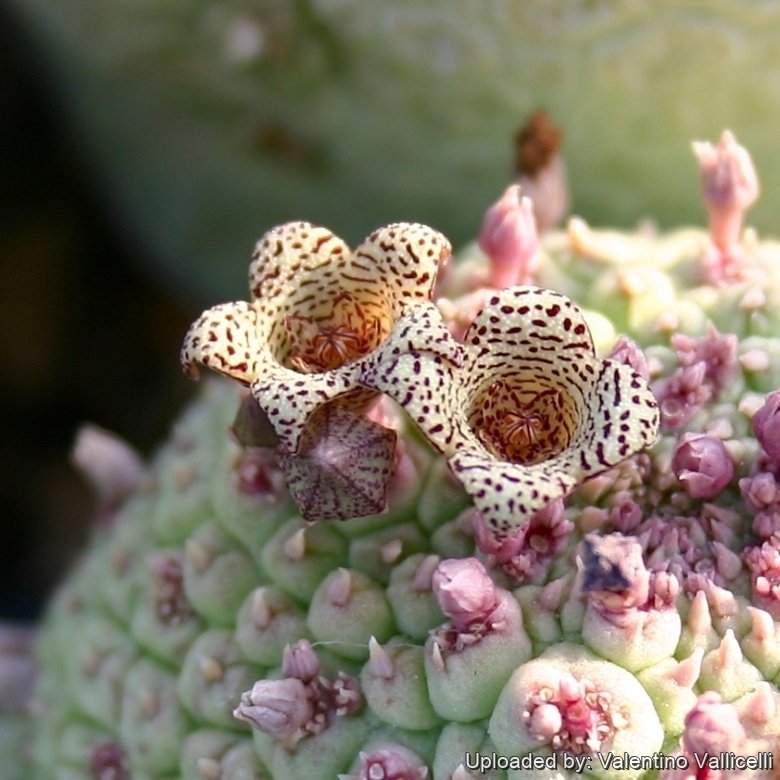
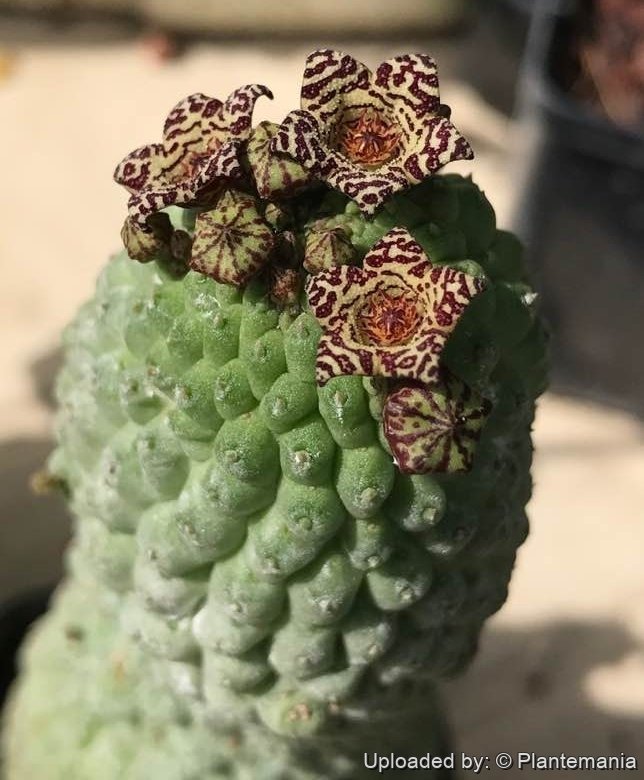
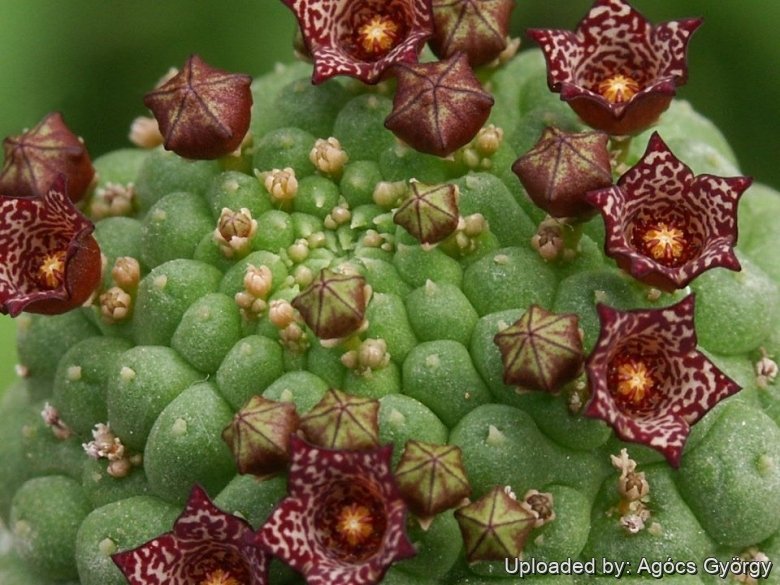
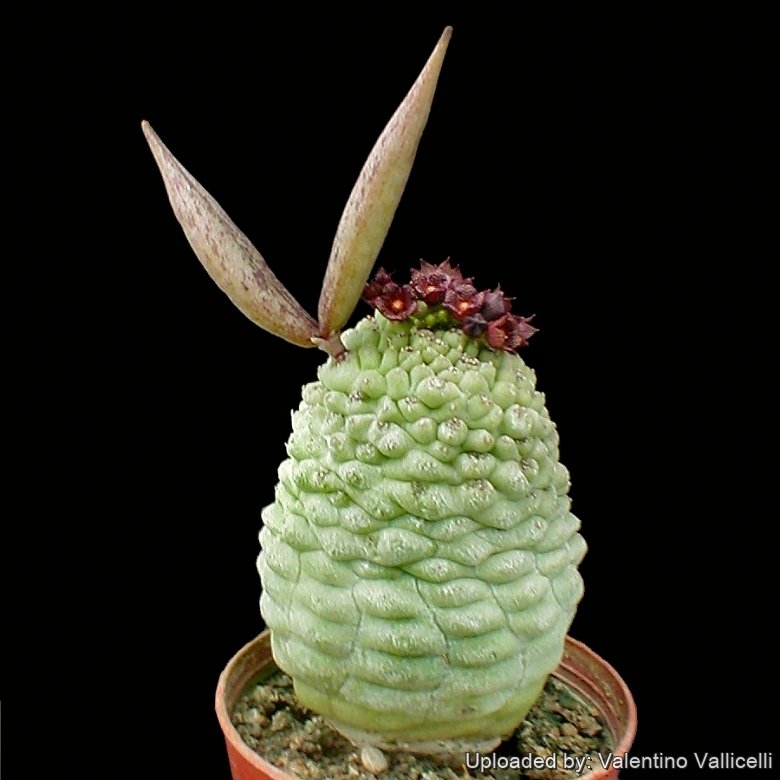
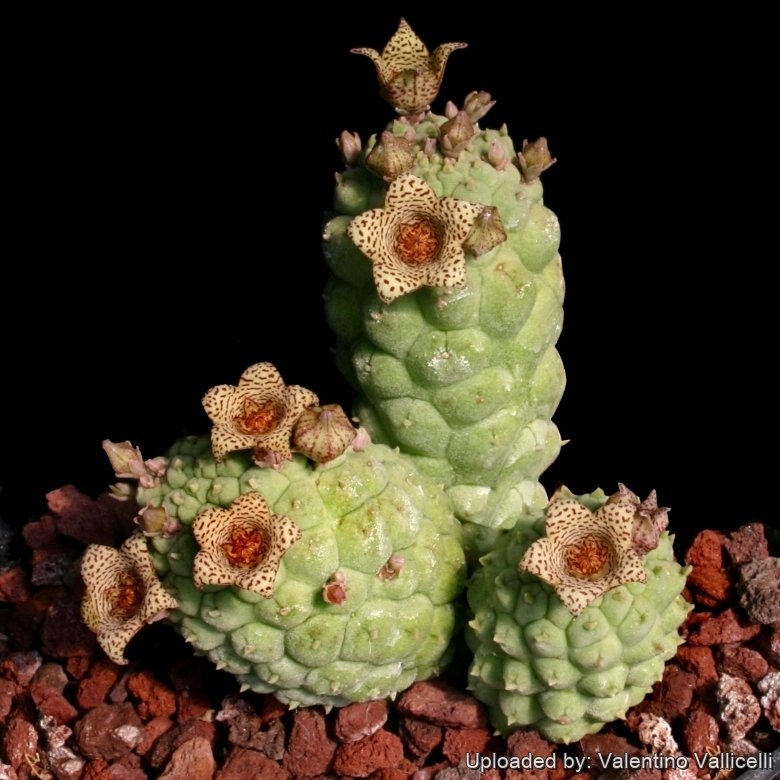
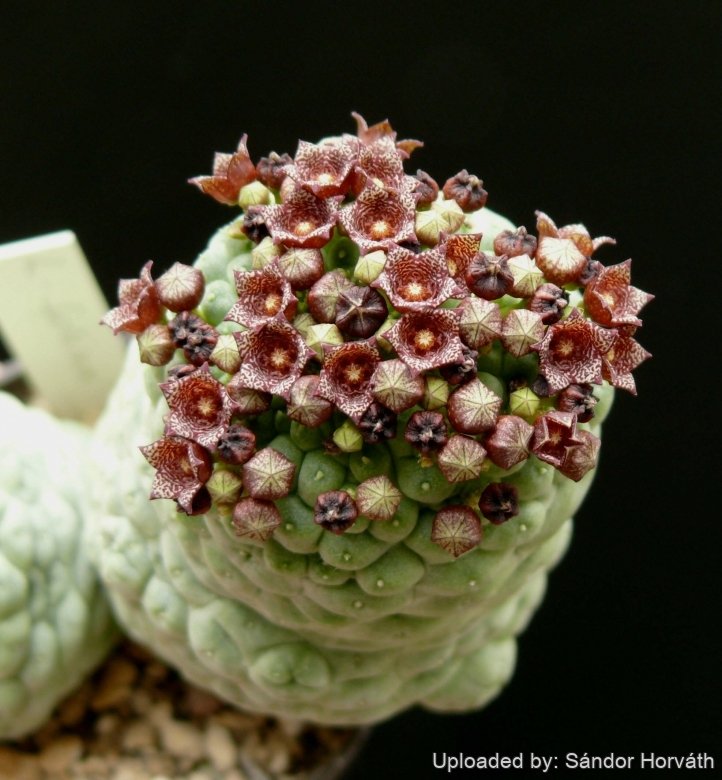
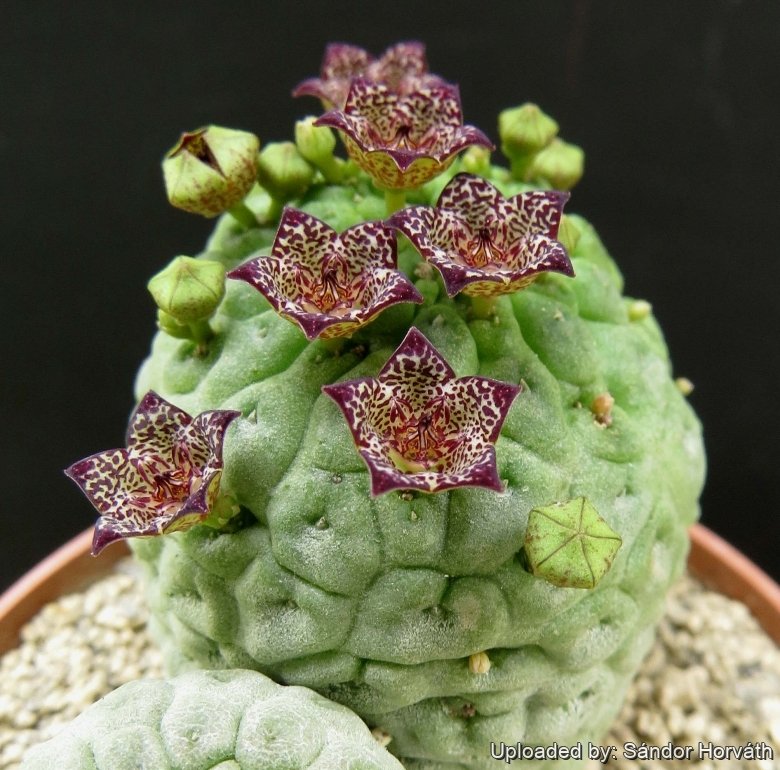
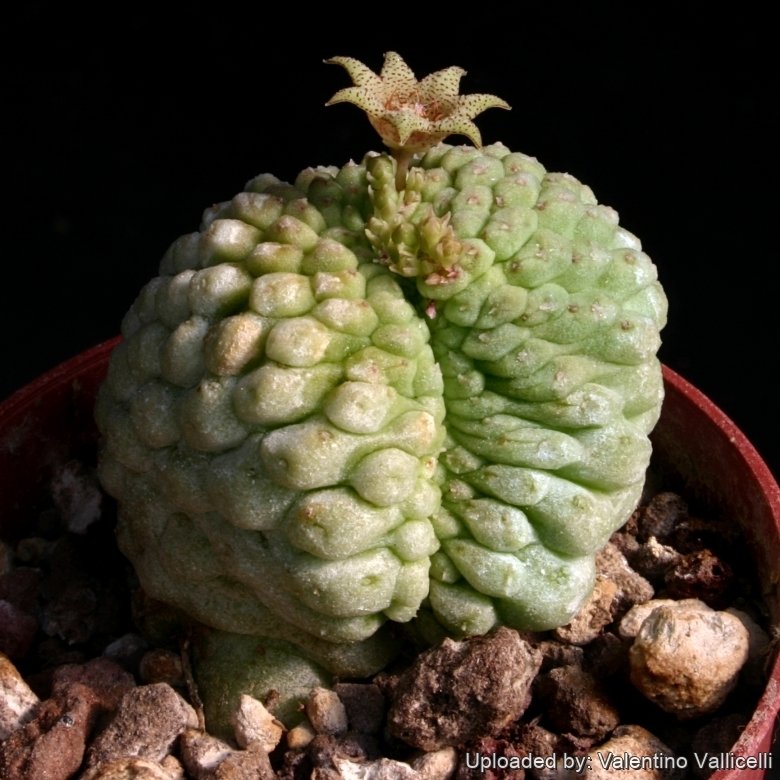
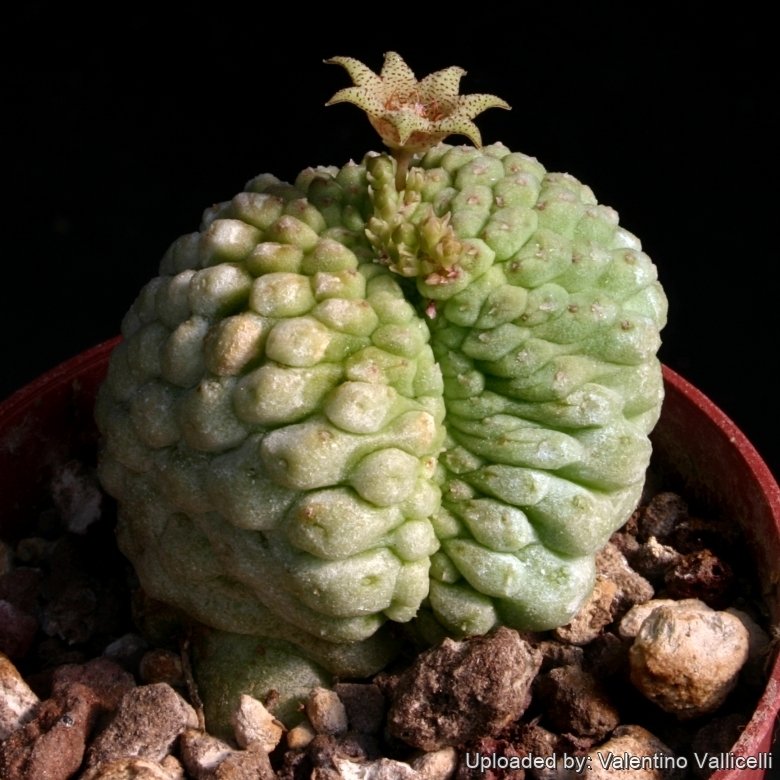
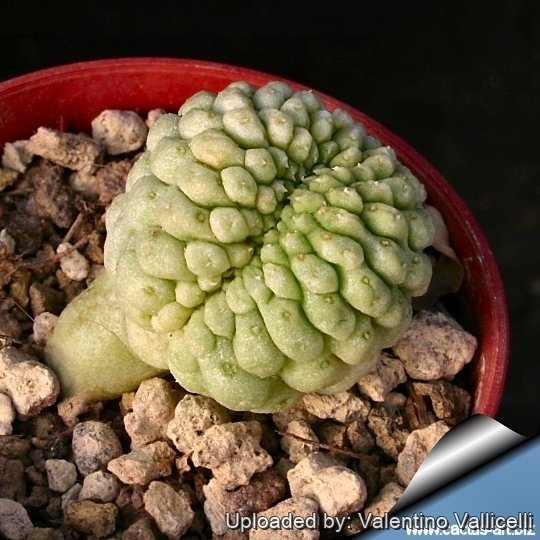
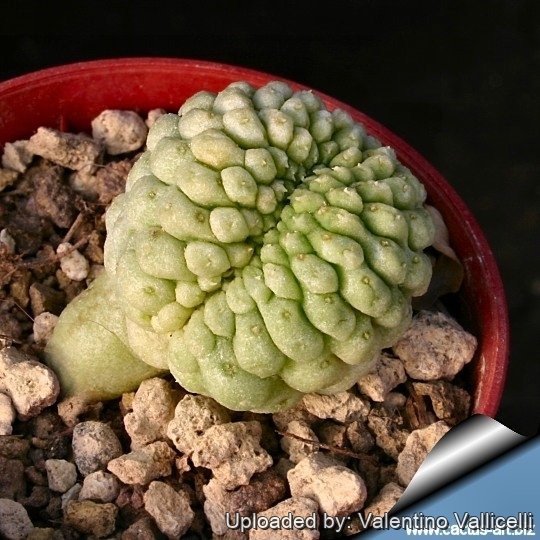
Larryleachia cactiformis, best known in cultivation as Trichocaulon cactiforme, is a small perennial stem succulent with a globular body tessellate with roughly pentangular, flat or depressed tubercles. This species is quite variable particularly in the colour of flowers.
Habit: Unbranched or sparsely branched.
Stem: Globular to short-cylindric, green or light green or blue-green 5-15(rarely 30 cm) high, 20-60 mm wide; latex colourless.
Ribs: 12-16, indistinct ribs and tessellate with roughly pentangular, flat or depressed tubercles closely set together.
Leaves: Persistent, reduced to scales, in spirals or verticillate, sessile (and sunken), strongly adscending, 0,5-1 mm long.
Roots: Fibrous.
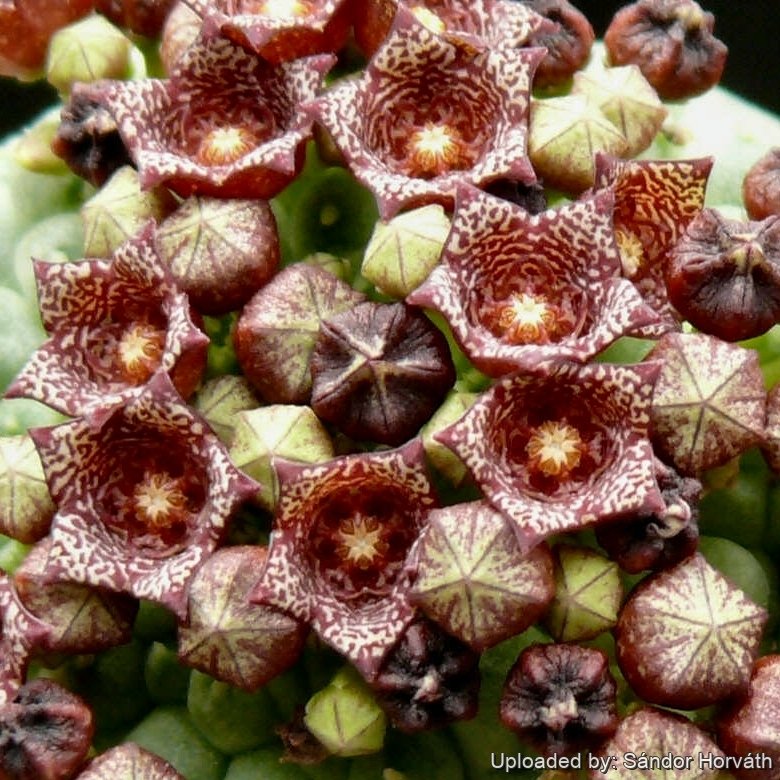
Flowers: Appear (usually) close to apex of stems in extra-axillary inflorescences 1 to 5 together on a tubercle apex, almost sessile or on a short peduncle to 1 mm long. Corolla about 6 to 10 mm in diameter, simple, fleshy, abaxially whitish cream, green, yellow to dull pinkish uniformly coloured or maculate with reddish, purple or maroon, adaxially white, cream, green or yellow, glabrous. Tube flat or deeply cup-shaped. Corolla lobes broad ovate, accuminate, 2-4 mm long, 2-5 mm wide, tip curved upwards, inside more or less papillate with small bristle toward the apex. Inner corona 4-5 mm in diameter.
Blooming season: Flowers open synchronously in summer.
Fruits: 2-3 cm long diverging at an angle of 180°.
Remarks: This plant has a highly specialized pollination biology, that depends upon flies which are deceived, partially trapped and used as collectors of the pollinia which they transport to a cyathium (Flower) on another plant.
Origin and Habitat
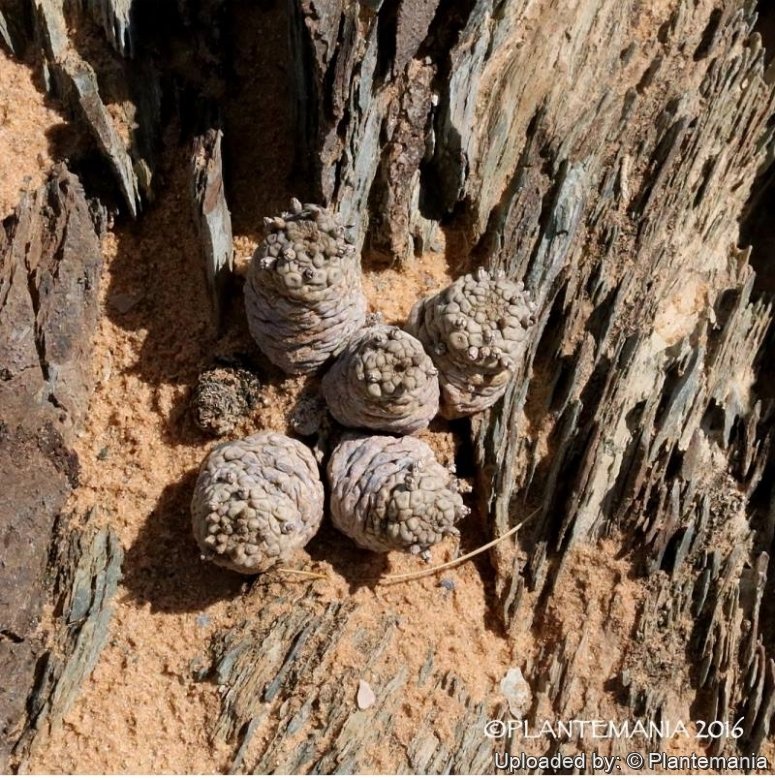
South Africa (Northern Cape, Richtersveld and Namaqualand, from Sendelingsdrift to Garies) and Namibia. This species is common, particularly on the quartz hills of western Bushmanland.
Altitude range: Larryleachia cactiformis grows at an altitude of 800 - 1600 metres above sea level.
Habitat and biology: It can be found on quartz flats, slopes and hills to gneiss domes on the Kamiesberg in the eastern edge of the winter rainfall region in Fynbos, Succulent Karoo. They are highly succulent and adapted to very harsh and bright habitats. Larryleachia is a very fine example of convergent evolution, very easy to mistake for a cactus. However the very similar development of very similar characters in plants evolving in similar conditions although separated by very great distances or otherwise impossible contact. It is widespread, common and not threatened.
Cultivation and Propagation
Watering Needs: Water normally in the growing season, dry in the winter.
Summer: In the summer months they will grow well in partial shade.
Potting medium: Since roots are quite shallow, use a cactus mix or add extra perlite or pumice to regular soil potting soil. A gritty, very free-draining compost is suitable, and clay pots help the plants to dry out between watering.
Propagation: Seeds.
Notes
The genus Larryleachia was erected by Plowes in honour of Leslie Leach, an English-born electrical engineer, self-taught botanist, and specialist in Asclepiads and Euphorbias. This plant is perhaps best known as one of the smooth-stemmed members of Trichocaulon, the spiny stemmed species were combined with Hoodia, leaving the former in need of a new generic home. The new genus Leachia was rendered invalid as it had already been applied to a genus in the Asteraceae. Realizing his error, Plowes chose a new name Leachiella. Despite having checked as to the availability of that name no one realized until after publication that it had been used before for a genus of red algae. In 1997 it was finally designated as Larryleachia picta along with several other smooth-stemmed species of the former Trichocaulon genus, now the preferred designation among botanists today.
Bibliography
Major references and further lectures
-
Focke Albers, Ulrich Meve “Illustrated Handbook of Succulent Plants: Asclepiadaceae, Volume 4” Springer, 2002
-
James Cullen, Sabina G. Knees, H. Suzanne Cubey “The European Garden Flora Flowering Plants: A Manual for the Identification of Plants Cultivated in Europe, Both Out-of-Doors and Under Glass”Cambridge University Press, 11/August/2011
-
Alain Campbell White, Boyd L. Sloane “The Stapelieae, Volume 3” Abbey San Encino Press, 1937
-
Werner Rauh “The Wonderful World of Succulents: Cultivation and Description of Selected Succulent Plants Other Than Cacti” Smithsonian Institution Press, 1984
-
Maurizio Sajeva, Mariangela Constanzo, Mariangela Costanz “The Illustrated Dictionary”
Cassell Illustrated, 1995
-
Peter V. Bruyns “Stapeliads of southern Africa and Madagascar, Volume 1” Umdaus Press, 01/January/2005
-
von Staden, L. 2012. Larryleachia cactiformis (Hook.) Plowes var. cactiformis. National Assessment: Red List of South African Plants version 2014.1. Accessed on 2015/06/02
-
Hilton-Taylor, C. 1996. “Red data list of southern African plants.” Strelitzia 4. South African National Botanical Institute, Pretoria.
-
Raimondo, D., von Staden, L., Foden, W., Victor, J.E., Helme, N.A., Turner, R.C., Kamundi, D.A. and Manyama, P.A. 2009. “Red List of South African Plants.” Strelitzia 25. South African National Biodiversity Institute, Pretoria.
From llifle page Hoodia felina
Description
Larryleachia felina (firstly described as Trichocaulon felinum by D.T. Cole in 1985) is a local or morphological form of the widespread and variable Larryleachia cactiformis. Larryleachia felina has characteristic inner corona lobes short and curved like cat’s claws, hence the specific name (from Latin ‘felinus’ of or belonging to the family Felidae, which includes the lions, tigers, jaguars, and cats.) Flowers are small creamy-white coloured, finely and uniformly spotted or striped with wine red. However the distinguishing characteristics of this plant, appear to fall within the natural variation of Larryleachia cactiformis and Bruyns placed this taxon as a synonym under his Lavrania cactiformis, stating that the size difference between the former and the latter that was seen in the original specimens from the summit of the Rosyntjesberg is not always constant and that a size and colour continuum exists there and elsewhere such as at Klipbok and Eenriet north of Steinkopf. However the plants in the summit of the Rosyntjesberg are all typical L. felina, albeit with some minor size differences, whereas lower down some 5 km to the north the plants on a quartz hill are normal Larryleachia cactiformis. Whatever this plant is, Larryleachia felina still has a value for a collector because they identify plants with particular characters.
Origin and Habitat
Larryleachia felina is only known from the type locality: Cape Province, Richtersveld, Near the summit of Rosyntjieberg, South Africa.
Cultivation and Propagation
Larryleachia felina is a slow growing species of relatively easy culture. If grown correctly, it will reward the grower with generous displays of flowers.
Potting medium: Since roots are quite shallow, use a cactus mix or add extra perlite or pumice to regular soil potting soil. A gritty, very free-draining compost is suitable, and clay pots help the plants to dry out between watering.
Fertilization: Feed with a high potassium fertilizer in summer.
Light requirements: High levels of light are needed to flower and for good development. Can be sunburned if moved from shade/greenhouse into full sun too quickly. During the spring it may be able to take full sun until the heat arrives at the end of spring. In an area that has hot afternoon sun, it may be able to take full morning sun, but requires afternoon shade or afternoon light shade.
Watering Needs: water normally in the growing season, but do not overwater (very wet-sensitively, especially in light of its small root system) Water thoroughly only if soil is dry to the touch, let soil dry in between to prevent root rot, keep dry in the winter with ample airflow. Care must be taken with watering as they tends to become swollen and untidy in growth habit if given too much water and shade.
Hardiness: It is quite frost resistant if kept dry, hardy as low as -5° C (or less)
Propagation: Seeds or division, wait until the offsets that appear at the base of old clustered specimens are 1/3 the size of the parent and then detach and plant.
Bibliography
Major references and further lectures
-
Excelsa, Editions 13-17 Aloe, Cactus and Succulent Society of Rhodesia, 1988
-
D.T. Cole “Trichocaulon felinum: a new species from the Richtersveld.” Aloe, Mondstuk van die Suid-Afrikaanse Aalwyn-en Vetplant Vereniging. Journal of the South african Aloe and Succulent Society. Pretoria 22(1): 6–7. 1985.
Source: Hoodia felina, LLIFLE - Encyclopedia of living forms, CC-BY-SA, retrieved 2026-10-25.
From llifle page Hoodia similis
Description
Larryleachia similis, formerly knows as Trichocaulon simile is a perennial succulent with stems resembling that of Larryleachia cactiformis. It is a small globular globular to oblong succulent distinguished from Larryleachia cactiformis for its cup-shaped corolla that encloses the corona, however the distinguishing characteristics of this plant, appear to fall within the natural variation of Larryleachia cactiformis and it should be synonymized with the latter. Larryleachia similis (whatever this plant is) still has a value for a collector because they identify plants with particular characters.
Stems: Oblong or globose-obovoid, tapering upwards, greyish-green 5-9 (or more?) cm high and 4-6 cm thick, quite smooth, only a little wrinkled, covered with irregular hexagonal tubercles, that are more prominent than in Larryleachia cactiformis, the youngest near the apex tipped with a small apiculus or bristle (a minute conical leaf less than 1 mm long and 1 mm broad).
Flowers: At the apex of the stems, opening in succession until a number are open together. Pedicels 2-3 mm long, glabrous. Calyx-lobes (sepals) 1-2 mm long and quite as broad, broadly ovate, acute, glabrous. Corolla 9-15 mm in diameter, green outside with copious reddish-brown blotches giving it a brown appearance, pale greenish-yellow above, with round dark brown-red spots, campanulate, quite glabrous and not ciliate on the lobes, smooth outside, minutely papillate-rugulose on the inner face of the lobes, deep purple-brown. Tube 3 mm long, 5-6 mm in diameter outside, cup-shaped, with fleshy ridges from the sinuses to the floor of the tube, cream-colored in the lower part, the upper part and the lobes with numerous dark red spots. Lobes spreading, 3-4 mm long, 5 mm in breadth, broadly ovate to triangular in outline, acute, reflexed. Outer corona shortly cupular at the base, 5-lobed, with each lobe deeply trifid and with the apices of the two lateral red teeth converging slightly over the somewhat shorter central spotted tooth, the two lateral teeth longer than and arching over the middle tooth, suberect, rising to the level of the inner corona, 1.5-2 mm long. Inner corona-lobes copiously spotted, 1-1.5 mm long, flat, oblong-linear, obtuse, ascending-connivent, closely pressed to the backs of the anthers and then ascending, converging to form a column for 1 mm. of their length, dorsally connected at the base to the cup of the outer corona.
Origin and Habitat
Southern Namibia to northern Cape (South Africa)
Cultivation and Propagation
Larryleachia similis is a slow growing species of relatively easy culture. If grown correctly, it will reward the grower with generous displays of flowers.
Potting medium: Since roots are quite shallow, use a cactus mix or add extra perlite or pumice to regular soil potting soil. A gritty, very free-draining compost is suitable, and clay pots help the plants to dry out between watering.
Fertilization: Feed with a high potassium fertilizer in summer.
Light requirements: High levels of light are needed to flower and for good development. Can be sunburned if moved from shade/greenhouse into full sun too quickly. During the spring it may be able to take full sun until the heat arrives at the end of spring. In an area that has hot afternoon sun, it may be able to take full morning sun, but requires afternoon shade or afternoon light shade.
Watering Needs: water normally in the growing season, but do not overwater (very wet-sensitively, especially in light of its small root system) Water thoroughly only if soil is dry to the touch, let soil dry in between to prevent root rot, keep dry in the winter with ample airflow. Care must be taken with watering as they tends to become swollen and untidy in growth habit if given too much water and shade.
Hardiness: It is quite frost resistant if kept dry, hardy as low as -5° C (or less)
Propagation: Seeds or division, wait until the offsets that appear at the base of old clustered specimens are 1/3 the size of the parent and then detach and plant.
Bibliography
Major references and further lectures
-
N. E. Brown “Flora Capensis”, Vol 4, 1909
-
Alain Campbell White, Boyd L. Sloane “The Stapelieae”, Volume 3 Typography and printing by S. E. Haselton at Abbey San Encino Press, 1937
-
Botanical Research Institute, Department of Agricultural Technical Services, Republic of South Africa “The Flowering Plants of Africa”, Volume 16, page 620, 1936
-
Botanical Research Institute (South Africa), South Africa. Dept. of Agricultural Technical Services “The Flowering Plants of Africa: A Magazine Containing Coloured Figures with Descriptions of the Flowering Plants Indigenous in Africa”, Volume 18 1938
Source: Hoodia similis, LLIFLE - Encyclopedia of living forms, CC-BY-SA, retrieved 2026-10-25.
From llifle page Trichocaulon cactiforme f. cristata
Description
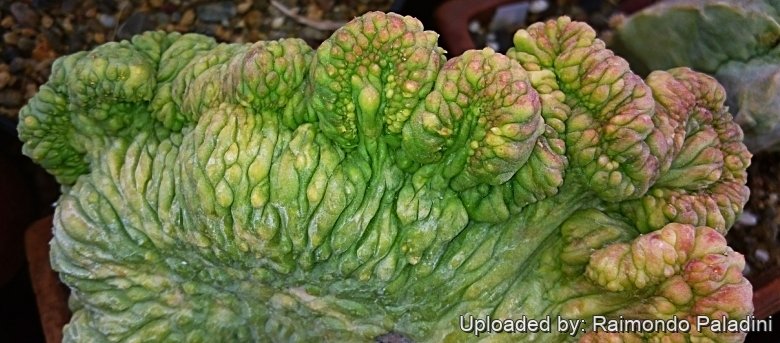
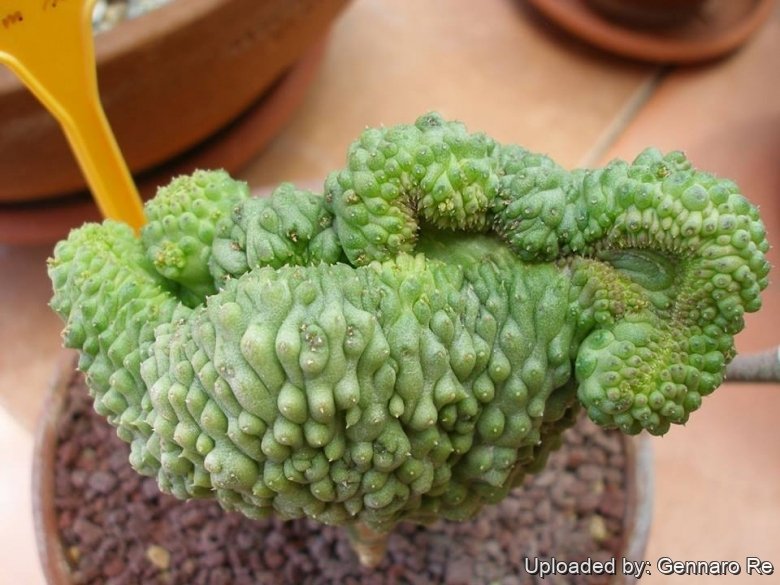
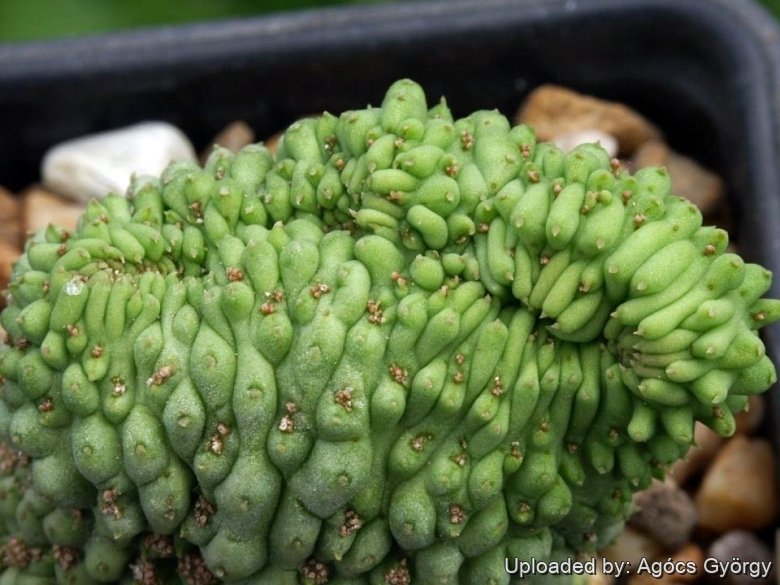
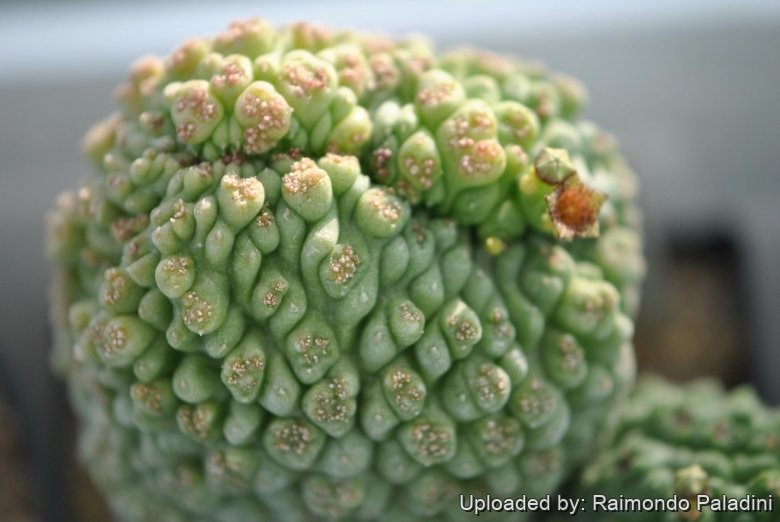
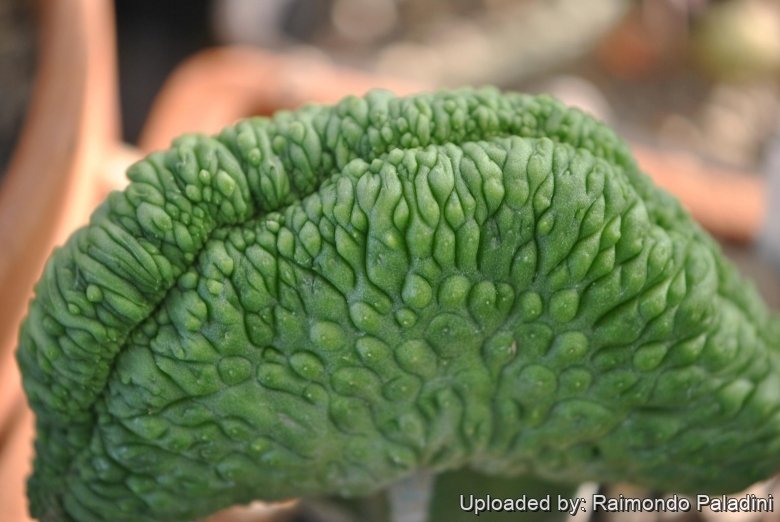
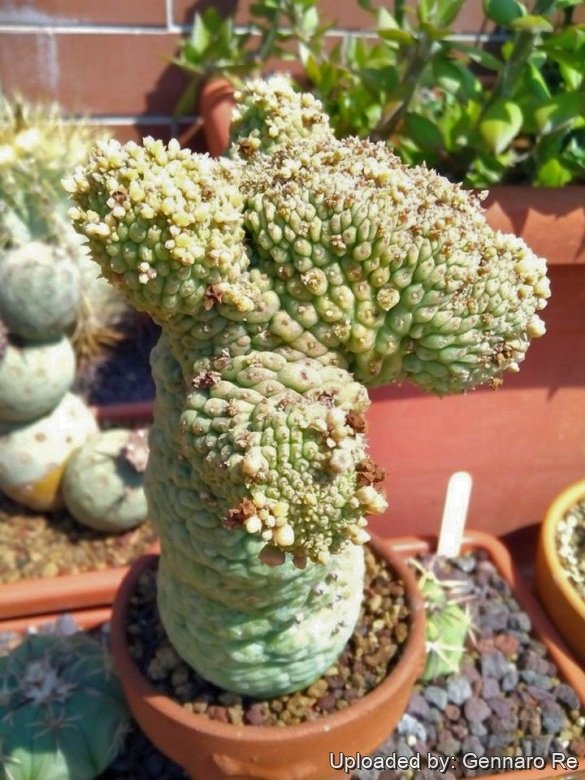
Larryleachia cactiforme is a small perennial stem succulent with a globular body tessellate with roughly pentangular, flat or depressed tubercles. This species is quite variable particularly in the colour of flowers. The crested form Larryleachia cactiformis var. cristata is very rare in cultivation and sought after by collectors, for its unique features.
Stem: Fan shaped, flattened on top, depressed centrally, green or light green or blue-green 20-60 mm thick; latex colourless.
Ribs: Indistinct ribs and tessellate with roughly pentangular, flat or depressed tubercles closely set together.
Leaves: Persistent, reduced to scales, in spirals or verticillate, sessile (and sunken), strongly adscending, 0,5-1 mm long.
Roots: Fibrous.
Flowers: Appear (usually) close to apex of stems in extra-axillary inflorescences 1 to 3 together on a tubercle apex, each about 6 to 10mm, in diameter, simple, sessile, fleshy, abaxially whitish cream, green, yellow to dull pinkish uniformly coloured or maculate with reddish, purple or maroon, adaxially white, cream, green or yellow, maculate, glabrous.
Blooming season: Flowers open synchronously in summer.
Remarks: This plant has a highly specialized pollination biology, that depends upon flies which are deceived, partially trapped and used as collectors of the pollinia which they transport to a cyathium (Flower) on another plant.
Origin and Habitat
Garden origin (Nursery produced cultivar)
Cultivation and Propagation
Water normally in the growing season, dry in the winter.
Summer: In the summer months they will grow well in partial shade.
Propagation: Seeds grafting.
Potting medium: Since roots are quite shallow, use a cactus mix or add extra perlite or pumice to regular soil potting soil. A gritty, very free-draining compost is suitable, and clay pots help the plants to dry out between watering.
Sun Exposure: Partial shade.
Bibliography
Major references and further lectures
-
Focke Albers, Ulrich Meve “Illustrated Handbook of Succulent Plants: Asclepiadaceae, Volume 4” Springer, 2002
-
James Cullen, Sabina G. Knees, H. Suzanne Cubey “The European Garden Flora Flowering Plants: A Manual for the Identification of Plants Cultivated in Europe, Both Out-of-Doors and Under Glass”Cambridge University Press, 11/ago/2011
-
Alain Campbell White, Boyd L. Sloane “The Stapelieae, Volume 3” Abbey San Encino Press, 1937
-
Werner Rauh “The Wonderful World of Succulents: Cultivation and Description of Selected Succulent Plants Other Than Cacti” Smithsonian Institution Press, 1984
-
Maurizio Sajeva, Mariangela Constanzo, Mariangela Costanz “The Illustrated Dictionary”
Cassell Illustrated, 1995
- Peter V. Bruyns “Stapeliads of southern Africa and Madagascar, Volume 1” Umdaus Press, 01/gen/2005
Source: Trichocaulon cactiforme f. cristata, LLIFLE - Encyclopedia of living forms, CC-BY-SA, retrieved 2026-10-26.
Cultivars and forms (2)
Gallery