Publication: Stapeliads S. Africa Madagascar 1: 223. 2005
Description
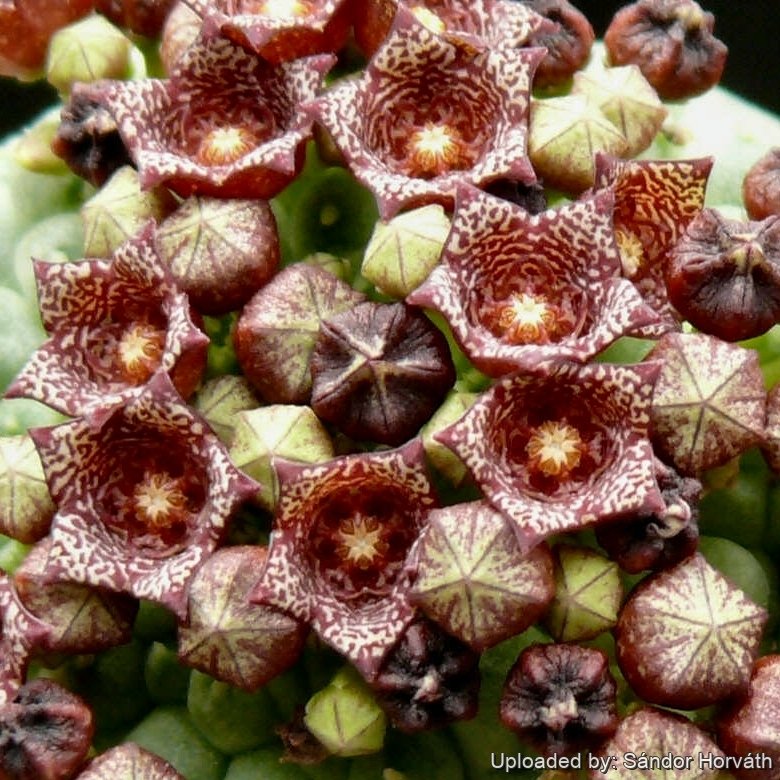
Larryleachia felina (firstly described as Trichocaulon felinum by D.T. Cole in 1985) is a local or morphological form of the widespread and variable Larryleachia cactiformis. Larryleachia felina has characteristic inner corona lobes short and curved like cat’s claws, hence the specific name (from Latin ‘felinus’ of or belonging to the family Felidae, which includes the lions, tigers, jaguars, and cats.) Flowers are small creamy-white coloured, finely and uniformly spotted or striped with wine red. However the distinguishing characteristics of this plant, appear to fall within the natural variation of Larryleachia cactiformis and Bruyns placed this taxon as a synonym under his Lavrania cactiformis, stating that the size difference between the former and the latter that was seen in the original specimens from the summit of the Rosyntjesberg is not always constant and that a size and colour continuum exists there and elsewhere such as at Klipbok and Eenriet north of Steinkopf. However the plants in the summit of the Rosyntjesberg are all typical L. felina, albeit with some minor size differences, whereas lower down some 5 km to the north the plants on a quartz hill are normal Larryleachia cactiformis. Whatever this plant is, Larryleachia felina still has a value for a collector because they identify plants with particular characters.
Origin and Habitat
Larryleachia felina is only known from the type locality: Cape Province, Richtersveld, Near the summit of Rosyntjieberg, South Africa.
Cultivation and Propagation
Larryleachia felina is a slow growing species of relatively easy culture. If grown correctly, it will reward the grower with generous displays of flowers.
Potting medium: Since roots are quite shallow, use a cactus mix or add extra perlite or pumice to regular soil potting soil. A gritty, very free-draining compost is suitable, and clay pots help the plants to dry out between watering.
Fertilization: Feed with a high potassium fertilizer in summer.
Light requirements: High levels of light are needed to flower and for good development. Can be sunburned if moved from shade/greenhouse into full sun too quickly. During the spring it may be able to take full sun until the heat arrives at the end of spring. In an area that has hot afternoon sun, it may be able to take full morning sun, but requires afternoon shade or afternoon light shade.
Watering Needs: water normally in the growing season, but do not overwater (very wet-sensitively, especially in light of its small root system) Water thoroughly only if soil is dry to the touch, let soil dry in between to prevent root rot, keep dry in the winter with ample airflow. Care must be taken with watering as they tends to become swollen and untidy in growth habit if given too much water and shade.
Hardiness: It is quite frost resistant if kept dry, hardy as low as -5° C (or less)
Propagation: Seeds or division, wait until the offsets that appear at the base of old clustered specimens are 1/3 the size of the parent and then detach and plant.
Bibliography
Major references and further lectures
-
Excelsa, Editions 13-17 Aloe, Cactus and Succulent Society of Rhodesia, 1988
-
D.T. Cole “Trichocaulon felinum: a new species from the Richtersveld.” Aloe, Mondstuk van die Suid-Afrikaanse Aalwyn-en Vetplant Vereniging. Journal of the South african Aloe and Succulent Society. Pretoria 22(1): 6–7. 1985.
Gallery