Publication: Cact. Succ. J. (Los Angeles) 42(2) 92 [Mar.-Apr. 1970]
Description
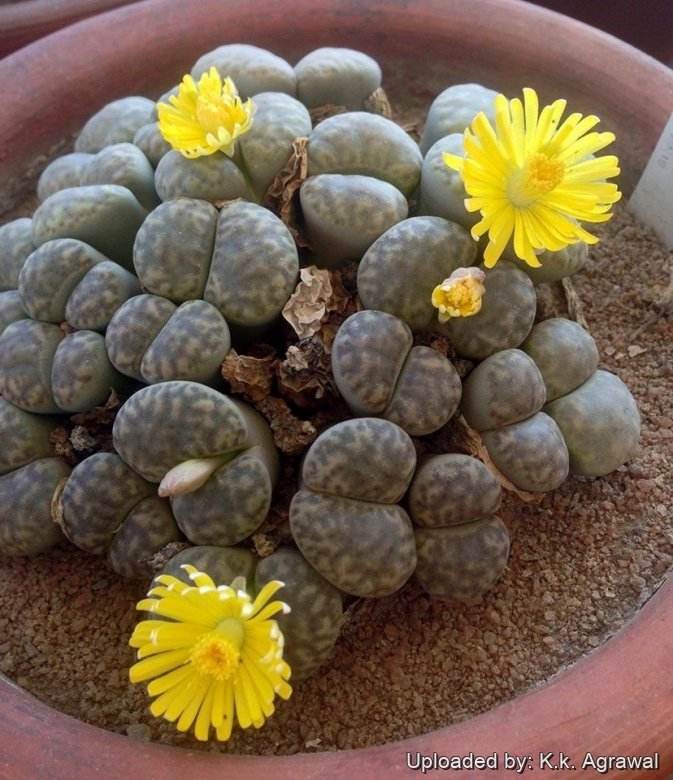
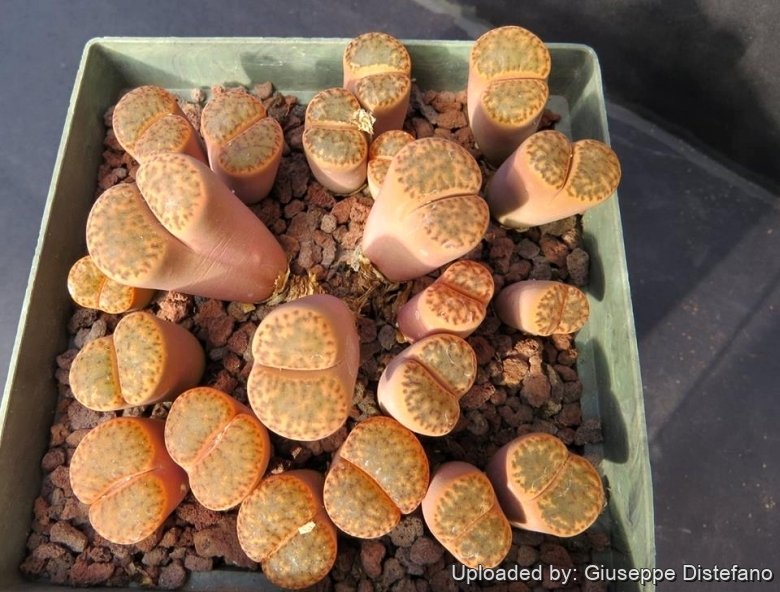
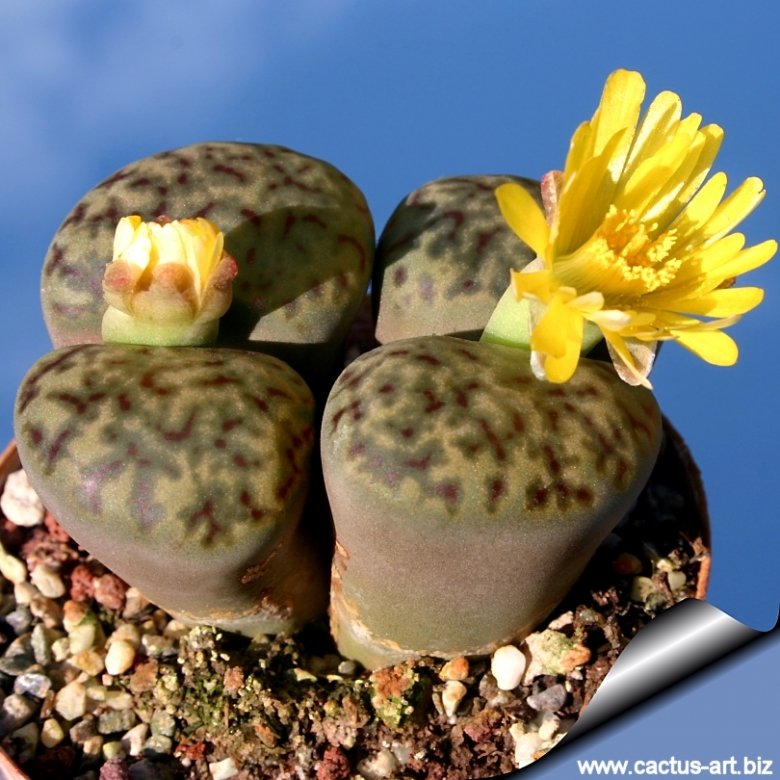
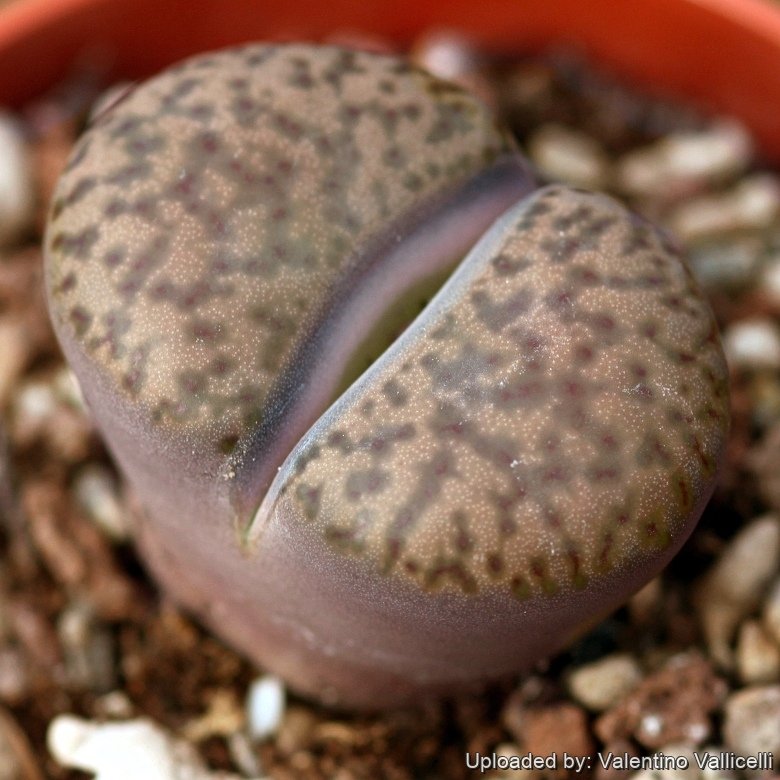
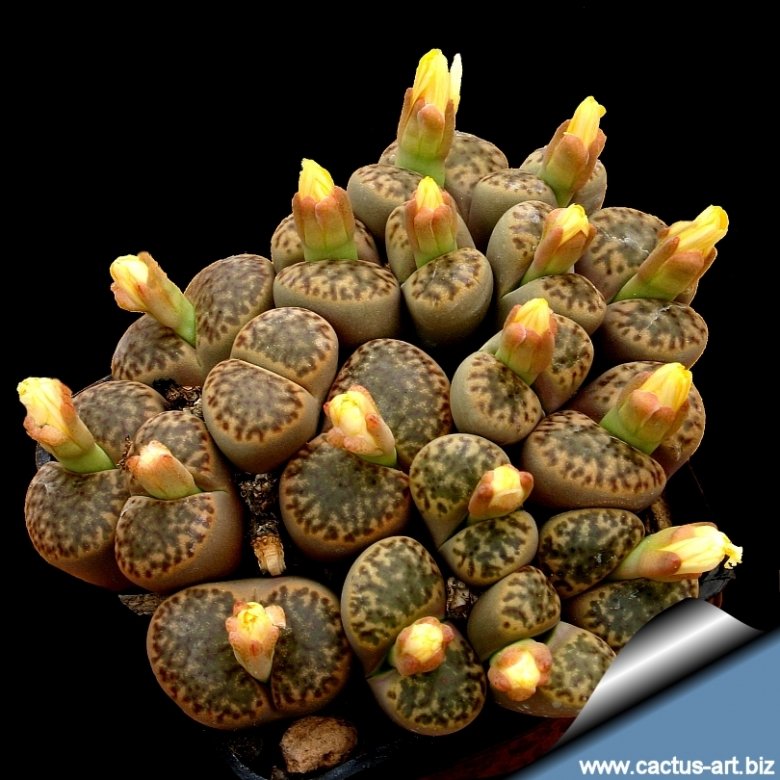
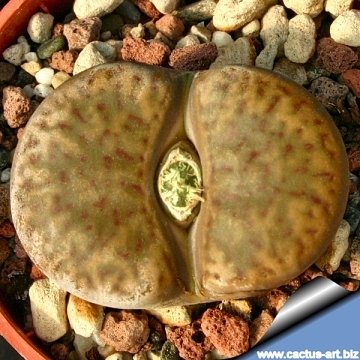
Lithops bromfieldii var. insularis is one of the local form of the variable Lithops bromfieldii , which grows in the immediate neighbourhood. It is a small sized plant characterised by bodies (significantly) smaller, darker, and more smooth, devoid of bumps, unless they are very thirsty. The colour of faces tends toward a deep earthy green, dark brown or black, with virtually no orange shine like in var. bromfieldii. The lines and the punctuation are dark and brilliant. The plants cluster profusely and form small cushions. However L. insularis is not a variant form of L. Bromfieldii and it stands at the one end of the breadth of variation of L. Bromfieldii and that L. Bromfieldii, as described by L. Bolus, is at the other end. This can only be settled by an examination of these two species in their natural habitat and cultivated plants can be reliably distinguished from Lithops bromfieldii only when seeds or details of wild source are available.
Habit: Lithops bromfieldii var. insularis forms clumps or cushions of 10 or more heads, up to to 1,5 cm high and conforms to the typical Lithops morphology: two thick, fleshy windowed leaves separated by a crack from which a yellow flower appears. The windowed part allows light into the inner portion of the leaf where the process of photosynthesis is carried out. As with many other species, several varieties or local forms have been described based on the variation of the colour of the tops of the leaves.
Bodies (paired leaves): Mostly less than 20 mm wide, obconical, truncate darker, and more smooth than the type, devoid of bumps, unless they are very thirsty. The colour of faces tends toward a deep earthy green, dark brown or black, with virtually no orange shine like in var. bromfieldii. The lines and the punctuation are dark and brilliant. The margins with small irregular peninsula are quite indistinct. Rubrications dull blood-red.
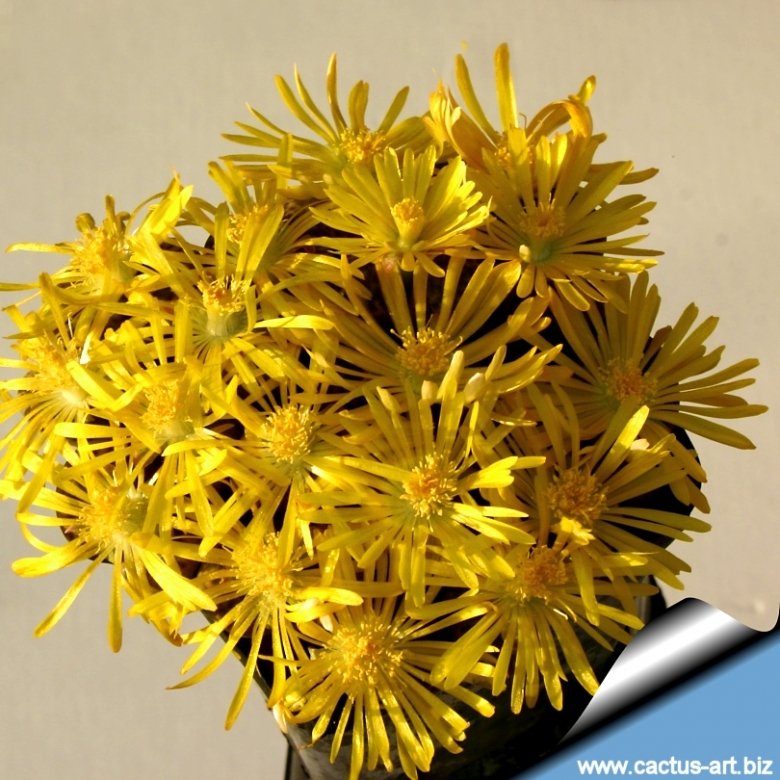
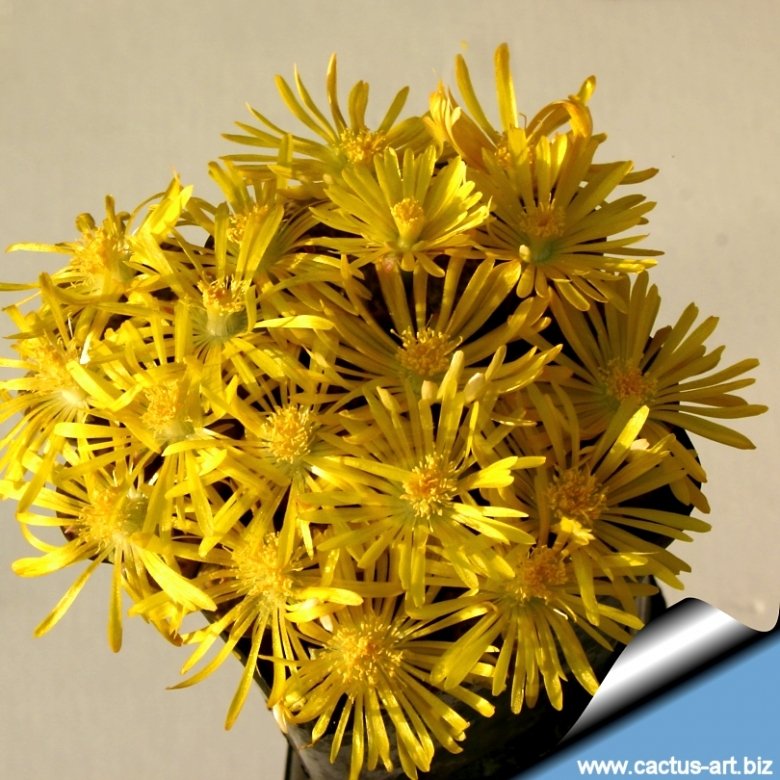
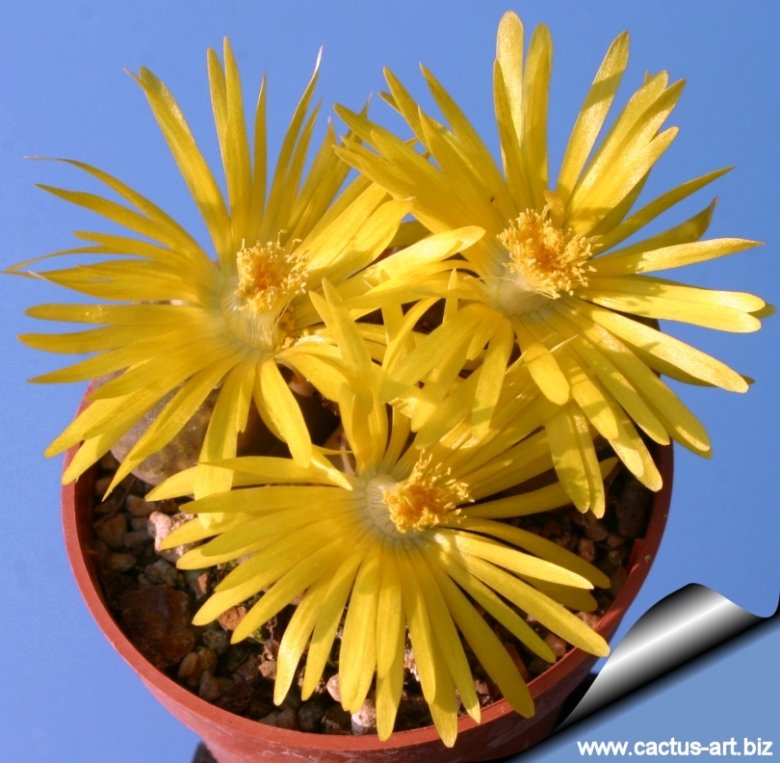
Flowers: Yellow, thinly petaled, 25-35 mm in diameter.
Fruits: Mostly 5-chambered, profile boat-shaped, top flat.
Seeds: Yellow-brown, rugose.
Origin and Habitat
South Africa, Cape province. It is found in a very small area within 5 km on both sides of the Orange River, to the NE and E of Keimoes.
Typical locality: The typical locality (TL) is an island (near) Keimoes, in the Orange River.
Habitat: Grows in stonily soils comprising Feldspathic quartzite; sheared pegmatite. Colours of the stony background greyish brown, pink, brown.
Cultivation and Propagation
In the winter season the plant doesn’t need watering, the plant at this time extracts water from the outer succulent leaves, allowing them to shrivel away, and relocating water to the rest of the plant and to the new leaves that form during this period. This plant is best for a well lit area (Bright shade to full sun). Water sparingly only when warm, no water when cold.
Bibliography
Major refences and further lectures
-
Heidrun E. K. Hartmann “Aizoaceae F – Z” Springer 2002
-
Desmond T. Cole & Naureen A. Cole, Uwe Beyer, Yves Delange “Les Lithops” SUCCULENTES Spécial 2008 AIAPS (now Terra seca). 2008
-
Desmond T. Cole & Naureen A. Cole “LITHOPS Flowering Stones” Cactus & Co. Libri. 2005
-
Yasuhiko Shimada“The Genus Lithops” Dobun Shoin. 2001
-
Rudolf Heine “Lithops - Lebende Steine” Neumann Verlag. 1986
-
Bernd Schlösser “Lithops – Lebende Steine” Praktische Anleitung für die Zimmerkultur. Bussiness Point MEDIA. 2000
-
Steven A. Hammer “Lithops – Treasures of the veld” British Cactus and Succulent Society. 1999
-
Desmond T. Cole “Lithops – Flowering Stones” Acorn Books CC. 1988
-
Rudolf Heine “Lithops – lebende Steine” Neumann Verlag. 1986
-
David L. Sprechman “Lithops” Associated University Presses, Inc. 1970
-
Gert Cornelius Nel “Lithops: Plantae succulantae, rarissimae, in terra obscuratae, e famailia Aizoaceae, ex Africa australi” Hortors Limited, South Africa, 1946
-
Achim Hecktheuer “Mesembs, mehr als nur Lithops” Books on Demand GmbH Norderstedt. 2008
-
Werner Rauh “Die grossartige Welt der Sukkulenten” Hamburg and Berlin: Verlag Paul Parey, 1966
-
Stuart Max Walters “The European Garden Flora: Dicotyledons (Part I)” Cambridge University Press, 1989
-
Gordon D. Rowley “The illustrated encyclopedia of succulents” Crown Publishers, 01/Aug/1978
-
Steven A. Hammer “Lithops: Joyaux du veld” Editions Quae, 25/nov/2010
-
Gustav Schwantes “Flowering Stones and Mid-day Flowers: A Book for Plant and Nature Lovers on the Mesembryanthemaceae” Ernest Benn, 1957
Gallery