Publication: Notes Mesembryanthemum [H.M.L. Bolus] 2: 452. 1934 [23 May 1934]
Description
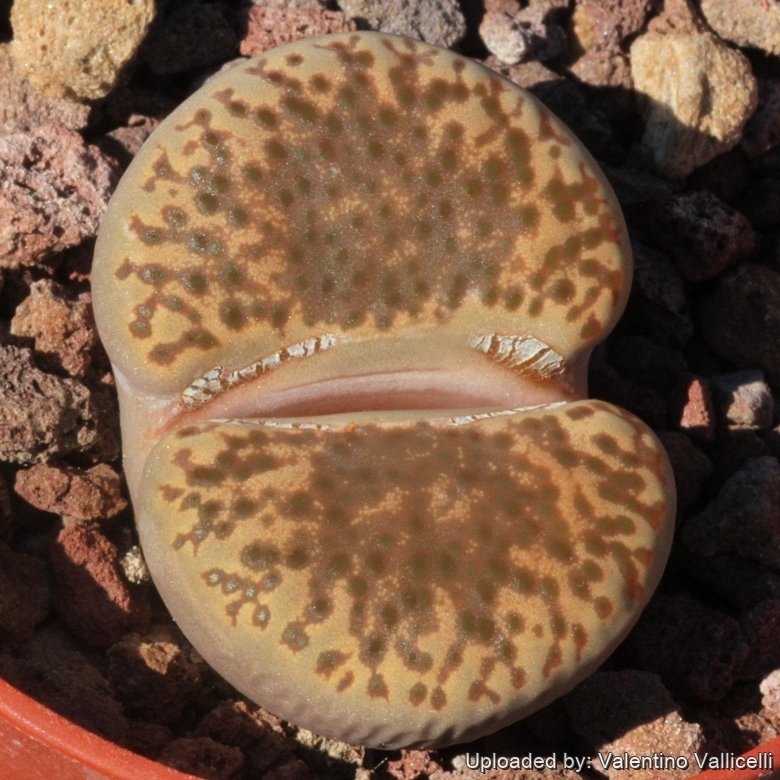
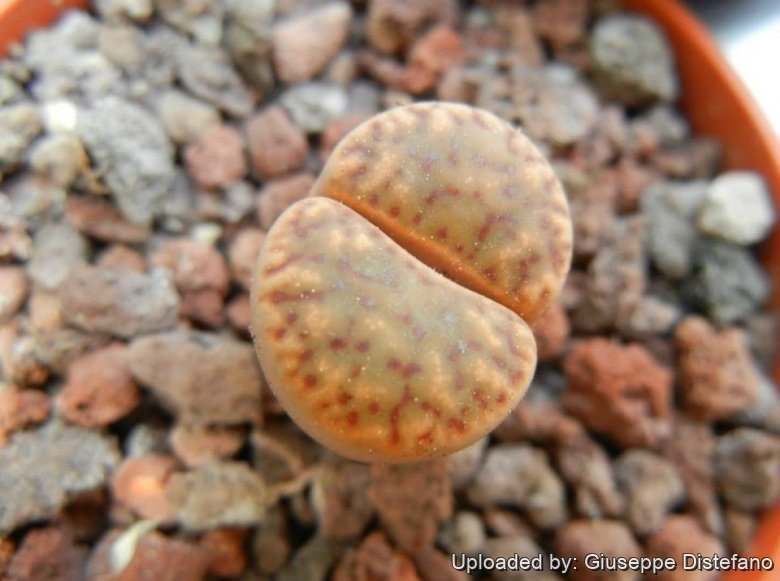
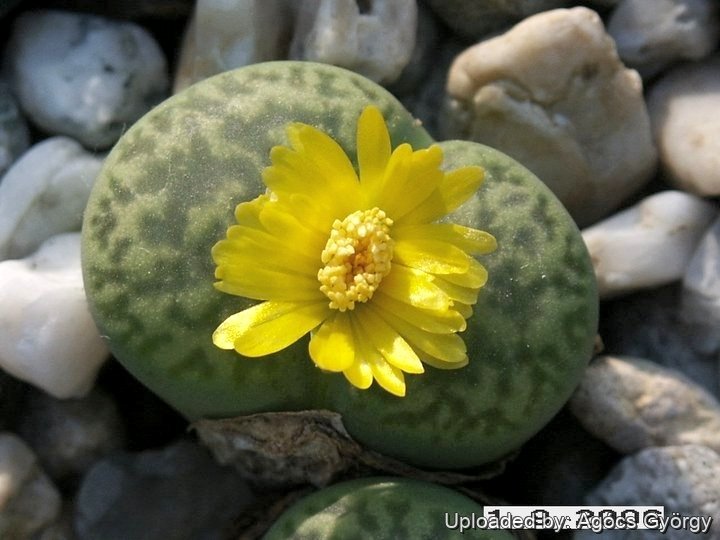
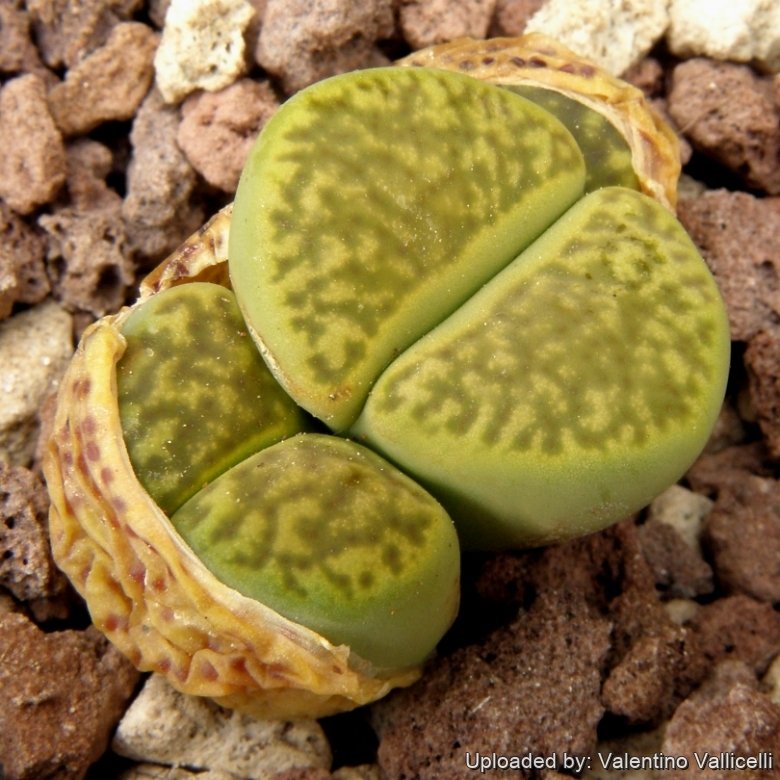
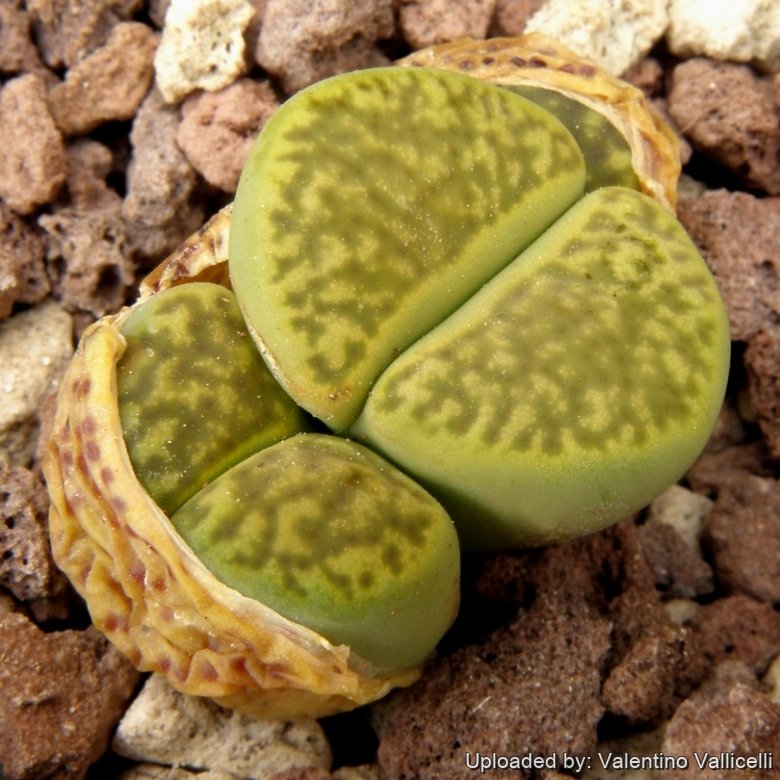
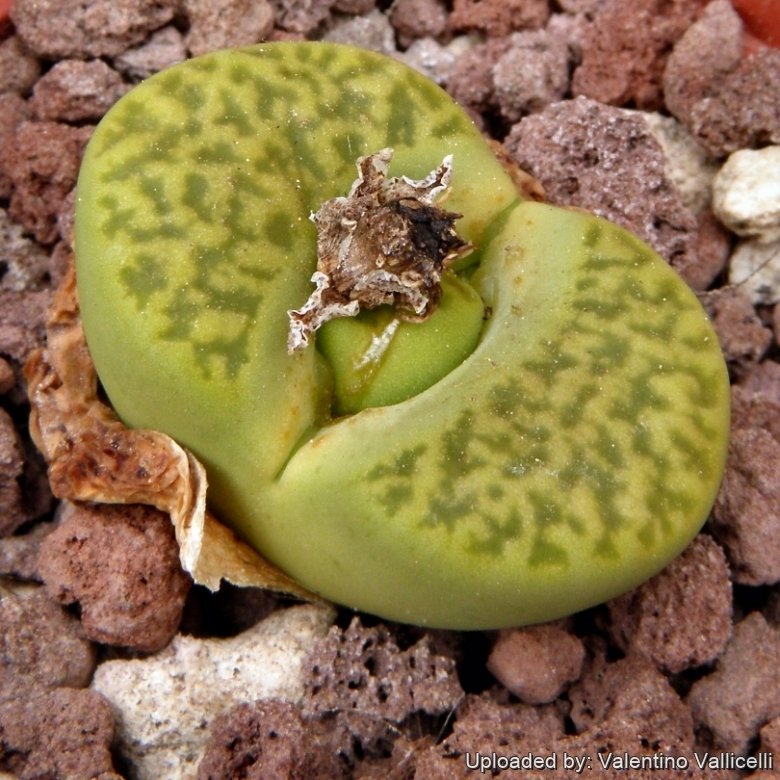
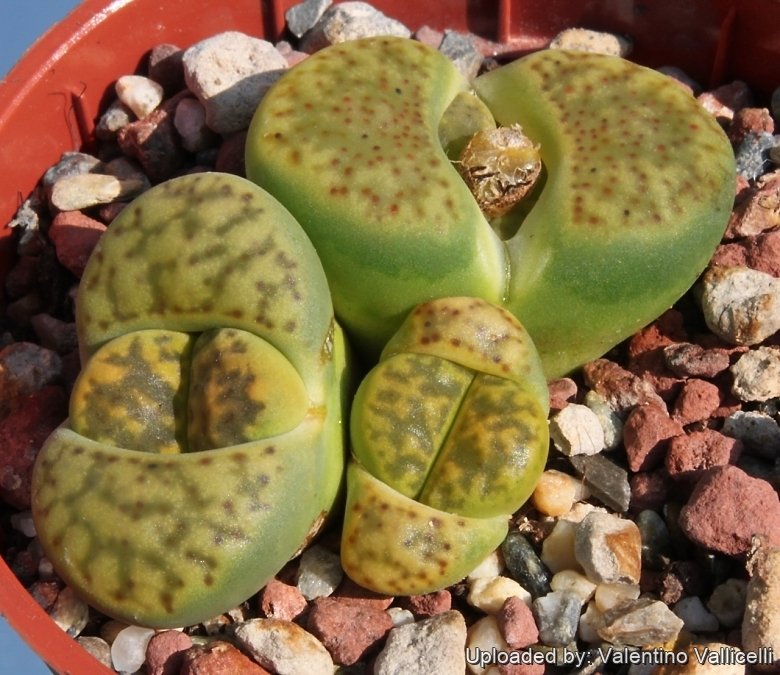
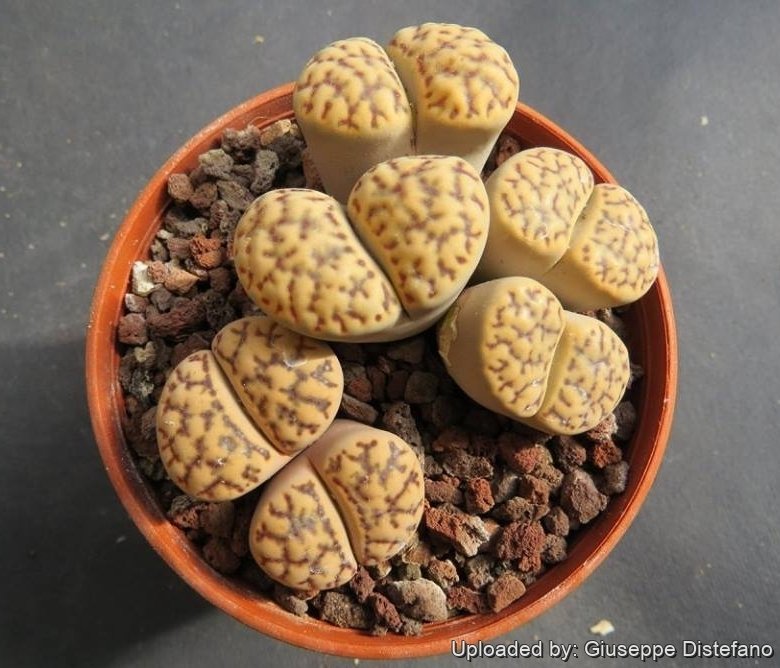
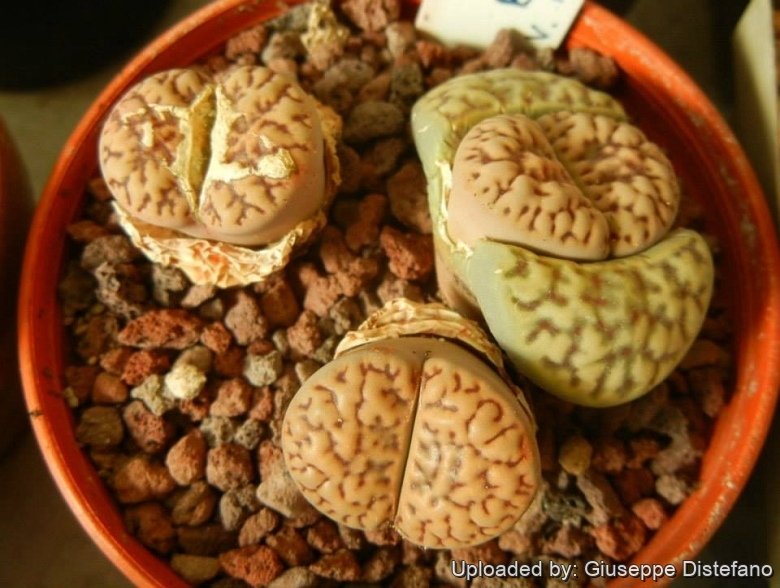
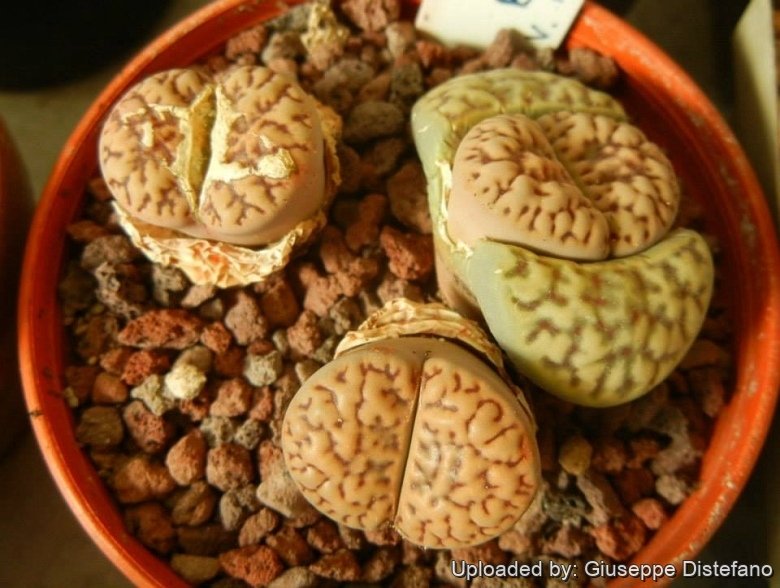
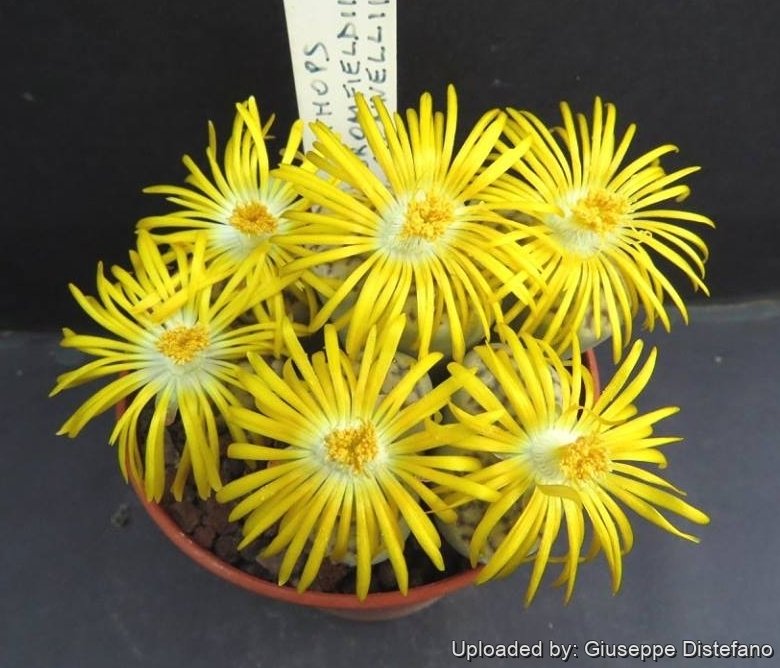
Lithops bromfieldii is a non-halophytic, medium sized Lithops, easily recognised by the bullate yellow-brown markings of the dark-green window, pinkish-grey facial colour and the many dark to blood-red rubrications. This species is quite variable and the colours and face pattern varies in plant from different provenance. As with many other Lithops species, several varieties have been described on the basis of variation in the colour of the tops of the leaves, the status of these uncertain, but all conforms to the typical Lithops morphology: two thick, fleshy windowed leaves separated by a crack from which a yellow flower appears. The windowed part allows light into the inner portion of the leaf where the process of photosynthesis is carried out.
Habit: Growths solitary or forming clumps of two to 10 or more heads, (mostly 2-4) to 1,5 cm high..
Bodies (paired leaves): Mostly about 25 X 20 mm obconical, truncate. The fissure is shallow, 4-8 mm; lobes conjunct, top surface flat or slightly convex and bullate generally reddish coloured. The face is elliptical to kidney-shaped more or less equal with window present ans irregular, very dark olive-green or more or less absent, and on this a number of bifurcated blood-red to dark brown-red lines, the forks ending in the sinuses of the outer margin, the surface is impressed by valley-like channels and raised islands, and bright to dark-blood red, orange-red rubrications sometimes scattered with dots, hooks and dashes in the channels.. Dusky dots dull dark greyish green. Outer margin lobed or laciniated, the lobes or laciniae projecting into the window and forming ridges or islands; islands and lobes bullate, coloured a brown-yellow; margin coloured light brown-yellow.
Flowers: Yellow, small to large 25-35(-45) mm in diameter.
Fruits: 5-chambered, profile boat-shaped, top flat.
Seeds: Yellow-brown, rugose.
Origin and Habitat
South Africa, Northern cape (Districts Gordonia, Hay, and Prieska)
Habitat: Lithops bromfieldii grows hidden under bushes or aloes on white greyish, brownish and red quartzite.
Cultivation and Propagation
In the winter season the plant doesn’t need watering, the plant in this time extracts water from the outer succulent leaves, allowing them to shrivel away, relocating water to the rest of the plant and to the new leaves that form during this period. This plant is best for a well lit area (Bright shade to full sun). Water sparingly only when warm, no water when cold.
Notes
Lithops bromfieldii is strictly related to Lithops bromfieldii var. insularis, which grows in the immediate neighbourhood, but L. Bromfieldii differs from var. insularis in that there are no yellow-brown markings in the window. However L. insularis is not a variant form of L. Bromfieldii and it stands at the one end of the breadth of variation of L. Bromfieldii and that L. Bromfieldii, as described by L. Bolus, is at the other end. This can only be settled by an examination of these two species in their natural habitat.
Bibliography
Major refences and further lectures
-
Heidrun E. K. Hartmann “Aizoaceae F – Z” Springer 2002
-
Desmond T. Cole & Naureen A. Cole, Uwe Beyer, Yves Delange “Les Lithops” SUCCULENTES Spécial 2008 AIAPS (now Terra seca). I 2008
-
Desmond T. Cole & Naureen A. Cole “LITHOPS Flowering Stones” Cactus & Co. Libri. 2005
-
Yasuhiko Shimada“The Genus Lithops” Dobun Shoin. 2001
-
Rudolf Heine “Lithops - Lebende Steine” Neumann Verlag. 1986
-
Bernd Schlösser “Lithops – Lebende Steine” Praktische Anleitung für die Zimmerkultur. Bussiness Point MEDIA. 2000
-
Steven A. Hammer “Lithops – Treasures of the veld” British Cactus and Succulent Society. 1999
-
Gordon D. Rowley “The illustrated encyclopedia of succulents” Crown Publishers, 01/Aug/1978
-
David L. Sprechman “Lithops” Associated University Presses, Inc. 1970
-
Gert Cornelius Nel “Lithops: Plantae succulantae, rarissimae, in terra obscuratae, e famailia Aizoaceae, ex Africa australi” Hortors Limited, South Africa, 1946
-
Achim Hecktheuer “Mesembs, mehr als nur Lithops” Books on Demand GmbH Norderstedt. 2008
-
Werner Rauh “Die grossartige Welt der Sukkulenten” Hamburg and Berlin: Verlag Paul Parey, 1966
-
Stuart Max Walters “The European Garden Flora: Dicotyledons (Part I)” Cambridge University Press, 1989
From llifle page Lithops glaudinae
Description
Lithops bromfieldii var. glaudinde is one of the local form of the variable Lithops bromfieldii. It is a medium sized plant characterised by a wide, flattened, blackish-red apex, with conspicuous glossy black dusky dots with a shining metallic reflex. However some of the more recently discovered populations (including Cole 382, typically smooth and rough) do not really respect this model; they represent an extension of the range and of the concept. And also some old plants cultivated in the Karoo Garden (Collected in the region of Kougas) shows the same patterns. While other populations have an embarrassing resemblance to the standard Lithops bromfieldii and are often indistinguishable, except perhaps in leaf shape and cultivated plants can be reliably distinguished from Lithops bromfieldii only when seeds or details of wild source are available.
Habit: Solitary or forming clumps of two to 10 or more heads, (mostly 2-4) to 1,5 cm high. It conforms to the typical Lithops morphology: two thick, fleshy windowed leaves separated by a crack from which a yellow flower appears. The windowed part allows light into the inner portion of the leaf where the process of photosynthesis is carried out. As with many other species, several varieties or local forms have been described based on the variation of the colour of the tops of the leaves.
Bodies (paired leaves): Mostly about 25 X 20 mm obconical, truncate with a wide, flattened, blackish-red apex with a shining metallic reflex. The fissure is shallow, 4-8 mm; lobes conjunct. The face is opaque, more or less translucent and smooth, bullate, with numerous, narrow, irregular channels, and small irregular islands with indistinct flecks composed of small opaque dots. The margins with small irregular peninsula are quite indistinct. Rubrications partially visible, sometimes with longer lines forming a sparse broken network. Shoulders, margins and islands as for the margins opaque light honey, pinkish brown or light orange-brown. Windows and channels transluscent dull green, dark greenish brown or greenish red. Rubrications dull blood-red.
Flowers: Yellow, small to large 25-35(-45) mm in diameter.
Fruits: Mostly 5-chambered, profile boat-shaped, top flat.
Seeds: Yellow-brown, rugose.
Note: Fearn recognizes Lithops glaudinae de Boer as a good species in its own, while Cole treats it as a variety of Lithops bromfieldii.
Cultivation and Propagation
The Lithops (a.k.a. Living Stones) are some of the world’s most fascinating plants and are sought by the collector of succulent plants. Paying attention to the particular growing requirement of Lithops is especially important. If you provide the Lithops with the right conditions, they will reward you with their unique shape, size, colour and a proliferation of blooms in autumn. However, Lithops are tricky plants that are very particular about their growing conditions and require the right maintenance in order to keep happy. But don’t be afraid even the best growers have plants that mysteriously dry up, or leave during the night. While Lithops are picky about their care, if you are patient and remember the basics, your efforts will be rewarded. Being small plants, a representative collection can be grown on a patio table, a sunny windowsill or a shelf in the greenhouse.
Growing rate: Slow growing for a mesemb.
Soil: They grow best in an open mineral, sandy-gritty soil and requires good drainage as they are prone to root rot. They can grow outdoor in sunny, dry, rock crevices (protection against winter wet is required) They can also be cultivated in alpine house, in poor, drained soil.
Repotting: They may stay in the same pot for many years. Plants grown in larger containers have frequently relatively poor flowers. Flowers might improve when the plants are given their own, small individual pots.
Watering They Require little water otherwise the epidermis breaks (resulting in unsightly scars). The basic cultivation routine is: Stop watering after flowering. Start watering after the old leaves are completely dry (usually late March or Early April). Water freely during the growing season, soak the compost fully but allow it to dry out between waterings. In the winter season the plant doesn’t need watering, the plant in this time extracts water from the outer succulent leaves, allowing them to shrivel away, relocating water to the rest of the plant and to the new leaves that form during this period. If grown in a container, bottom watering by immersing the container is recommended. Water sparingly only when warm, no water when cold. Nearly all problems occur as a result of overwatering and poor ventilation, especially when weather conditions are dull and cool or very humid. They must have very dry atmosphere.
Fertilization: Feed them once during the growing season with a fertilizer specifically formulated for cactus and succulents (high potash fertilizer with a dilute low nitrogen), including all micro nutrients and trace elements diluted to ½ the strength recommended on the label. They thrive in poor soils and need a limited supplies of fertilizer to avoid the plants developing excess vegetation, which is easily attacked by fungal diseases. Some growers fertilize frequently, some hardly ever. However, for the highly succulent mesembs, (Lithops, Conophytums, etc.) fertilization is not really necessary.
Light: They prefer a very bright situation and in winter they need the maximum amount of light you are able to give them, but keep more cool and partially shaded in summer. The only exception to this is seedlings in their first year that enjoy a shades place. Such tiny plants can easily get scorched or broiled and their appearance spoiled (this may not matter in the wild, where the Lithops have probably shrunk into the ground and becomes covered with sands). Outdoor (Lithops prefer full sun, with some shade in the hottest summer months. High levels of light are needed in autumn to flower and for good plant development. The low intensity of sun light during the growing season of this species generally prevents the white flower flowers from opening.
Special Advice: Lithops are best planted in a sunny and airy part of the greenhouse, and not too close to the glass roof or sides of the house as the plants can overheat during hot spells.
Hardiness: They require a minimum temperature 5°C (But will take a light frost and are hardy down to -7° C for short periods if they are in dry soil). USDA zones 9A – 11.
Uses: Container, rock garden.
Pests & diseases: Lithops may be attractive to a variety of insects, but plants in good condition should be nearly pest-free, particularly if they are grown in a mineral potting-mix, with good exposure and ventilation. Nonetheless, there are several pests to watch for:
- Red spiders: they may be effectively rubbed up by misting the vulnerable plants every day.
- Mealy bugs: occasianlly they develop aerial into the new leaves and flowers with disfiguring results, but the worst types develop underground on the roots and are invisible except by their effects.
- Sciara Flies: they are one of the major problems for seedlings. It is a good practice to mulch your seedlings with a layer of grit, which will strongly discourage the flies.
- Scales, thrips and aphids: (they are rarely a problem.)
It is wise to treat your whole collection with a systemic insecticide twice a year in spring and autumn.
- Rot: it is only a minor problem with mesembs if the plants are watered and “aired” correctly. If they are not, fungicides won’t help all that much.
Remarks: After flowering in the autumn and extending through winter season the plant doesn’t need watering, but they will still be growing, the new bodies will be increasing in size extracting water from the outer succulent leaves, allowing them to shrivel away. In fact the plant in this time extracts water and nutrient stored in the outer succulent leaves, allowing them to dehydrate relocating the water to the rest of the plant and to the new leaves that form during this period until the old leaves are reduced to nothing more than “thin papery shells”.
Propagation: Seed or (or rarely) cuttings. The small seeds can be sown in pots of fine, well-drained sand, any time during the spring and summer months when temperatures are warm. Cover the seeds with a very fine layer of grit and water from below with a fungicide to prevent damping off. For the first 3-4 days cover the pots with a sheet of glass/clear perspex to keep the humidity levels high. Remove the glass and replace it with light shadecloth and mist once or twice a day for the next two weeks after which most seeds should have germinated. From then on mistings can be reduced to every second and then every third day as the little plants grow. Take the cuttings from a grown-up mother plant. Each cutting must contain one or more heads along with a fraction of root and permit them to dry out a couple of days, lay the cuttings on the soil and insert the stem end partially into the soil. Try to keep the cutting somewhat upright so that the roots are able to grow downward. It is relatively difficult to root Lithops from cuttings and generally pointless as well, so quick are they from seed.
Comment: Improvement of Lithops characteristics: Some growers (but not all!!) think it is very intriguing to reinforce any characteristic of cultivated Lithops of by crossing two similar selected plants and then back-crossing with the mother plant. This way we can eventually get some interesting results. Of course, many of the nicest Lithops we grow in cultivation have already been selected over time. However many Lithops are already nice plants which can’t really be improved, on the other hand one could try to improve the colour or the markings etc. Now if we have two particular plants we may attempt to breed between them and can maybe get a whole improved population and then select some better offspring to continue the selection.
Seed production: Plants can be hand pollinated, using a small paint brush. Remember always to cross different clones as the plants are self-sterile. The seed will remain viable for many years provided it is stored in a cool dry place.
Bibliography
Major refences and further lectures
-
Heidrun E. K. Hartmann “Aizoaceae F – Z” Springer 2002
-
Desmond T. Cole & Naureen A. Cole, Uwe Beyer, Yves Delange “Les Lithops” SUCCULENTES Spécial 2008 AIAPS (now Terra seca). 2008
-
Desmond T. Cole & Naureen A. Cole “LITHOPS Flowering Stones” Cactus & Co. Libri. 2005
-
Yasuhiko Shimada“The Genus Lithops” Dobun Shoin. 2001
-
Rudolf Heine “Lithops - Lebende Steine” Neumann Verlag. 1986
-
Bernd Schlösser “Lithops – Lebende Steine” Praktische Anleitung für die Zimmerkultur. Bussiness Point MEDIA. 2000
-
Steven A. Hammer “Lithops – Treasures of the veld” British Cactus and Succulent Society. 1999
-
Desmond T. Cole “Lithops – Flowering Stones” Acorn Books CC. 1988
-
Rudolf Heine “Lithops – lebende Steine” Neumann Verlag. 1986
-
David L. Sprechman “Lithops” Associated University Presses, Inc. 1970
-
Gert Cornelius Nel “Lithops: Plantae succulantae, rarissimae, in terra obscuratae, e famailia Aizoaceae, ex Africa australi” Hortors Limited, South Africa, 1946
-
Achim Hecktheuer “Mesembs, mehr als nur Lithops” Books on Demand GmbH Norderstedt. 2008
-
Werner Rauh “Die grossartige Welt der Sukkulenten” Hamburg and Berlin: Verlag Paul Parey, 1966
-
Stuart Max Walters “The European Garden Flora: Dicotyledons (Part I)” Cambridge University Press, 1989
-
Gordon D. Rowley “The illustrated encyclopedia of succulents” Crown Publishers, 01/Aug/1978
-
Steven A. Hammer “Lithops: Joyaux du veld” Editions Quae, 25/nov/2010
Source: Lithops glaudinae, LLIFLE - Encyclopedia of living forms, CC-BY-SA, retrieved 2026-10-25.
From llifle page Lithops insularis
Description
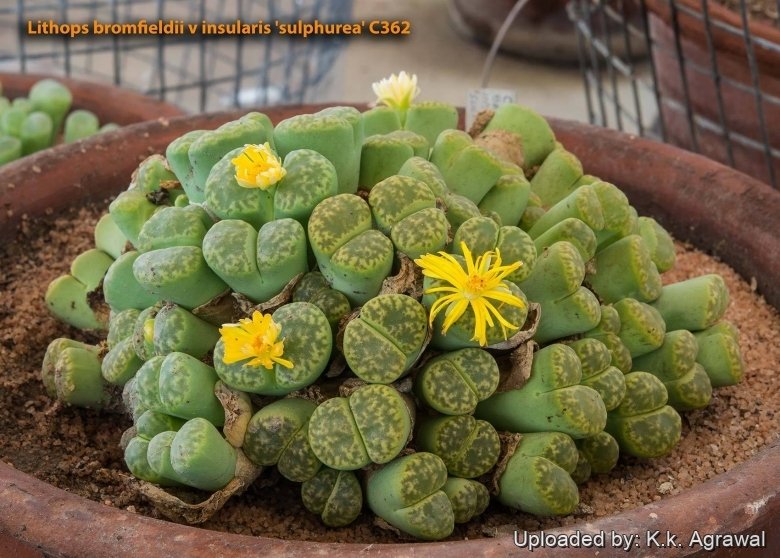
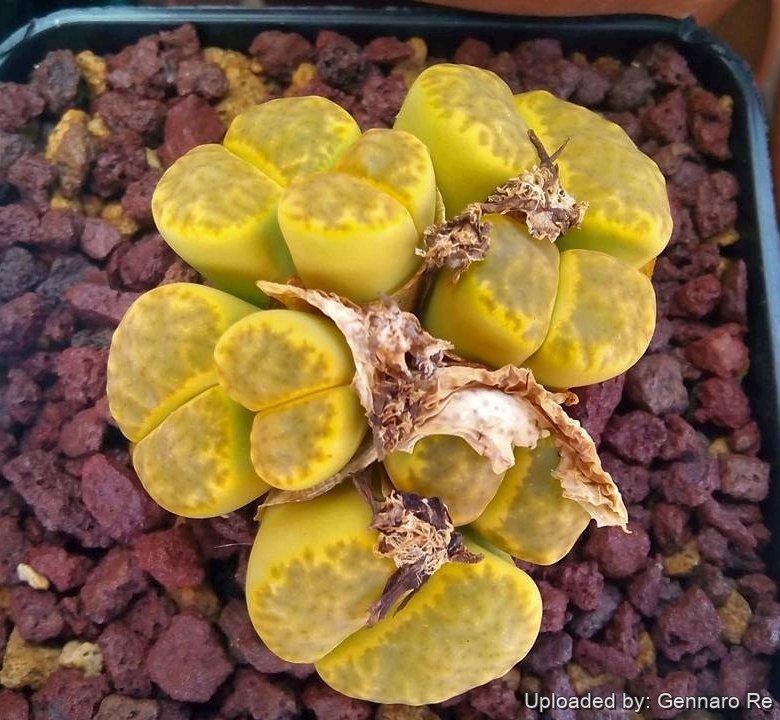
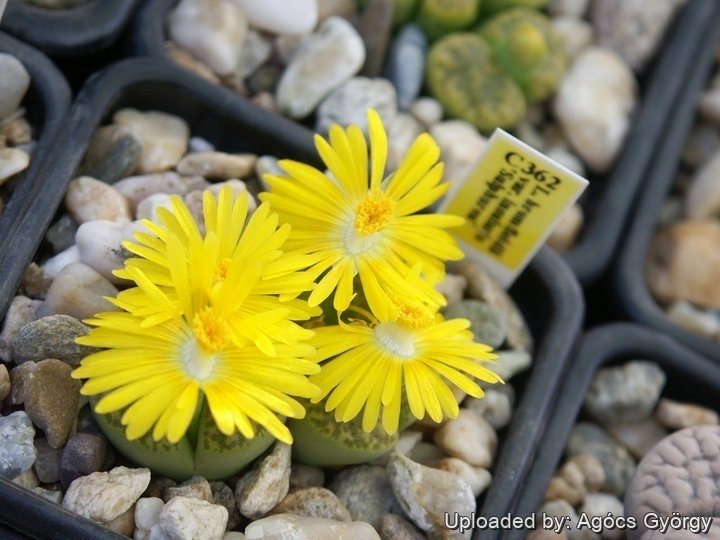
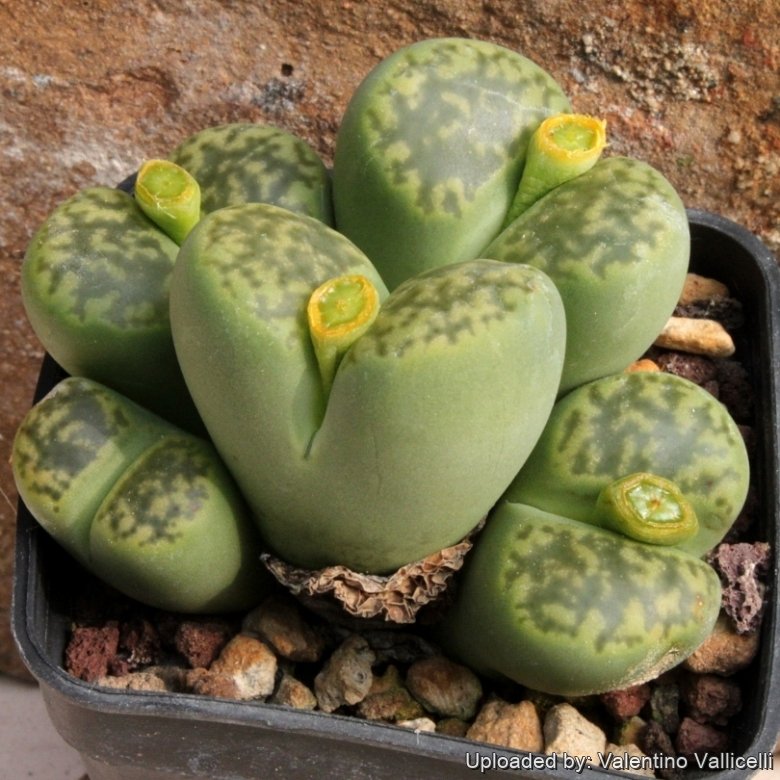
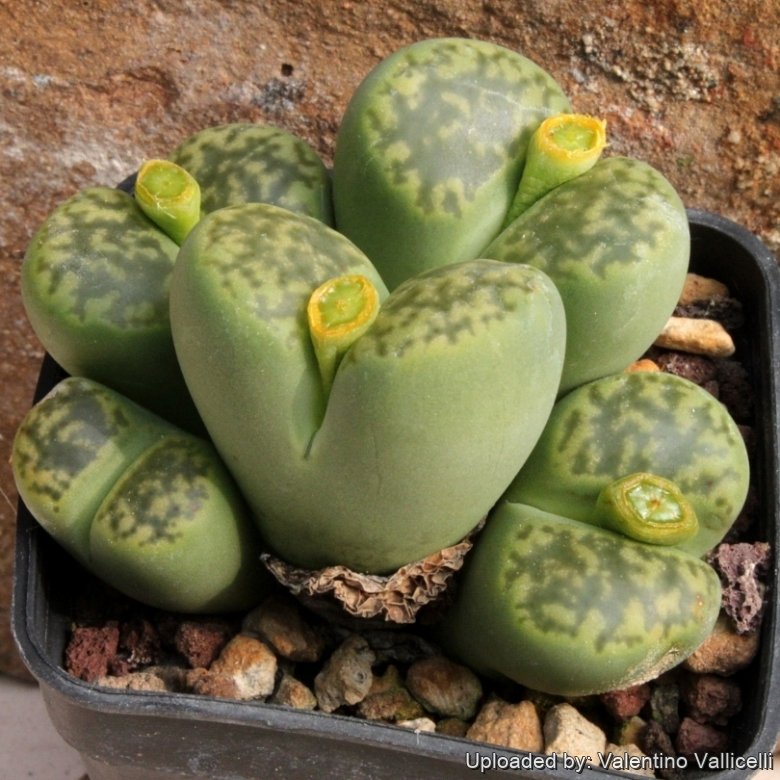
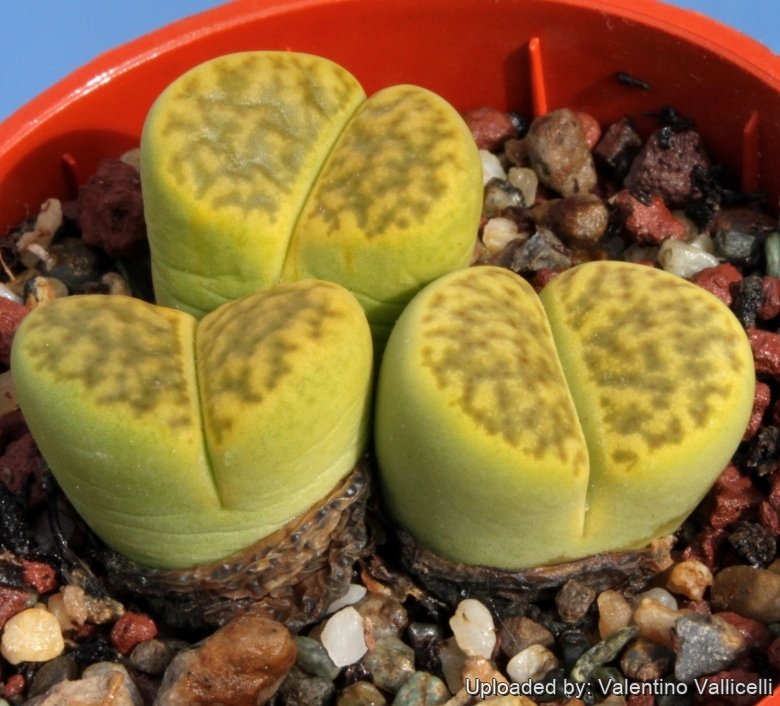
Lithops bromfieldii var. sulphurea C362 is one of the most sought-after Lithops cultivars in which the leaves have lost their brown pigment resulting in various shades of green, opaque creamy yellow-green or lime green with numerous tiny darker green blotches on the face. The bodies are small and often odd looking, in particular the variation in the size of the various heads in relation to one another. It is a fast clumper that can produce readily large mound with dozen of heads. The flowers are yellow. This cultivar comes true from seed.
Origin and Habitat
Japanese cultivar obtained by Yasuhiko Shimada.
Bibliography
Major refences and further lectures
-
Heidrun E. K. Hartmann “Aizoaceae F – Z” Springer 2002
-
Desmond T. Cole & Naureen A. Cole, Uwe Beyer, Yves Delange “Les Lithops” SUCCULENTES Spécial 2008 AIAPS (now Terra seca). 2008
-
Desmond T. Cole & Naureen A. Cole “LITHOPS Flowering Stones” Cactus & Co. Libri. 2005
-
Yasuhiko Shimada“The Genus Lithops” Dobun Shoin. 2001
-
Rudolf Heine “Lithops - Lebende Steine” Neumann Verlag. 1986
-
Bernd Schlösser “Lithops – Lebende Steine” Praktische Anleitung für die Zimmerkultur. Bussiness Point MEDIA. 2000
-
Steven A. Hammer “Lithops – Treasures of the veld” British Cactus and Succulent Society. 1999
-
Desmond T. Cole “Lithops – Flowering Stones” Acorn Books CC. 1988
-
Rudolf Heine “Lithops – lebende Steine” Neumann Verlag. 1986
-
David L. Sprechman “Lithops” Associated University Presses, Inc. 1970
-
Gert Cornelius Nel “Lithops: Plantae succulantae, rarissimae, in terra obscuratae, e famailia Aizoaceae, ex Africa australi” Hortors Limited, South Africa, 1946
-
Achim Hecktheuer “Mesembs, mehr als nur Lithops” Books on Demand GmbH Norderstedt. 2008
-
Werner Rauh “Die grossartige Welt der Sukkulenten” Hamburg and Berlin: Verlag Paul Parey, 1966
-
Stuart Max Walters “The European Garden Flora: Dicotyledons (Part I)” Cambridge University Press, 1989
-
Gordon D. Rowley “The illustrated encyclopedia of succulents” Crown Publishers, 01/Aug/1978
-
Steven A. Hammer “Lithops: Joyaux du veld” Editions Quae, 25/nov/2010
-
Gustav Schwantes “Flowering Stones and Mid-day Flowers: A Book for Plant and Nature Lovers on the Mesembryanthemaceae” Ernest Benn, 1957
Source: Lithops insularis, LLIFLE - Encyclopedia of living forms, CC-BY-SA, retrieved 2026-10-25.
From llifle page Lithops mennellii
Description
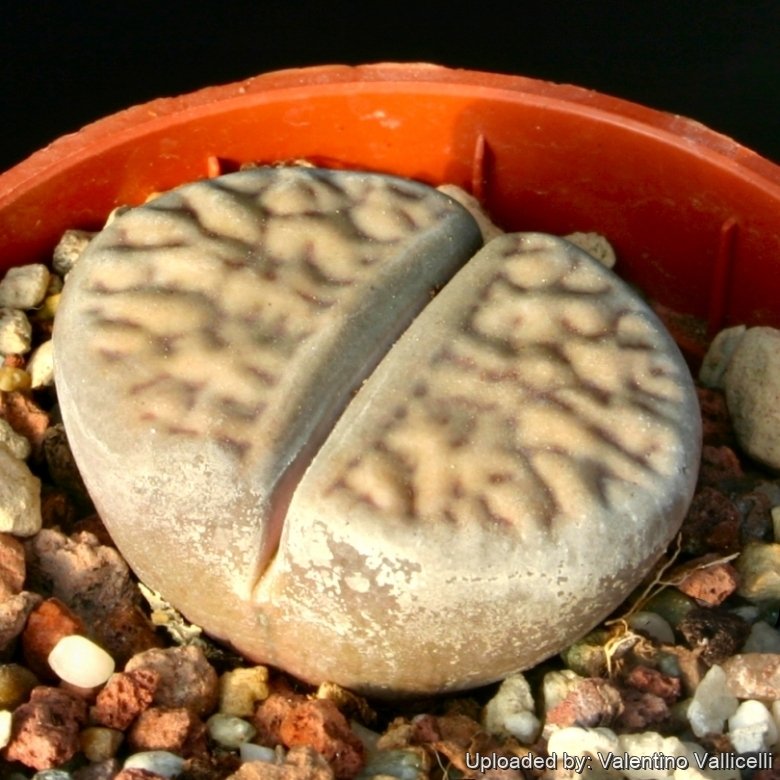
Lithops bromfieldii var. mennellii is one of the local form of the variable Lithops bromfieldii. distinguished for the clear and opaque, pinkish-grey, somewhat raised and bumpy surface, with distinct islands marked with very, contrasting, impressed and branched dark chocolate lines (rubrications).
Habit: It is a small to medium sized plant, solitary or forming clumps of two to 10 heads, (mostly 4-6) to 1,5 cm high, typically dwarfed, in particular in the natural environment, but cultivated specimens can reach relatively large sizes. It conforms to the typical Lithops morphology: two thick, fleshy windowed leaves separated by a crack from which a yellow flower appears. The windowed part allows light into the inner portion of the leaf where the process of photosynthesis is carried out.
Bodies (paired leaves): Mostly less 20-35 mm wide, obconical, truncate with rugose surface, pinkish-grey facial colour and very dark rubrications. Channels deeply impressed which branch and tail off into the marginal area and enclosing fairly large, raised islands and peninsulas. Margins and windows vaguely distinguishable. Rubrications filling the channels in an irregular network of lines, dots, hooks and dashes. Face and shoulders pinkish grey, creamy grey, greenish grey or light milky grey. Channels dull dark greyish green; it is often difficult to distinguish between the channels and concentrations of dusky dots. Rubrications dark red, red-brown or purplish red. Dusky dots dull dark greyish green.
Flowers: Yellow, thinly petaled, 25-35(-45) mm in diameter.
Fruits: Mostly 5-chambered, profile boat-shaped, top flat.
Seeds: Yellow-brown, rugose.
Similar species: Lithops bromfieldii var. mennellii and Lithops karasmontana var. mickbergensis are the same in the shape of the body and patterning of the surface, but their type localities lie far apart: Louisval near Upigton in the Gordonia district and Mickberg in the south of west Africa.
Origin and Habitat
South Africa, Cape province. It is found in a very small area on the south side and within 2-3 km of the Orange River, to the SW of Louisvale, S of Upington. TL ‘Louisvale, near Upington, on low quartz slopes between the road and the Orange River’
Habitat: Grows in stonily soils comprising micaceous quartzo-feldspathic gneiss; granitic gneiss. Colours of the stony background grey-white, brown, pink.
Source: Lithops mennellii, LLIFLE - Encyclopedia of living forms, CC-BY-SA, retrieved 2026-10-25.
Cultivars and forms (17)
Varieties (10)
- Lithops bromfieldii var. glaudinae
- Lithops bromfieldii var. glaudinae C116 TL: 70 km WNW of Griquatown, South Africa
- Lithops bromfieldii var. glaudinae C382 70 km W of Griquatown, South Africa
- Lithops bromfieldii var. insularis
- Lithops bromfieldii var. insularis C043 15 km E of Keimoes, South Africa
- Lithops bromfieldii var. insularis C057 10 km NE of Keimoes, South Africa
- Lithops bromfieldii var. menellii
- Lithops bromfieldii var. menellii C044 TL: 25 km SSW of Upington, South Africa
- Lithops bromfieldii var. menellii C283 20 km SSW of Upington, South Africa
- Lithops bromfieldii var. sulphurea C362
Forms (1)
Other names (5)
- Lithops bromfieldii C040 TL: 15 km ENE of Upington, South Africa
- Lithops bromfieldii C041 15 km ENE of Upington, South Africa
- Lithops bromfieldii C279 45 km E of Upington, South Africa
- Lithops bromfieldii C348 20km East of Upington, Cape Province, South Africa
- Lithops bromfieldii C368 25 km SE of Upington, South Africa
Gallery