Description
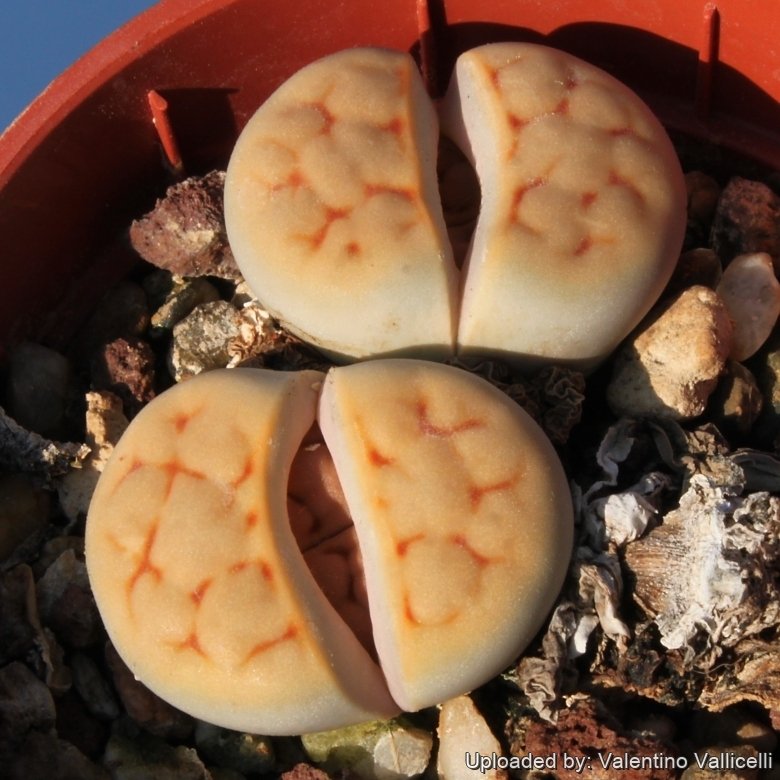
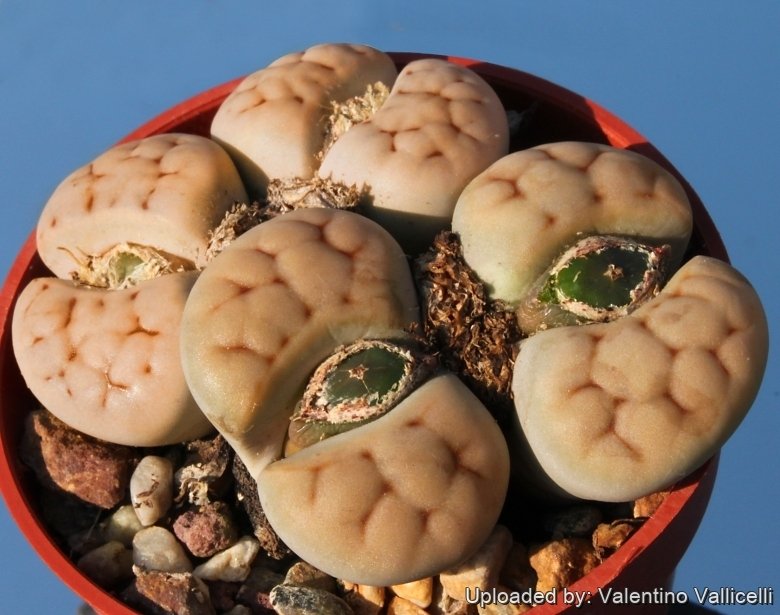
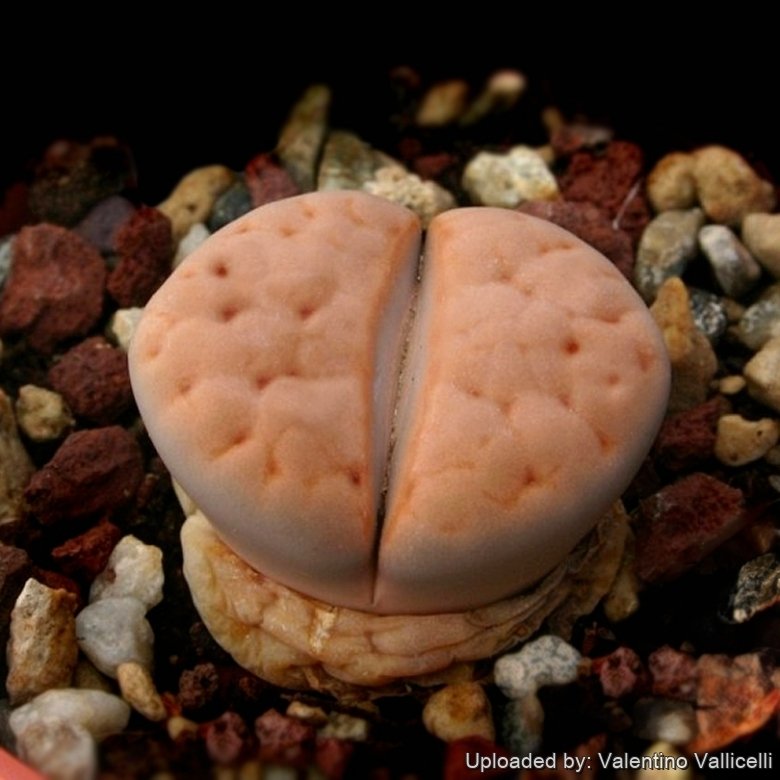
Lithops karasmontana (a.k.a. Stone plant) is a tiny perennial, caespitose, succulent plant resembling a grouping of tiny pebbles split down the middle like cleft hooves. It grows to a maximum eight of 4 cm above ground and spreads to form small clumps with up to 12 or more heads (usually 2-6). It is one of the more variable species, with uniformly coloured or variously ornamented plants, and yet with opaque or obscurely windowed forms; there is also a great variation in the colours. Plants from different localities show strikingly different colours or patterns, but all natural populations show some degree of variation among individuals, and in some all possible intermediates colours and pattens occur. The “mickbergensis” form has a quite uniform orange grey to pinkish-grey tops. It is variable.
Stem: Almost stemless.
Bodies (Paired leaves): Inverted cone-like, divided into 2 unequal-sized, conjunct and coalescent leaves. These leaves are modified for water storage as well as photosynthesis. Face elliptic-reniform 25-35 x 20-28 mm broad usually rugose. Top flat to slightly convex, fissure fairly deep, 4-10 mm long. Colours pale grey or bluish-grey on lower parts and shoulders, upper surfaces beige, to orange-grey on the flat sunken surfaces. Windows often absent. Margins indistinct grey tinged with various shades of orange-grey. Islands frequently only vaguely noticeable. Dusky dots absent or very inconspicuous.
The plant renews itself every year or so by putting out a new plantlet from between the two lobes. Once the new plant is full sized, the old lobes shrivel up and slough off as a snake skin does.
Flowers: Big up to 4,5 cm in diameter (mostly 25-35 mm) satiny white, narrow-rayed.
Blooming season: Late summer or early autumn.
Fruit: Seed capsules mostly 5-chambered, otherwise 4 or 6-chambered. Profile boat-shaped.
Seeds: Minuscule, yellow-brown; smooth to rugose.
Origin and Habitat
15 km NNE of Grünau, Namibia
Cultivation and Propagation
Need an open mineral, fast draining mix and the maximum amount of light you are able to give them. The basic cultivation routine is: Stop watering after flowering. Start watering after the old leaves completely dry. (Usually late March or Early April) Water freely during the growing season, soak the compost fully but allow it to dry out between waterings, no water when cold. Some growers fertilize frequently, some hardly ever. Keep them dry during the winter. Nearly all problems occur as a result of overwatering and poor ventilation especially when weather conditions are dull and cool or very humid. This plant is best for a well lit area (Bright shade to full sun).
Remarks: After flowering in the autumn and extending through winter season the plant doesn’t need watering, but they will still be growing, the new bodies will be increasing in size extracting water from the outer succulent leaves, allowing them to shrivel away. In fact the plant in this time extracts water and nutrient stored in the outer succulent leaves, allowing them to dehydrate relocating the water to the rest of the plant and to the new leaves that form during this period until the old leaves are reduced to nothing more than “thin papery shells”.
Notes
Lithops are partly subterranean, with only the clear ‘window’ in each leaf tip exposed above soil. A type of optical system exists whereby a layer of apical tissue rich in calcium oxalate crystals acts as a filter to intense sunlight before it reaches the thin chlorophyllous layer below. They are also called mimicry plants as they show a striking similarity to their background rocks and are difficult to detect when not in flower. These are the commonly known as pebble plants or living stones; each species is associated with one particular type of rock formation and occurs nowhere else. Its soil-embedded, subterranean growth form also reduces the need for chemical defences against herbivores.
Bibliography
Major references and further lectures
-
Gert Cornelius Nel (1946) “Lithops” Hortors Limited, South Africa
-
Linda R. Berg “Introductory Botany: Plants, People, and the Environment” Cengage Learning, 02/Mar/2007
-
Dieter J. Von Willert “Life strategies of succulents in deserts: with special reference to the Namib desert” CUP Archive, 1992
-
Chris Mcintyre “Namibia” Bradt Travel Guides, 2007
-
Neale (W. T.) & Co, Edgar Lamb “Neale’s photographic reference plates, 1949: Combining cacti and other succulents” Vol. 2 W. T. Neale & Co.
-
RHS “A-Z encyclopedia of garden plants.” United Kingdom: Dorling Kindersley. 2008. p. 1136. ISBN 1405332964.
-
American Horticultural Society “The American Horticultural Society encyclopedia of garden plants” Macmillan, 30/Nov/1989
-
H. E. K. Hartmann “Illustrated Handbook of Succulent Plants: Aizoaceae F-Z” Springer, 2002
-
Schwantes, Gustav (1957). “Flowering Stones and Mid-day Flowers” London: Ernst Benn.
-
S. M Walters “The European Garden Flora Flowering Plants: Casuarinaceae to Aristolochiaceae” Cambridge University Press, 1989
-
Clive Innes “Complete Handbook of Cacti and Succulents” Van Nostrand Reinhold Company, 01/Dec/1981
-
Cole, D. T. 1988. “Flowering stones” Acorn Books, Randburg.
-
Smith et al. 1998. “Mesembs of the World.” Briza.Pretoria
-
Leistner, O.A. (ed.), 2000, “Seed plants of southern Africa: families and genera” Strelitzia 10., National Botanical Institute, Pretoria
-
Achim Hecktheuer (2008) “Mesembs, mehr als nur Lithops” Books on Demand GmbH Norderstedt. ISBN-13 978-3-8370-1724-3
-
Cole (2005) “LITHOPS Flowering Stones” Cactus & Co. Libri. ISBN 88-900511-7-5 ISBN-13 978-88-900511-7-3
-
Yasuhiko Shimada (2001) “The Genus Lithops” Dobun Shoin. ISBN 4-8103-4066-X
-
Rudolf Heine (1986) “Lithops - Lebende Steine” Neumann Verlag. ISBN 3-7402-0000-6; ISBN-13 978-3-7402-0000-8
-
Bernd Schlösser (2000) “Lithops – Lebende Steine” Praktische Anleitung für die Zimmerkultur. BussinessPoint MEDIA. ISBN 3-934945-01-5; ISBN-13 978-3-934945-01-2
-
Steven A. Hammer (1999) “Lithops – Treasures of the veld” British Cactus and Succulent Society. ISBN 0-902-099-64-7; ISBN-13 978-0-902099-64-7
-
David L. Sprechman (1970) “Lithops” Associated University Presses, Inc. SBN 8386-6902-6
Gallery