Publication: Gard. Chron. 1926, Ser. III. lxxix. 102.
Description
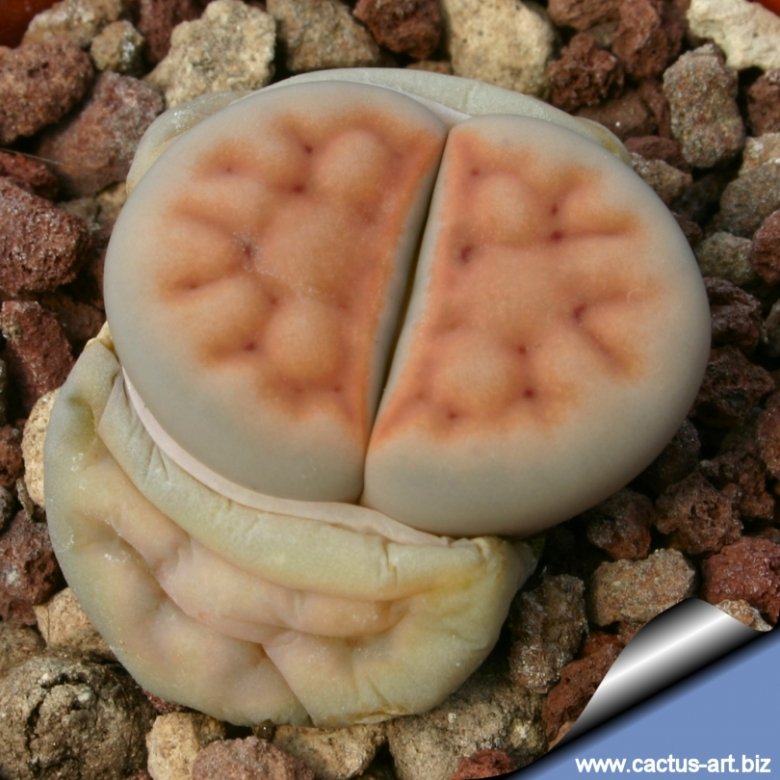
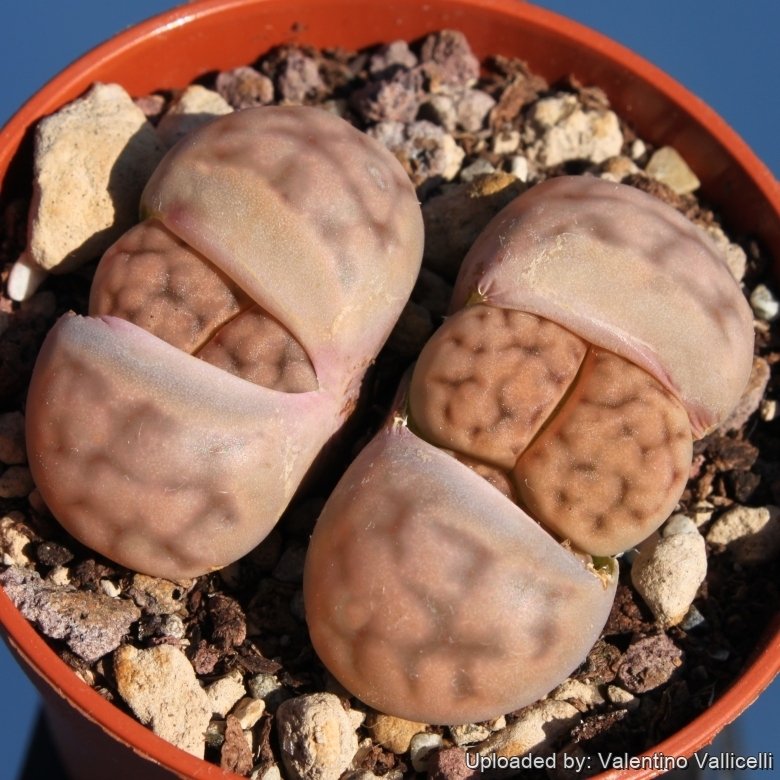
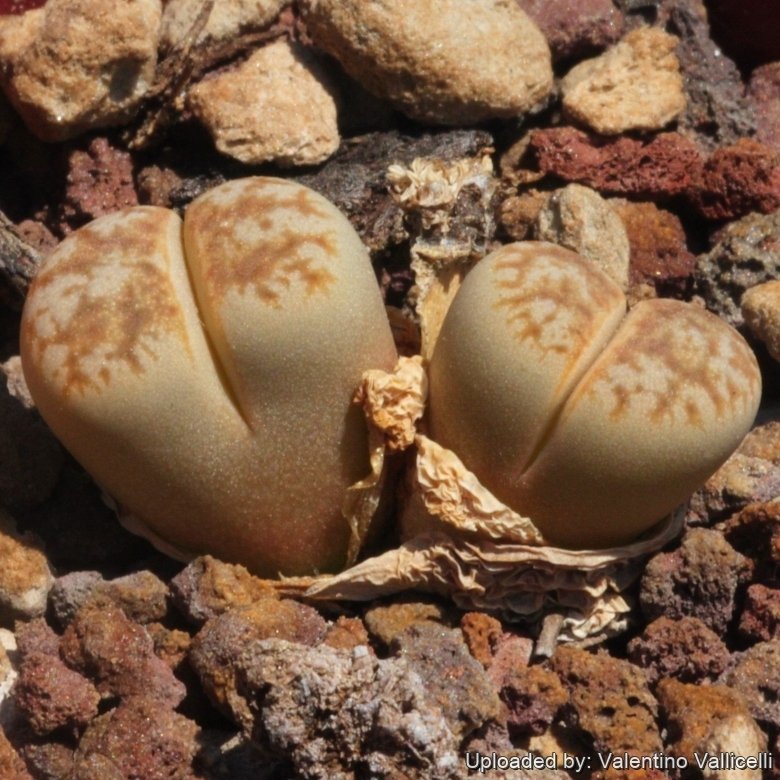
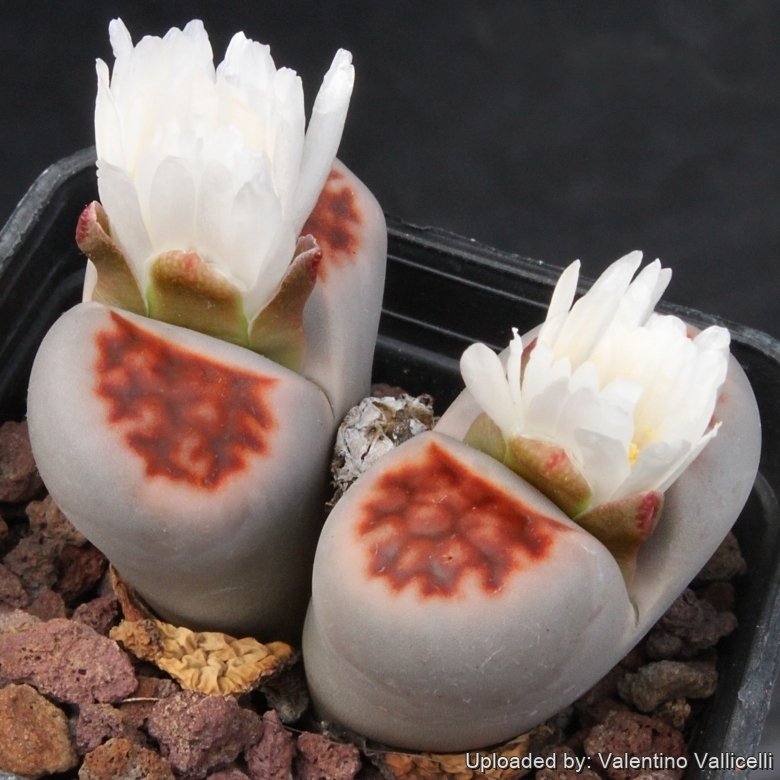
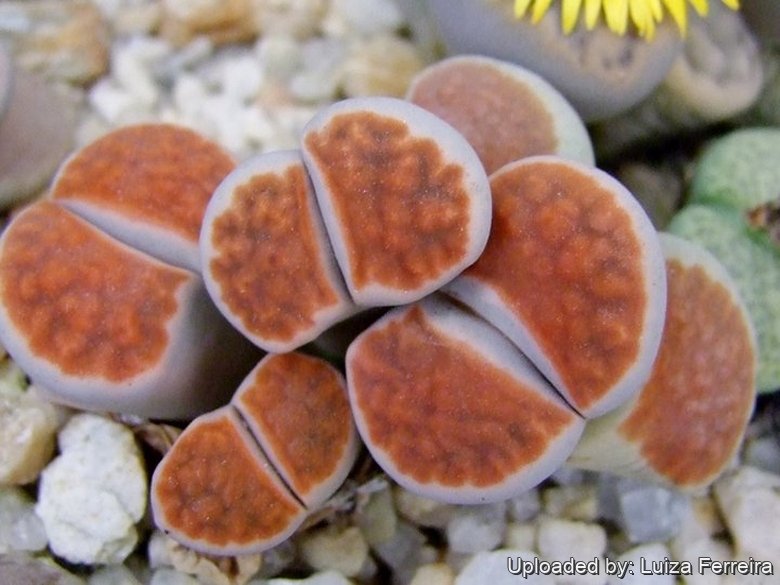
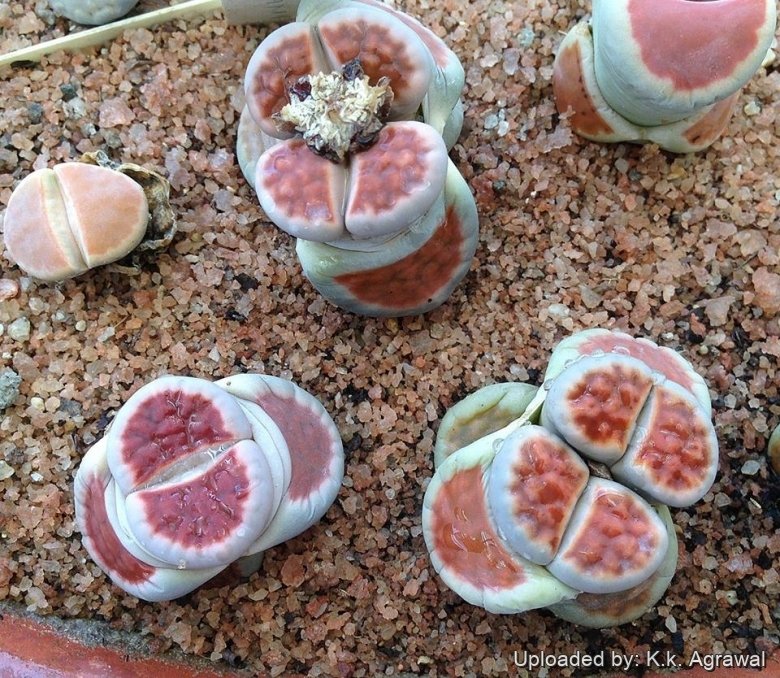
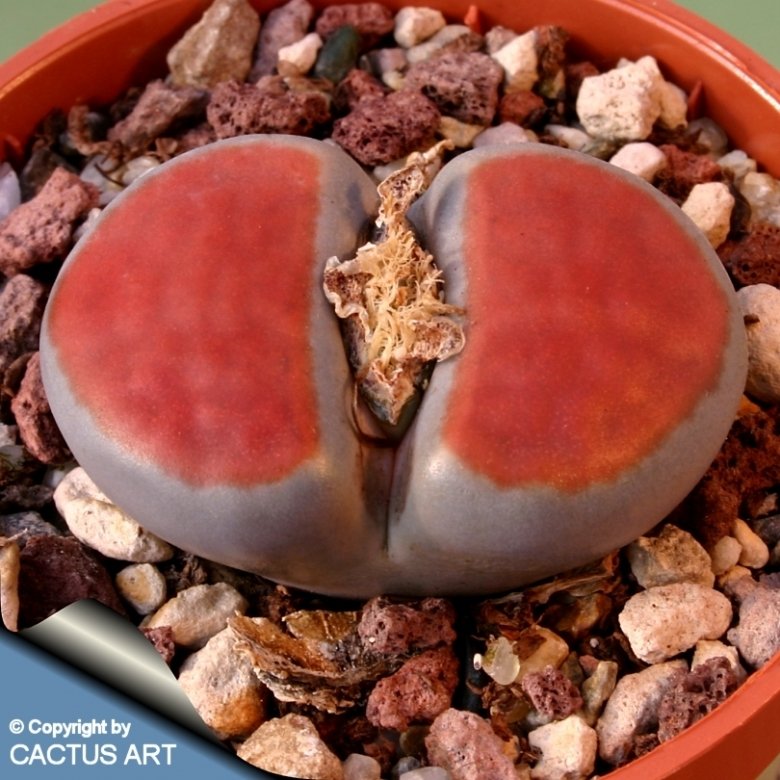
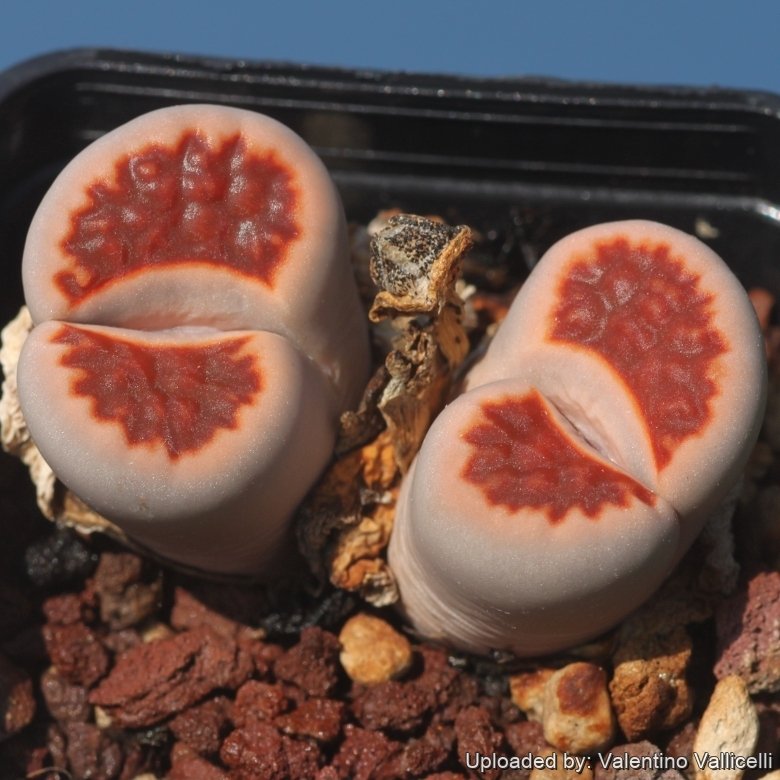
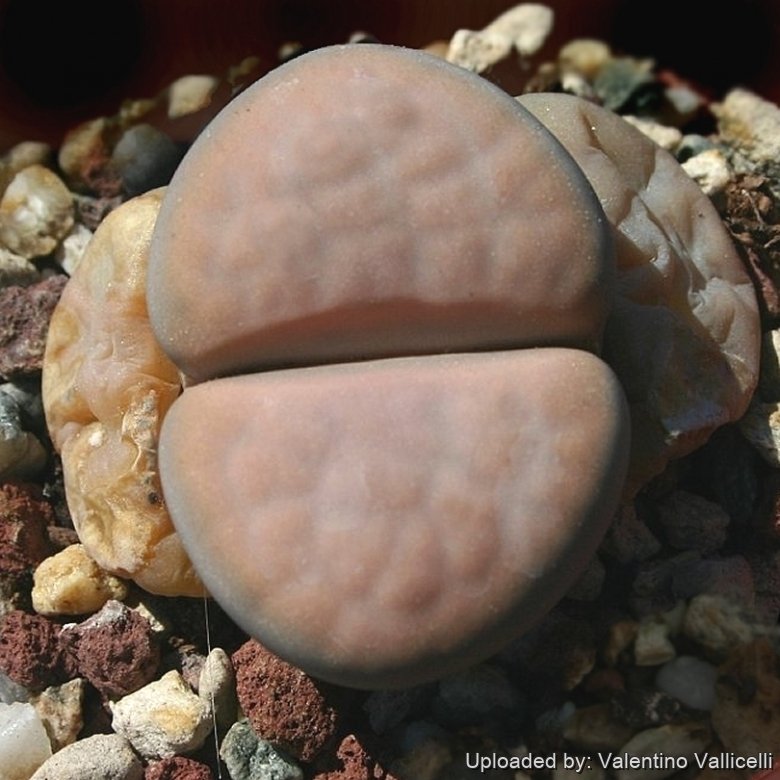
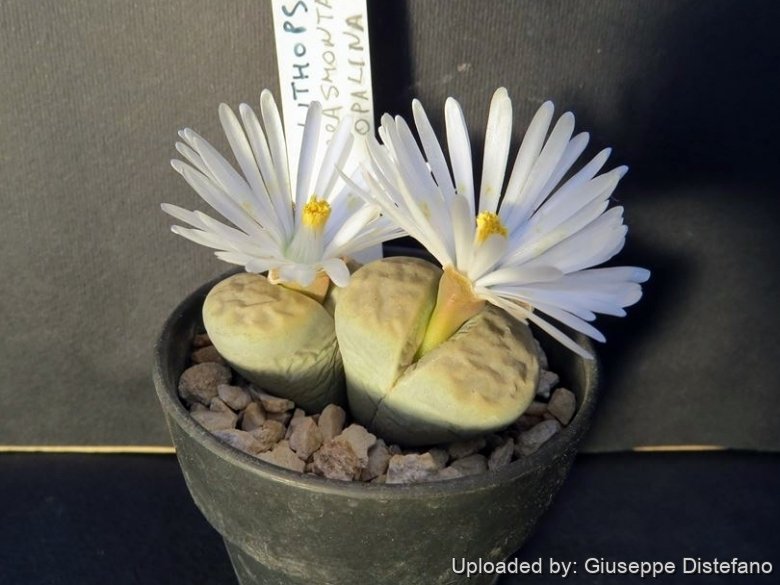
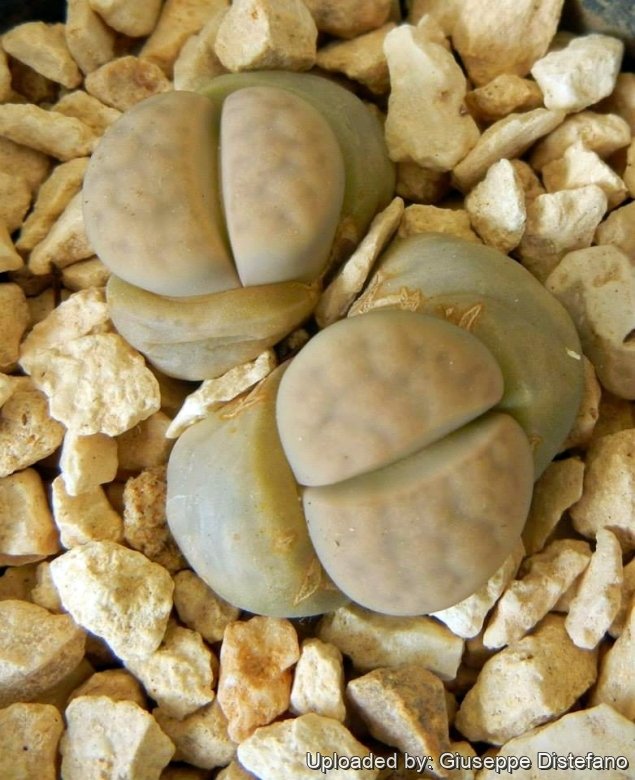
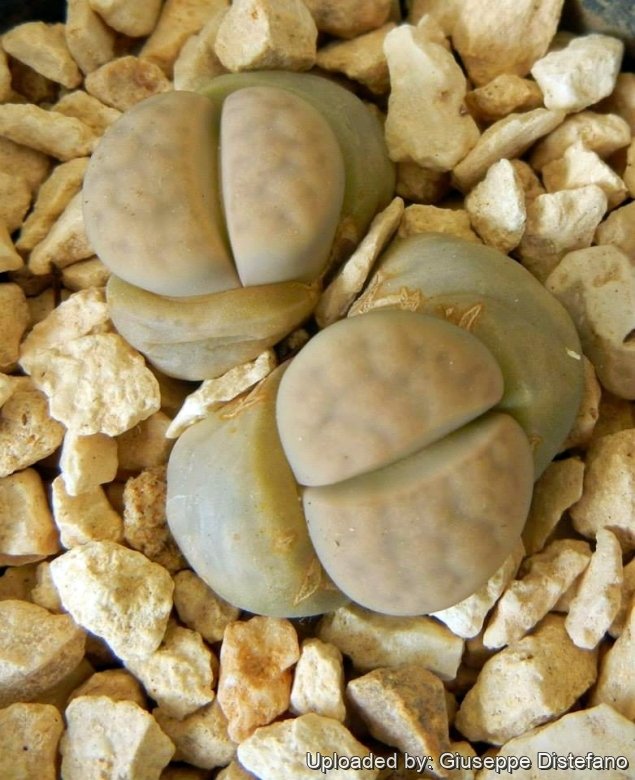
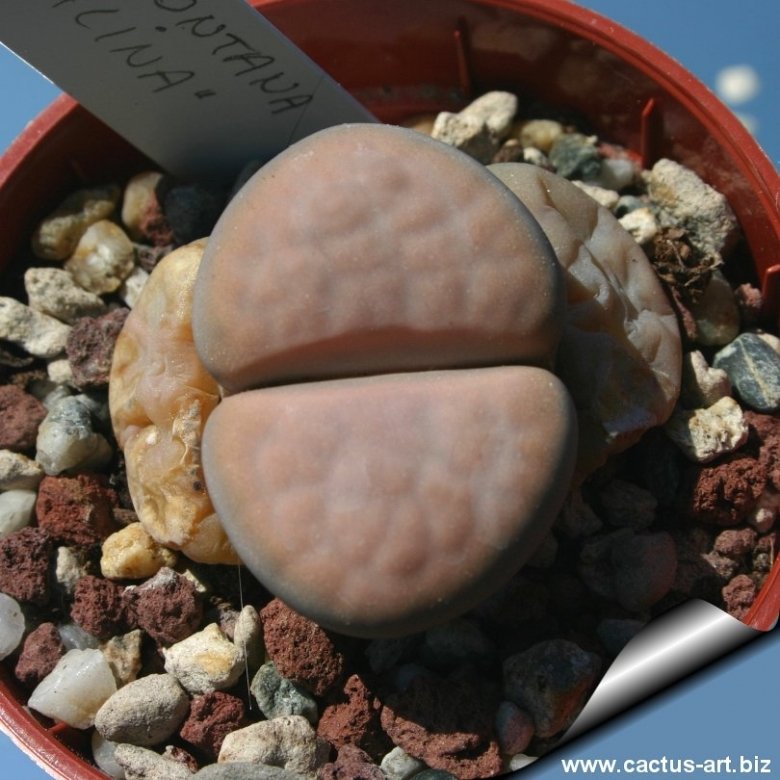
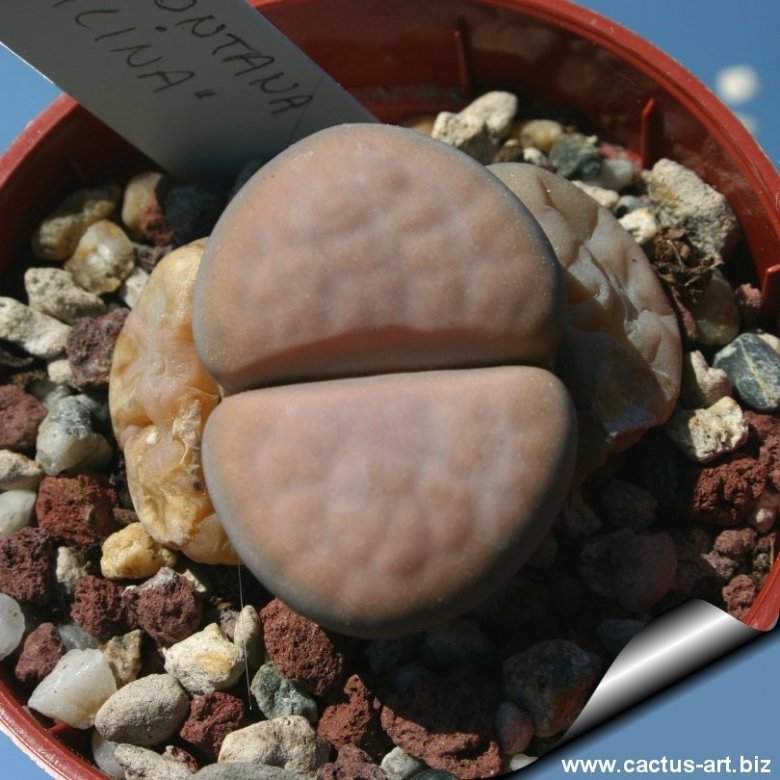
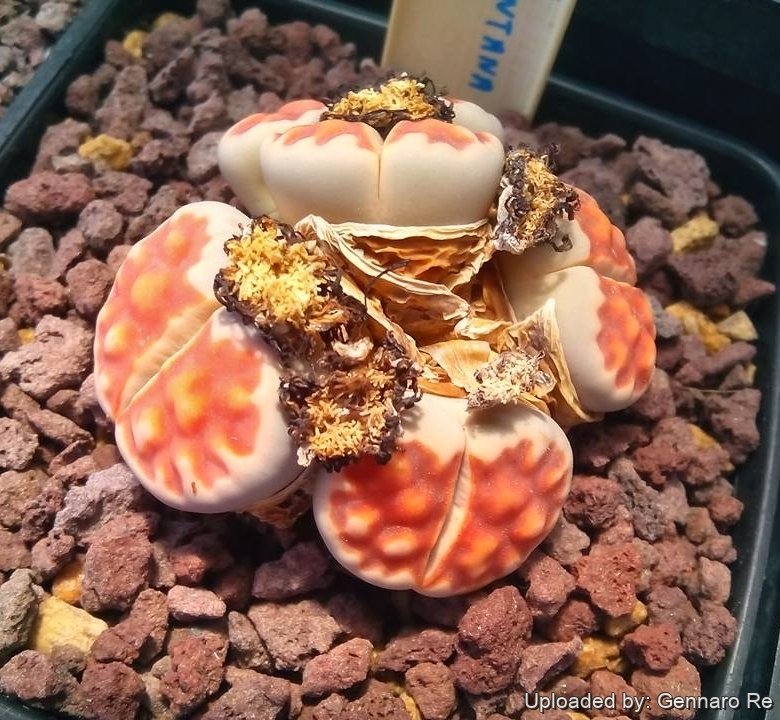
Lithops karasmontana (a.k.a. Stone plant) is a tiny perennial, caespitose, succulent plant resembling a grouping of tiny pebbles split down the middle like cleft hooves. It grows to a maximum eight of 4 cm above ground and spreads to form small clumps with up to 12 or more heads (usually 2-6). It is one of the more variable species, with uniformly coloured or variously ornamented plants, and yet with opaque or obscurely windowed forms; there is also a great variation in the colours. Plants from different localities show strikingly different colours or patterns, but all natural populations show some degree of variation among individuals, and in some all possible intermediates colours and pattens occur.
Stem: Almost stemless.
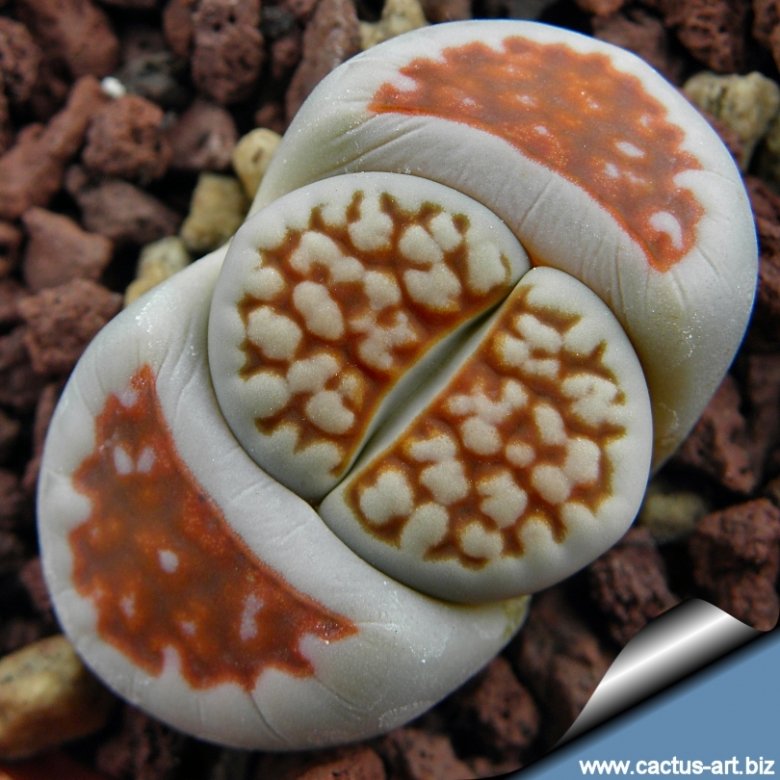
Bodies (Paired leaves): Inverted cone-like, divided into 2 unequal-sized, conjunct and coalescent leaves. These leaves are modified for water storage as well as photosynthesis. Face elliptic-reniform 25-35 x 20-28 mm broad usually rugose. Top flat to slightly convex, fissure fairly deep, 4-10 mm long. Colours pale grey or bluish-grey on lower parts and shoulders, upper surfaces mottled with, brick red, beige, yellow, grey-green, brown, pale purple-brown, pink, grey-white on the flat sunken surfaces, rubrications absent or a network of dots, hooks, triangles, short lines, no lip-smear. Windows obscurely translucent greyish, bluish or brownish often absent. Margins indistinct or with more or less evident indentations, light grey tinged with various shades of blue, green, yellow, brown, pink or red. Channels narrow and irregular greyish, bluish, brownish green, or red-brown often limited to slightly impressed obscure lines and obscurely translucent. Often the channel are completely covered with dark brown, red or purplish rubrications that forms short lines, hooks, triangles and dots linked into a network. Islands irregular in shape, frequently only vaguely noticeable. Dusky dots absent or very inconspicuous.
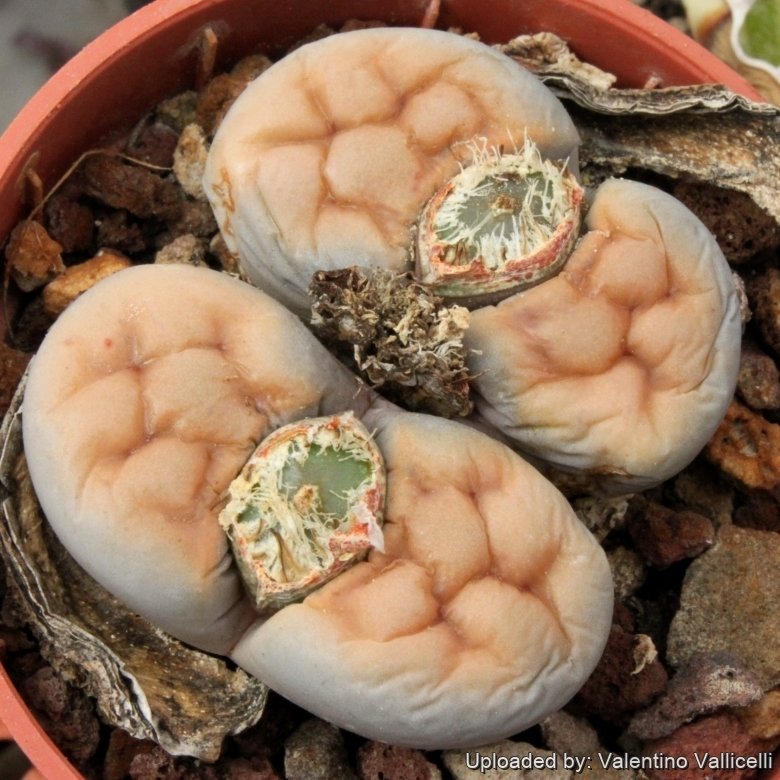
The plant renews itself every year or so by putting out a new plantlet from between the two lobes. Once the new plant is full sized, the old lobes shrivel up and slough off as a snake skin does.
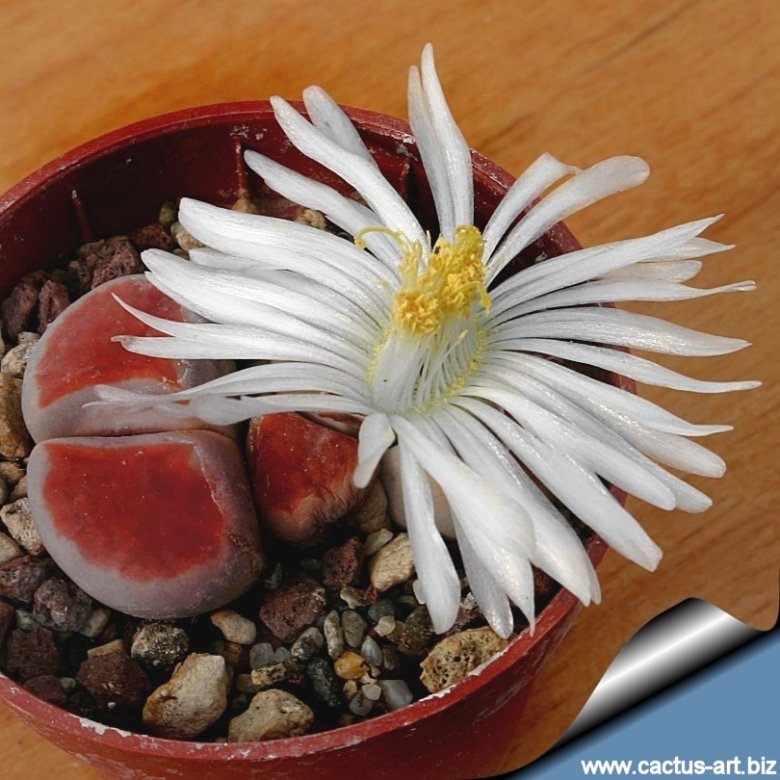
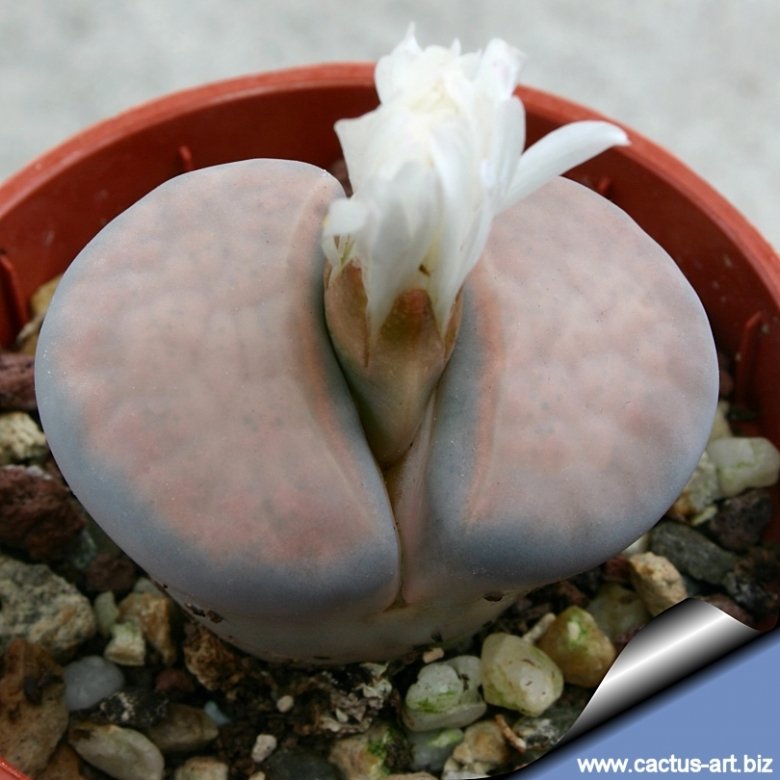
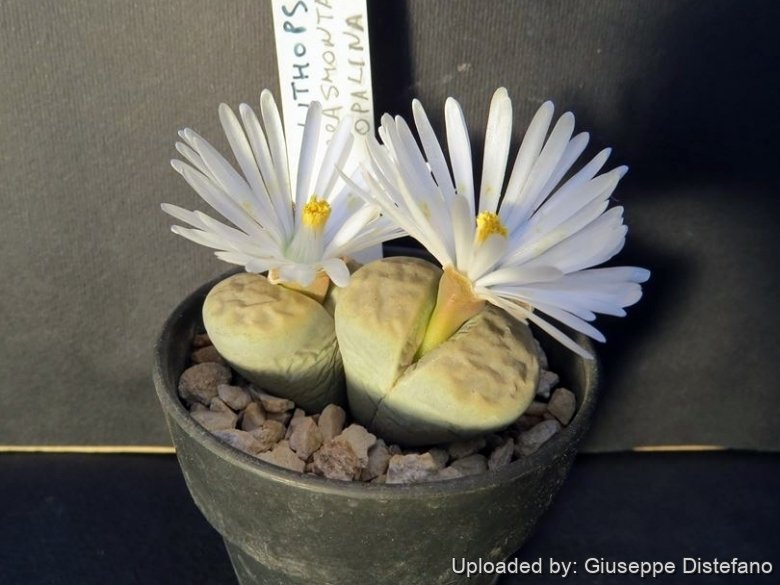
Flowers: Big up to 4,5 cm in diameter (mostly 25-35 mm) satiny white, narrow-rayed.
Blooming season: Late summer or early autumn.
Fruit: Seed capsules mostly 5-chambered, otherwise 4 or 6-chambered. Profile boat-shaped.
Seeds: Minuscule, yellow-brown; smooth to rugose.
Origin and Habitat
Namibia. It is sporadically distributed throughout the West and South West Great Karasberg, mainly in the Klein Karas, Grünau and and Ai-Ais.
Habitat: These fantastic stone or pebble plants grows in barren minerals plains and mountain slopes clinging to life in this harsh landscape. They live a precarious existence hidden beneath outcrops of quartz and Lichens. They grow almost completely buried in the ground with only the upper truncated portion of the thick, succulent leaves visible. Lithops karasmontana resist attacks from herbivorous predators by mimicking the local stone formations, in this case quartzite, pegmatite, gneiss, calcrete, sandstone, and is almost impossible to distinguish from their surroundings until they erupt into vivid daisy-like white flowers. Colours of the background grey-white, white, grey, pink, yellow-brown, brown, reddish brown, greenish white. They grow along with some of the most fascinating succulent and xerophyte plants like Welwitschia mirabilis and quiver trees (Aloe dichotoma).
Cultivation and Propagation
Lithops need an open mineral, fast draining mix and the maximum amount of light you are able to give them. The basic cultivation routine is: Stop watering after flowering. Start watering after the old leaves completely dry. (Usually late March or Early April) Water freely during the growing season, soak the compost fully but allow it to dry out between waterings. Some growers fertilize frequently, some hardly ever. Keep them dry during the winter. Nearly all problems occur as a result of overwatering and poor ventilation especially when weather conditions are dull and cool or very humid.
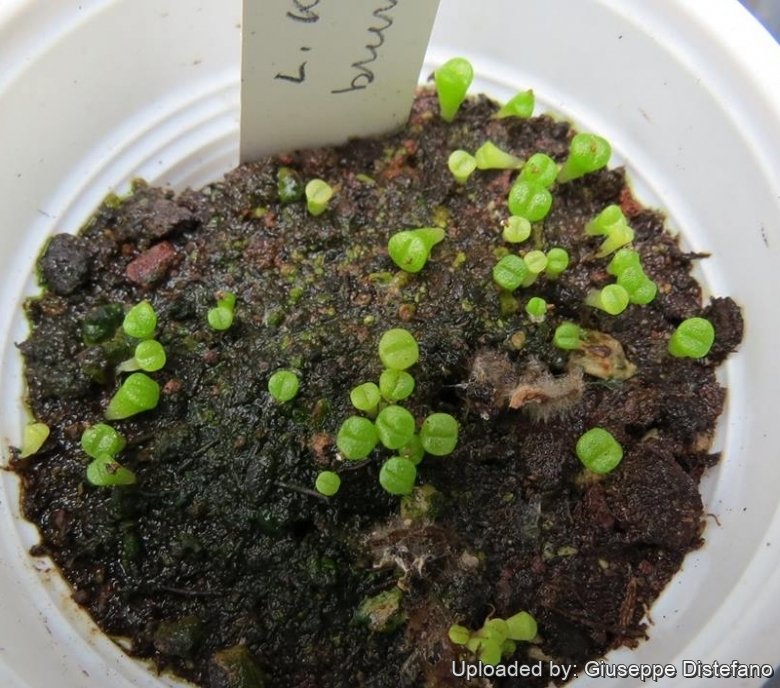
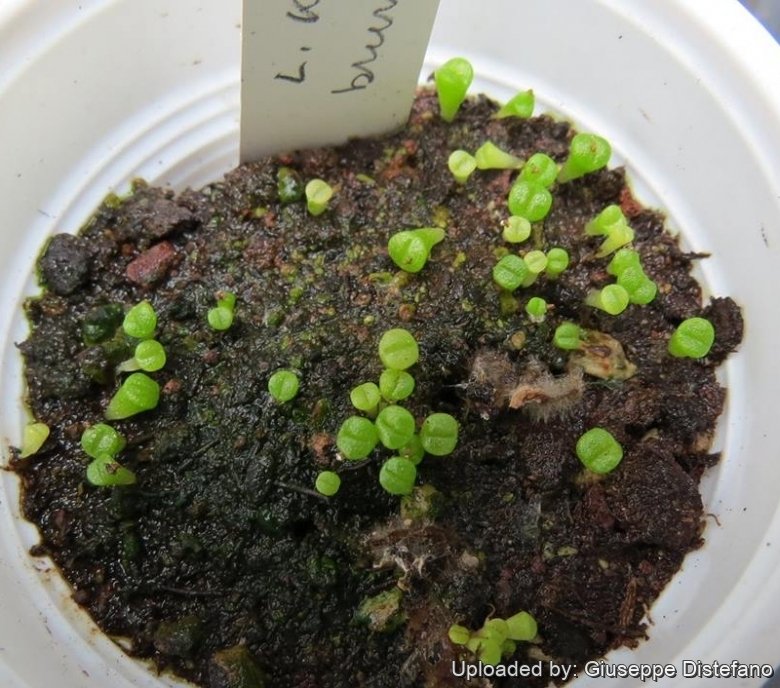
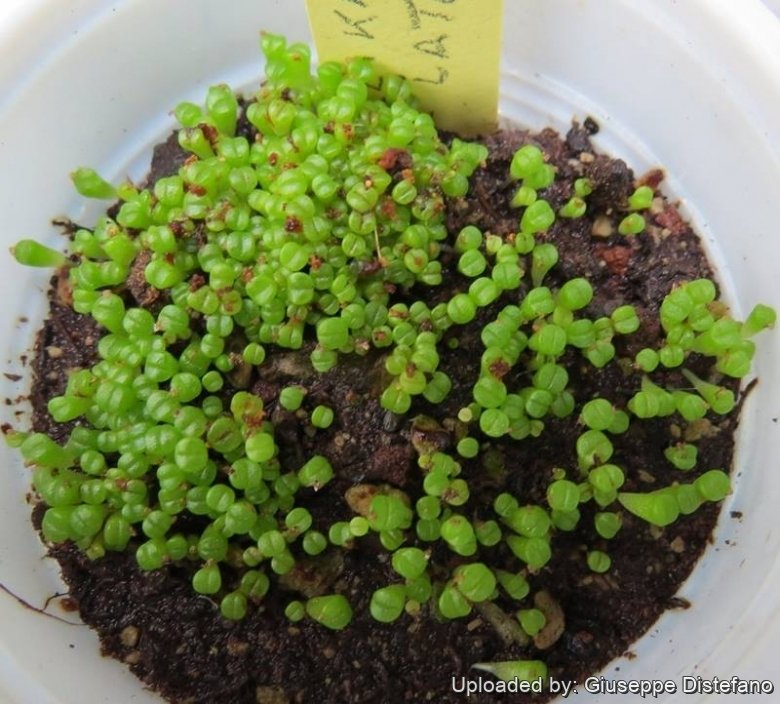
Propagation: From seed, with seed planting best in either October or April.
Notes
Lithops are partly subterranean, with only the clear ‘window’ in each leaf tip exposed above soil. A type of optical system exists whereby a layer of apical tissue rich in calcium oxalate crystals acts as a filter to intense sunlight before it reaches the thin chlorophyllous layer below. They are also called mimicry plants as they show a striking similarity to their background rocks and are difficult to detect when not in flower. These are the commonly known as pebble plants or living stones; each species is associated with one particular type of rock formation and occurs nowhere else. Its soil-embedded, subterranean growth form also reduces the need for chemical defences against herbivores.
Bibliography
Major references and further lectures
-
Gert Cornelis Nel, “Lithops: Plantae Succulente, Rarissimae, in Terra Obsuratae, E Familia Aizoaceae, Ex Africa Australi” Hortors Limited, University Press, Stellenbosch. 1946
-
Linda R. Berg “Introductory Botany: Plants, People, and the Environment” Cengage Learning, 02/Mar/2007
-
Dieter J. Von Willert “Life strategies of succulents in deserts: with special reference to the Namib desert” CUP Archive, 1992
-
Chris Mcintyre “Namibia” Bradt Travel Guides, 2007
-
Neale (W. T.) & Co, Edgar Lamb “Neale’s photographic reference plates, 1949: Combining cacti and other succulents” Vol. 2 W. T. Neale & Co.
-
RHS “A-Z encyclopedia of garden plants.” United Kingdom: Dorling Kindersley. 2008
-
American Horticultural Society “The American Horticultural Society encyclopedia of garden plants” Macmillan, 30/Nov/1989
-
H. E. K. Hartmann “Illustrated Handbook of Succulent Plants: Aizoaceae F-Z” Springer, 2002
-
Schwantes, Gustav. “Flowering Stones and Mid-day Flowers” London: Ernst Benn. 1957
-
S. M Walters “The European Garden Flora Flowering Plants: Casuarinaceae to Aristolochiaceae” Cambridge University Press, 1989
-
Clive Innes “Complete Handbook of Cacti and Succulents” Van Nostrand Reinhold Company, 01/Dec/1981
-
Cole, D. T. “Flowering stones” Acorn Books, Randburg. 1988
-
Smith et al. “Mesembs of the World.” Briza.Pretoria 1998
-
Leistner, O.A. (ed.), “Seed plants of southern Africa: families and genera” Strelitzia 10., National Botanical Institute, Pretoria 2000
-
Achim Hecktheuer “Mesembs, mehr als nur Lithops” Books on Demand GmbH Norderstedt. 2008
-
Cole “LITHOPS Flowering Stones” Cactus & Co. Libri. 2005
-
Yasuhiko Shimada “The Genus Lithops” Dobun Shoin. 2001
-
Rudolf Heine “Lithops - Lebende Steine” Neumann Verlag. 1986
-
Bernd Schlösser “Lithops – Lebende Steine” Praktische Anleitung für die Zimmerkultur. BussinessPoint MEDIA. 2000
-
Steven A. Hammer “Lithops – Treasures of the veld” British Cactus and Succulent Society. 1999
-
David L. Sprechman “Lithops” Associated University Presses, Inc. 1970
From llifle page Lithops bella var. lericheana
Description
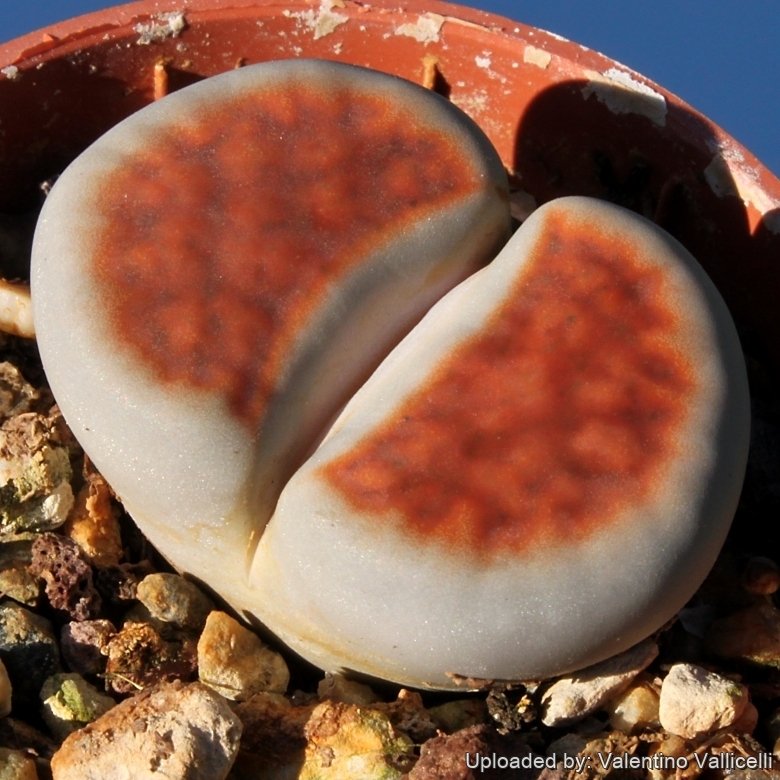
Lithops karasmontana subs. lericheana is a form of the very variable Lithops karasmontana somewhat similar to Lithops karasmontana subs. bella. It is distinguished for its light and dark orange grey jagged pattern, with window large, irregular, dark orange-red surrounded by a buff coloured, light orange, light brown or grey brown border. The flowers are white and sweetly scented.
Habit: Bodies solitary or in groups of 2 or more, to 3 cm high.
Stem: Almost stemless.
Bodies (Paired leaves): Inverted cone-like, turbiniform, each 2,5-3 cm, divided into 2 unequal-sized, conjunct and coalescent leaves; in the young stage slightly convex, in the older stage more or less flat. Fissure fairly deep, 4-10 mm long, sides light grey; window large, irregular, light and dark orange grey, with window large, irregular, dark orange-red surrounded by a buff coloured, light orange, light brown or grey brown border.
Flowers: Big up to 4,5 cm in diameter (mostly 25-35 mm) satiny white, narrow-rayed.
Blooming season: Late summer or early autumn.
Fruit: Seed capsules mostly 5-chambered, otherwise 4 or 5-chambered. Profile boat-shaped.
Origin and Habitat
Type Locality 70 km North of Karasburg, Namibia.
Cultivation and Propagation
Lithops karasmontana var. lericheana need an open mineral, fast draining mix and the maximum amount of light you are able to give them. The basic cultivation routine is: Stop watering after flowering. Start watering after the old leaves completely dry. (Usually late March or Early April) Water freely during the growing season, soak the compost fully but allow it to dry out between waterings. Some growers fertilize frequently, some hardly ever. Keep them dry during the winter. Nearly all problems occur as a result of overwatering and poor ventilation especially when weather conditions are dull and cool or very humid.
Propagation: From seed, with seed planting best in either October or April.
Source: Lithops bella var. lericheana, LLIFLE - Encyclopedia of living forms, CC-BY-SA, retrieved 2026-10-25.
From llifle page Lithops erniana var. aiaisensis
Description
Lithops karasmontana var. aiaisensis is one of the innumerable local form of the very variable Lithops karasmontana coming from Ai-Ais in Namibia (hence the name). It distinguishes for the top of leaves varying from pale grey to brownish, with branched branched depressions or wrinkles darker grey to reddish-brown which form a network, window usually absent or not obvious. It has the same variable characteristics of the species.
Habit: Bodies solitary or in groups, to 4 cm high.
Flowers: Big up to 4,5 cm in diameter (mostly 25-35 mm) satiny white, narrow-rayed.
Blooming season: Late summer or early autumn.
Fruit: Seed capsules mostly 5-chambered, otherwise 4 or 6-chambered. Profile boat-shaped.
Seeds: Minuscule, yellow-brown; smooth to rugose.
Origin and Habitat
Ai-Ais and adjacent areas, Namibia.
Cultivation and Propagation
The Lithops (a.k.a. Living Stones) are some of the world’s most fascinating plants and are sought by the collector of succulent plants. Paying attention to the particular growing requirement of Lithops is especially important. If you provide the Lithops with the right conditions, they will reward you with their unique shape, size, colour and a proliferation of blooms in autumn. However, Lithops are tricky plants that are very particular about their growing conditions and require the right maintenance in order to keep happy. But don’t be afraid even the best growers have plants that mysteriously dry up, or leave during the night. While Lithops are picky about their care, if you are patient and remember the basics, your efforts will be rewarded. Being small plants, a representative collection can be grown on a patio table, a sunny windowsill or a shelf in the greenhouse.
Growing rate: Slow growing for a mesemb.
Soil: They grow best in an open mineral, sandy-gritty soil and requires good drainage as they are prone to root rot. They can grow outdoor in sunny, dry, rock crevices (protection against winter wet is required) They can also be cultivated in alpine house, in poor, drained soil.
Repotting: They may stay in the same pot for many years. Plants grown in larger containers have frequently relatively poor flowers. Flowers might improve when the plants are given their own, small individual pots.
Watering They Require little water otherwise the epidermis breaks (resulting in unsightly scars). The basic cultivation routine is: Stop watering after flowering. Start watering after the old leaves are completely dry (usually late March or Early April). Water freely during the growing season, soak the compost fully but allow it to dry out between waterings. In the winter season the plant doesn’t need watering, the plant in this time extracts water from the outer succulent leaves, allowing them to shrivel away, relocating water to the rest of the plant and to the new leaves that form during this period. If grown in a container, bottom watering by immersing the container is recommended. Water sparingly only when warm, no water when cold. Nearly all problems occur as a result of overwatering and poor ventilation, especially when weather conditions are dull and cool or very humid. They must have very dry atmosphere.
Fertilization: Feed them once during the growing season with a fertilizer specifically formulated for cactus and succulents (high potash fertilizer with a dilute low nitrogen), including all micro nutrients and trace elements diluted to ½ the strength recommended on the label. They thrive in poor soils and need a limited supplies of fertilizer to avoid the plants developing excess vegetation, which is easily attacked by fungal diseases. Some growers fertilize frequently, some hardly ever. However, for the highly succulent mesembs, (Lithops, Conophytums, etc.) fertilization is not really necessary.
Light: They prefer a very bright situation and in winter they need the maximum amount of light you are able to give them, but keep more cool and partially shaded in summer. The only exception to this is seedlings in their first year that enjoy a shades place. Such tiny plants can easily get scorched or broiled and their appearance spoiled (this may not matter in the wild, where the Lithops have probably shrunk into the ground and becomes covered with sands). Outdoor (Lithops prefer full sun, with some shade in the hottest summer months. High levels of light are needed in autumn to flower and for good plant development. The low intensity of sun light during the growing season of this species generally prevents the white flower flowers from opening.
Special Advice: Lithops are best planted in a sunny and airy part of the greenhouse, and not too close to the glass roof or sides of the house as the plants can overheat during hot spells.
Hardiness: They require a minimum temperature 5°C (But will take a light frost and are hardy down to -7° C for short periods if they are in dry soil). USDA zones 9A – 11.
Uses: Container, rock garden.
Pests & diseases: Lithops may be attractive to a variety of insects, but plants in good condition should be nearly pest-free, particularly if they are grown in a mineral potting-mix, with good exposure and ventilation. Nonetheless, there are several pests to watch for:
- Red spiders: they may be effectively rubbed up by misting the vulnerable plants every day.
- Mealy bugs: occasianlly they develop aerial into the new leaves and flowers with disfiguring results, but the worst types develop underground on the roots and are invisible except by their effects.
- Sciara Flies: they are one of the major problems for seedlings. It is a good practice to mulch your seedlings with a layer of grit, which will strongly discourage the flies.
- Scales, thrips and aphids: (they are rarely a problem.)
It is wise to treat your whole collection with a systemic insecticide twice a year in spring and autumn.
- Rot: it is only a minor problem with mesembs if the plants are watered and “aired” correctly. If they are not, fungicides won’t help all that much.
Remarks: After flowering in the autumn and extending through winter season the plant doesn’t need watering, but they will still be growing, the new bodies will be increasing in size extracting water from the outer succulent leaves, allowing them to shrivel away. In fact the plant in this time extracts water and nutrient stored in the outer succulent leaves, allowing them to dehydrate relocating the water to the rest of the plant and to the new leaves that form during this period until the old leaves are reduced to nothing more than “thin papery shells”.
Propagation: Seed or (or rarely) cuttings. The small seeds can be sown in pots of fine, well-drained sand, any time during the spring and summer months when temperatures are warm. Cover the seeds with a very fine layer of grit and water from below with a fungicide to prevent damping off. For the first 3-4 days cover the pots with a sheet of glass/clear perspex to keep the humidity levels high. Remove the glass and replace it with light shadecloth and mist once or twice a day for the next two weeks after which most seeds should have germinated. From then on mistings can be reduced to every second and then every third day as the little plants grow. Take the cuttings from a grown-up mother plant. Each cutting must contain one or more heads along with a fraction of root and permit them to dry out a couple of days, lay the cuttings on the soil and insert the stem end partially into the soil. Try to keep the cutting somewhat upright so that the roots are able to grow downward. It is relatively difficult to root Lithops from cuttings and generally pointless as well, so quick are they from seed.
Comment: Improvement of Lithops characteristics: Some growers (but not all!!) think it is very intriguing to reinforce any characteristic of cultivated Lithops of by crossing two similar selected plants and then back-crossing with the mother plant. This way we can eventually get some interesting results. Of course, many of the nicest Lithops we grow in cultivation have already been selected over time. However many Lithops are already nice plants which can’t really be improved, on the other hand one could try to improve the colour or the markings etc. Now if we have two particular plants we may attempt to breed between them and can maybe get a whole improved population and then select some better offspring to continue the selection.
Seed production: Plants can be hand pollinated, using a small paint brush. Remember always to cross different clones as the plants are self-sterile. The seed will remain viable for many years provided it is stored in a cool dry place.
Notes
Lithops karasmontana is a choice example of the window-leaf ( fenestrate leaf) adaptation found in many other succulent species like Peperomia columnella, Fenestraria rhopalophylla, Haworthia truncata, Ophthalmophyllum friedrichiae, etc. These windowed plants usually grows buried in the ground with only the upper truncated portion of the thick, succulent leaves visible. Both the coalescent leaf pair of Lithops (shaped like an inverted cone) and the leaves of the other windowed plants have a more or less upright position with the leaf tips at the soil surface or protruding only a little from the soil. The leaf tips either are rounded or flattened. This windows leaf tip is free of green pigments. The greater part of the photosynthetic leaf surface, the mantle, is not exposed directly to sun light since the leaf is embedded into the soil and the solar radiation is transmitted by the colourless water storage tissue to the assimilatory tissue, so the photosynthetically active mantle gets light only from inside the leaf and not across the epidermis. Moreover this light is more or less evenly dispersed over the whole assimilatory tissue since the water storage tissue disperses the solar radiation. All species of Lithops and Ophthalmophyllum have coloured windows that matches with the colours of the soil and the pebbles of the plant’s habitat. While other window plants such as Haworthia maughanii have dark green pigmented window areas. This green colour, however, does not result from a pigmentation of the window area but is the result of light that penetrates the window and is transmitted across the water storage tissue.
Source: Lithops erniana var. aiaisensis, LLIFLE - Encyclopedia of living forms, CC-BY-SA, retrieved 2026-10-25.
From llifle page Lithops fossulifera
Description
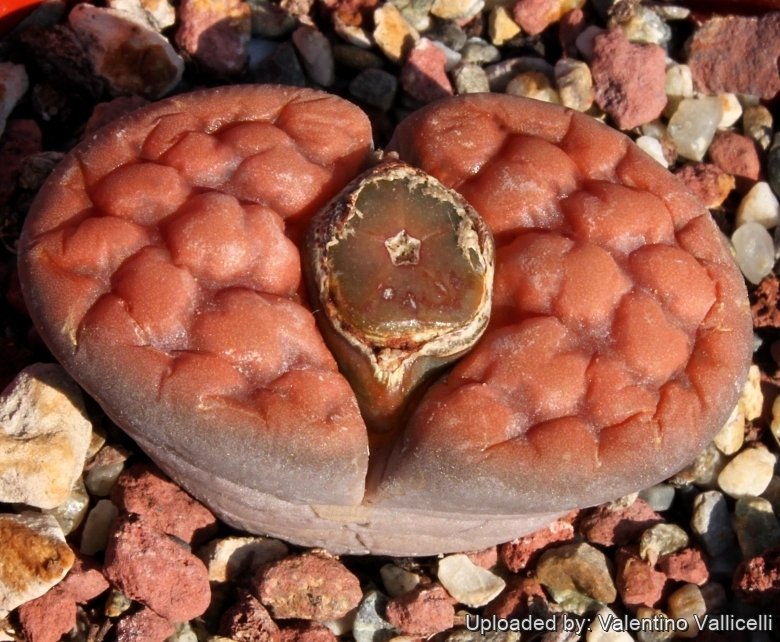
Lithops karasmontana var. tischeri is one form of the very variable Lithops karasmontana distinguished for its tops strongly bullate with deep depressions, ochre-brown with red-brown blue-grey channels.
Habit: Bodies solitary or in groups of 2 or more, to 3 cm high.
Stem: Almost stemless.
Bodies (Paired leaves): Inverted cone-like, turbiniform, each 2,5-3 cm, divided into 2 unequal-sized, conjunct and coalescent leaves; in the young stage slightly convex, in the older stage more or less flat. Fissure deep, 4-10 mm long, sides light grey to brownish-grey. Tops strongly bullate with deep depressions ochre-brown with red-brown blue-grey channels
Flowers: Big up to 4,5 cm in diameter (mostly 25-35 mm) satiny white, narrow-rayed.
Blooming season: Late summer or early autumn.
Fruit: Seed capsules mostly 5-chambered, otherwise 4 or 5-chambered. Profile boat-shaped.
Seeds: Minuscule, yellow-brown; smooth to rugose.
Origin and Habitat
Type Locality: 30 km NNE of Grünau, Namibia
Cultivation and Propagation
Lithops karasmontana var. tischeri need an open mineral, fast draining mix and the maximum amount of light you are able to give them. The basic cultivation routine is: Stop watering after flowering. Start watering after the old leaves completely dry. (Usually late March or Early April) Water freely during the growing season, soak the compost fully but allow it to dry out between waterings. Some growers fertilize frequently, some hardly ever. Keep them dry during the winter. Nearly all problems occur as a result of overwatering and poor ventilation especially when weather conditions are dull and cool or very humid.
Propagation: From seed, with seed planting best in either October or April.
Source: Lithops fossulifera, LLIFLE - Encyclopedia of living forms, CC-BY-SA, retrieved 2026-10-25.
From llifle page Lithops jacobseniana
Description
Lithops karasmontana (a.k.a. Stone plant) is a tiny perennial, caespitose, succulent plant resembling a grouping of tiny pebbles split down the middle like cleft hooves. It grows to a maximum eight of 4 cm above ground and spreads to form small clumps with up to 12 or more heads (usually 2-6). It is one of the more variable species, with uniformly coloured or variously ornamented plants, and yet with opaque or obscurely windowed forms; there is also a great variation in the colours. Plants from different localities show strikingly different colours or patterns, but all natural populations show some degree of variation among individuals, and in some all possible intermediates colours and pattens occur. The “mickbergensis” form has a quite uniform orange grey to pinkish-grey tops. It is variable.
Stem: Almost stemless.
Bodies (Paired leaves): Inverted cone-like, divided into 2 unequal-sized, conjunct and coalescent leaves. These leaves are modified for water storage as well as photosynthesis. Face elliptic-reniform 25-35 x 20-28 mm broad usually rugose. Top flat to slightly convex, fissure fairly deep, 4-10 mm long. Colours pale grey or bluish-grey on lower parts and shoulders, upper surfaces beige, to orange-grey on the flat sunken surfaces. Windows often absent. Margins indistinct grey tinged with various shades of orange-grey. Islands frequently only vaguely noticeable. Dusky dots absent or very inconspicuous.
The plant renews itself every year or so by putting out a new plantlet from between the two lobes. Once the new plant is full sized, the old lobes shrivel up and slough off as a snake skin does.
Flowers: Big up to 4,5 cm in diameter (mostly 25-35 mm) satiny white, narrow-rayed.
Blooming season: Late summer or early autumn.
Fruit: Seed capsules mostly 5-chambered, otherwise 4 or 6-chambered. Profile boat-shaped.
Seeds: Minuscule, yellow-brown; smooth to rugose.
Source: Lithops jacobseniana, LLIFLE - Encyclopedia of living forms, CC-BY-SA, retrieved 2026-10-25.
From llifle page Lithops lateritia
Description
Lithops karasmontana var. lateritia is one of the innumerable local form of the very variable Lithops karasmontana distingushed for the oval bodies with fissure extending right across, top surface quite homogeneous with brick-red or rusty-red tones. Flowers white. It has the same variable characteristics of the species.
Habit: Bodies solitary or in groups of 2 or more, to 3 cm high.
Stem: Almost stemless.
Bodies (Paired leaves): Inverted cone-like, divided into 2 unequal-sized, conjunct and coalescent leaves. Each 2,5-3 cm. Fissure fairly deep, 4-10 mm long. Top of lobe flat or subconvex; sides and top tinted a pale red-ochre, brick-red or bright rusty-red; window semi-opaque, surface slightly uneven, the depressions coloured darker than the ridges, which are coloured a deeper brick-red.
The plant renews itself every year or so by putting out a new plantlet from between the two lobes. Once the new plant is full sized, the old lobes shrivel up and slough off as a snake skin does.
Flowers: Big up to 4,5 cm in diameter (mostly 25-35 mm) satiny white, narrow-rayed.
Blooming season: Late summer or early autumn.
Fruit: Seed capsules mostly 5-chambered, otherwise 4 or 5-chambered. Profile boat-shaped.
Seeds: Minuscule, yellow-brown; smooth to rugose.
Origin and Habitat
Namibia.
Bibliography
Major refences and further lectures
-
Heidrun E. K. Hartmann (2002) “Aizoaceae F – Z” Springer
-
Achim Hecktheuer (2008) “Mesembs, mehr als nur Lithops” Books on Demand GmbH Norderstedt. ISBN-13 978-3-8370-1724-3
-
Desmond T. Cole & Naureen A. Cole, Uwe Beyer, Yves Delange (2008) “Les Lithops” SUCCULENTES Spécial 2008 AIAPS (now Terra seca). ISSN 0258-5359
-
Desmond T. Cole & Naureen A. Cole (2005) “LITHOPS Flowering Stones” Cactus & Co. Libri. ISBN 88-900511-7-5 ISBN-13 978-88-900511-7-3
-
Yasuhiko Shimada (2001) “The Genus Lithops” Dobun Shoin. ISBN 4-8103-4066-X
-
Rudolf Heine (1986) “Lithops - Lebende Steine” Neumann Verlag. ISBN 3-7402-0000-6; ISBN-13 978-3-7402-0000-8
-
Bernd Schlösser (2000) “Lithops – Lebende Steine” Praktische Anleitung für die Zimmerkultur. BussinessPoint MEDIA. ISBN 3-934945-01-5; ISBN-13 978-3-934945-01-2
-
Steven A. Hammer (1999) “Lithops – Treasures of the veld” British Cactus and Succulent Society. ISBN 0-902-099-64-7; ISBN-13 978-0-902099-64-7
-
Desmond T. Cole (1988) “Lithops – Flowering Stones” Acorn Books CC. ISBN 0-620-09678-0; ISBN-13 978-0-620-09678-2
-
Rudolf Heine (1986) “Lithops – lebende Steine” Neumann Verlag. ISBN 3-7402-0000-6; ISBN-13 978-3-7402-0000-8
-
David L. Sprechman (1970) “Lithops” Associated University Presses, Inc. SBN 8386-6902-6
-
Gert Cornelius Nel (1946) “Lithops” Hortors Limited, South Africa
Source: Lithops lateritia, LLIFLE - Encyclopedia of living forms, CC-BY-SA, retrieved 2026-10-25.
From llifle page Lithops opalina
Description
Lithops karasmontana var. opalina is one of the innumerable local form of the very variable Lithops karasmontana distingushed for the oval bodies with fissure extending right across, pale bluish-white, top surface quite homogeneous with pinkish tint. Flowers white.
Habit: Bodies solitary or in groups of 2 or more, to 3 cm high.
Bodies (paired leaves): More or less subequal, each 2,5-3 cm; top of lobe flat or subconvex; sides and top tinted a pinkish grey; window semi-opaque, surface slightly uneven, the depressions coloured lighter than the ridges, which are coloured a deeper grey.
Flowers: Big up to 4,5 cm in diameter (mostly 25-35 mm) satiny white, narrow-rayed.
Blooming season: Late summer or early autumn.
Fruit: Seed capsules mostly 5-chambered. Profile boat-shaped.
Seeds: Minuscule, yellow-brown; smooth to rugose.
Origin and Habitat
Namibia
Habitat: It is found growing among quartzite stones.
Cultivation and Propagation
Need an open mineral, fast draining mix and the maximum amount of light you are able to give them. The basic cultivation routine is: Stop watering after flowering. Start watering after the old leaves completely dry. (Usually late March or Early April) Water freely during the growing season, soak the compost fully but allow it to dry out between waterings, no water when cold. Some growers fertilize frequently, some hardly ever. Keep them dry during the winter. Nearly all problems occur as a result of overwatering and poor ventilation especially when weather conditions are dull and cool or very humid. This plant is best for a well lit area (Bright shade to full sun).
Bibliography
Major refences and further lectures
-
Heidrun E. K. Hartmann (2002) “Aizoaceae F – Z” Springer
-
Achim Hecktheuer (2008) “Mesembs, mehr als nur Lithops” Books on Demand GmbH Norderstedt.
-
Desmond T. Cole & Naureen A. Cole, Uwe Beyer, Yves Delange (2008) “Les Lithops” SUCCULENTES Spécial 2008 AIAPS (now Terra seca).
-
Desmond T. Cole & Naureen A. Cole (2005) “LITHOPS Flowering Stones” Cactus & Co. Libri.
-
Yasuhiko Shimada (2001) “The Genus Lithops” Dobun Shoin. ISBN 4-8103-4066-X
-
Rudolf Heine (1986) “Lithops - Lebende Steine” Neumann Verlag.
-
Bernd Schlösser (2000) “Lithops – Lebende Steine” Praktische Anleitung für die Zimmerkultur. BussinessPoint MEDIA.
-
Steven A. Hammer (1999) “Lithops – Treasures of the veld” British Cactus and Succulent Society.
-
Desmond T. Cole (1988) “Lithops – Flowering Stones” Acorn Books CC.
-
Rudolf Heine (1986) “Lithops – lebende Steine” Neumann Verlag.
-
David L. Sprechman (1970) “Lithops” Associated University Presses, Inc.
-
Gert Cornelius Nel (1946) “Lithops” Hortors Limited, South Africa
Source: Lithops opalina, LLIFLE - Encyclopedia of living forms, CC-BY-SA, retrieved 2026-10-25.
From llifle page Lithops summitatum
Description
Lithops karasmontana var. summitatum, is a controversial name, sometimes considered nomina nuda, used to indicate one of the innumerable local form of the very variable Lithops karasmontana.
Taxonomy notes: Gert Cornelius Nel in 1946 wrote that the species L. summitata created by Dinter in 1927, was supposed by the author to differ from L. karasmontana in certain respects. There were two kinds of plants on the same plate both of which he called L. summitata. The one on the extreme left was very decided darker colouration in the depressions than the others. He goes on to say that L. summitata is “hellgrau-blau am Kegelteil” (greyish or brownish blue on the cone part ) with very branched grooves printed superficially and L. karasmontana “taubengrau-blau.” (greysh-blue). This assumes that there is a definite colour called taubengrau‑blau. It is clear that these fine differences in colour cannot possibly be used to distinguish species. Dinter also asserted that the weight of the seed of L. summitata is 0.072 mg. and that of L. karasmontana is 0.064 mg. That is driving the art of distinguishing species to a very fine point indeed. Since these forms coexist in nature, names have a good secondary importance from this point of view and the two “species” result hardly discernible. Moreover there are not “pure” stand or colony of L. summitatum; on the other hand, specimens conforming to the description of this taxon occur in most colonies of L. karasmontana. There seems therefore to be no reason for retaining this as a separate species or variety. Desmond Cole does not mention nor “summitatum” nor “lateritia” in varieties of L. karasmontana. The first is similar to the variety Lithops karasmontana var. lericheana, while the second, it is often presented as a cultivar of Lithops karasmontana var. mickbergensis. But in karasmontana seedlings, there are all possible forms. With patience, time and space, one must be able to produce nice cultivars. Although the distinction between these forms is very artificial to a botanical point of view, it can be justified from a horticultural point of view if the difference is really stable and obvious.
Remarks: In the trade, “summitatum” is often used to indicate Lithops karasmontana var. lateritia and Boer also used the name “var. summitatum” for a cultivar with pure red top of L. karasmontana, but others red topped forms are similar and plants from different localities look more like it.
Bodies (paired leaves): Inversely cone-shaped or club-like truncate, rounded to 25 mm high; a deep, greyish beige cleft dividing tops into unequal or unequal parts, the upper surface light brown with subdued greyish-purple blotching. The “summitatum” still found in the trade (referable to Lithops lateritia) have top of lobe flat or subconvex tinted a pale red-ochre, orange, brick-red or bright rusty-red mostly lined; window semi-opaque, surface slightly uneven, the depressions coloured darker than the ridges, which are coloured a deeper brick-red.
Flowers: White
Specific name: The neuter specific adjectives “summitatum” agrees with Mesembryanthemum but not with the feminine noun Lithops. However the incorrect name “summitatum” (not “summitata”) has been conserved.
Origin and Habitat
Namibia. Karas Mountains.
Cultivation and Propagation
Need an open mineral, fast draining mix and the maximum amount of light you are able to give them. The basic cultivation routine is: Stop watering after flowering. Start watering after the old leaves completely dry. (Usually late March or Early April) Water freely during the growing season, soak the compost fully but allow it to dry out between waterings, no water when cold. Some growers fertilize frequently, some hardly ever. Keep them dry during the winter. Nearly all problems occur as a result of overwatering and poor ventilation especially when weather conditions are dull and cool or very humid. This plant is best for a well lit area (Bright shade to full sun).
Remarks: After flowering in the autumn and extending through winter season the plant doesn’t need watering, but they will still be growing, the new bodies will be increasing in size extracting water from the outer succulent leaves, allowing them to shrivel away. In fact the plant in this time extracts water and nutrient stored in the outer succulent leaves, allowing them to dehydrate relocating the water to the rest of the plant and to the new leaves that form during this period until the old leaves are reduced to nothing more than “thin papery shells”.
Bibliography
Major references and further lectures
-
Steven A. Hammer “Lithops: joyaux du veld” Editions Quae, 2010
-
Gert Cornelius Nel “Lithops” Hortors Limited, South Africa 1946
-
Excelsa, Editions 1-6 Aloe, Cactus and Succulent Society of Rhodesia, 1971
-
Alfred Byrd Graf “Exotica, series 4 international: pictorial cyclopedia of exotic plants from tropical and near-tropic regions” Roehrs Co. Publishers, 1985
-
Desmond T. Cole & Naureen A. Cole “LITHOPS Flowering Stones” Cactus & Co. Libri. 2005
Source: Lithops summitatum, LLIFLE - Encyclopedia of living forms, CC-BY-SA, retrieved 2026-10-26.
Cultivars and forms (35)
Subspecies (10)
- Lithops karasmontana subs. bella
- Lithops karasmontana subs. bella C143A 60 km NNE of Aus, Namibia
- Lithops karasmontana subs. bella C285 Near Aus, Namibia
- Lithops karasmontana subs. bella C295 115 km SSE of Aus, Namibia
- Lithops karasmontana subs. eberlanzii
- Lithops karasmontana subs. eberlanzii C082 35 km E of Lüderitz, Namibia
- Lithops karasmontana subs. eberlanzii C149 (syn. erniana witputzensis) TL: 110 km SSE of Aus, Namibia
- Lithops karasmontana subs. eberlanzii C208 10 km S of Aus, Namibia
- Lithops karasmontana subs. eberlanzii C370 35 km 35 km E of Lüderitz, Namibia
- Lithops karasmontana subs. opalina
Varieties (14)
- Lithops karasmontana var. aiaisensis
- Lithops karasmontana var. aiaisensis C224 TL: 110 km W of Karasburg, Namibia
- Lithops karasmontana var. aiaisensis C409 30 km E of Ai-Ais, Namibia
- Lithops karasmontana var. lateritia
- Lithops karasmontana var. lericheana
- Lithops karasmontana var. lericheana C193 50 km NNE of Grünau, Namibia
- Lithops karasmontana var. lericheana C267 TL: 70 km N of Karasburg, Namibia
- Lithops karasmontana var. lericheana C329 70 km N of Karasburg, Namibia
- Lithops karasmontana var. lericheana C330 70 km N of Karasburg, Namibia
- Lithops karasmontana var. mickbergensis
- Lithops karasmontana var. opalina
- Lithops karasmontana var. summitatum
- Lithops karasmontana var. tischeri
- Lithops karasmontana var. tischeri C182 TL: 30 km NNE of Grünau, Namibia
Cultivars (3)
Other names (8)
- Lithops karasmontana C065 (Signalberg Form) 25 km WNW of Grünau, Namibia
- Lithops karasmontana C168 (syn. mickbergensis) 10 km NNE of Grünau, Namibia
- Lithops karasmontana C169 (syn. mickbergensis) 20 km NNE of Grünau, Namibia
- Lithops karasmontana C225 30 km NW of Grünau, Namibia
- Lithops karasmontana C226 25 km W of Grünau, Namibia
- Lithops karasmontana C227 (syn. jacobseniana) TL: 10 km SW of Grünau, Namibia
- Lithops karasmontana C317 (syn. mickbergensis) 15 km NE of Grünau, Namibia
- Lithops karasmontana C327 (syn. mickbergensis) 15 km NNE of Grünau, Namibia
Gallery