Description
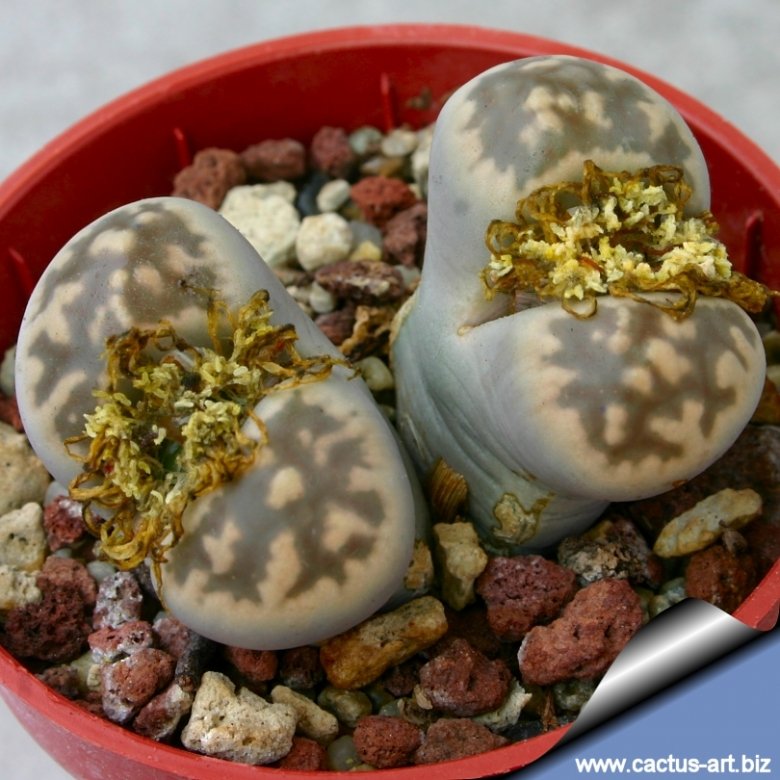
Lithops karasmontana subs. bella is one form of the very variable Lithops karasmontana distingushed for its “zebra” appearance with window large, irregular, dark green to light green, surrounded by a buff coloured, light green, light brown or grey brown border.
Habit: Bodies solitary or in groups of 2 or more, to 3 cm high.
Stem: Almost stemless.
Bodies (Paired leaves): Inverted cone-like, turbiniform, each 2,5-3 cm, divided into 2 unequal-sized, conjunct and coalescent leaves; in the young stage slightly convex, in the older stage more or less flat. Fissure fairly deep, 4-10 mm long, sides light grey; window large, irregular, dark green to light green, surrounded by a buff coloured, light green, light brown or grey brown border. The outer part of the border provided with lobes varying in length and shape, giving the border a toothed or dendritic appearance; a few irregularly shaped, jagged lobes raised above the level of the dark green parts of the window generally and projecting into the window, subdividing it into smaller areas; some times in the old
Origin and Habitat
115 km SSE of Aus, Namibia
Cultivation and Propagation
Lithops karasmontana subs. bella need an open mineral, fast draining mix and the maximum amount of light you are able to give them. The basic cultivation routine is: Stop watering after flowering. Start watering after the old leaves completely dry. (Usually late March or Early April) Water freely during the growing season, soak the compost fully but allow it to dry out between waterings. Some growers fertilize frequently, some hardly ever. Keep them dry during the winter. Nearly all problems occur as a result of overwatering and poor ventilation especially when weather conditions are dull and cool or very humid.
Propagation: From seed, with seed planting best in either October or April.
Bibliography
Major references and further lectures
-
Gert Cornelis Nel, “Lithops: Plantae Succulente, Rarissimae, in Terra Obsuratae, E Familia Aizoaceae, Ex Africa Australi” Hortors Limited, University Press, Stellenbosch. 1946
-
Linda R. Berg “Introductory Botany: Plants, People, and the Environment” Cengage Learning, 02/Mar/2007
-
Dieter J. Von Willert “Life strategies of succulents in deserts: with special reference to the Namib desert” CUP Archive, 1992
-
Chris Mcintyre “Namibia” Bradt Travel Guides, 2007
-
Neale (W. T.) & Co, Edgar Lamb “Neale’s photographic reference plates, 1949: Combining cacti and other succulents” Vol. 2 W. T. Neale & Co.
-
RHS “A-Z encyclopedia of garden plants.” United Kingdom: Dorling Kindersley. 2008
-
American Horticultural Society “The American Horticultural Society encyclopedia of garden plants” Macmillan, 30/Nov/1989
-
H. E. K. Hartmann “Illustrated Handbook of Succulent Plants: Aizoaceae F-Z” Springer, 2002
-
Schwantes, Gustav. “Flowering Stones and Mid-day Flowers” London: Ernst Benn. 1957
-
S. M Walters “The European Garden Flora Flowering Plants: Casuarinaceae to Aristolochiaceae” Cambridge University Press, 1989
-
Clive Innes “Complete Handbook of Cacti and Succulents” Van Nostrand Reinhold Company, 01/Dec/1981
-
Cole, D. T. “Flowering stones” Acorn Books, Randburg. 1988
-
Smith et al. “Mesembs of the World.” Briza.Pretoria 1998
-
Leistner, O.A. (ed.), “Seed plants of southern Africa: families and genera” Strelitzia 10., National Botanical Institute, Pretoria 2000
-
Achim Hecktheuer “Mesembs, mehr als nur Lithops” Books on Demand GmbH Norderstedt. 2008
-
Cole “LITHOPS Flowering Stones” Cactus & Co. Libri. 2005
-
Yasuhiko Shimada “The Genus Lithops” Dobun Shoin. 2001
-
Rudolf Heine “Lithops - Lebende Steine” Neumann Verlag. 1986
-
Bernd Schlösser “Lithops – Lebende Steine” Praktische Anleitung für die Zimmerkultur. BussinessPoint MEDIA. 2000
-
Steven A. Hammer “Lithops – Treasures of the veld” British Cactus and Succulent Society. 1999
-
David L. Sprechman “Lithops” Associated University Presses, Inc. 1970
Gallery