Description
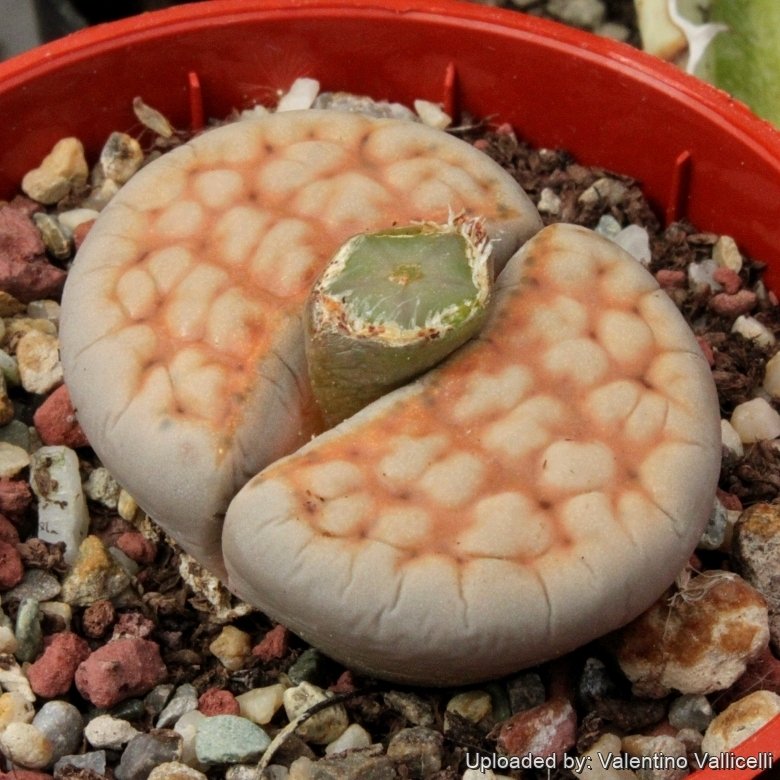
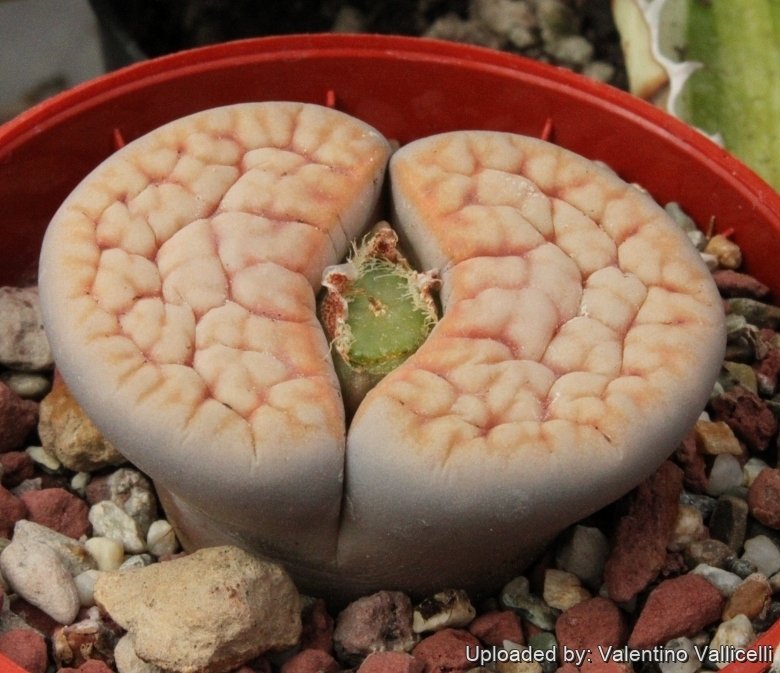
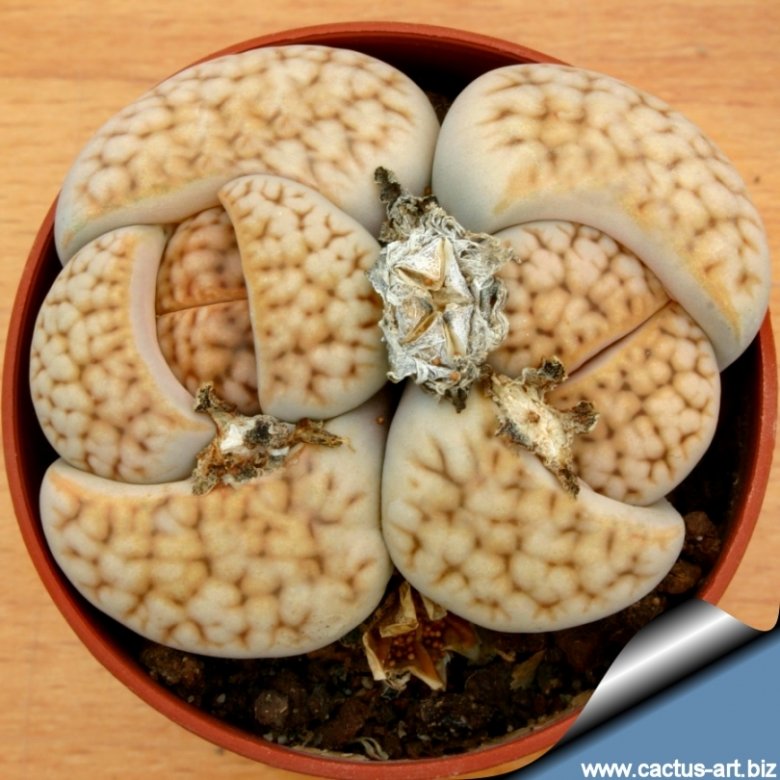
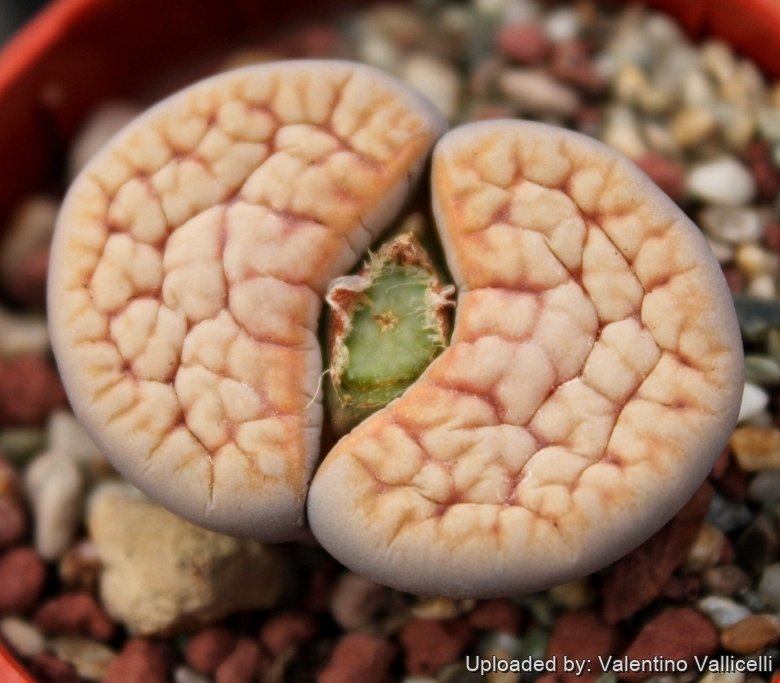
Lithops karasmontana var. aiaisensis cv. Red Top is a selected form of the very variable Lithops karasmontana. It distinguishes for the distinctive top mottled orange-grey often reddish-orange. They are quite variable, no two plants look exactly the same. It has the same variable characteristics of the species.
Stem: Almost stemless.
Bodies (Paired leaves): Inverted cone-like, divided into 2 unequal-sized, conjunct and coalescent leaves. Each 2,5-3 cm. Fissure fairly deep, 4-10 mm long. Top of lobe flat or subconvex; sides and top tinted a pale pastel with branched depressions or wrinkles orange-grey often reddish-orange, surface slightly uneven, the depressions coloured darker than the ridges, which are coloured a deeper orangish.
The plant renews itself every year or so by putting out a new plantlet from between the two lobes. Once the new plant is full sized, the old lobes shrivel up and slough off as a snake skin does.
Habit: Bodies solitary or in groups, to 4 cm high.
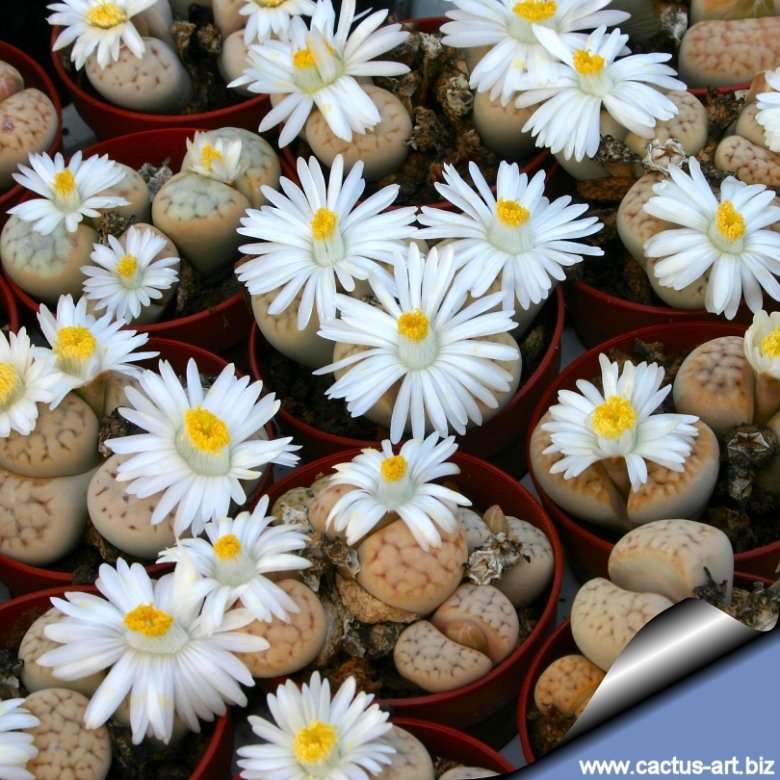
Flowers: Big up to 4,5 cm in diameter (mostly 25-35 mm) satiny white, narrow-rayed.
Blooming season: Late summer or early autumn.
Fruit: Seed capsules mostly 5-chambered, otherwise 4 or 6-chambered. Profile boat-shaped.
Seeds: Minuscule, yellow-brown; smooth to rugose.
Origin and Habitat
Unknown.
Cultivation and Propagation
Need an open mineral, fast draining mix and the maximum amount of light you are able to give them. The basic cultivation routine is: Stop watering after flowering. Start watering after the old leaves completely dry. (Usually late March or Early April) Water freely during the growing season, soak the compost fully but allow it to dry out between waterings. Some growers fertilize frequently, some hardly ever. Keep them dry during the winter. Nearly all problems occur as a result of overwatering and poor ventilation especially when weather conditions are dull and cool or very humid.
Propagation: From seed, with seed planting best in either October or April.
Notes
Lithops are partly subterranean, with only the clear ‘window’ in each leaf tip exposed above soil. A type of optical system exists whereby a layer of apical tissue rich in calcium oxalate crystals acts as a filter to intense sunlight before it reaches the thin chlorophyllous layer below. They are also called mimicry plants as they show a striking similarity to their background rocks and are difficult to detect when not in flower. These are the commonly known as pebble plants or living stones; each species is associated with one particular type of rock formation and occurs nowhere else. Its soil-embedded, subterranean growth form also reduces the need for chemical defences against herbivores.
Bibliography
Major references and further lectures
-
Gert Cornelis Nel, “Lithops: Plantae Succulente, Rarissimae, in Terra Obsuratae, E Familia Aizoaceae, Ex Africa Australi” Hortors Limited, University Press, Stellenbosch. 1946
-
Linda R. Berg “Introductory Botany: Plants, People, and the Environment” Cengage Learning, 02/Mar/2007
-
Dieter J. Von Willert “Life strategies of succulents in deserts: with special reference to the Namib desert” CUP Archive, 1992
-
Chris Mcintyre “Namibia” Bradt Travel Guides, 2007
-
Neale (W. T.) & Co, Edgar Lamb “Neale’s photographic reference plates, 1949: Combining cacti and other succulents” Vol. 2 W. T. Neale & Co.
-
RHS “A-Z encyclopedia of garden plants.” United Kingdom: Dorling Kindersley. 2008
-
American Horticultural Society “The American Horticultural Society encyclopedia of garden plants” Macmillan, 30/Nov/1989
-
H. E. K. Hartmann “Illustrated Handbook of Succulent Plants: Aizoaceae F-Z” Springer, 2002
-
Schwantes, Gustav. “Flowering Stones and Mid-day Flowers” London: Ernst Benn. 1957
-
S. M Walters “The European Garden Flora Flowering Plants: Casuarinaceae to Aristolochiaceae” Cambridge University Press, 1989
-
Clive Innes “Complete Handbook of Cacti and Succulents” Van Nostrand Reinhold Company, 01/Dec/1981
-
Cole, D. T. “Flowering stones” Acorn Books, Randburg. 1988
-
Smith et al. “Mesembs of the World.” Briza.Pretoria 1998
-
Leistner, O.A. (ed.), “Seed plants of southern Africa: families and genera” Strelitzia 10., National Botanical Institute, Pretoria 2000
-
Achim Hecktheuer “Mesembs, mehr als nur Lithops” Books on Demand GmbH Norderstedt. 2008
-
Cole “LITHOPS Flowering Stones” Cactus & Co. Libri. 2005
-
Yasuhiko Shimada “The Genus Lithops” Dobun Shoin. 2001
-
Rudolf Heine “Lithops - Lebende Steine” Neumann Verlag. 1986
-
Bernd Schlösser “Lithops – Lebende Steine” Praktische Anleitung für die Zimmerkultur. BussinessPoint MEDIA. 2000
-
Steven A. Hammer “Lithops – Treasures of the veld” British Cactus and Succulent Society. 1999
-
David L. Sprechman “Lithops” Associated University Presses, Inc. 1970
Gallery