Description
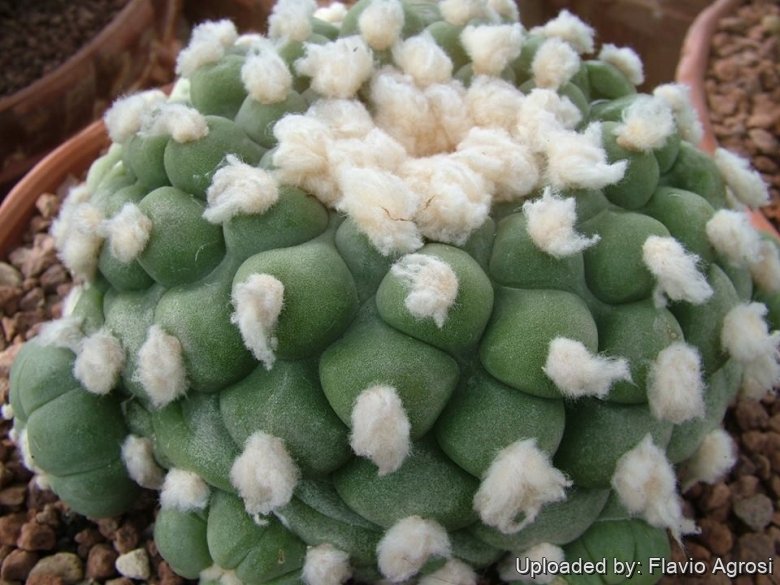
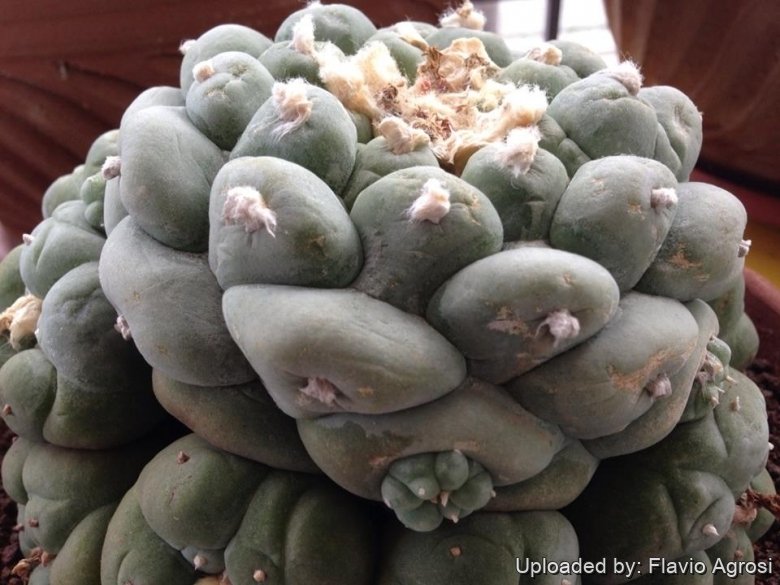
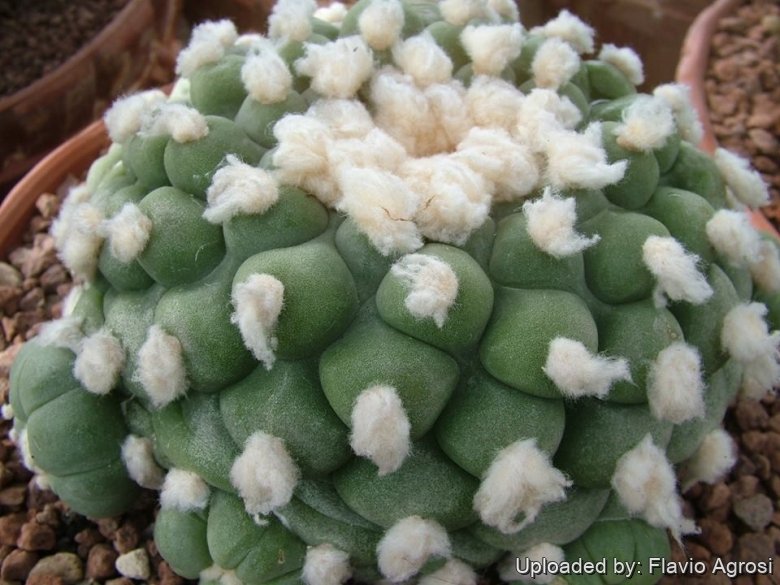
Lophophora williamsii var. fricii is a geophytic, button-like, spineless cactus with large tap root, and only the apical part of the stem exposed at soil level. The cv. Marbles (also knows in cultivation as cv. Big Tubercles or cv. Habermann) differs from standard fricii for its wide well developed rounded tubercles and stems lacking well defined ribs. Seems to be a pretty variable plant with several clones. A large well grown Lophophora is truly an achievement. These are harder to grow well than they appear.
Stem: Globular spineless, pale grey-green to yellow-green, 6-10 cm across.
Ribs: 5 to 13 not well defined. The podaria (tubercles) are noticeably elevated, broad and rounded.
Areoles: With tufts of hairs that usually spread unequally on the prominent podaria.
Flowers: Commonly pale to dark pink ( or rarely pinkish white), reaching over 4 centimeter in diameter.
Origin and Habitat
This species grows around the lagoon near Viesca in the state of Coahuila, Northern Mexico.
Cultivation and Propagation
Lophophora williamsii var. fricii is a slow growing cactus species.
Soil: Because of the tap root they are very rot prone, so use highly gritty compost with much drainage.
Exposure: Requires half shade to part sun.
Watering: Watering should be rather infrequent to keep the plant compact and avoid it becoming excessively elongated and unnatural in appearance. Watering it properly is often difficult, because this plant tends to crack open or rot if over-watered. The fact that the plant retracts into the soil and assumes a grey-green colouring between watering, is perfectly natural, and doesn’t cause any damage.
Overwintering: Keep completely dry and cool in winter (An unheated greenhouse would be perfect) or when night temperatures remain below 10° C, it can survive low temperatures (appr. -7°C) for a short period. Assure a good ventilation.
Use and Trade: The species is used locally for treating sore muscles.
It is very likely that the species is collected for the production of ointments at a large scale. The species might seldom be collected for ingestion by mistake, as it does not have hallucinogenic properties such as Lophophora williansii.
Propagation: Seeds. Seeds should be sown in spring in sterile cacti mix. Cover with a humidity dome or plastic wrap and leave in a warm spot in 50-75% shade. Fluctuating temperatures are best (ie. high day temperature and low night temperature) as they simulate the desert environment. Keep constantly humid as seedlings cannot survive if to dry. Seedlings will emerge in 7-21 days and can be grown in the same environment for a number of months. Mulch with thin layer of small quartz gravel (1-2mm diameter) this helps them stay upright, hinders algae growth and regulates moisture. As they get older the watering can become less frequent. Potting up can be done when 5-10 mm in diameter.