Publication: Contr. U.S. Natl. Herb. 3: 131. 1894
Description
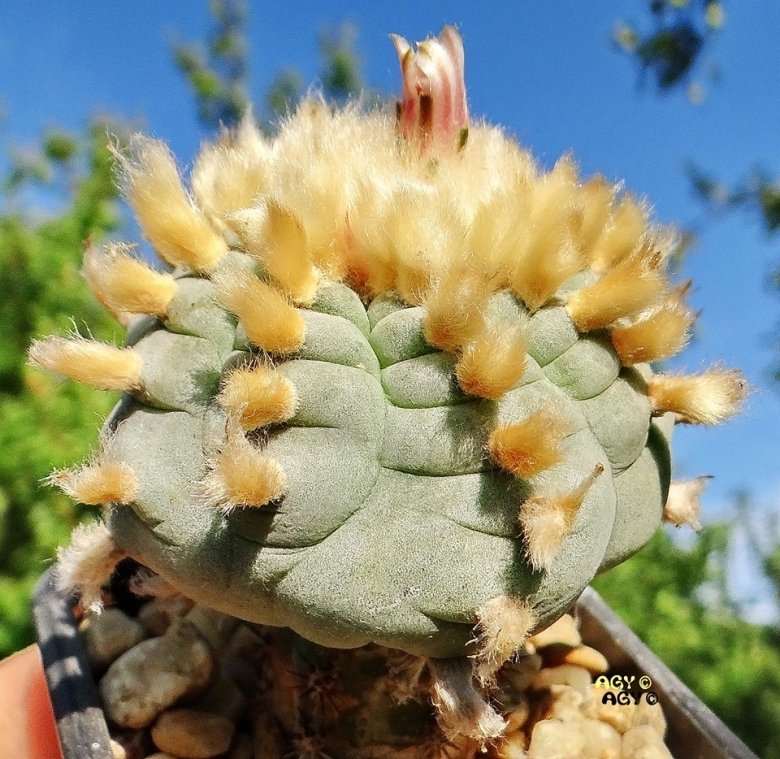
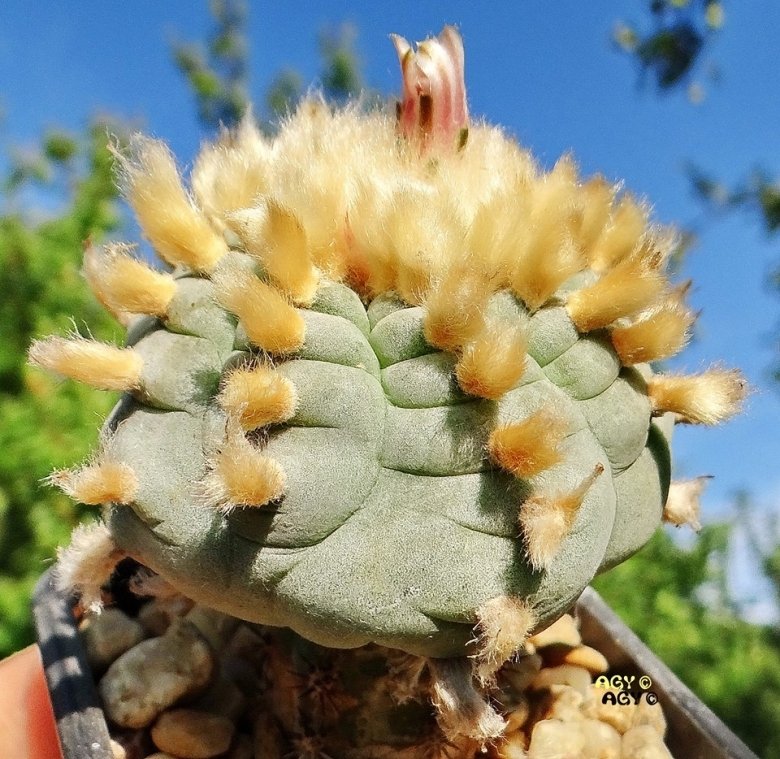
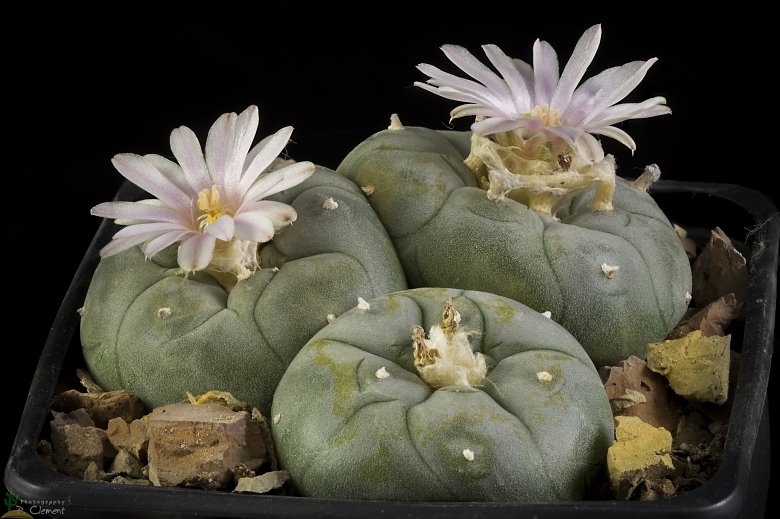
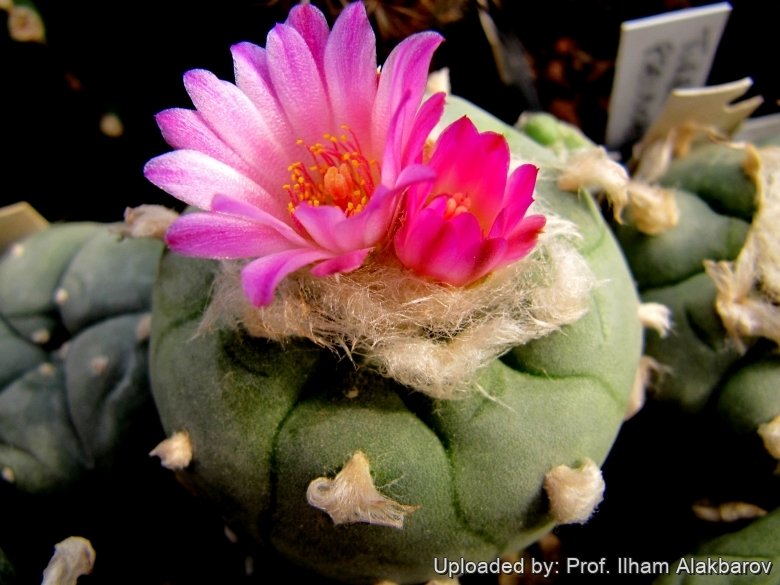
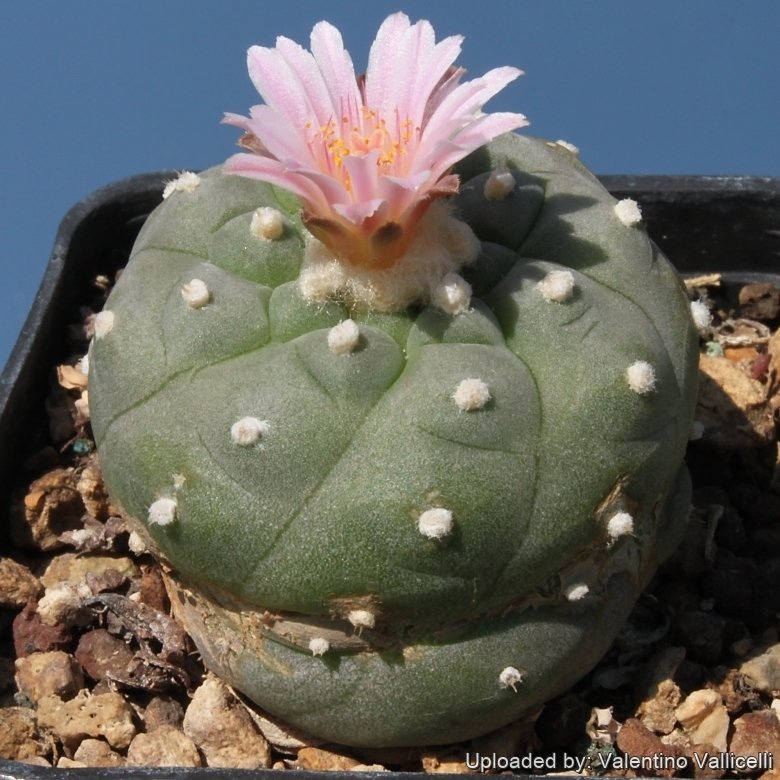
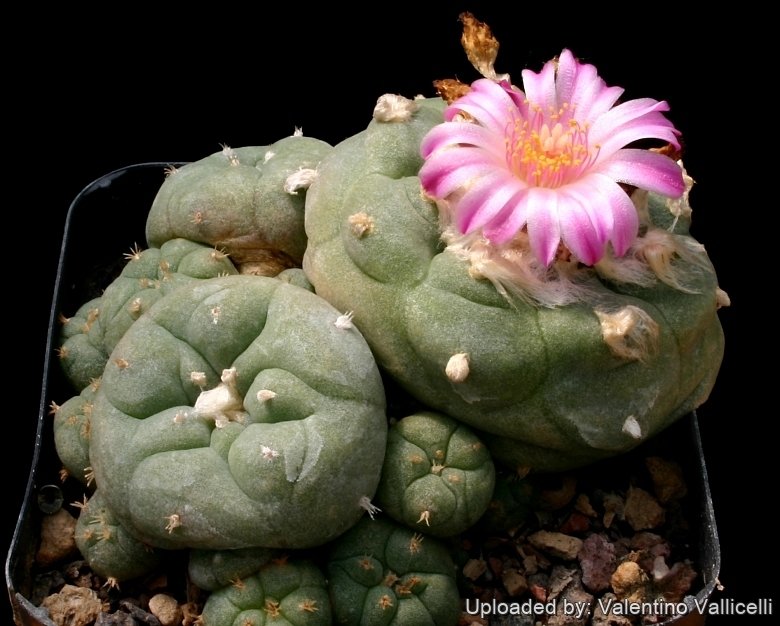
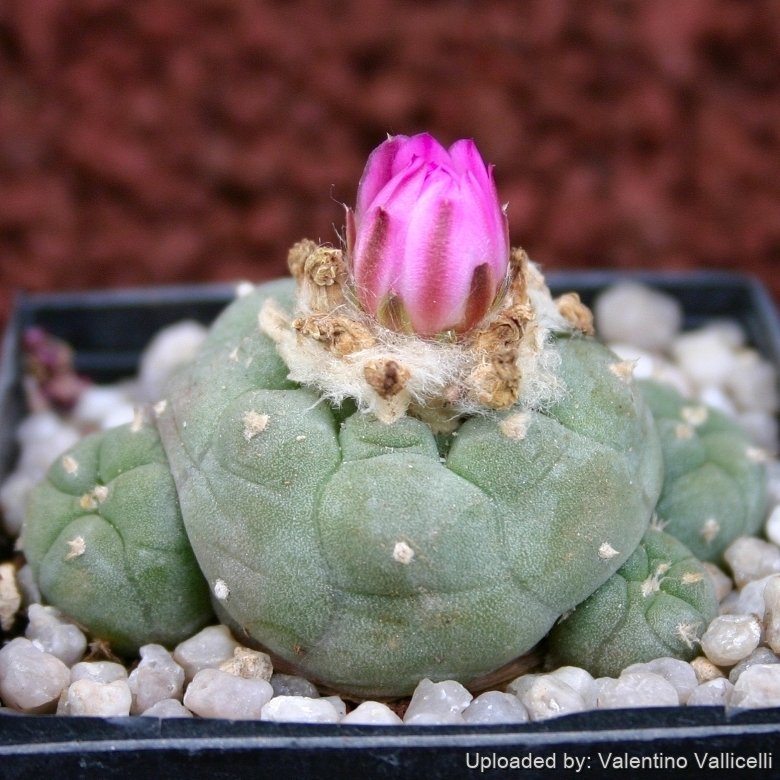
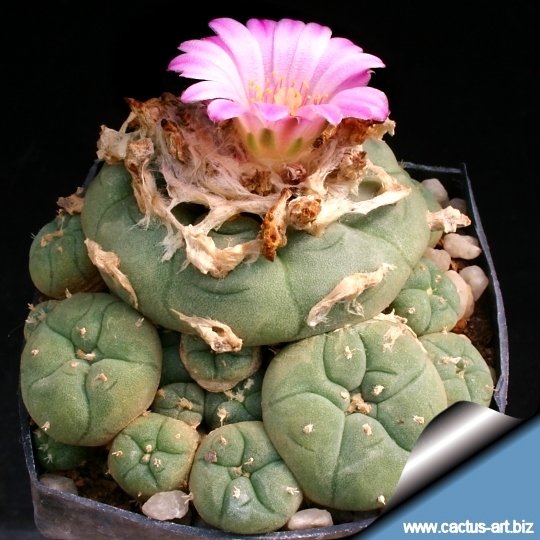
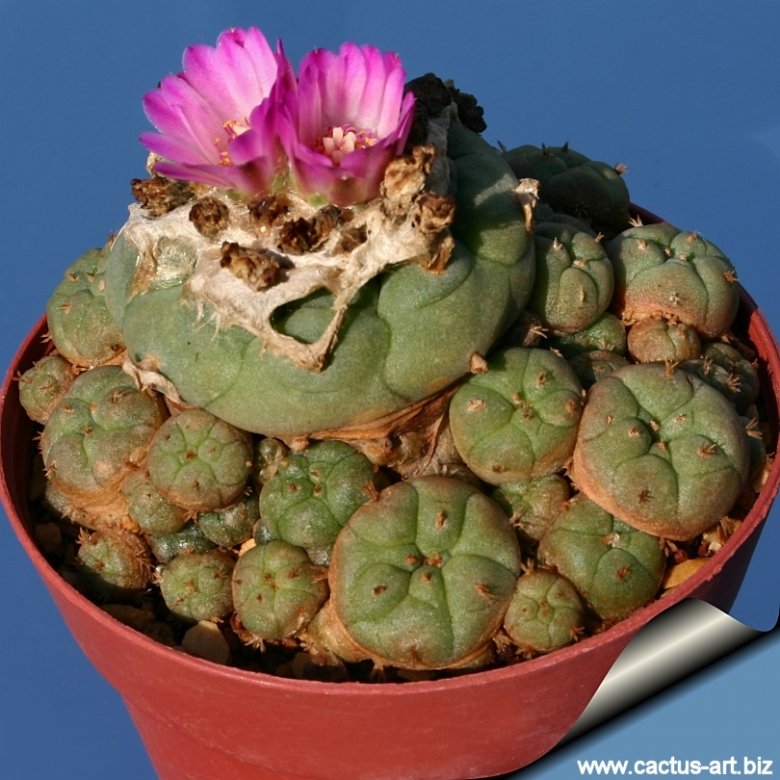
Lophophora williamsii is a solitary or (rarely) caespitose, spineless cactus, normally unicephalous but becoming polycephalous with age or injury,
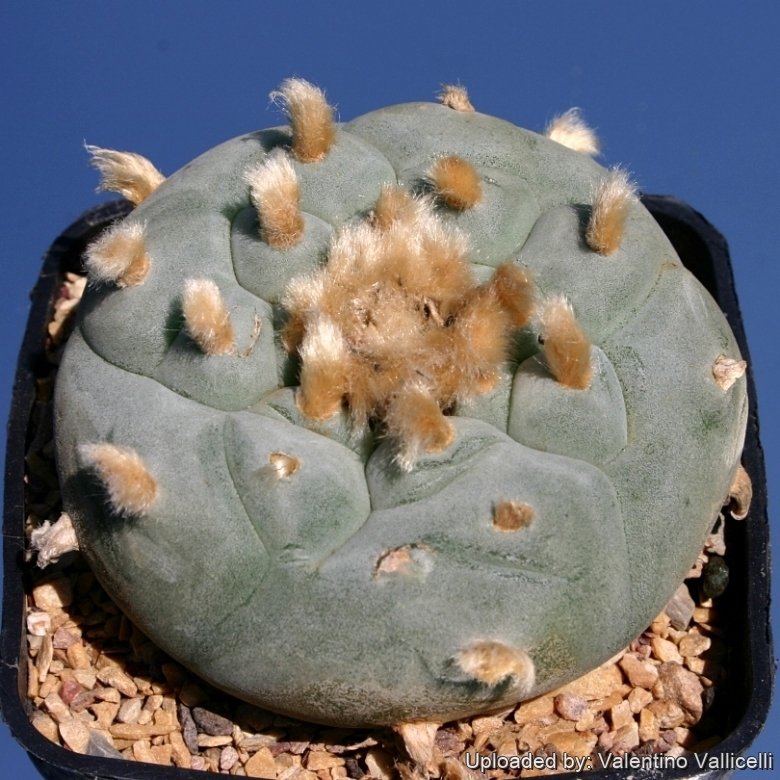
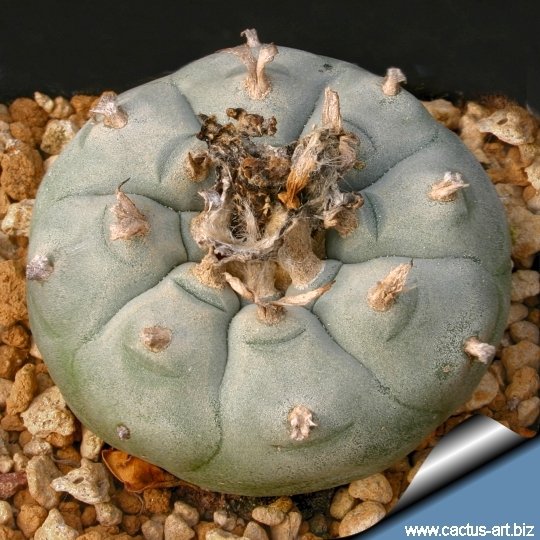
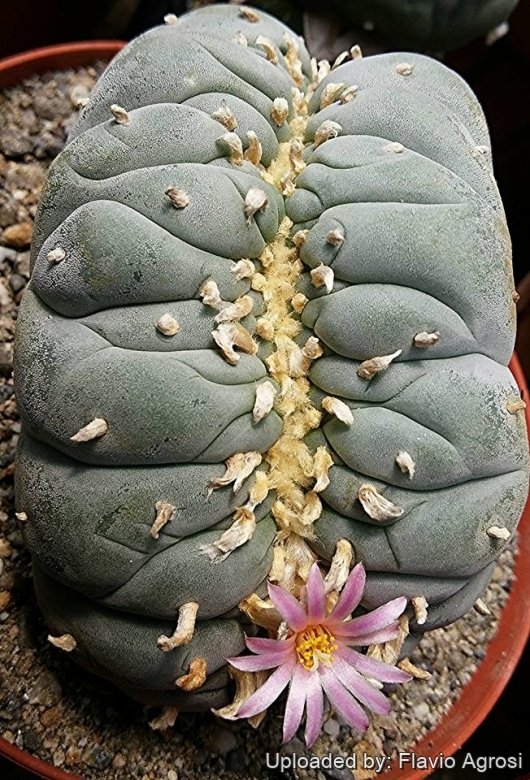
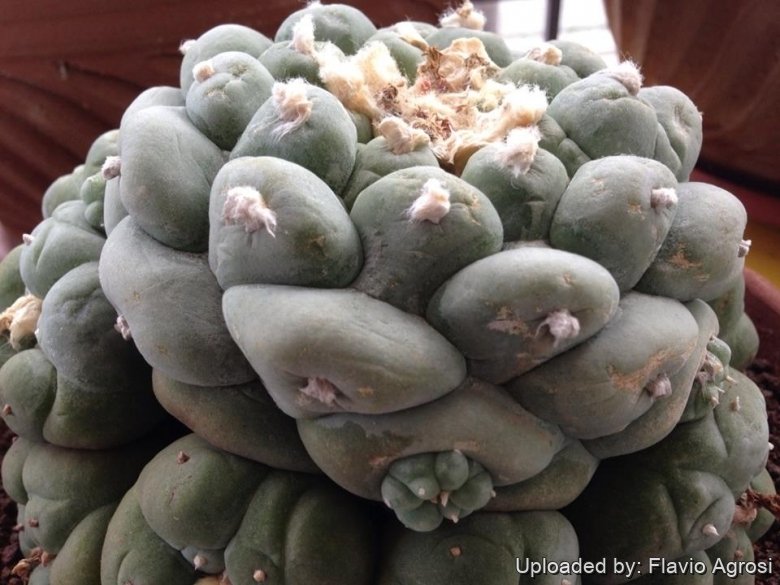
Stem: Glaucous green, dull bluish or greyish green, very succulent, globular, top-shaped, or somewhat flattened up to 6 cm tall, 12 cm diameter, with a woolly top; The subterranean portion of the stem, which is as wide as the aerial portion, extends several cm below the surface of the ground and transitions smoothly (through a thin hypocotyl) into a large taproot which may extend over 25 cm below ground level.
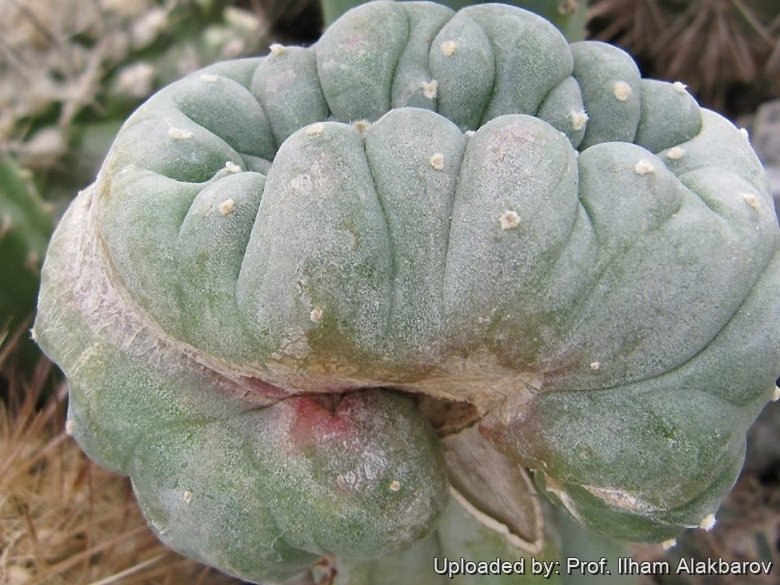
Ribs: (5 when young) 7 to 13 (very rarely 4 or 14 ) broad, rounded, straight, or spiralled, often tuberculate, sometimes irregular and indistinct, with transverse furrows forming more or less regular, polyhedral tubercles;
Roots: Napiform, usually 8-11 cm long
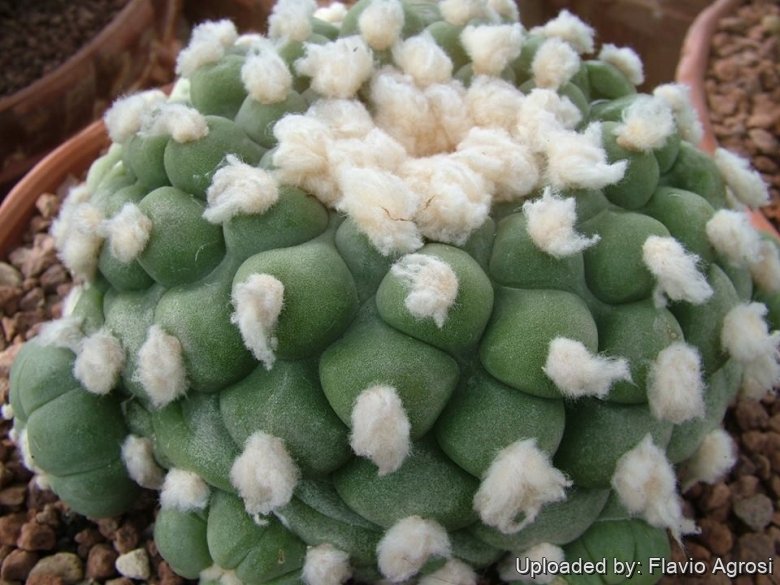
Areoles: Round spineless, bearing flowers only when young with some bunches of long erect, matted, wooly greyish hairs, up to 1 cm long.
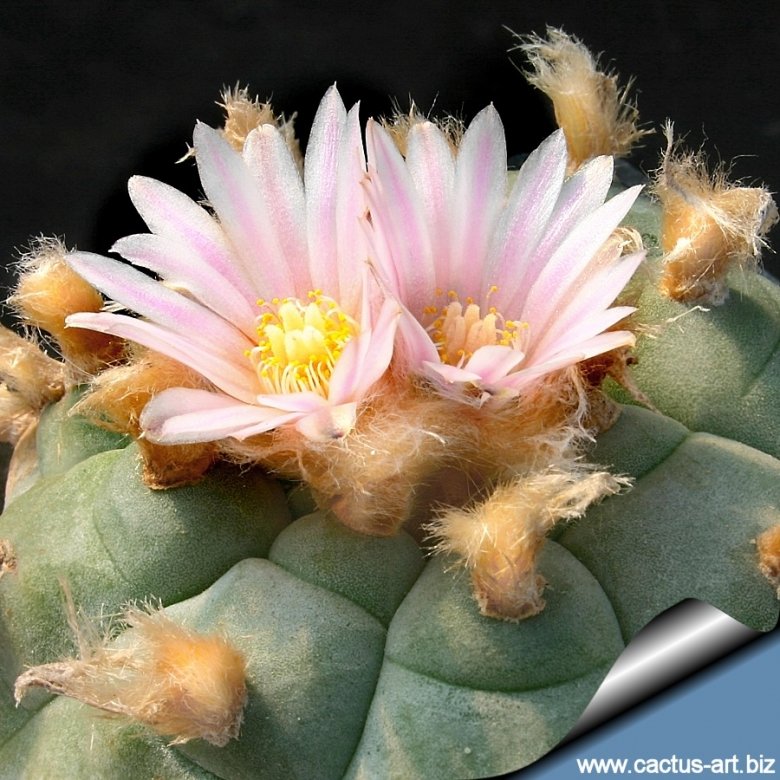
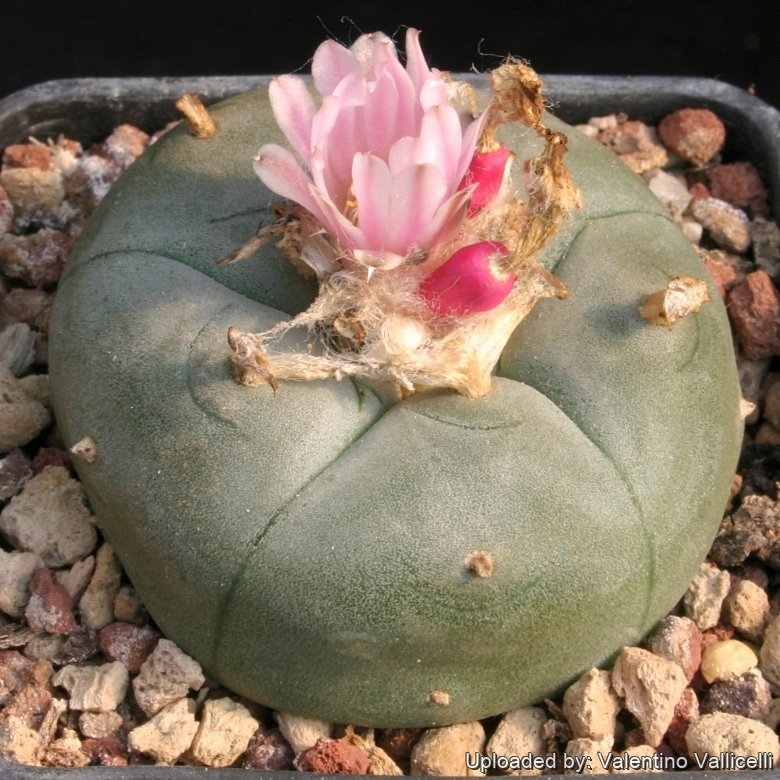
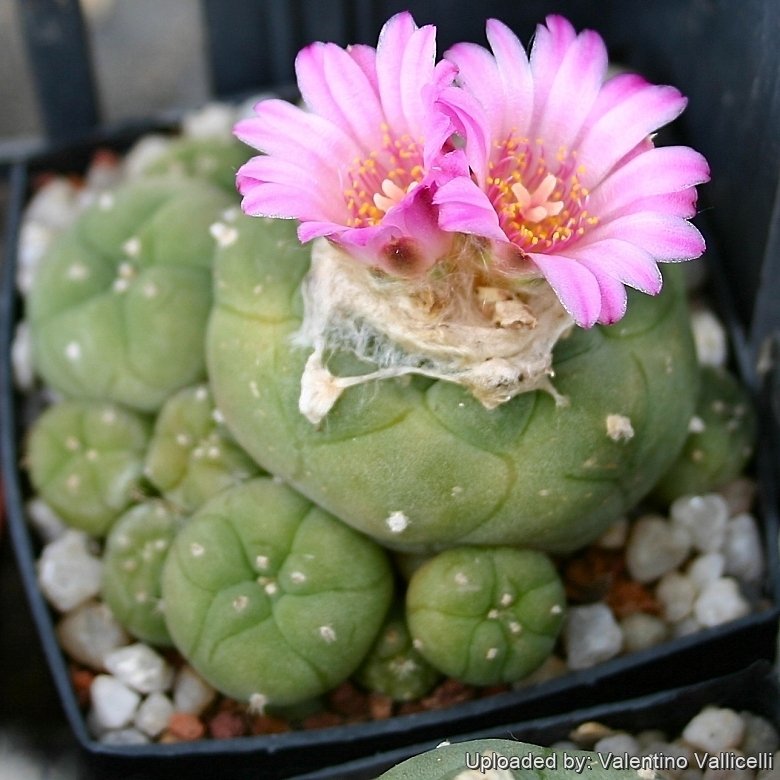
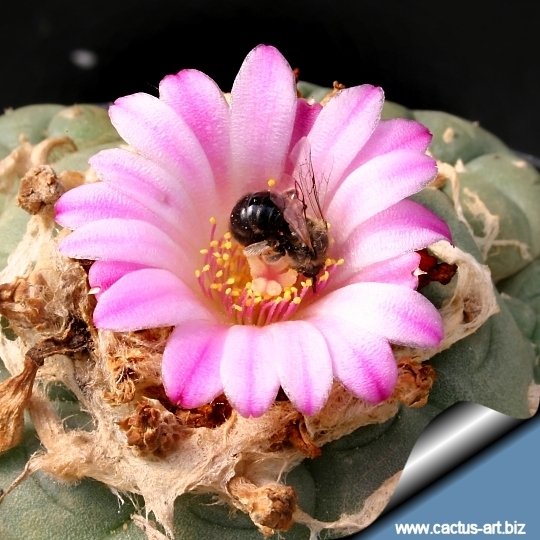
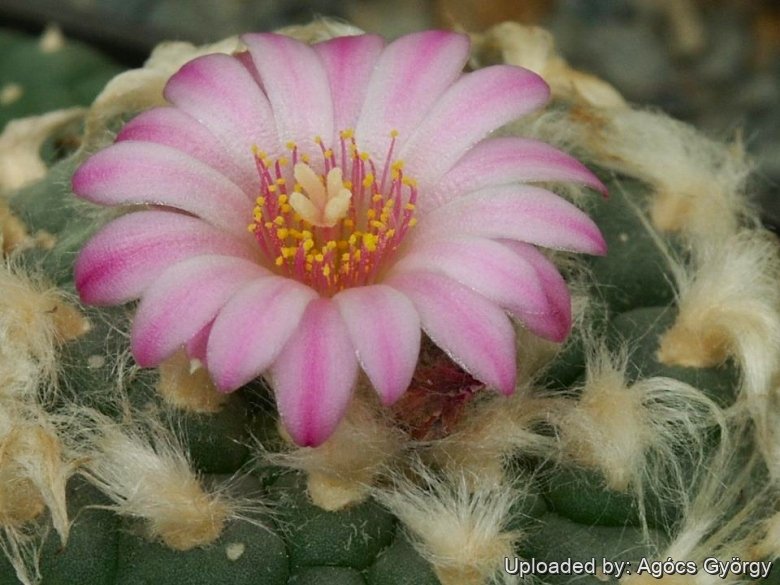
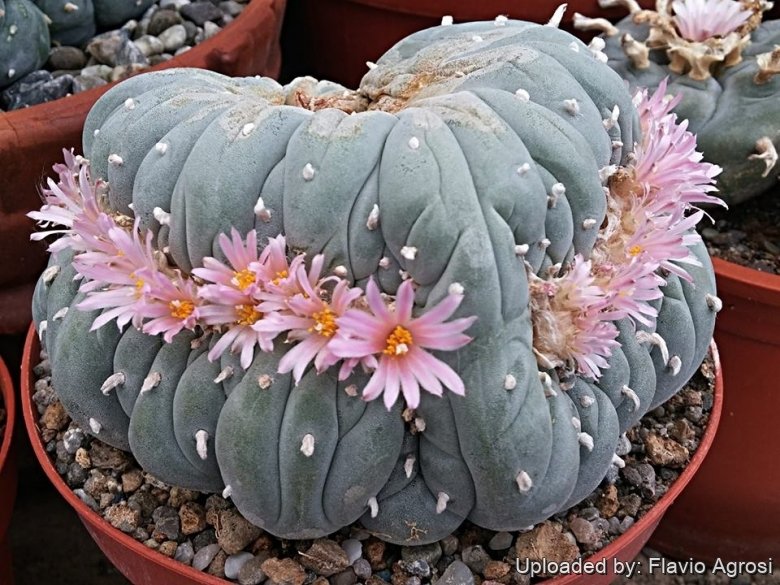
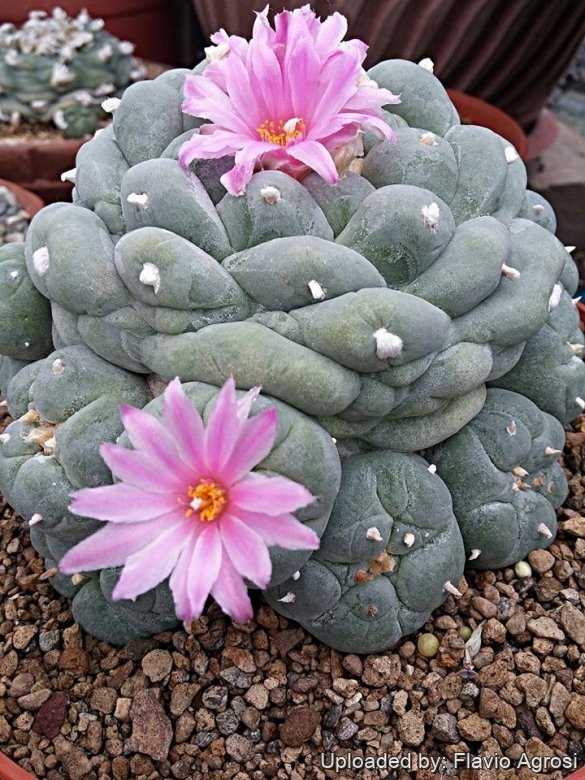
Flowers: Solitary, campanulate, 1.5-2.5 cm across when open usually pink (rarely whitish) outer perianth segments and scales ventrally greenish. They emerge from the mass of hairs at umbilicate centre of crown each surrounded by a mass of long hairs. Stigma-lobes 5-7, linear, pink.
Blooming season: Flowers sporadically throughout summer.
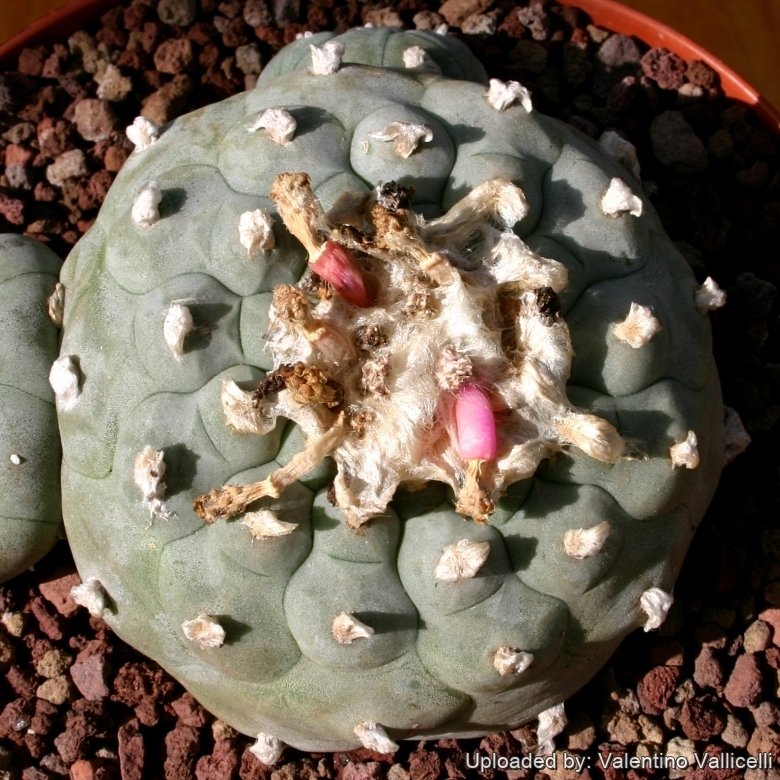
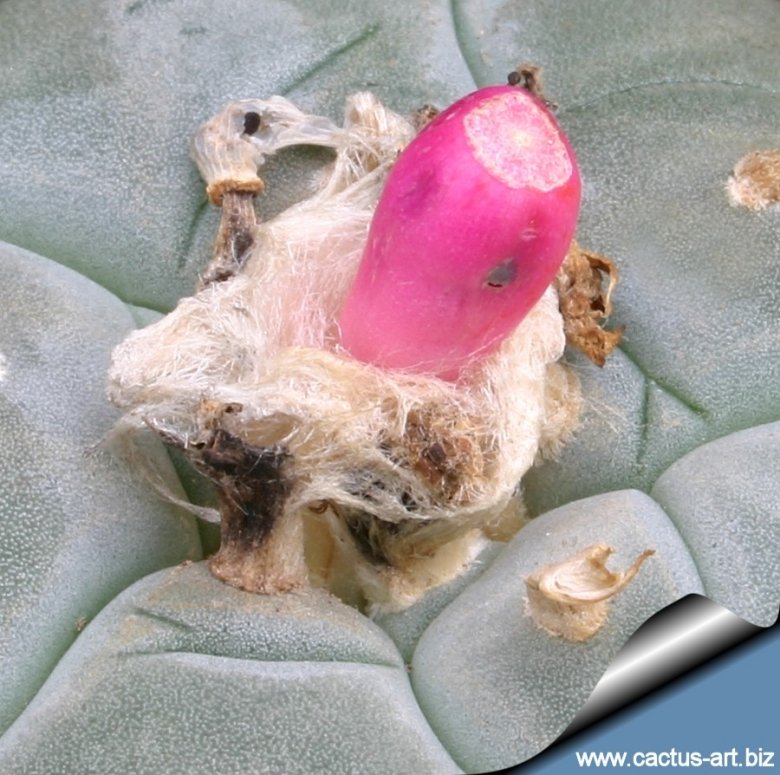
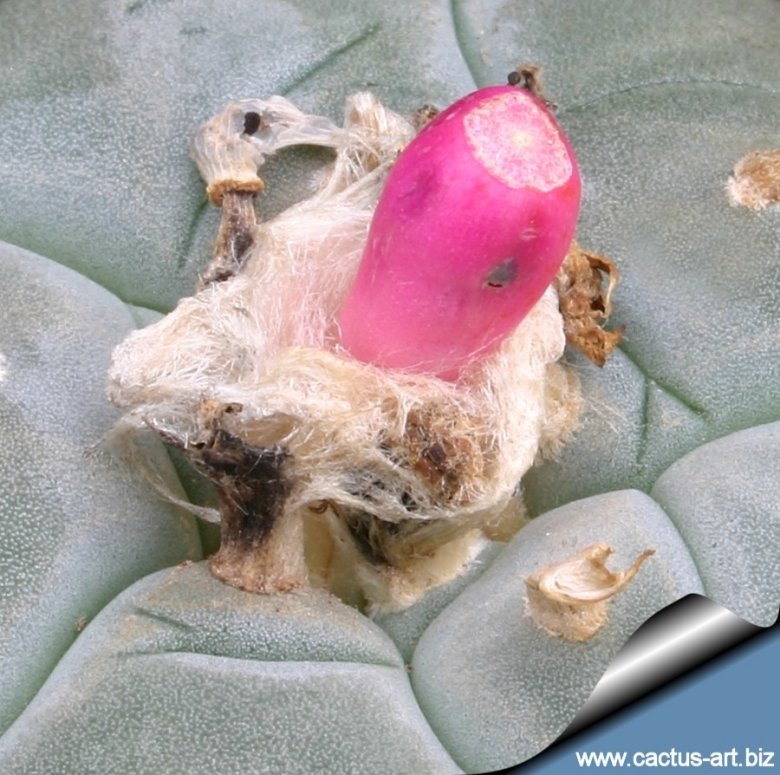
Fruits: Club-shaped, red to pinkish, 2 cm long or shorter which can be very delectable and sweet-tasting when eaten.
Seeds: Small and black up to1 mm in diameter, with broad basal hilum, tuberculate-roughened.
Origin and Habitat
Grows in an area that stretches from from the Chihuahuan Desert to the South Texas Plains, on either side of the middle and lower Rio Grande River, southward to the Mexican states of Chihuahua, Coahuila, Durango, Nuevo León, San Luis Potosí, Tamaulipas, Zacatecas. Extensive stands of peyote occur on the low, rocky hills in Starr, Zapata, Webb, and Jim Hogg counties of southern Texas.
Altitude: It grows from 100 up to 1900 metres above sea level.
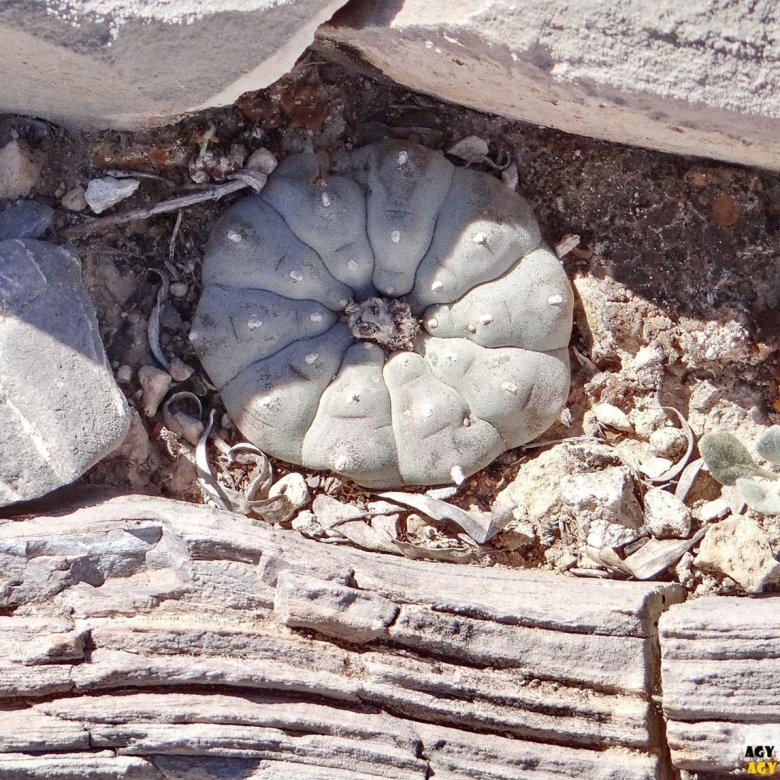
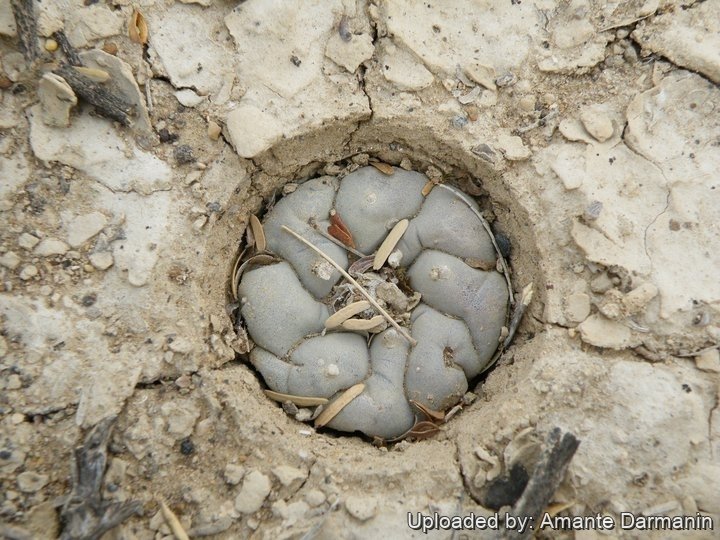
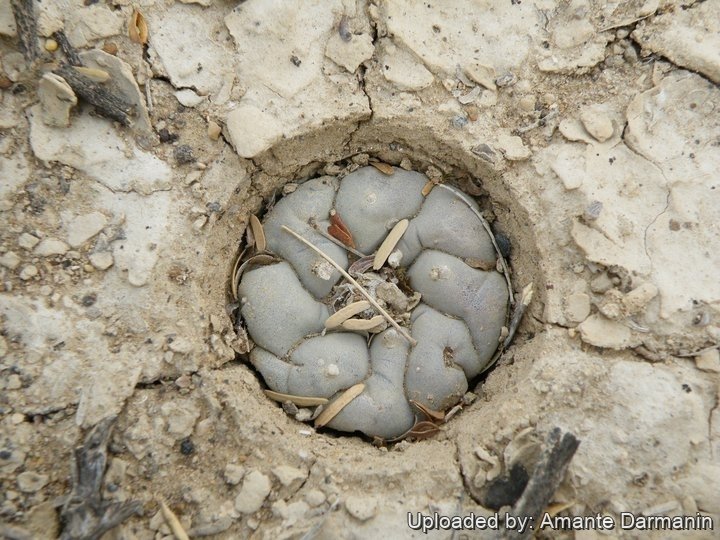
Habitat and Ecology: This geophytic, button-like cactus occurs in xerophyllous scrub including Tamaulipan thorn scrub isolated or in groups usually in calcareous deserts, on rocky slopes, or in dried river beds. The species is very abundant in habitat with large number of mature individuals however many subpopulations of Lophophora williamsii are heavily harvested in the wild throughout the range of the species, some to the point of extirpation. In Mexico, collection is illegal and people are punished for collecting it. Land use change for agriculture is a significant threat, as the land is completely ploughed, thus eliminating all vegetation including L. williamsii and its seed bank.
Cultivation and Propagation
All Lophophora species are extremely slow growing, often taking up to thirty years to reach flowering age in the wild (about the size of a golf ball, not including its root). Human cultivated specimens grow considerably faster, usually taking from six to ten years to go from seedling to mature flowering adult.
Because of the tap root they are very rot prone, so use highly gritty compost with much drainage. Requires half shade to part sun. Waterings should be rather infrequent to keep the plant compact and not to become excessively elongated and unnatural in appearance, watering it properly is often difficult because this plant tends to crack open or rot if over-watered. The fact that the plant retracts into the soil and assume a grey-green colouring between watering, is perfectly natural and doesn’t cause any damage.
Overwatering: Keep completely dry and cool in winter (An unheated greenhouse would be perfect) or when night temperatures remain below 10° C, it can survive low temperatures (appr. -7°C) for a short period. Assure a good ventilation.
Propagation: Easy to propagate from seeds. The seeds are, requiring hot and humid conditions to germinate.
Uses: Peyote has been used for centuries for the mystical effects experienced when it is ingested. It contains a large spectrum of phenethylamine alkaloids, the principal of which is mescaline. The top of the cactus that grows above ground, also referred to as the crown, consists of disc-shaped buttons that are cut from the roots and dried. These buttons are generally chewed, or boiled in water to produce a psychoactive tea. The resulting infusion is extremely bitter and, in most cases, the user experiences a high degree of nausea before the onset of the psychedelic effects.
However cultivated plants have only traces of the alkaloid present in wild harvested plant and their “psychedelic” effect are minimal or completely absent, but they still cause nausea, vomit, headache.
Bibliography
Major references and further lectures
-
Terry, M. 2013. Lophophora williamsii. In: IUCN 2013. IUCN Red List of Threatened Species. Version 2013.2. <www.iucnredlist.org>. Downloaded on 24 February 2014.
-
Edward Anderson “The Cactus family” Timber Press, Incorporated, 2001
-
James Cullen, Sabina G. Knees, H. Suzanne Cubey “The European Garden Flora Flowering Plants: A Manual for the Identification of Plants Cultivated in Europe, Both Out-of-Doors and Under Glass” Cambridge University Press, 11/Aug/2011
-
David R Hunt; Nigel P Taylor; Graham Charles; International Cactaceae Systematics Group. “The New Cactus Lexicon” dh books, 2006
-
Edward F. Anderson “Peyote: The Divine Cactus” University of Arizona Press, 1996
From llifle page Lophophora jourdaniana
Description
Lophophora jourdaniana is a clumping flattened cactus. Slowly forms small clumps up to 15cm in diameter.
Stem: Glaucous green (but more darker green than L. williamsii) are up to 4 cm tall, 5 cm in diameter, with a woolly top.
Ribs: 5 to 9 (or more).
Areoles: With some bunches of greyish hairs, up to 1 cm long.
Spines: Small short, thin and long persisting on young areoles.
Flowers: 2,5-3,5 cm in diameter that emerge from the mass of hairs in the center of the plant. Perianth, pistil, and filaments rose-violet; The stamens are thigmotropic.
Origin and Habitat
Unknown (Perhaps it is a nursery produced cultivar)
Cultivation and Propagation
Slow growing. Because of the tap root they are very rot prone, so use highly gritty compost with much drainage. Requires half shade to part sun. Watering: waterings should be rather infrequent to keep the plant compact and not to become excessively elongated and unnatural in appearance, watering it properly is often difficult because this plant tends to crack open or rot if over-watered. The fact that the plant retracts into the soil and assume a grey-green colouring between watering, is perfectly natural and doesn’t cause any damage. Overwintering: Keep completely dry and cool in winter (An unheated greenhouse would be perfect) or when night temperatures remain below 10° C, it can survive low temperatures (appr. -7°C) for a short period. Assure a good ventilation.
Propagation: Easy to propagate from cuttings or grafting.
Notes
Some people suppose Lophophora jourdaniana may perhaps be an hybrid between Lophophora williamsii and Lophophora fricii.
Furthermore L. jourdaniana is called Lophophora williamsii var. jourdaniana by some other people. These same people labels Lophophora fricii as Lophophora williamsii var. fricii. This is incorrect because Lophophora fricii is not a variation of Lophophora williamsii, and also the breading of the two different species seems impossible, in fact the flowers are frequently cleistogame. It is not possible to fertilize Lophophora jourdaniana with the pollen of Lophophora williamsii, nor with the pollen of Lophophora diffusa and Lophophora fricii. Some websites say this species contain some mescaline, but at a much lower content than williamsii, some other say it don’t contain the alkaloid at all, because this plant is more related to diffusa than williamsii.
Source: Lophophora jourdaniana, LLIFLE - Encyclopedia of living forms, CC-BY-SA, retrieved 2026-10-25.
From llifle page Lophophora lutea var. texana
Description
Lophophora williamsii var. texana (texensis) is the phenotype from the Texas area (USA), this local form has very grey pruinose stems with numerous flat ribs (up to 14 in adult specimens). In cultivation forms beautiful long tuft of wool from the areoles.
Origin and Habitat
Grows in an area that stretches from from the Chihuahuan Desert to the South Texas Plains, on either side of the middle and lower Rio Grande River, southward to the Mexican state of San Luís Potosí. Extensive stands of peyote occur on the low, rocky hills in Starr, Zapata, Webb, and Jim Hogg counties of southern Texas.
Habitat: Grows isolated or in groups usually in calcareous deserts, on rocky slopes, or in dried river beds.
Cultivation and Propagation
Slow growing. Because of the tap root they are very rot prone, so use highly gritty compost with much drainage. Requires half shade to part sun. Watering: waterings should be rather infrequent to keep the plant compact and not to become excessively elongated and unnatural in appearance, watering it properly is often difficult because this plant tends to crack open or rot if over-watered. The fact that the plant retracts into the soil and assume a grey-green colouring between watering, is perfectly natural and doesn’t cause any damage.
Overwatering: Keep completely dry and cool in winter (An unheated greenhouse would be perfect) or when night temperatures remain below 10° C, it can survive low temperatures (appr. -7°C) for a short period. Assure a good ventilation.
Propagation: Easy to propagate from seed.
Source: Lophophora lutea var. texana, LLIFLE - Encyclopedia of living forms, CC-BY-SA, retrieved 2026-10-25.
From llifle page Lophophora pentagona
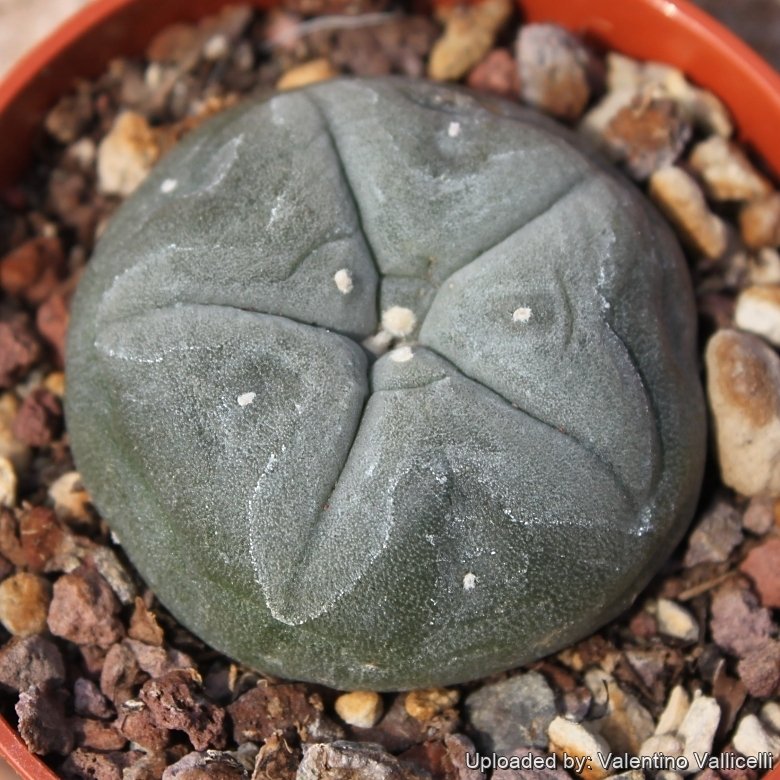
Origin and Habitat
Described from cultivated material)
Source: Lophophora pentagona, LLIFLE - Encyclopedia of living forms, CC-BY-SA, retrieved 2026-10-25.
From llifle page Lophophora fricii f. variegata
Description
Globular spineless cactus with large tap root.
Stem: Pale grey-green to yellow-green, usually lacking well defined ribs and furrows.
Ribs: 5 to 13 the podaria are rarely elevated, but are broad and flat.
Areoles: With tufts of hairs that usually spread unequally on the prominent podaria.
Flowers: Commonly pale to dark pink ( or rarely pinkish white), reaching over 4 centimetre in diameter.
Remarks: In habitat Lophophora fricii is a very mutable species. It´s hardly to find two similar plants at one location. Particularly in terms of the bloom they are different at the same locations.
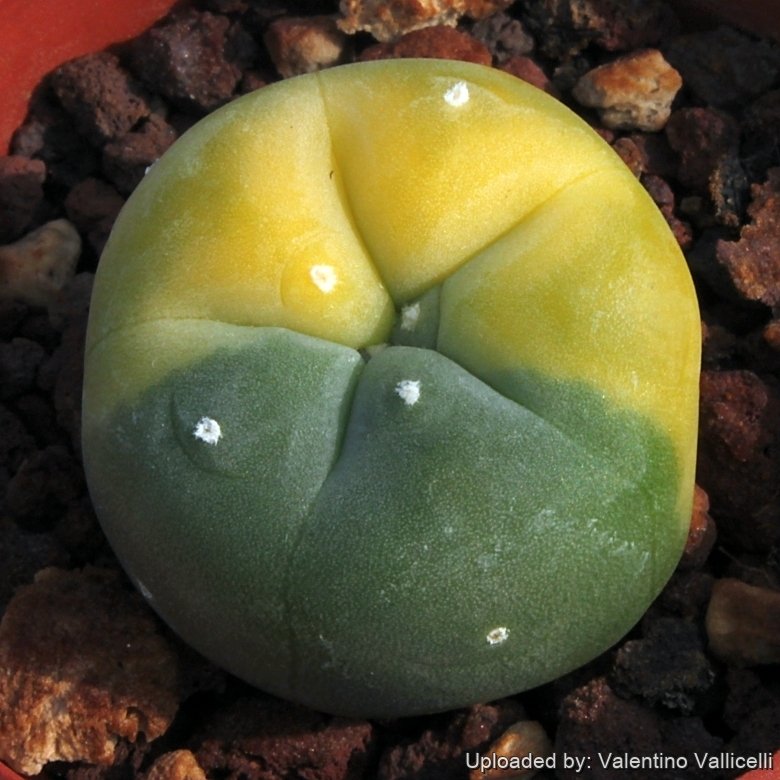
Variegate forms: Variegate Lophophora williamsii var. fricii are seldom available, but coveted by impassioned for the beautiful spineless body stripped in yellow, cream or pink. The odd variegate appear unpredictably in seedling batches in a small percentage, and are generally separated from normal plants. Variegated plants grow more slowly, and are generally smaller than non-variegates. Coloured areas are also generally weaker, and more susceptible to fungus, sunburn and other defects. A large well grown variegate Lophophora is truly an achievement. These are harder to grow well than they appear.
Origin and Habitat
This species grows around the lagoon near Viesca in the state of Coahuila, Northern Mexico.
Cultivation and Propagation
Variegated and albinos Lophophora are regarded as choice and difficult in cultivation, but despite that some of them are relatively easy to grow. Be aware that they cannot tolerate prolonged exposure to direct sun light (especially during the hottest summer days), so grow them in half-shade or under filtered sun. They are sometime seen as grafted plants, but some grow well on their own roots, too.
On the contrary, the albinos can survive only if grafted on a strong green base.
Use mineral well-permeable substratum with little organic matter (peat, humus). Water sparingly from March till October and keep perfectly dry in winter at temperatures from 5 to 15 degrees centigrade. (In general these plants are more tender and cannot endure freezing temperatures ) In the rest period no high atmospheric humidity!!
Propagation: Almost usually by seed. Plants are often grafted onto column-shaped cacti.
Source: Lophophora fricii f. variegata, LLIFLE - Encyclopedia of living forms, CC-BY-SA, retrieved 2026-10-25.
From llifle page Lophophora fricii f. cristata
Description
Lophophora williamsii var. fricii is a geophytic, button-like, spineless cactus with large tap root, and only the apical part of the stem exposed at soil level. Variety fricii differs from var. williamsii by the large pale to dark pink flowers and stems usually lacking well defined ribs.
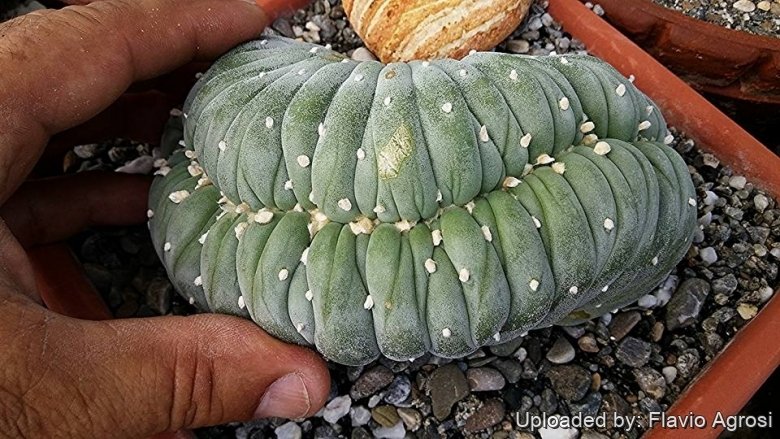
Crested form: The beautiful and very rare crested form (Lophophora williamsii var. fricii f. cristata) is sought after by specialized collectors and impassioned for its unique tufted appearance. It forms low growing grey-green fan-shaped stems with broad and flat (rarely elevated) tubercles.
Stem: Fan shaped forming in time nicely contorted and convoluted brain-like mounds. Pale grey-green to yellow-green, usually lacking well defined ribs and furrows.
Areoles: With tufts of hairs that usually spread unequally on the prominent podaria.
Flowers: Commonly pale to dark pink ( or rarely pinkish white), reaching over 4 centimeter in diameter.
Note: Lophophora williamsii var. fricii f. cristata is generally increased from cuttings. However, on sowing seed, a minimal proportion of seedlings show the same crested condition. Whichever way propagation is carried out, the same name is to be applied to the crested plants that form the cultivar, moreover there are several clones shoving different degrees of cristation all referable to the same cultivar name. The non-cristate plants raised from seeds collected on crested parents are treated as indistinguishable parts of the species.
Origin and Habitat
Garden origin (Nursery produced cultivar). The natural species has a very limited range around the lagoon near Viesca in the state of Coahuila, Northern Mexico.
Cultivation and Propagation
Lophophora williamsii var. fricii is a slow growing cactus species.
Soil: Because of the tap root they are very rot prone, so use highly gritty compost with much drainage.
Exposure: Requires half shade to part sun.
Watering: Watering should be rather infrequent to keep the plant compact and avoid it becoming excessively elongated and unnatural in appearance. Watering it properly is often difficult, because this plant tends to crack open or rot if over-watered. The fact that the plant retracts into the soil and assumes a grey-green colouring between watering, is perfectly natural, and doesn’t cause any damage.
Overwintering: Keep completely dry and cool in winter (An unheated greenhouse would be perfect) or when night temperatures remain below 10° C, it can survive low temperatures (appr. -7°C) for a short period. Assure a good ventilation.
Use and Trade: The species is used locally for treating sore muscles.
It is very likely that the species is collected for the production of ointments at a large scale. The species might seldom be collected for ingestion by mistake, as it does not have hallucinogenic properties such as Lophophora williansii.
Specific tips for growing the crested forms: The crests are frequently grafted onto columnar cacti but are easily grown on their own roots. Any normal shoots should be removed to promote the growth of the crest.
Propagation: Seeds. Seeds should be sown in spring in sterile cacti mix. Cover with a humidity dome or plastic wrap and leave in a warm spot in 50-75% shade. Fluctuating temperatures are best (ie. high day temperature and low night temperature) as they simulate the desert environment. Keep constantly humid as seedlings cannot survive if to dry. Seedlings will emerge in 7-21 days and can be grown in the same environment for a number of months. Mulch with thin layer of small quartz gravel (1-2mm diameter) this helps them stay upright, hinders algae growth and regulates moisture. As they get older the watering can become less frequent. Potting up can be done when 5-10 mm in diameter.
Bibliography
Major references and further lectures
-
Terry, M. 2013. “Lophophora fricii.” The IUCN Red List of Threatened Species. Version 2014.3. <www.iucnredlist.org>. Downloaded on 09 December 2014.
-
Edward Anderson “The Cactus family” Timber Press, Incorporated, 2001
-
James Cullen, Sabina G. Knees, H. Suzanne Cubey “The European Garden Flora Flowering Plants: A Manual for the Identification of Plants Cultivated in Europe, Both Out-of-Doors and Under Glass” Cambridge University Press, 11/Aug/2011
-
David R Hunt; Nigel P Taylor; Graham Charles; International Cactaceae Systematics Group. “The New Cactus Lexicon” dh books, 2006
-
Edward F. Anderson “Peyote: The Divine Cactus” University of Arizona Press, 1996
Source: Lophophora fricii f. cristata, LLIFLE - Encyclopedia of living forms, CC-BY-SA, retrieved 2026-10-25.
From llifle page Lophophora fricii cv. Big Tubercles
Description
Lophophora williamsii var. fricii is a geophytic, button-like, spineless cactus with large tap root, and only the apical part of the stem exposed at soil level. The cv. Marbles (also knows in cultivation as cv. Big Tubercles or cv. Habermann) differs from standard fricii for its wide well developed rounded tubercles and stems lacking well defined ribs. Seems to be a pretty variable plant with several clones. A large well grown Lophophora is truly an achievement. These are harder to grow well than they appear.
Stem: Globular spineless, pale grey-green to yellow-green, 6-10 cm across.
Ribs: 5 to 13 not well defined. The podaria (tubercles) are noticeably elevated, broad and rounded.
Areoles: With tufts of hairs that usually spread unequally on the prominent podaria.
Flowers: Commonly pale to dark pink ( or rarely pinkish white), reaching over 4 centimeter in diameter.
Cultivation and Propagation
Lophophora williamsii var. fricii is a slow growing cactus species.
Soil: Because of the tap root they are very rot prone, so use highly gritty compost with much drainage.
Exposure: Requires half shade to part sun.
Watering: Watering should be rather infrequent to keep the plant compact and avoid it becoming excessively elongated and unnatural in appearance. Watering it properly is often difficult, because this plant tends to crack open or rot if over-watered. The fact that the plant retracts into the soil and assumes a grey-green colouring between watering, is perfectly natural, and doesn’t cause any damage.
Overwintering: Keep completely dry and cool in winter (An unheated greenhouse would be perfect) or when night temperatures remain below 10° C, it can survive low temperatures (appr. -7°C) for a short period. Assure a good ventilation.
Use and Trade: The species is used locally for treating sore muscles.
It is very likely that the species is collected for the production of ointments at a large scale. The species might seldom be collected for ingestion by mistake, as it does not have hallucinogenic properties such as Lophophora williansii.
Propagation: Seeds. Seeds should be sown in spring in sterile cacti mix. Cover with a humidity dome or plastic wrap and leave in a warm spot in 50-75% shade. Fluctuating temperatures are best (ie. high day temperature and low night temperature) as they simulate the desert environment. Keep constantly humid as seedlings cannot survive if to dry. Seedlings will emerge in 7-21 days and can be grown in the same environment for a number of months. Mulch with thin layer of small quartz gravel (1-2mm diameter) this helps them stay upright, hinders algae growth and regulates moisture. As they get older the watering can become less frequent. Potting up can be done when 5-10 mm in diameter.
Source: Lophophora fricii cv. Big Tubercles, LLIFLE - Encyclopedia of living forms, CC-BY-SA, retrieved 2026-10-25.
Cultivars and forms (12)
Varieties (7)
Forms (3)
Gallery