Publication: Kakteenkunde 1939: 47, fig. as Mamillaria
Description
Mammillaria albilanata Backeberg (Mammillaria fitauxiana Backeberg) is a clumping cactus species typically so densely spined and woolly in the tubercular axils that the epidermis is almost completely concealed. There are four subspecies recognized the nominate, oaxacana D.R.Hunt, reppenhagenii (D.R.Hunt) D.R.Hunt and tegelbergiana (G.E.Linds.) D.R.Hunt.
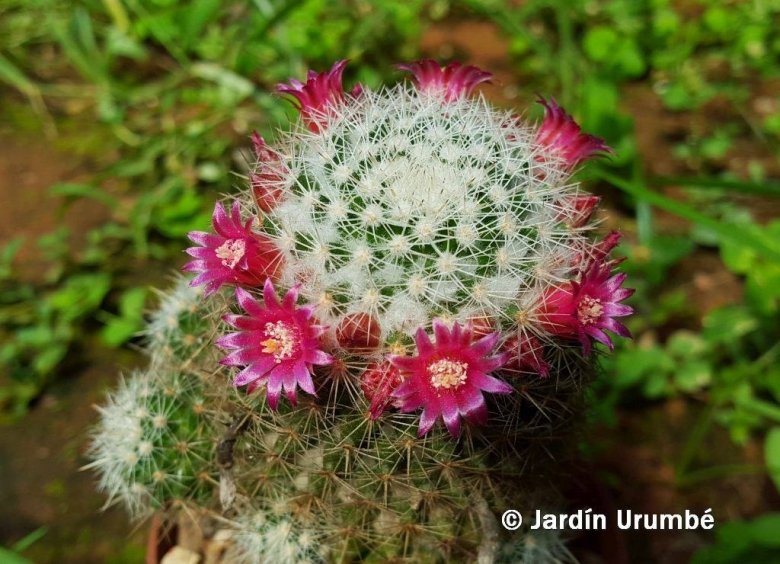
Habit: Plants usually solitary, sometimes branching basally and from the sides to form small clumps. Each head is surrounded by a complete ring of star-like purple-pink flowers.
Roots: Fibrous.
Stems: Spherical-flattened, elongate or shortly cylindrical, sunken apically, to 15 cm high and 8 cm in diameter.
Tubercles: Grey-green, spiralling, firm, without latex, axils coarsely woolly.
Central spines: 2-4, stiff, straight, very short 2-3 mm long, white,cream or pale yellow, with brownish tips.
Radial spines: 15-26, stiff, straight to slightly curved, chalky white, 2-4 mm long.
Flowers: Very small (7-8 mm long) circling the crown of the plant. Carmine to purplish pink to pink.
Flowering Time: Late spring onwards.
Fruits: Clavate, pink to red.
Seeds: Pale brown.
Origin and Habitat
This species is endemic to SW Mexico, where it occurs in the states of Chiapas, Colima, Guerrero, Oaxaca and Puebla.
Altitude: It grows at altitudes between 500 and 2,200 m asl
Habitat: The species grows in tropical deciduous and temperate forest between spare overgrowth in limestone rocks, and vertical cliffs in humus soil. In the same area it is possible to find several cactus and succulent species like: Mammillaria beneckei, Mammillaria fuauxiana, Mammillaria guerreronis, Coryphantha bumamma, Coryphantha retusa, and Ferocactus macrodiscus.
Ecology: They have an extremely dense white wool cover that certainly reflect a large fraction of the visible solar radiation contributing to protect the plants from the blazing sun of their bare habitat.
Major Threat(s): The species is relatively rare and uncommon, but in some subpopulations it is abundant. There are no major threats, however in some areas habitat destruction for cattle ranching and small-scale farming is having an impact on the subpopulations.
Cultivation and Propagation
In good conditions with careful application of water and excellent ventilation Mammillaria albilanata grows without difficulty.
Growing rate: It is a slow growing species that rewards the patient grower with a beautiful displays of flowers since from an early age.
Soil: Requires good drainage provided by a very permeable open cactus soil (With not less than 50% grit content). Reduce the use of peat or other humus sources in the potting mixture.
Repotting: Repot every 2-3 years. Use small sized pots.
Feeding: During the beautiful season enrich the soil using a fertilizer rich in potassium and phosphorous, but poor in nitrogen, because this chemical element doesn’t help the development of succulent plants, making them too soft and full of water.
Watering: Water should be carefully applied and only when the soil is dry to the touch, as this cliff-dwelling species is very prone to root rot. Allow soil to drain thoroughly before watering again. Additionally, water should not be applied from above, as the feathery spines will retain water and add to rotting problems, but in good conditions with excellent ventilation, in bright light, it usually grows without particular difficulty. Do not water in the winter.
Light: Outside full sun or afternoon shade, inside it needs bright light, and some direct sun. Direct sun encourages flowering and heavy spine production.
Hardiness: Protect from frost. But it’s hardy to -5°C if kept dry. A winter rest that allows the plant to shrivel (perhaps losing up to 25% of its summer height) will encourage flowering and long time survival.
Pests & diseases: It may be attractive to a variety of insects, but plants in good condition should be nearly pest-free, particularly if they are grown in a mineral potting-mix, with good exposure and ventilation. Nonetheless, there are several pests to watch for:
- Red spiders: Red spiders may be effectively rubbed up by misting the vulnerable plants every day
- Mealy bugs: occasionally they develop aerial into the new growth among the wool with disfiguring results, but the worst types develop underground on the roots and are invisible except by their effects.
- Scales: Scales are rarely a problem.
- Rot: it is only a minor problem with cacti if the plants are watered and “aired” correctly. If they are not, fungicides won’t help all that much.
Propagation: Direct sow after last frost or (rarely) cuttings. Seeds germinate in 7-14 days at 21-27° C in spring, remove gradually the glass cover as soon the plants will be well rooted (ca 1-2 weeks) and keep ventilated, no full sun for young plants!
Bibliography
Major references and further lectures
-
Hernández, H.M., Gómez-Hinostrosa, C. & Cházaro, M. 2013. Mammillaria albilanata. In: IUCN 2013. “IUCN Red List of Threatened Species.” Version 2013.2. <www.iucnredlist.org>. Downloaded on 13 January 2014.
-
Pilbeam J., “The Cactus file, Mammillaria” 6: 120, Cirio Pub. Services, 01/Dec/1999
-
James Cullen, Sabina G. Knees, H. Suzanne Cubey “The European Garden Flora Flowering Plants: A Manual for the Identification of Plants Cultivated in Europe, Both Out-of-Doors and Under Glass” Cambridge University Press, 11/Aug/2011
-
David R Hunt; Nigel P Taylor; Graham Charles; International Cactaceae Systematics Group. “The New Cactus Lexicon” dh books, 2006
-
Edward Anderson “The Cactus family” Timber Press, Incorporated, 2001
-
Reppenhagen, “Die Gattung Mammillaria” 1987
-
Curt Backeberg: “Die Cactaceae: Handbuch der Kakteenkunde.” Volume 5, Gustav Fischer Verlag, Stuttgart New York 1984
-
Ulises Guzmán “Catálogo de cactáceas mexicanas.” Universidad National Autonoma de México, Mexico State, 2007
-
Urs Eggli, Leonard E. Newton “Etymological Dictionary of Succulent Plant Names”. Birkhäuser 2004
-
Backeberg: “Kakteenkunde, Monatsschrift der Deutschen Kakteengesellschaft” 1939
-
D.R. Hunt, “Mammillaria Postscripts” 6: 9, 1997
-
D.R.Hunt: “Kakteen und andere Sukkulenten”. 6: 129-130 1977
-
H.E.Gates ex G.E.Lindsay: “Cactus and Succulent Journal (US),” 38: 196 1966
-
CONABIO. “Catálogo taxonómico de especies de México.” In Capital Nat. México. CONABIO, Mexico City. 2009.
\1. Véliz Pérez, M. E. “Cactáceas Guatemala” 1–129. Univ. de San Carlos de Guatemala, Guatemala. 2008
From llifle page Mammillaria fuauxiana
Origin and Habitat
Guerrero (Mexico, Northern America)
Source: Mammillaria fuauxiana, LLIFLE - Encyclopedia of living forms, CC-BY-SA, retrieved 2026-10-25.
From llifle page Mammillaria igualensis
Origin and Habitat
Distribution: Iguala, Guerrero (Mexico, Northern America)
Source: Mammillaria igualensis, LLIFLE - Encyclopedia of living forms, CC-BY-SA, retrieved 2026-10-25.
From llifle page Mammillaria igualensis var. palmillensis
Origin and Habitat
Palmillas, Guerrero (Mexico, Northern America)
Source: Mammillaria igualensis var. palmillensis, LLIFLE - Encyclopedia of living forms, CC-BY-SA, retrieved 2026-10-25.
From llifle page Mammillaria lanigera
Origin and Habitat
San Miguel Maninaltepec, Oaxaca (Mexico, Northern America)
Source: Mammillaria lanigera, LLIFLE - Encyclopedia of living forms, CC-BY-SA, retrieved 2026-10-25.
From llifle page Mammillaria lanigera var. juxtlahuacensis
Origin and Habitat
Juxtlahuaca, Oaxaca (Mexico, Northern America)
Source: Mammillaria lanigera var. juxtlahuacensis, LLIFLE - Encyclopedia of living forms, CC-BY-SA, retrieved 2026-10-25.
From llifle page Mammillaria monticola
Origin and Habitat
Puente Marques, Puebla (Mexico, Northern America)
Source: Mammillaria monticola, LLIFLE - Encyclopedia of living forms, CC-BY-SA, retrieved 2026-10-25.
Cultivars and forms (2)
Gallery