Basionym: Mammillaria duwei Rogoz. & P.J.Braun 1985
Description
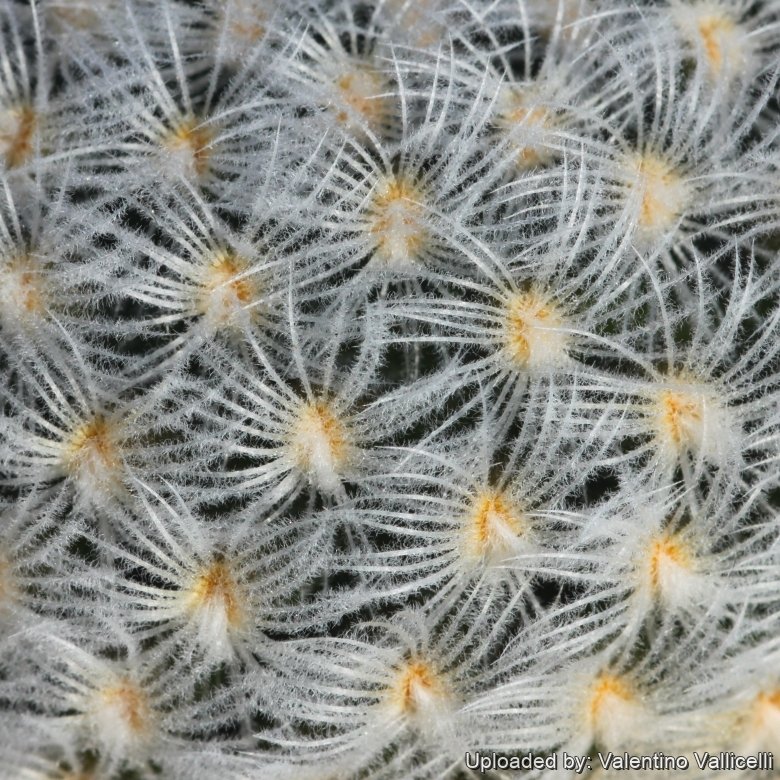
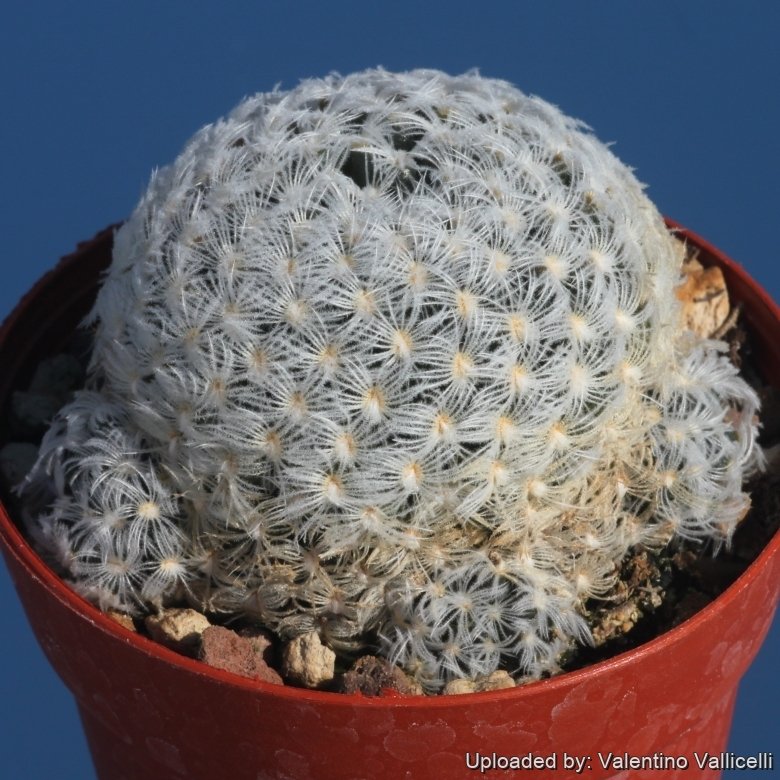
Mammillaria duwei is a small solitary rarely offsetting plants that eventually forms tiny mounds. The form “inermis” is a selected strain with pure feathery radial spines lacking central spines.
Stems: Heads 3,5 to 6 cm in diameter, 2 - 4 cm high, dark green, soft, globoid, flattened-globose, to shortly cylindrical.
Tubercles: Small, clavate 4-5 mm high, With a woolly axil and little hair.
Central spines: Absent.
Radial spines: 28 - 36, acicular, thin, white, brownish at base, pubescent/feathery, 3,5 - 4 mm long, interlacing and densely wrapped against the body of the cactus
Flowers: Funnel-form, less deeply set, yellowish/cream to light yellow, about 20 mm long and in diameter. Inner segments lanceolate, widely spreading, accuminate, style and stigma lobes greenish.
Blooming season: Flowers readily, and for a long period from spring to the early summer.
Fruits: Light red to red, elongated.
Seeds: Blackish brown.
Origin and Habitat
Mexico (Guanajuato and Queretaro)
Habitat: Altitude 1.800 - 2.000 m.
Note: The form “inermis” is has been obtained in cultivation from selected plants without central spines.
Cultivation and Propagation
Mammillaria duwei is not the easiest to grow of the mammillarias, more rot prone than most and more demanding regarding soil conditions.
Growth rate: It is a small growing, but easily flowering, species that will make clumps given the best conditions.
Soils: It likes very porous standard cactus mix soil.
Repotting: It will need a pot with sufficient depth to allow the tap root. Use pot with good drainage.
Watering: Water regularly in summer, but do not overwater (Rot prone), keep dry in winter. Keep Mammillaria duwei in very dry and ventilated place especially in winter.
Fertilization: Feed with a high potassium fertilizer in summer.
Hardiness: Reputedly sensitive to frost , but less so if kept on the dry side prior to, and during, cold weather (hardy to -5° C for short periods). However warmth throughout the year will increase the grower’s success (minimum 5° to 8°C during rest season).
Exposition: Outside bright sun, filtered sunlight or afternoon shade, inside it needs bright light, and some direct sun. Subject to sunburn if exposed to direct sun for too long. Tends to bronze in strong light, which encourages flowering and heavy wool and spine production.
Uses: It is an excellent plant for container growing. It always looks good and stays small. It look fine in a cold greenhouse and frame.
Pests & diseases: It may be attractive to a variety of insects, but plants in good condition should be nearly pest-free, particularly if they are grown in a mineral potting-mix, with good exposure and ventilation. Nonetheless, there are several pests to watch for:
- Red spiders: Red spiders may be effectively rubbed up by misting the vulnerable plants every day
- Mealy bugs: Mealy bugs easily they develop aerial into the new growth among the wool with disfiguring results, but the worst types develop underground on the roots and are invisible except by their effects.
- Scales: Scales are rarely a problem.
It is wise to treat your whole collection with a systemic insecticide twice a year in spring and autumn.
- Rot: Rot is only a minor problem with mammillaria if the plants are watered and “aired” correctly. If they are not, fungicides won’t help all that much.
Propagation: Direct sow after last frost or (rarely) cuttings. Seeds germinate in 7-14 days at 21-27° C in spring, remove the glass cover gradually as the plants develops and keep ventilated, no full sun for young plants! To make a cutting twist off a branch and permit it to dry out a couple of weeks, lay it on the soil and insert the stem end partially into the soil. Try to keep the cutting somewhat upright so that the roots are able to grow downward.
Bibliography
Major references and further lectures
-
David Hunt, Nigel Taylor “The New Cactus Lexicon” DH Books, 2006 ISBN 0953813444, 9780953813445
-
Edward F. Anderson “The Cactus Family” Timber Press, 2001
-
Rod Preston-Mafham, Ken Preston-Mafham “Cacti: the illustrated dictionary” Timber Press, 1991
-
John Pilbeam (1999) “Mammillaria The Cactus File Handbook” - page 203.