Basionym: Mammillaria duwei Rogoz. & P.J.Braun 1985
Publication: [Basionym: Mammillaria duwei Rogoz. & P.J.Braun 1985]
Description
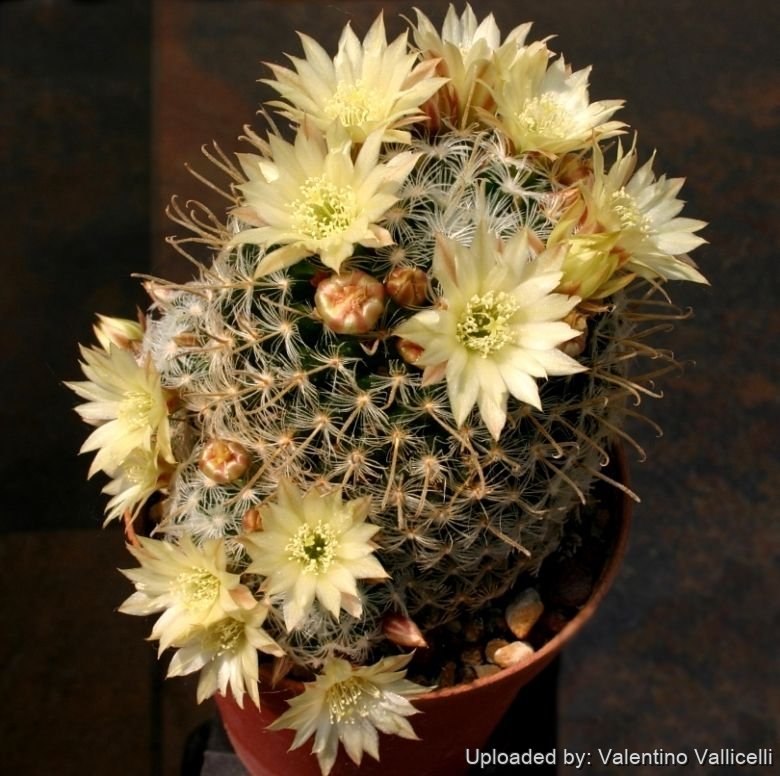
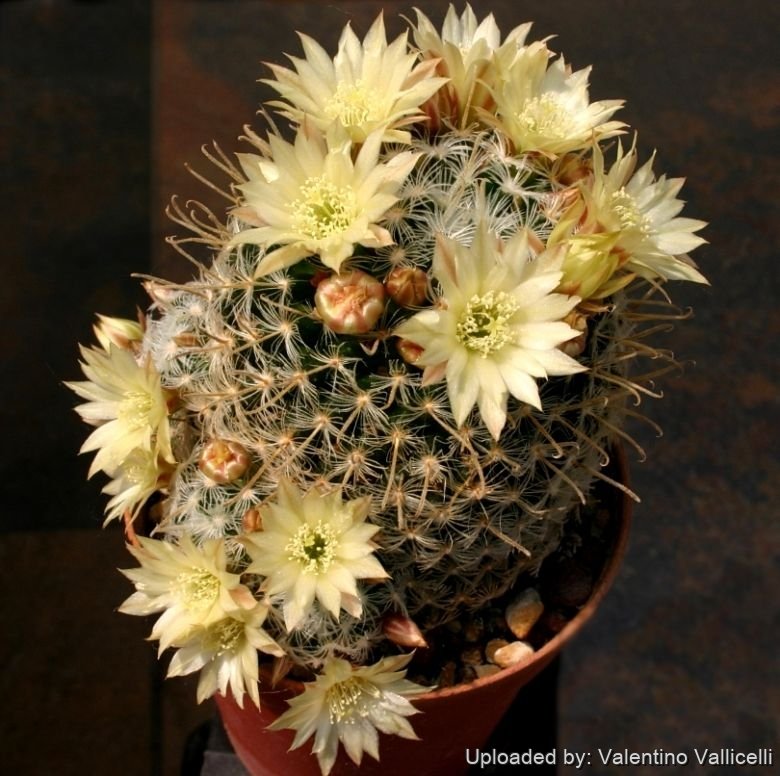
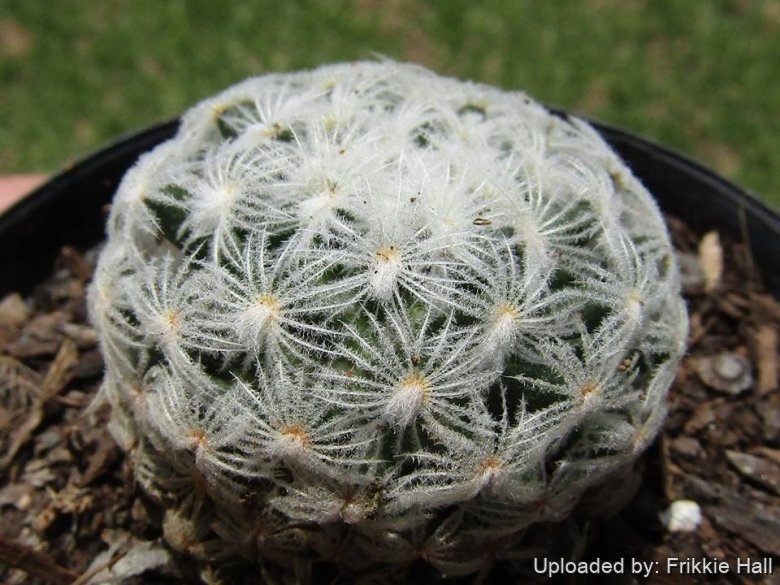
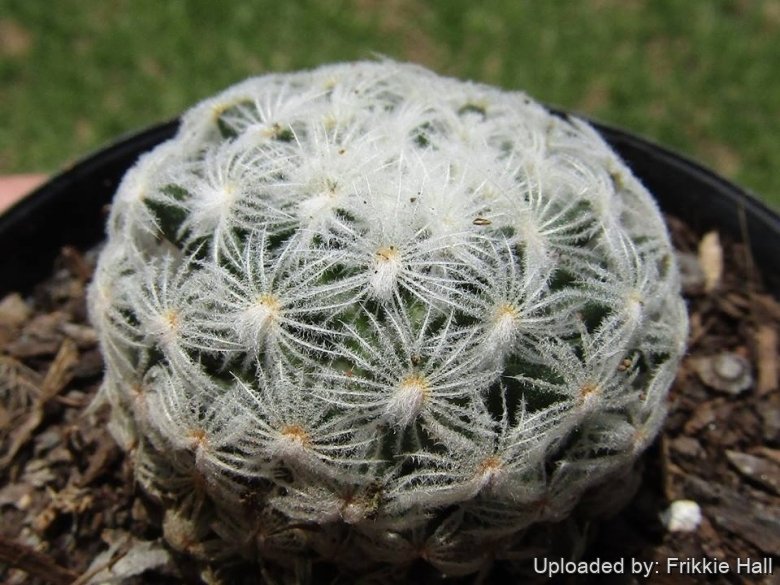
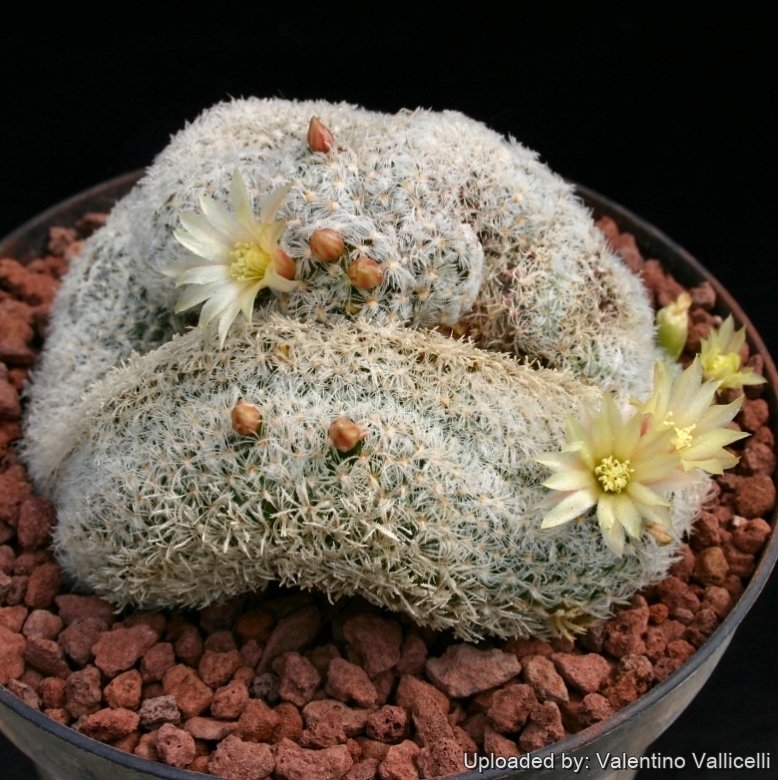
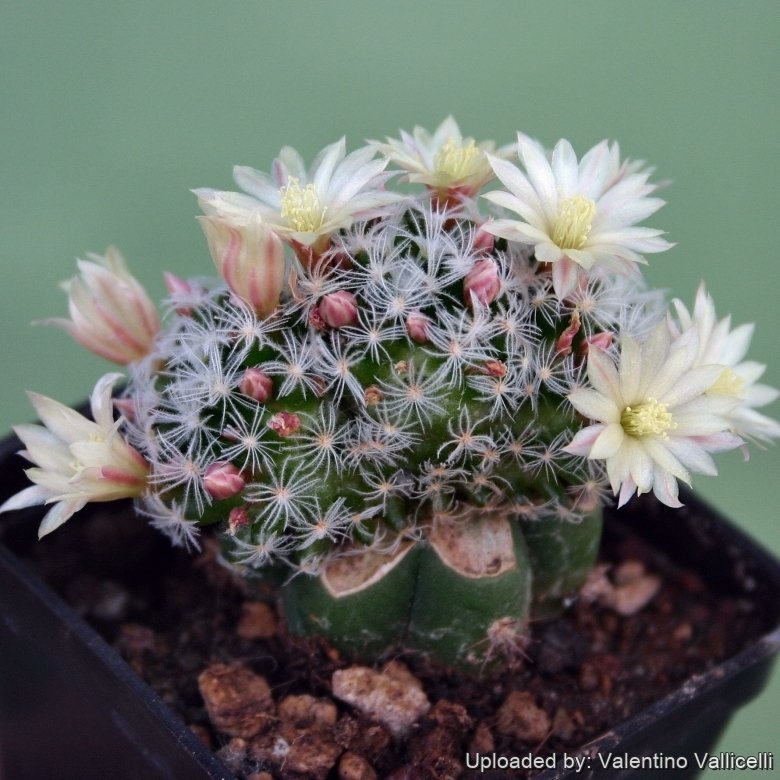
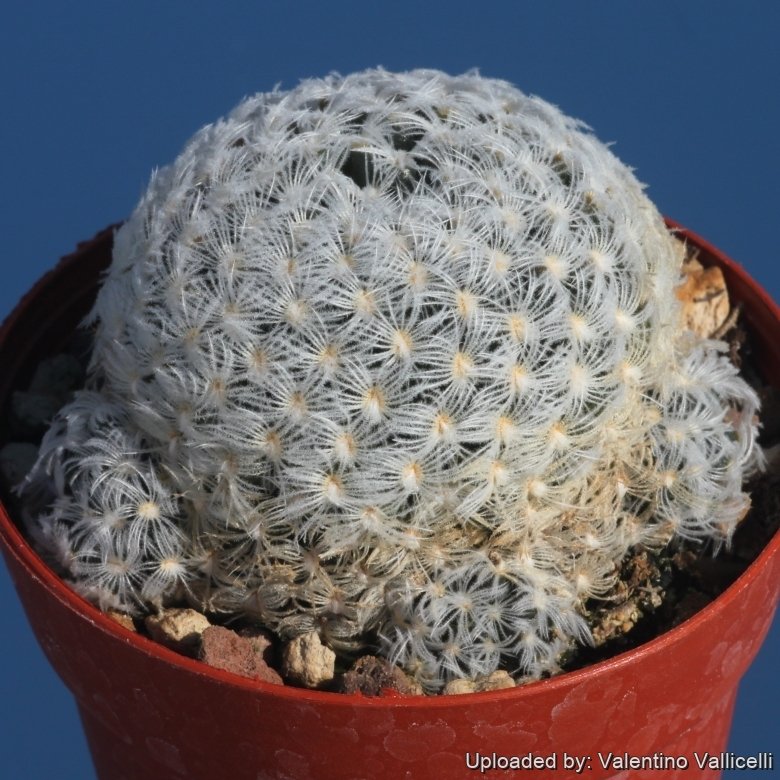
Mammillaria duwei is a small solitary rarely offsetting plants that eventually forms tiny mounds.
Taxonomic Notes: Mammillaria duwei is considered a synonym of Mammillaria crinita by Anderson (2001) and by Fitz Maurice (2002). Considered a provisional species by Hunt (1999) and a subspecies of Mammillaria nana by Pilbeam (1999).
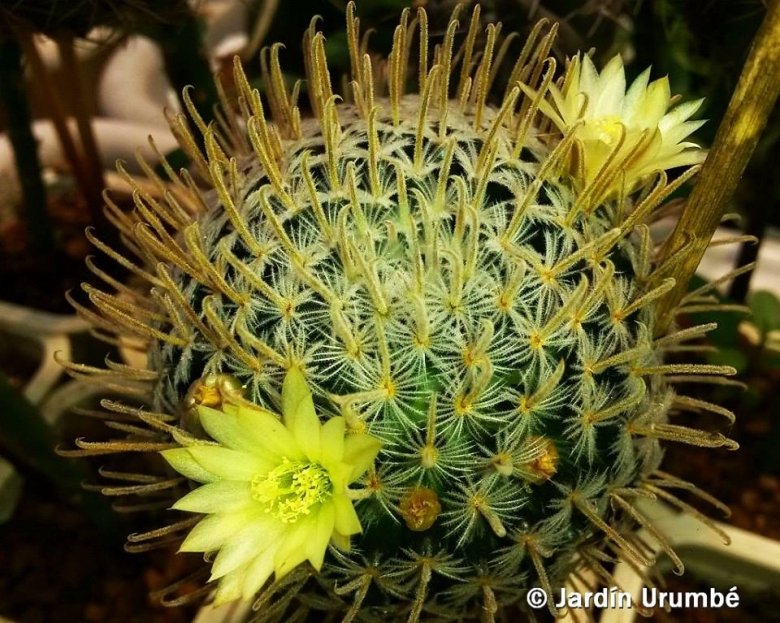
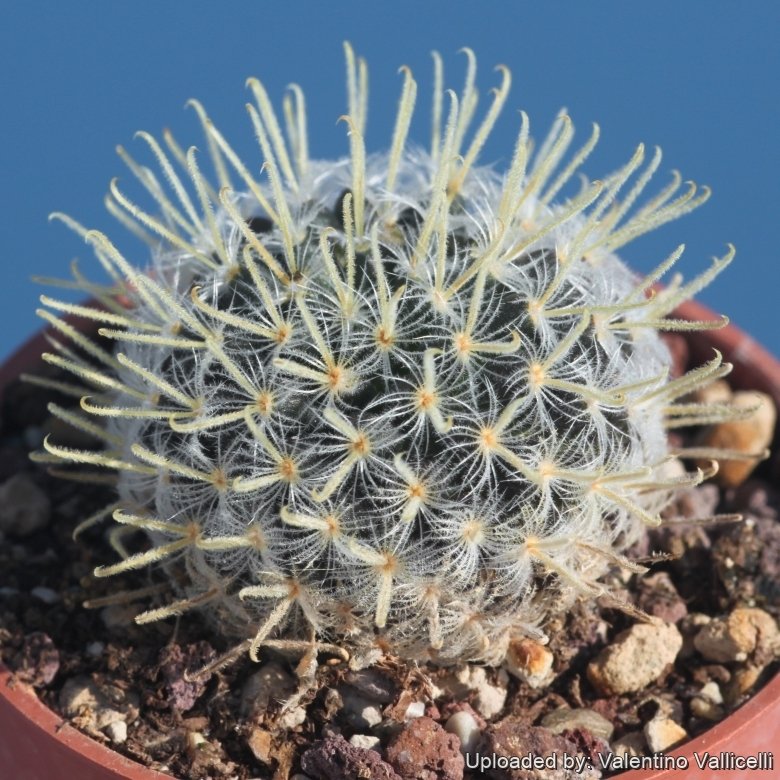
Stems: Heads 3,5 to 6 cm in diameter, 2-4 cm high, dark green, soft, globoid, flattened-globose, to shortly cylindrical.
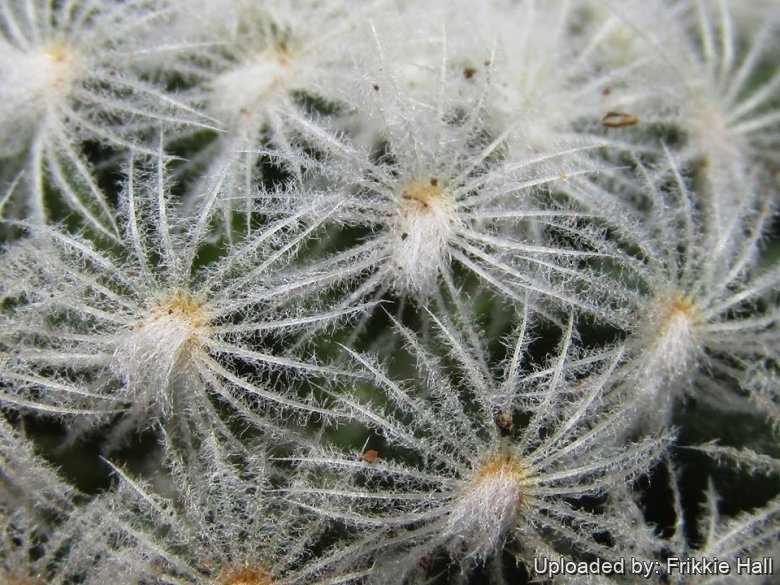
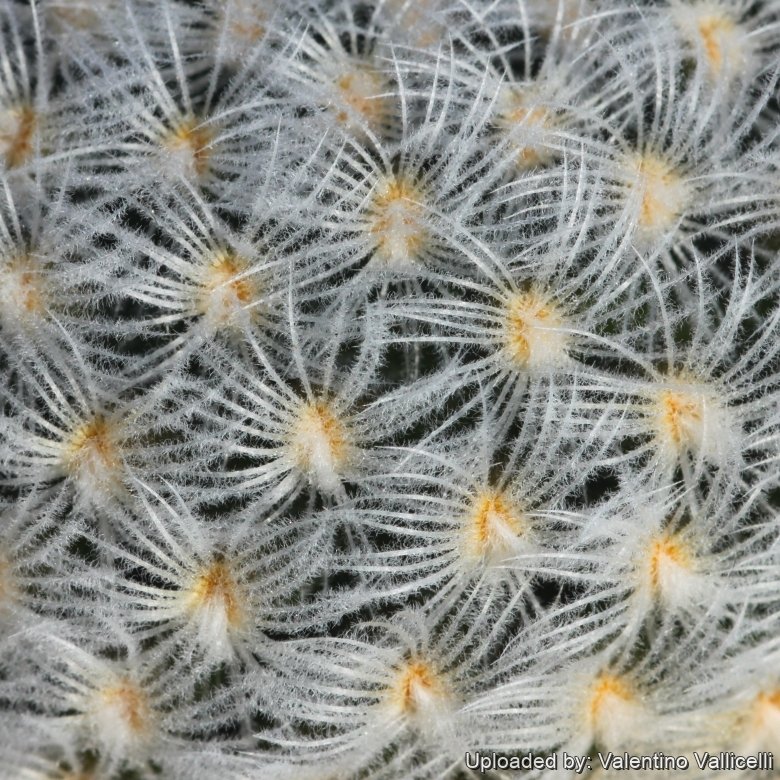
Tubercles: Small, clavate 4-5 mm high, With a woolly axil and little hair.
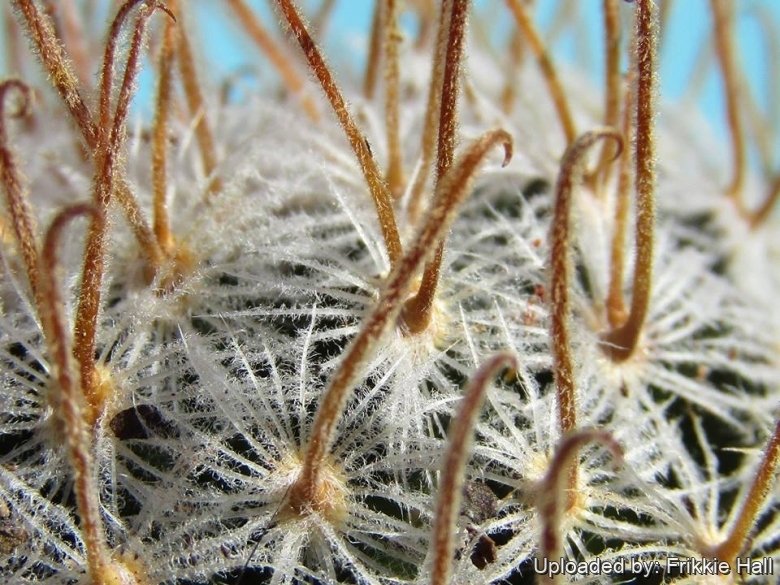
Central spines: 0-1 or 2 (occasiaonally 4). The long central spine is not present on all the clones, yellowish, hooked, to 8 mm long, pubescent.
Radial spines: 28-36, acicular, thin, white, brownish at base, pubescent, 3,5-4 mm long, interlacing and densely wrapped against the body of the cactus.
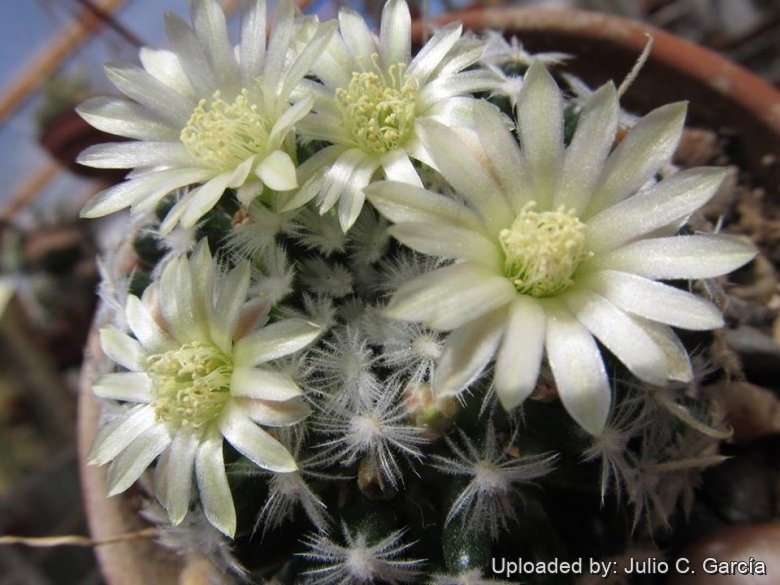
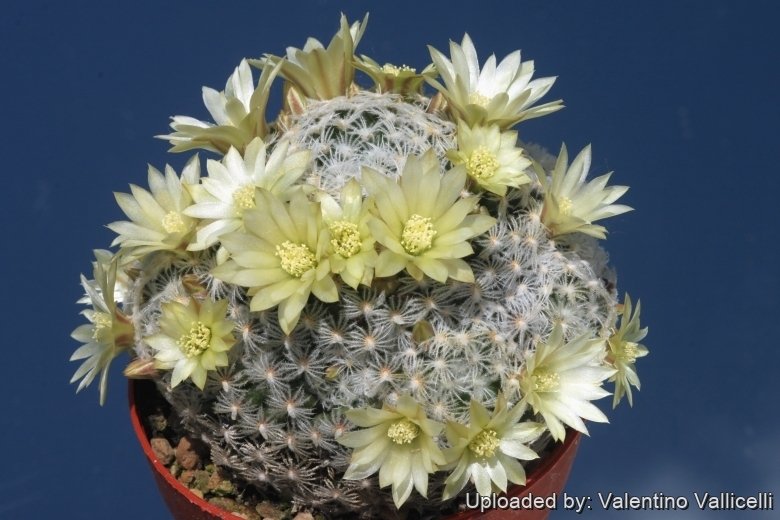
Flowers: Funnel-form, less deeply set, yellowish/cream to light yellow, about 20 mm long and in diameter. Inner segments lanceolate, widely spreading, accuminate, style and stigma lobes greenish.
Blooming season: Flowers readily, and for a long period from spring to the early summer.
Fruits: Light red to red, elongated.
Seeds: Blackish brown.
Origin and Habitat
This species is found at one location northeast of the city of Guanajuato, Mexico (extent of occurrence and area of occupancy 35 km2).
Altitude range: 1.800 - 2.000 metres above sea level.
Habitat: This species is found on volcanic rock in xerophyllous scrub. Mammillaria duwei is known from only one location, has a small population size, and there is a continuing decline due to overcollection and development. The southernmost of the two known subpopulations of this species has declined as a result of collecting over the past 15 years. Currently the total population is estimated at approximately 500 individuals.
Cultivation and Propagation
Mammillaria duwei is not the easiest to grow of the mammillarias, more rot prone than most and more demanding regarding soil conditions.
Growth rate: It is a small growing, but easily flowering, species that will make clumps given the best conditions.
Soils: It likes very porous standard cactus mix soil.
Repotting: It will need a pot with sufficient depth to allow the tap root. Use pot with good drainage.
Watering: Water regularly in summer, but do not overwater (Rot prone), keep dry in winter. Keep Mammillaria duwei in very dry and ventilated place especially in winter.
Fertilization: Feed with a high potassium fertilizer in summer.
Hardiness: Reputedly sensitive to frost , but less so if kept on the dry side prior to, and during, cold weather (hardy to -5° C for short periods). However warmth throughout the year will increase the grower’s success (minimum 5° to 8°C during rest season).
Exposition: Outside bright sun, filtered sunlight or afternoon shade, inside it needs bright light, and some direct sun. Subject to sunburn if exposed to direct sun for too long. Tends to bronze in strong light, which encourages flowering and heavy wool and spine production.
Uses: It is an excellent plant for container growing. It always looks good and stays small. It look fine in a cold greenhouse and frame.
Pests & diseases: It may be attractive to a variety of insects, but plants in good condition should be nearly pest-free, particularly if they are grown in a mineral potting-mix, with good exposure and ventilation. Nonetheless, there are several pests to watch for:
- Red spiders: Red spiders may be effectively rubbed up by misting the vulnerable plants every day
- Mealy bugs: Mealy bugs easily they develop aerial into the new growth among the wool with disfiguring results, but the worst types develop underground on the roots and are invisible except by their effects.
- Scales: Scales are rarely a problem.
It is wise to treat your whole collection with a systemic insecticide twice a year in spring and autumn.
- Rot: Rot is only a minor problem with mammillaria if the plants are watered and “aired” correctly. If they are not, fungicides won’t help all that much.
Propagation: Direct sow after last frost or (rarely) cuttings. Seeds germinate in 7-14 days at 21-27° C in spring, remove the glass cover gradually as the plants develops and keep ventilated, no full sun for young plants! To make a cutting twist off a branch and permit it to dry out a couple of weeks, lay it on the soil and insert the stem end partially into the soil. Try to keep the cutting somewhat upright so that the roots are able to grow downward.
Notes
This plant is a member of the Mammillaria crinita complex (Stylothele Series). Only some authors consider Mammillaria duwei to be a good species; the others classify it as M. crinita (e.g. According to Anderson’s classification, this species is considered as a synonym of Mammillaria crinita)
Bibliography
Major references and further lectures
-
David Hunt, Nigel Taylor “The New Cactus Lexicon” DH Books, 2006
-
Edward F. Anderson “The Cactus Family” Timber Press, 2001
-
Rod Preston-Mafham, Ken Preston-Mafham “Cacti: the illustrated dictionary” Timber Press, 1991
-
John Pilbeam (1999) “Mammillaria The Cactus File Handbook” - page 203.
-
Fitz Maurice, B & Fitz Maurice, W.A. 2013. Mammillaria duwei. The IUCN Red List of Threatened Species. Version 2014.3. <www.iucnredlist.org>. Downloaded on 31 May 2015.
From llifle page Mammillaria duwei f. monstruosa
Description
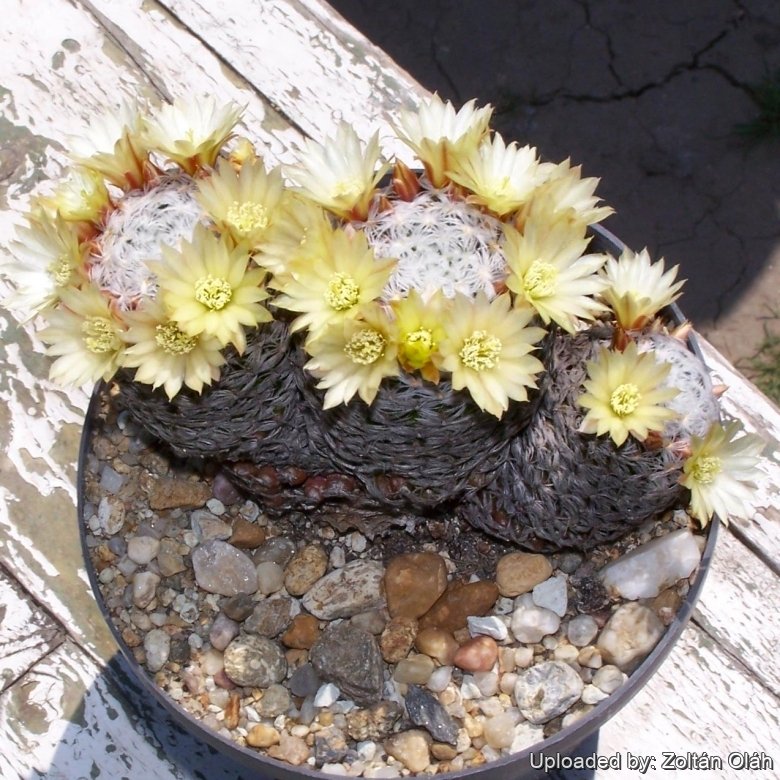
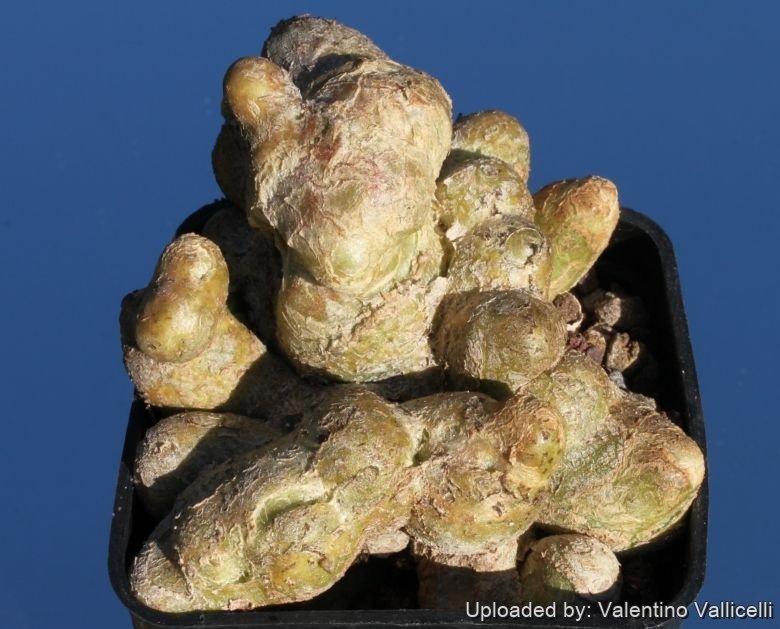
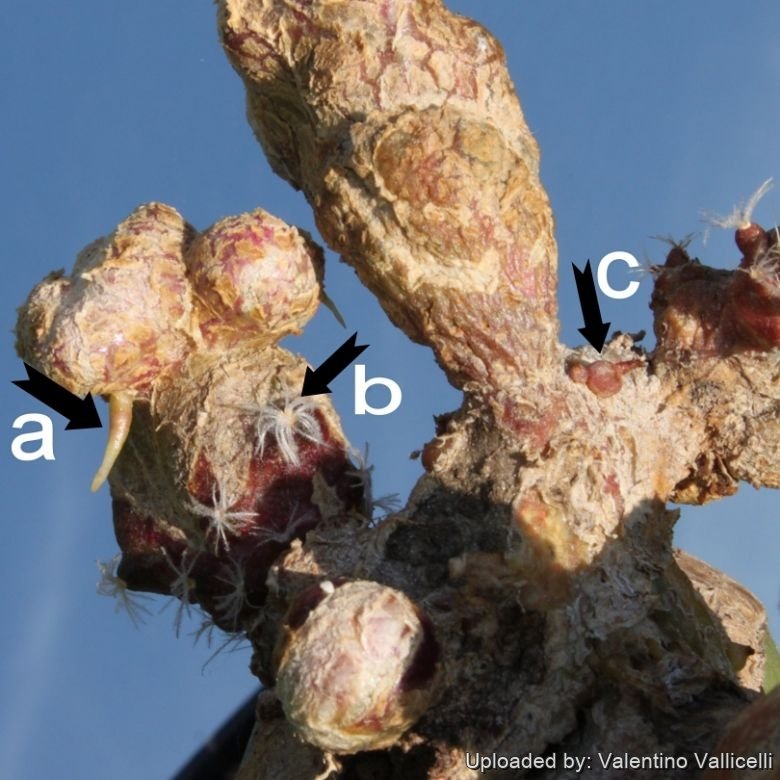
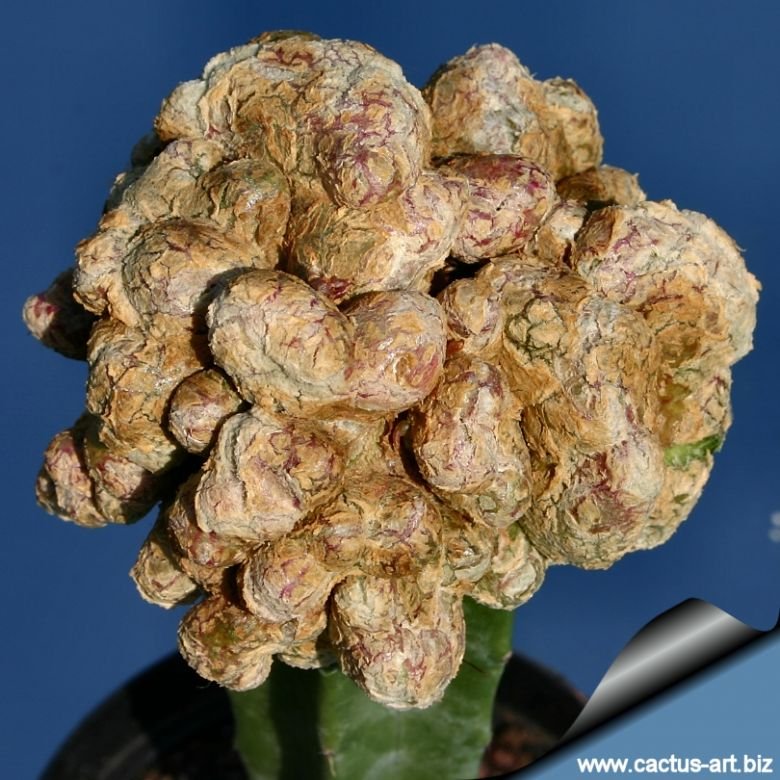
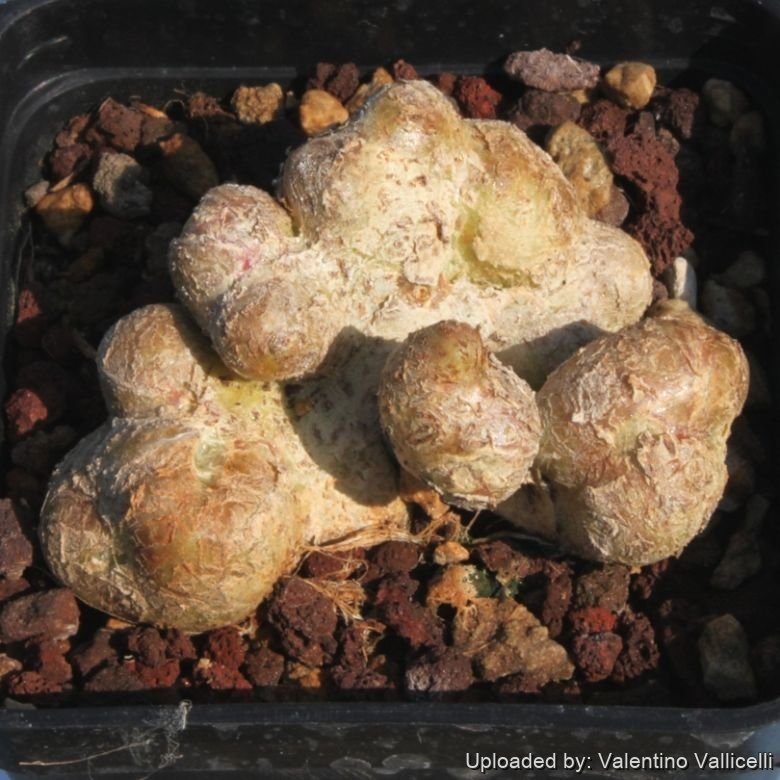
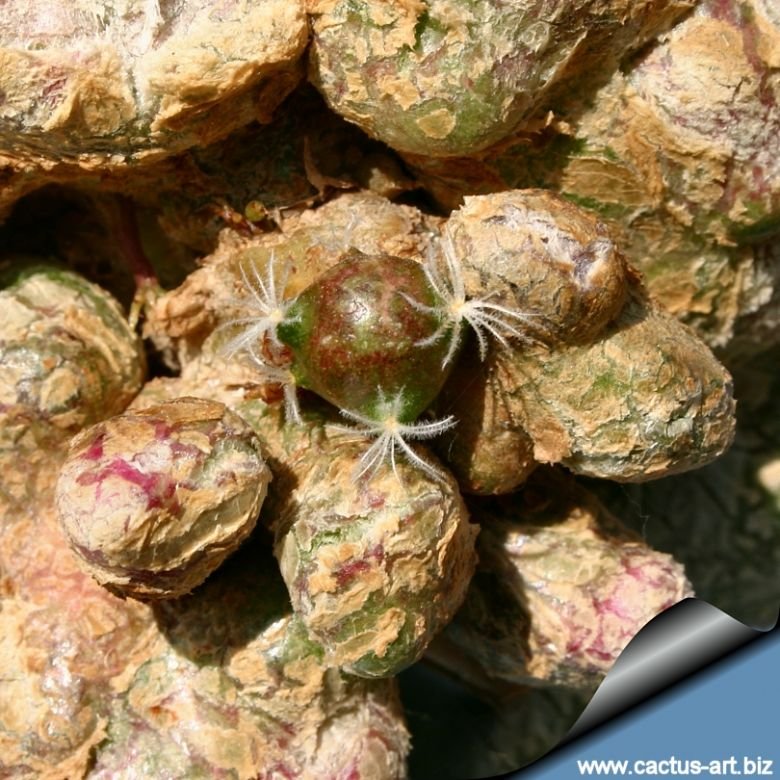
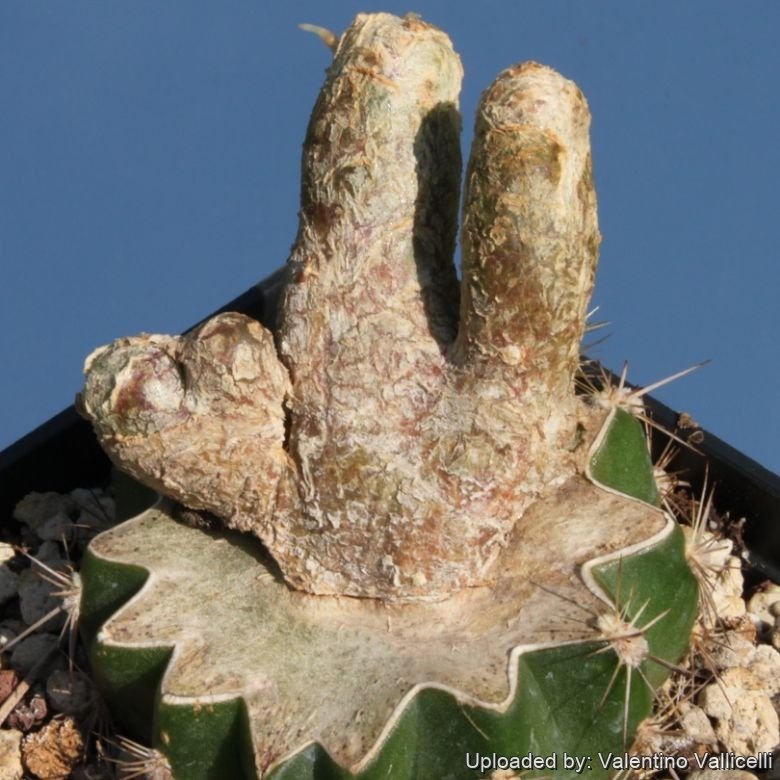
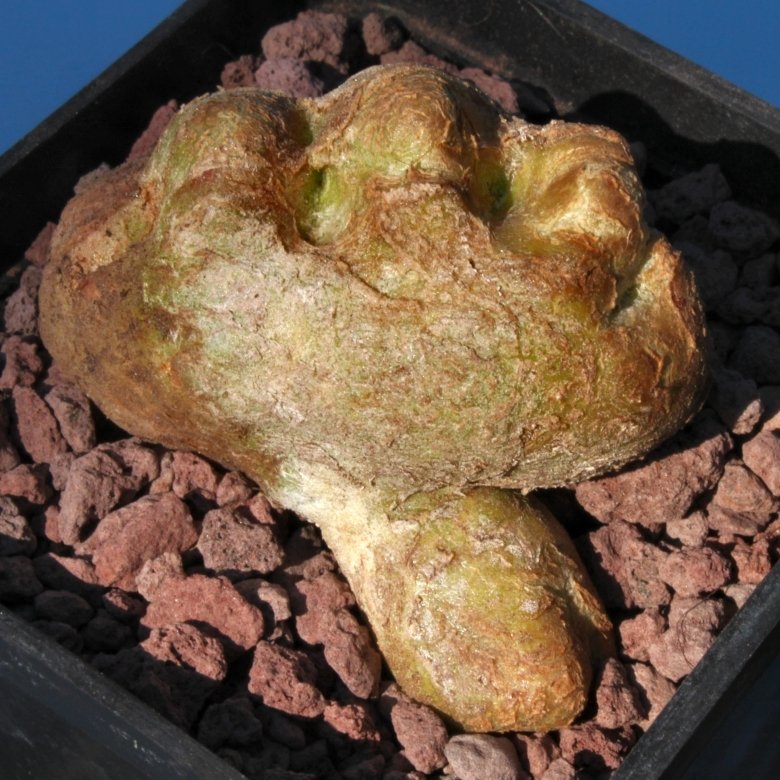
This plant is very different from a normal Mammillaria duwei, it reveal its true identity only when an occasional normal areole produces a tuft of white feathery spines. It is thought by some that it is nothing else than a monstrous root grafted upside down, in fact it produces easily adventitious roots in any part of its body. It forms large low clusters of hard, corky-textured creamy-brownish, greenish and pinkish fissured protuberances, some only a few centimetres across. The plant looks more like some non-cactus succulent or rocky material than a cactus. This cultivar shows many growing variations, with different crested and monstrous shapes.
Origin and Habitat
Garden origin (Nursery produced cultivar)
Cultivation and Propagation
Mammillaria crinita subs. duwei f. monstruosa is almost always seen grafted on a stronger stock, but seems it can grows well on its own roots too. The plants on their roots are quite difficult to grow long enough to produce clumps as it is very rot sensitive and needs lots of light with ample airflow.
Growth rate: It is a small growing.
Soils: It likes very porous standard cactus mix soil with little organic matter (peat, humus).
Repotting: Repotting every 2-3 years. It will need a pot with sufficient depth to allow the tap root. As it is especially prone to rot under-pot in a smaller container filled with very porous compost. Use pot with good drainage.
Watering: Water regularly in summer, but do not overwater (very wet-sensitively, especially in light of its succulent root system). Its roots are easily lost in pots that stay damp for any length of time. Keep dry with ample airflow in winter. In the rest period no high atmospheric humidity!!
Fertilization: During the growing season enrich the soil using a fertilizer rich in potassium and phosphorous, but poor in nitrogen, because this chemical element doesn’t help the development of succulent plants, making them too soft and full of water.
Hardiness: Reputedly sensitive to frost , but less so if kept on the dry side prior to, and during, cold weather (hardy to -5° C for short periods). However some warmth throughout the year will increase the grower’s success (minimum 5° to 8°C during rest season).
Exposition: Outside filtered sunlight or afternoon shade, inside it needs bright light, and some direct sun. Subject to sunburn if exposed to direct sun for too long.
Uses: It is an excellent plant for container growing. It always looks good and stays small. It look fine in a cold greenhouse and frame.
Pests & diseases: It may be attractive to a variety of insects, but plants in good condition should be nearly pest-free, particularly if they are grown in a mineral potting-mix, with good exposure and ventilation. Nonetheless, there are several pests to watch for:
- Red spiders: Sensitive to red spider mite. Overhead watering is helpful in controlling mites.
- Mealy bugs: Easily they develop aerial into the new growth with disfiguring results, but the worst types develop underground on the roots and are invisible except by their effects.
- Sciara Flies: they are one of the major problems for seedlings. It is a good practice to mulch your seedlings with a layer of grit, which will strongly discourage the flies.
- Scales: they are rarely a problem.
It is wise to treat your whole collection with a systemic insecticide twice a year in spring and autumn.
- Rot: it is only a minor problem with mammillaria if the plants are watered and “aired” correctly. If they are not, fungicides won’t help all that much.
Propagation: Graftingt or (rarely) cuttings. Cuttings of healthy shoots can be taken in the spring and summer. Cut the stem with a sharp, sterile knife, leave the cutting in a warm, dry place for a week or weeks (depending on how thick the cutting is) until a callus forms over the wound. Once the callus forms, the cutting may be inserted in a container filled with firmed cactus potting mix topped with a surface layer of coarse grit. They should be placed in the coarse grit only; this prevents the cut end from becoming too wet and allows the roots to penetrate the rich compost underneath. The cuttings should root in 2 to 6 weeks.
Notes
This plant is a monstrous root that sometime produces normal roots and normal areoles. But extraordinarily it produces viable somatic embryos. Somatic embryogenesis is a phenomenon observed during plant tissue culture, some of the somatic cells start behaving like the embryonic cells. They form the embryos which are not formed due to fusion of gametes. So they are called as somatic embryos. The formation of complete embryo from these cells is called as somatic embryo genesis. It is very rare to see such a phenomenon in a living plant out of a laboratory.
Source: Mammillaria duwei f. monstruosa, LLIFLE - Encyclopedia of living forms, CC-BY-SA, retrieved 2026-10-25.
From llifle page Mammillaria duwei f. cristata
Description
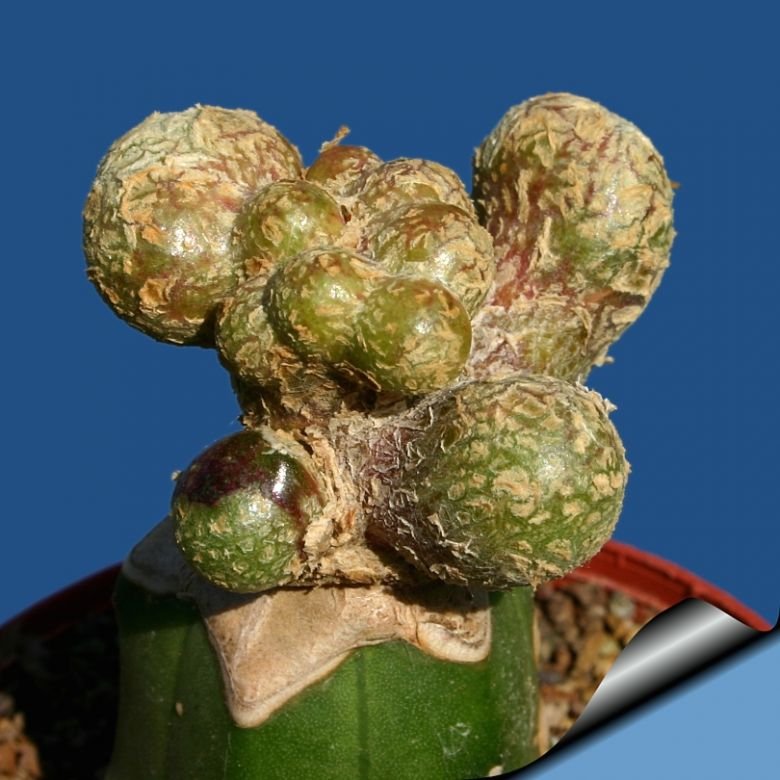
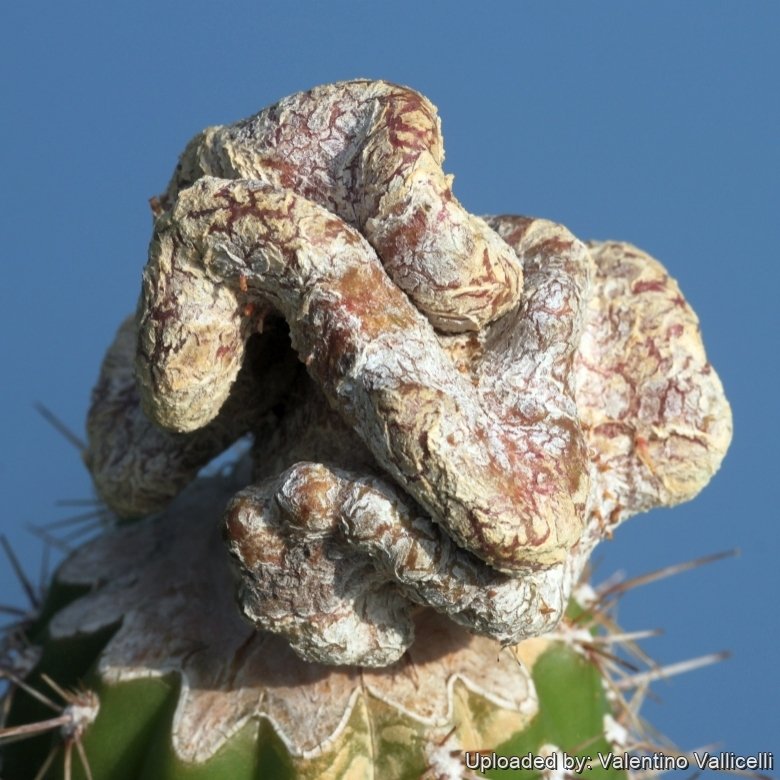
The standard Mammillaris duwei is a well known small cactus that appears above the ground as a squat, spherical stem, completely covered by tight pubescent spines. The crested form (Mammillaria duwei f. cristata) - despite to its beauty - is still very rare and sought after by collectors, for its unique features.
Habit: It is a small low growing crested cactus that will slowly forms tangled groups up to 20 cm in diameter.
Stems: Fan-shaped about 3,5 thick, dark green, soft, globoid, flattened-globose, to shortly cylindrical.
Tubercles: Small, clavate 4-5 mm high, With a woolly axil and little hair.
Central spines: 0-1 or 2 (occasiaonally 4). The long central spine is not present on all the clones, yellowish, hooked, to 8 mm long, pubescent.
Radial spines: 28-36, acicular, thin, white, brownish at base, pubescent, 3,5-4 mm long, interlacing and densely wrapped against the body of the cactus.
Flowers: Funnel-form, less deeply set, yellowish/cream to light yellow, about 20 mm long and in diameter. Inner segments lanceolate, widely spreading, accuminate, style and stigma lobes greenish.
Blooming season: Flowers readily, and for a long period from spring to the early summer.
Fruits: Light red to red, elongated.
Seeds: Blackish brown.
Cultivation and Propagation
It is regarded as a choice and difficult plant andgrows quite slowly. It is usually seen as a grafted plant but can grow on its own roots too.
Soil: Use mineral well permeable mineral soil with little organic matter (peat, humus).
Exposure: They need a good amount of light shade to full sun this help to keep the plants healthy, although slow growth.
Watering: Water sparingly from March till October (weekly during summertime, if the weather is sunny enough), with a little fertilizer added. Less or no water during cold winter months, or when night temperatures remain below 10° to prevent root loss. It is sensitive to overwatering (rot prone).
Fertilization: Feeding may not be necessary at all if the compost is fresh then, feed in summer only if the plant hasn’t been repotted recently. Do not feed the plants from September onwards as this can cause lush growth which can be fatal during the darker cold months.
Hardiness: Keep perfectly dry in winter at temperatures from 5 to 15 degrees centigrade. (but it is relatively cold resistant and hardy to -5° C, or possibly colder for short periods) In the rest period no high atmospheric humidity!! (Temperature Zone: USDA 9-11)
Crested growth: Unlike ‘monstrose’ varieties of plants, where the variation from normal growth is due to genetic mutation, crested growth can occur on normal plants. Sometimes it’s due to variances in light intensity, or damage, but generally the causes are unknown. A crested plant may have some areas growing normally, and a cresting plant that looks like a brain, may revert to normal growth for no apparent reason. If you have any of the crested part left you need to remove the normal growth and leave the crested part behind this will need to be done regularly.
Propagation: Grafting or cuttings. Plants are usually grafted onto column-shaped cacti but proved to be able to produce their own roots if degrafted. Cuttings will take root in a minimum temperature of 20° C (but better in hot weather). Cuttings of healthy shoots can be taken in the spring and summer. Cut the stem with a sharp, sterile knife, leave the cutting in a warm, dry place for a week or weeks (depending on how thick the cutting is) until a callus forms over the wound. Once the callus forms, the cutting may be inserted in a container filled with firmed cactus potting mix topped with a surface layer of coarse grit. They should be placed in the coarse grit only; this prevents the cut end from becoming too wet and allows the roots to penetrate the rich compost underneath. The cuttings should root in 2 to 6 weeks. Large crested piece must be placed on the soil surface without burying the plant base down in the soil.
Bibliography
Major references and further lectures
-
David Hunt, Nigel Taylor “The New Cactus Lexicon” DH Books, 2006
-
Edward F. Anderson “The Cactus Family” Timber Press, 2001
-
Rod Preston-Mafham, Ken Preston-Mafham “Cacti: the illustrated dictionary” Timber Press, 1991
-
John Pilbeam (1999) “Mammillaria The Cactus File Handbook”
Source: Mammillaria duwei f. cristata, LLIFLE - Encyclopedia of living forms, CC-BY-SA, retrieved 2026-10-25.
From llifle page Mammillaria duweii f. inermis
Description
Mammillaria duwei is a small solitary rarely offsetting plants that eventually forms tiny mounds. The form “inermis” is a selected strain with pure feathery radial spines lacking central spines.
Stems: Heads 3,5 to 6 cm in diameter, 2 - 4 cm high, dark green, soft, globoid, flattened-globose, to shortly cylindrical.
Tubercles: Small, clavate 4-5 mm high, With a woolly axil and little hair.
Central spines: Absent.
Radial spines: 28 - 36, acicular, thin, white, brownish at base, pubescent/feathery, 3,5 - 4 mm long, interlacing and densely wrapped against the body of the cactus
Flowers: Funnel-form, less deeply set, yellowish/cream to light yellow, about 20 mm long and in diameter. Inner segments lanceolate, widely spreading, accuminate, style and stigma lobes greenish.
Blooming season: Flowers readily, and for a long period from spring to the early summer.
Fruits: Light red to red, elongated.
Seeds: Blackish brown.
Origin and Habitat
Mexico (Guanajuato and Queretaro)
Habitat: Altitude 1.800 - 2.000 m.
Note: The form “inermis” is has been obtained in cultivation from selected plants without central spines.
Bibliography
Major references and further lectures
-
David Hunt, Nigel Taylor “The New Cactus Lexicon” DH Books, 2006 ISBN 0953813444, 9780953813445
-
Edward F. Anderson “The Cactus Family” Timber Press, 2001
-
Rod Preston-Mafham, Ken Preston-Mafham “Cacti: the illustrated dictionary” Timber Press, 1991
-
John Pilbeam (1999) “Mammillaria The Cactus File Handbook” - page 203.
Source: Mammillaria duweii f. inermis, LLIFLE - Encyclopedia of living forms, CC-BY-SA, retrieved 2026-10-25.
Gallery