Publication: Mammillaria Postscripts 6: 6 (1997)
Description
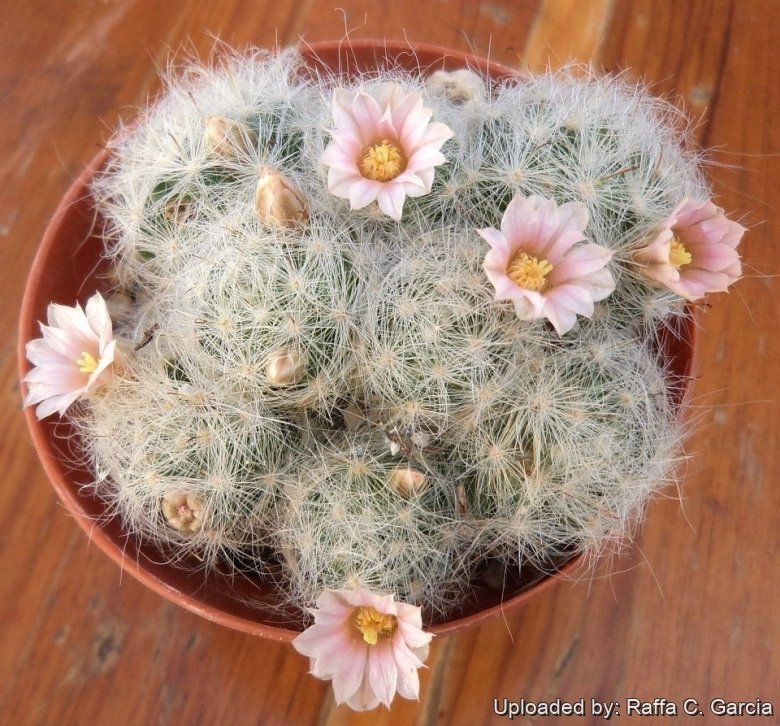
Mammillaria glassii var. ascensionis is a controversial variety of Mammillaria glassii now reduced to synonym. It distinguish for its larger stems (up to 10 cm in diameter), axil almost naked with short wool and few (If any) bristles. Central spines 7-7 mm long, flowers larger up to 18-22 mm wide.
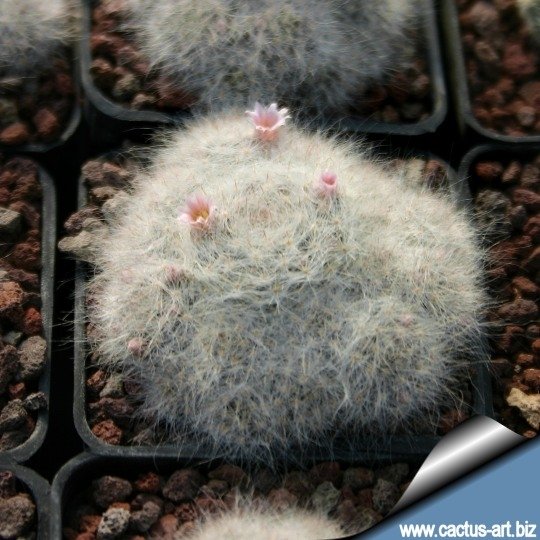
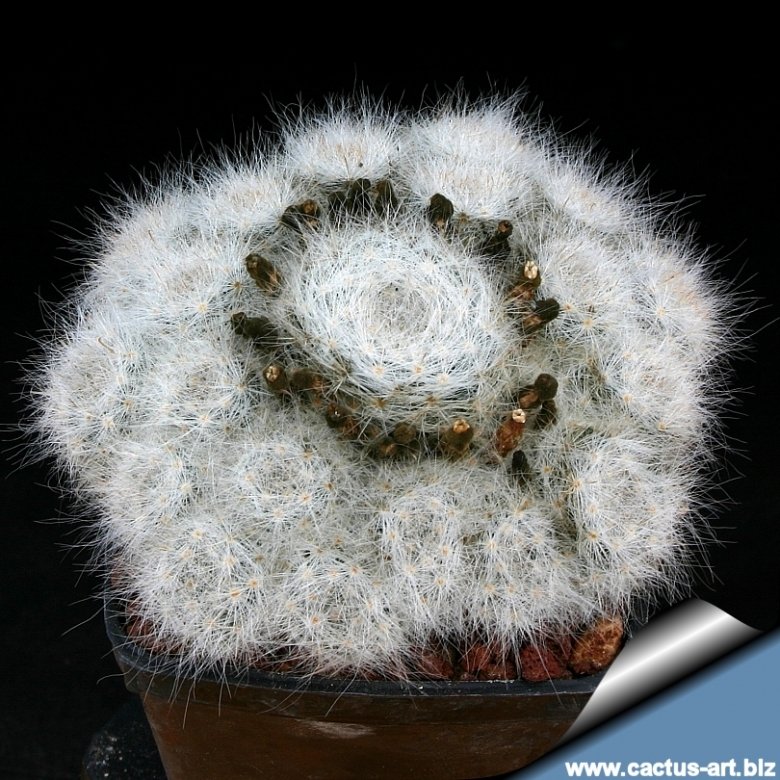
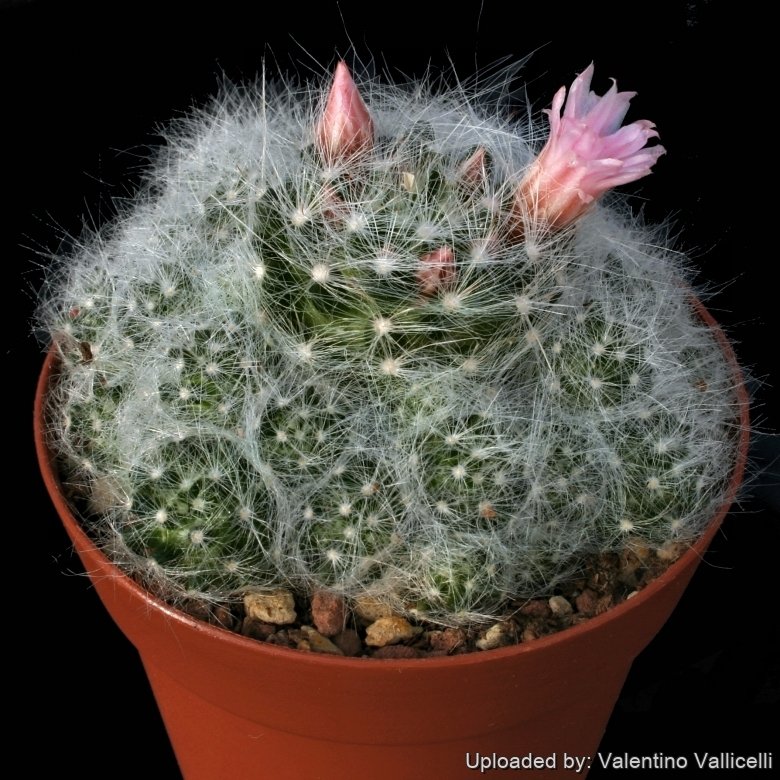
Habit: It is a small free branching plant that forms low clusters or dense cushions. Individual stems are globose.
Stem: Globular 40-50 mm in diameter, becoming cylindrical, to 10 cm high. Without latex
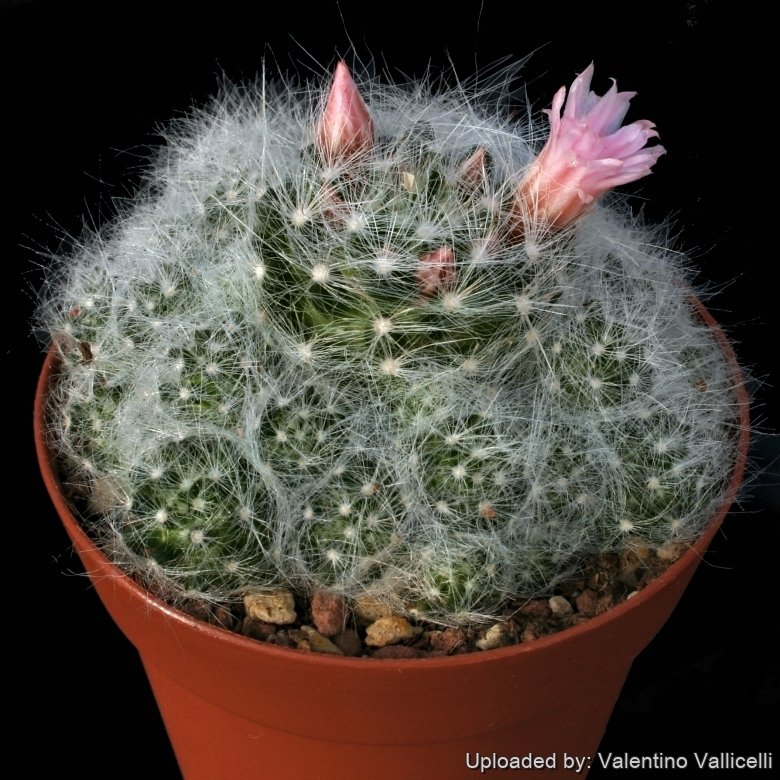
Tubercles: Cylindrical with usually short white hairs and about 3-8 hairlike bristles in the axil up to 3-15 mm long.
Central spines: 1 longer erect, straight or hooked, 5-7 mm long, white, brown on the tip, and 4 to 7 straight, 4-6 mm long, more or less orderly, dispersing to the sides, while difficult to distinguish from radials.
Radial spines: 50-75, 4-14 mm long, , interlacing, hairlike, white.
Flowers: Often not opening completely, white, with a pink nuance, usually 16-18 X 18-22 mm
Fruits: 15-17 Long, 3-5 mm in diameter, greenish- white to pale pinkish-olive. Ripens about 3 months after flowering.
Seeds: Pear-shaped, 1.2 X 1.0 mm, black.
Remarks: Vaguely resembles Mammillaria prolifera. Glass and Foster consider it a variety of Mammillaria glassii.
Origin and Habitat
Mexico (Nuevo León)
Habitat: Grows in moss on limestone mountains near Ascension, 2400 - 2.750 m.
Cultivation and Propagation
Of easy culture and recommended for any collection, it doesn’t requires any special treatment. It readily forms clumps of many small heads. It needs as much light as possible without burning the plant, to encourage the heaviest spine formation. Growth and flowering are improved under these conditions. Use very gritty potting mix (rot prone) For best results, use a shallow pot, and only use the smallest diameter pot that will accommodate the plant. Regular water in summer, dry in winter. The use of a covering gravel is a good way to preserve the whiteness of spines. Frost tolerance -6° C.
Reproduction: Seeds or offsets.
Bibliography
Major references and further lectures
-
Fitz Maurice, B, Fitz Maurice, W.A., Hernández, H.M., Sotomayor, M. & Smith, M. 2013. Mammillaria glassii. The IUCN Red List of Threatened Species. Version 2014.3. <www.iucnredlist.org>. Downloaded on 01 February 2015.
-
John Pilbeam “Mammillaria The Cactus File Handbook” Cirio Pub. Services, 01/December/1999
-
Edward Anderson “The Cactus family” Timber Press, Incorporated, 2001
-
James Cullen, Sabina G. Knees, H. Suzanne Cubey “The European Garden Flora Flowering Plants: A Manual for the Identification of Plants Cultivated in Europe, Both Out-of-Doors and Under Glass” Cambridge University Press, 11/August /2011
-
David R Hunt; Nigel P Taylor; Graham Charles; International Cactaceae Systematics Group. “The New Cactus Lexicon” dh books, 2006
-
Urs Eggli, Leonard E. Newton “Etymological Dictionary of Succulent Plant Names” Birkhäuser 2004
-
Ulises Guzmán, Salvador Arias, Patricia Dávila “Catálogo de cactáceas mexicanas.” Universidad Nacional Autónoma de México Mexiko-Stadt 2003
-
Hunt, D. “A new review of Mammillaria names.” British Cactus and Succulent Society. Oxford. 1987.
Gallery