Publication: Cact. Succ. J. (Los Angeles) 40: 132. 1968
Description
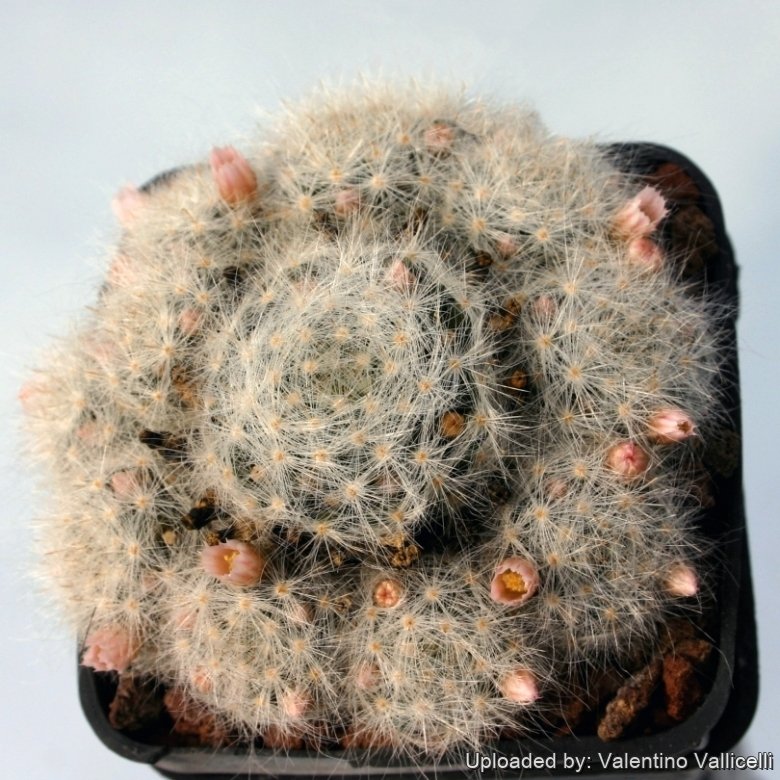
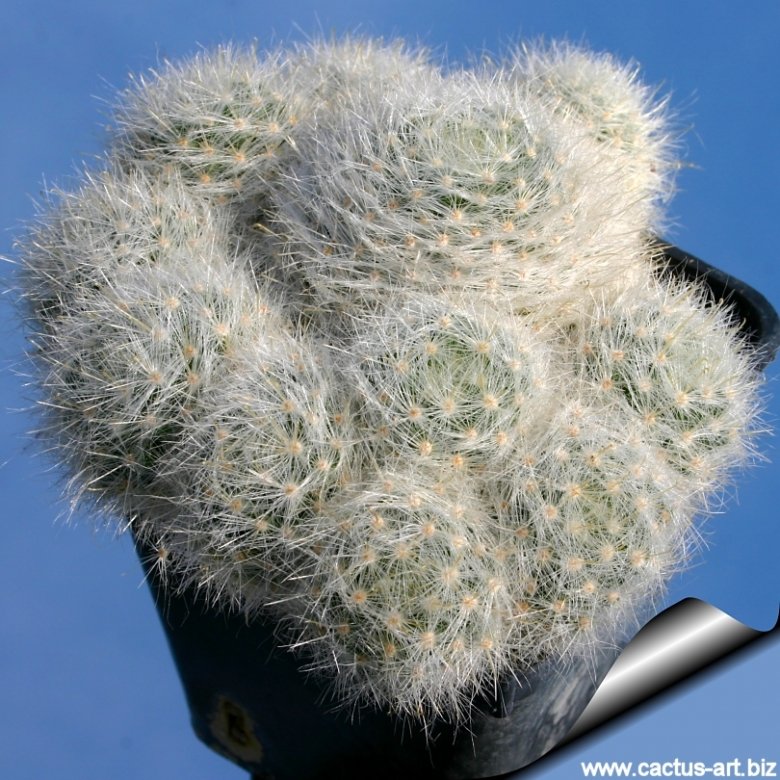
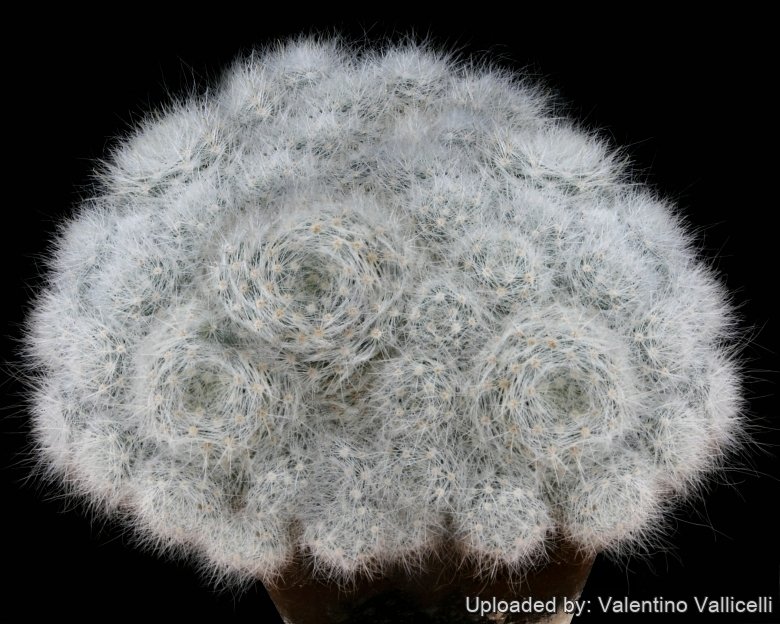
Mammillaria glassii is a small rapidly clumping plant that forms large, low clusters, with numerous basal branches, densely covered in fluffy white spines. No subspecies are now recognized, they are all subsumed under the species as synonyms.
Stems: Individual stems are short, globose, becoming cylindrical, 3-10 cm tall.
Tubercles: Cylindrical, up to 7 mm tall, with watery juice (without latex).
Areoles: Circular, naked. The axil is furnished with10 to 20 fine, white bristles, up to 25 mm long or almost naked.
Radial spines: 50 - 60, hairlike, white, interlacing, 10 - 15 mm long,
Central spines: 1 to 4, up to 7 mm long, erect, straight or hooked, but difficult to distinguish from radials.
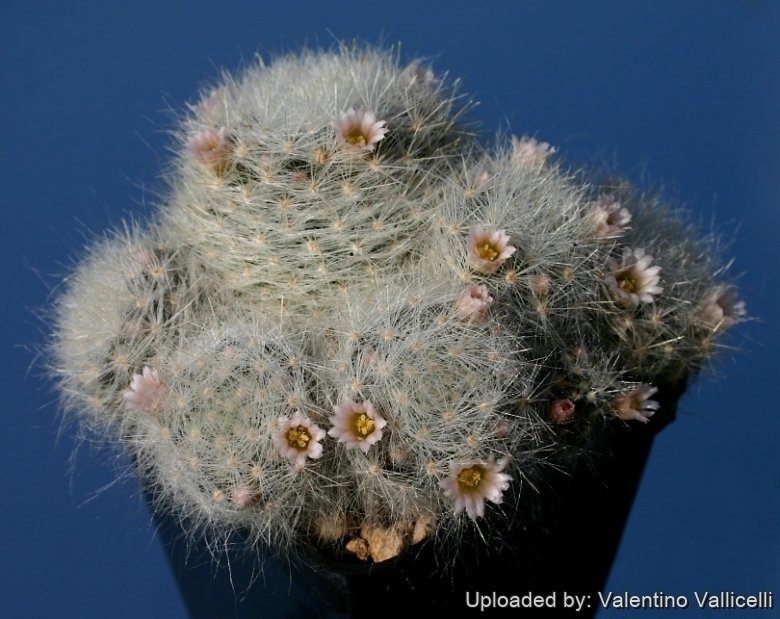
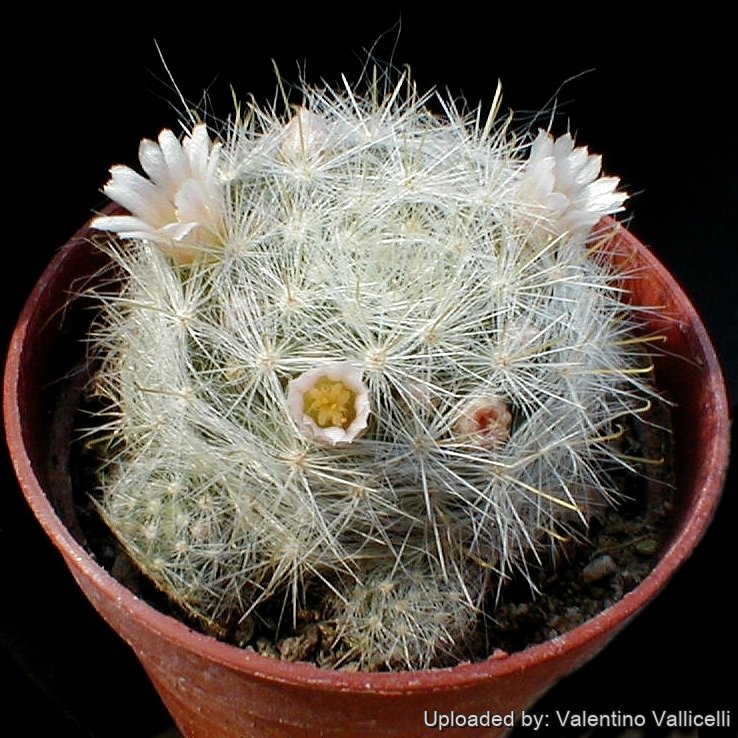
Flower: Very small, funnel shaped, often not opening completely, creamy-yellow to light pink, up to 14 mm long, 3-22 mm across.
Blooming season: It one of the earliest mammillarias to flower in spring.
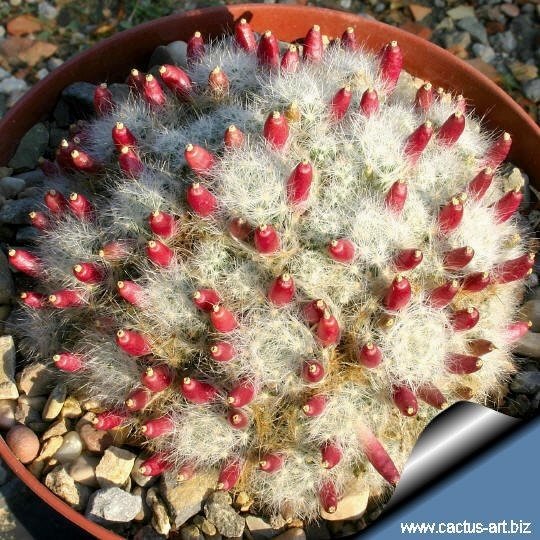
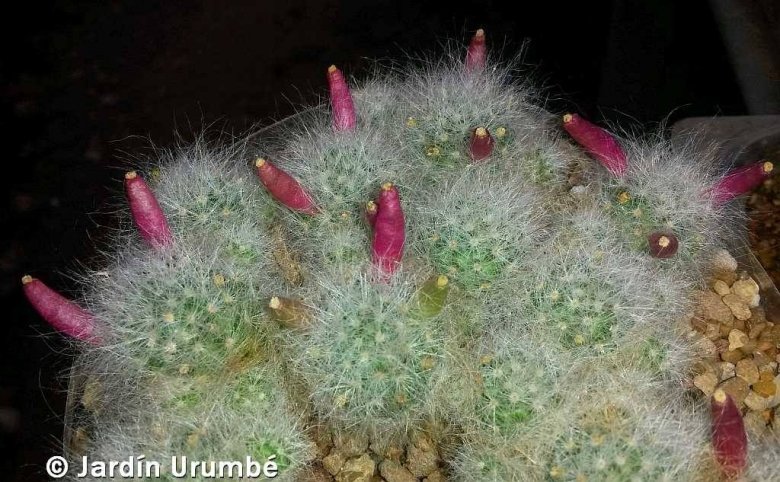
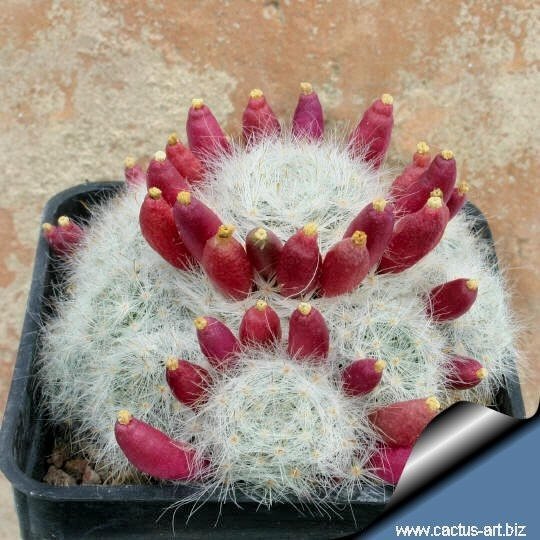
Fruits: Protruding, very ornamental green, becoming pink-reddish, up to 20 mm long.
Seeds: Black.
Roots: Fibrous.
Origin and Habitat
Sierra. Madre Oriental, Coahuila, Tamaulipas and Nuevo Leon, Mexico Altitude 1.450 - 2.250 m.
Cultivation and Propagation
It is a slow growing species of easy culture, recommended for any collection, it doesn’t require any special treatment. Water regularly in summer, but do not overwater (Rot prone) Use pot with good drainage and a very porous potting media, keep dry in winter. Feed with a high potassium fertilizer in summer. It is quite frost resistant if kept dry, hardy as low as -5° C (some reports give it hardy to -5°C) Sun Exposure: It needs as much light as possible without burning the plant, to encourage the heaviest spine formation. Growth and flowering are improved under these conditions. Can be sunburned if moved from shade/greenhouse into full sun too quickly. During the spring it may be able to take full sun until the heat arrives at the end of spring. In an area that has hot afternoon sun, it may be able to take full morning sun, but requires afternoon shade or afternoon light shade.
It readily forms clumps of many small heads and flowers easily. For best results, use a shallow pot, and only use the smallest diameter pot that will accommodate the plant. Regular water in summer, dry in winter. The use of a covering gravel is a good way to preserve the whiteness of spines.
Propagation: Direct sow after last frost (usually) or division, wait until the offsets that appear at the base of old clustered specimens are 1/3 the size of the parent and then detach and plant.
Bibliography
Major references and further lectures
-
Fitz Maurice, B, Fitz Maurice, W.A., Hernández, H.M., Sotomayor, M. & Smith, M. 2013. Mammillaria glassii. The IUCN Red List of Threatened Species. Version 2014.3. <www.iucnredlist.org>. Downloaded on 01 February 2015.
-
John Pilbeam “Mammillaria The Cactus File Handbook” Cirio Pub. Services, 01/December/1999
-
Edward Anderson “The Cactus family” Timber Press, Incorporated, 2001
-
James Cullen, Sabina G. Knees, H. Suzanne Cubey “The European Garden Flora Flowering Plants: A Manual for the Identification of Plants Cultivated in Europe, Both Out-of-Doors and Under Glass” Cambridge University Press, 11/August /2011
-
David R Hunt; Nigel P Taylor; Graham Charles; International Cactaceae Systematics Group. “The New Cactus Lexicon” dh books, 2006
-
Urs Eggli, Leonard E. Newton “Etymological Dictionary of Succulent Plant Names” Birkhäuser 2004
-
Ulises Guzmán, Salvador Arias, Patricia Dávila “Catálogo de cactáceas mexicanas.” Universidad Nacional Autónoma de México Mexiko-Stadt 2003
-
Hunt, D. “A new review of Mammillaria names.” British Cactus and Succulent Society. Oxford. 1987.
Cultivars and forms (2)
Subspecies (1)
Varieties (1)
Gallery