Publication: Syn. Cact. U. S. 6. 1856 Proc. Amer. Acad. Arts 3: 262. 1857
Description
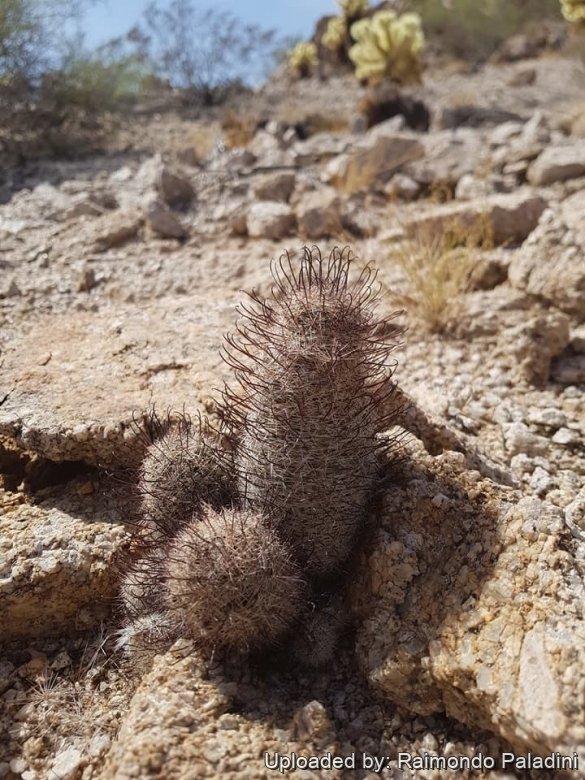
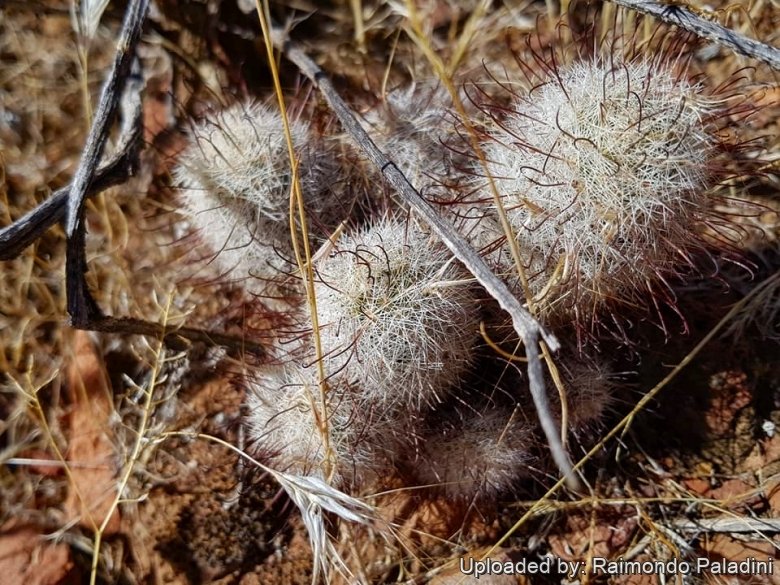
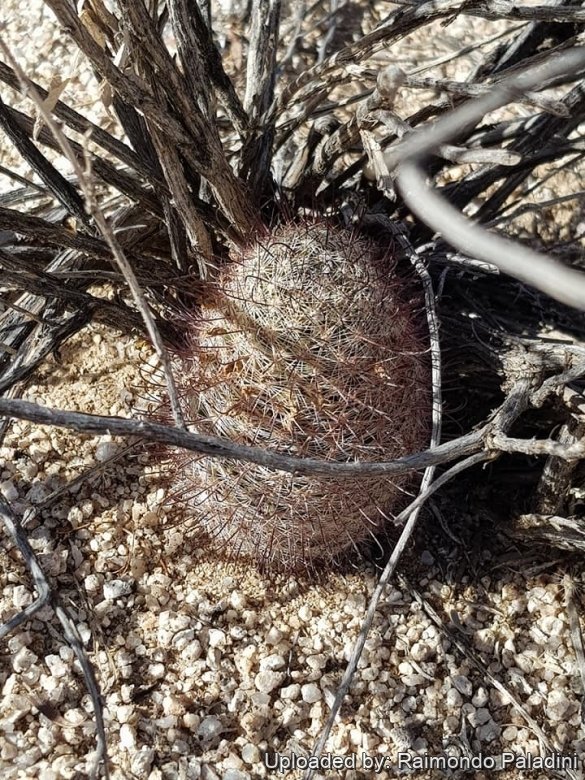
Plants are solitary or budding either basally or near the middle, often cespitose, but in small clusters (but sometime they can form clusters of many individuals). This species is quite common in habitat, but variable throughout the region.
Roots: Thickened.
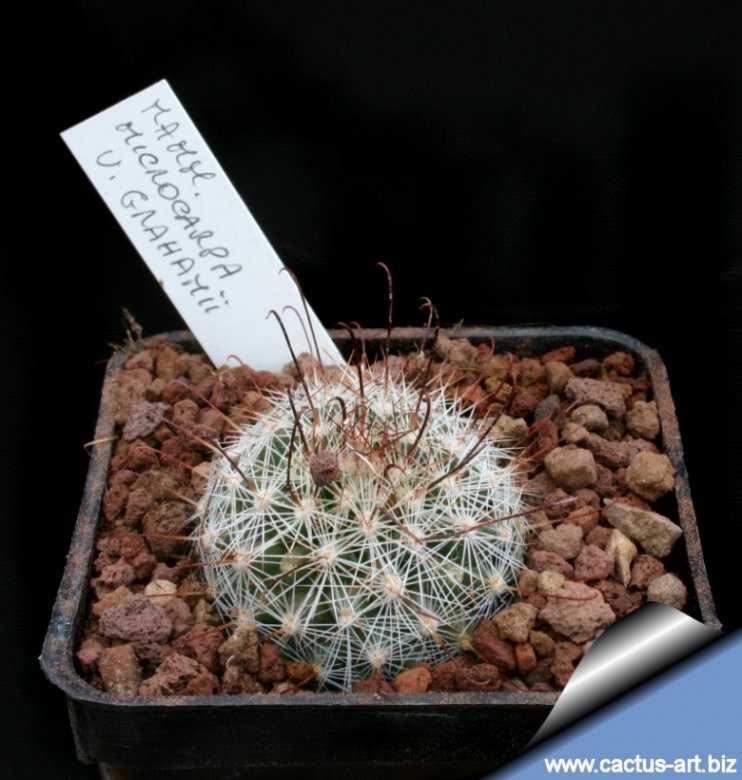
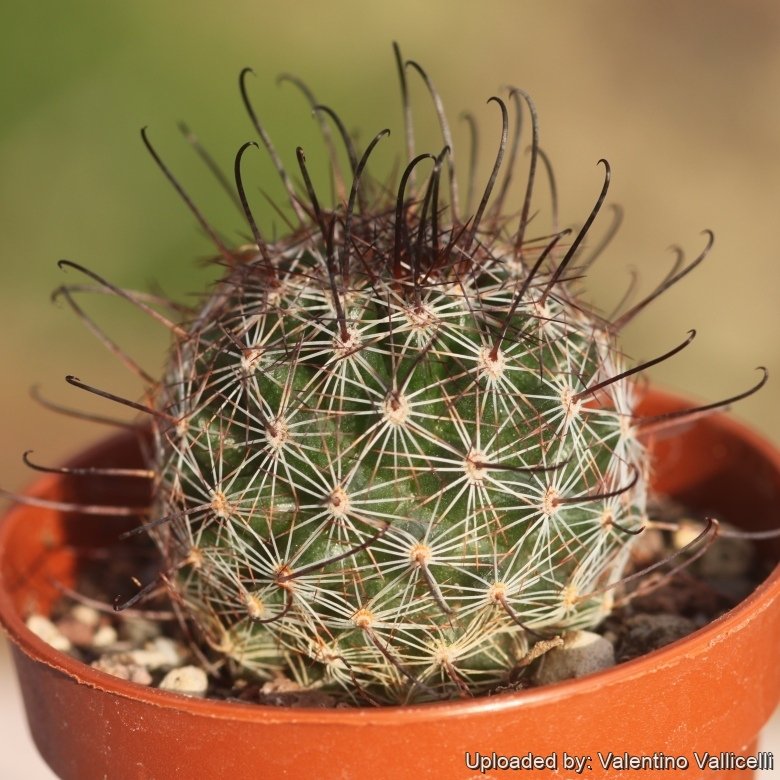
Stems: Globose to short cylindrical, light green, 7 - 15 cm or more in height, 7.5 - 11 cm in diameter without latex.
Tubercles: Ovoid to cylindrical, often four-angled, corky when old . The axil is naked.
Radial spines: 20 - 35, straight, glabrous, needle-like, interlacing, so dense that it is difficult to see the stem body underneath, white to greyish to light brown to reddish, 6 - 12 mm long, lateral ones longest.
Central spines: 1 - 4, yellowish brown to (often) dark brown, 12 - 25 mm long, the longest one usually hooked.
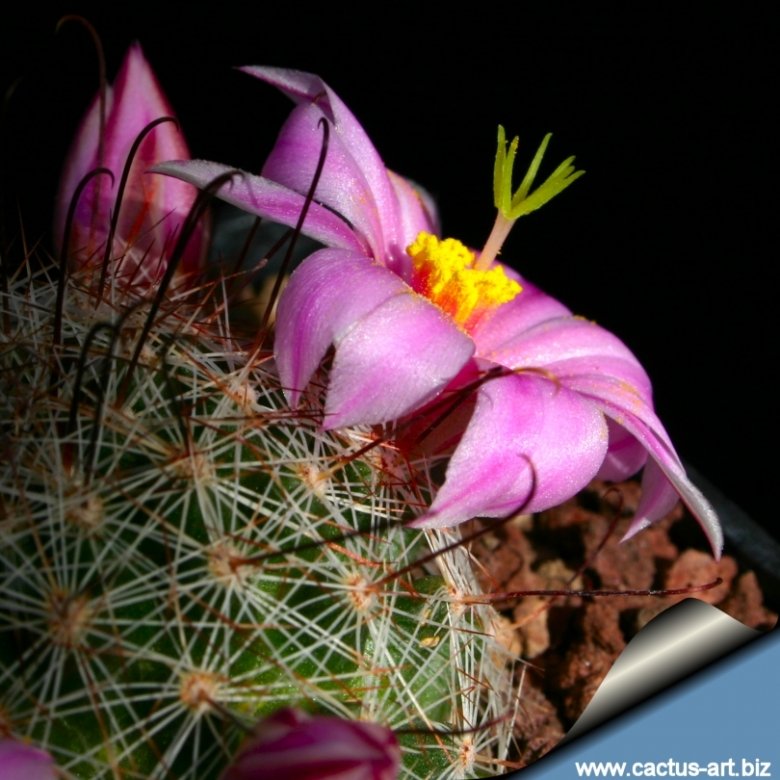
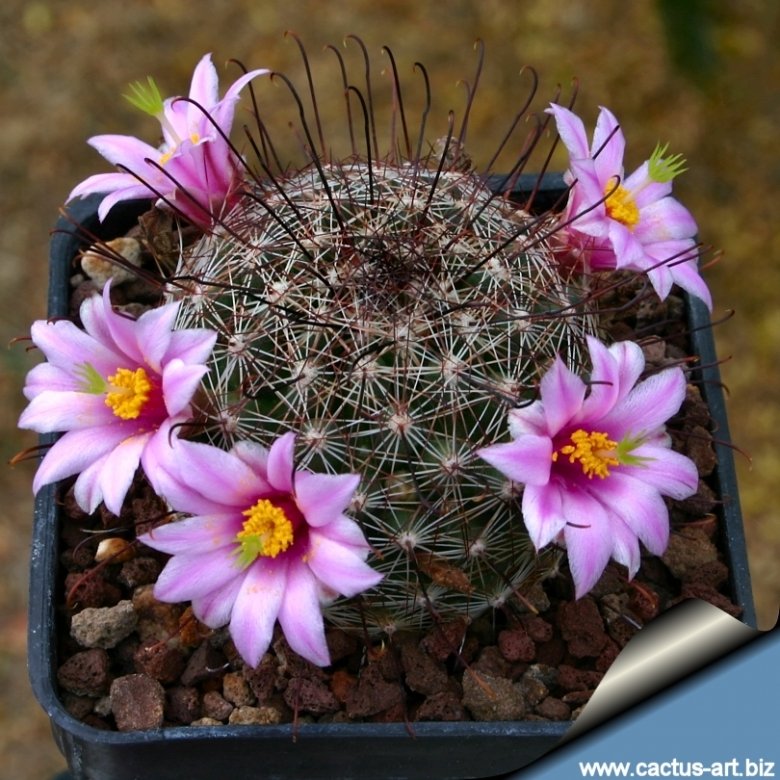
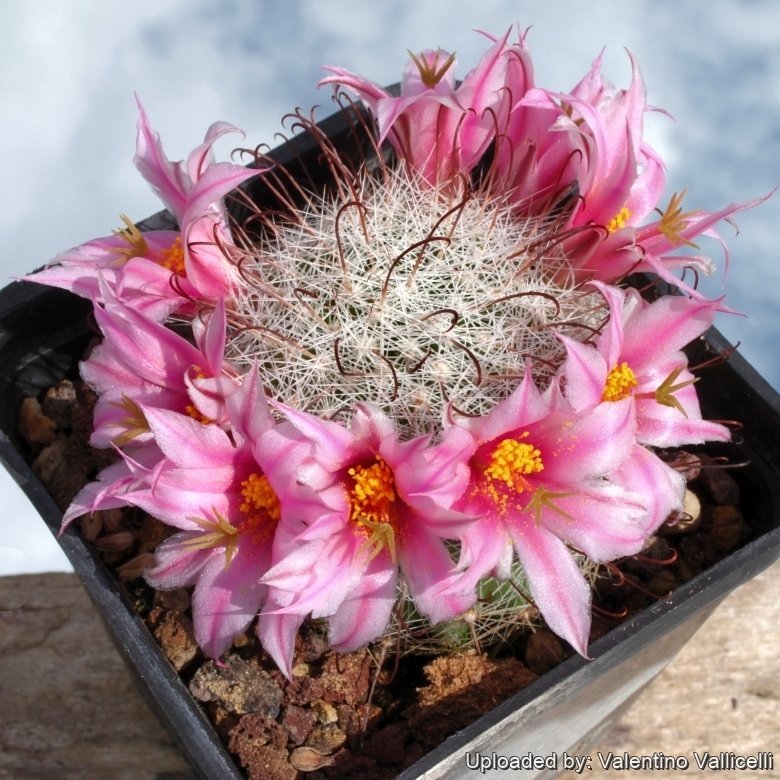
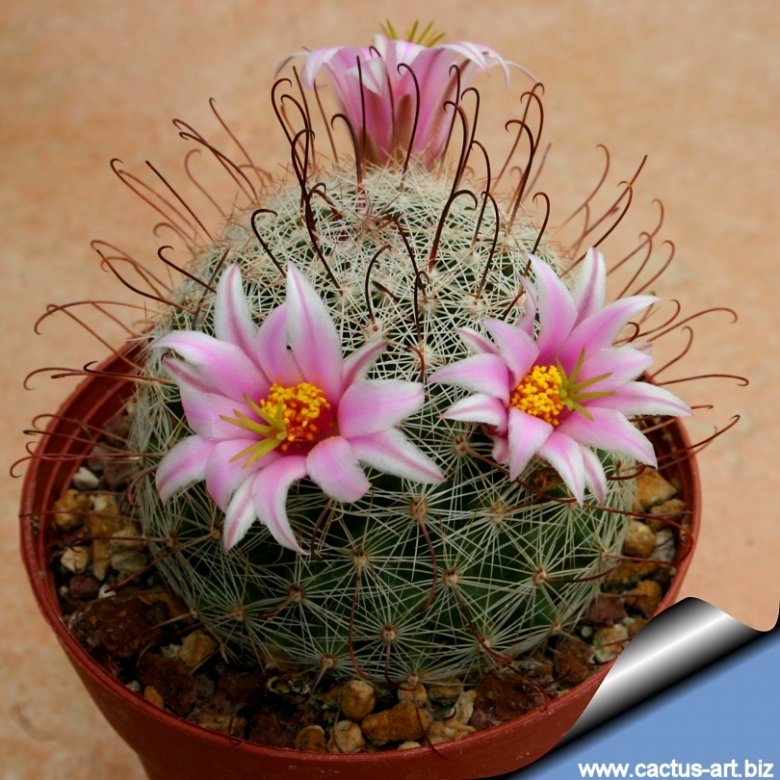
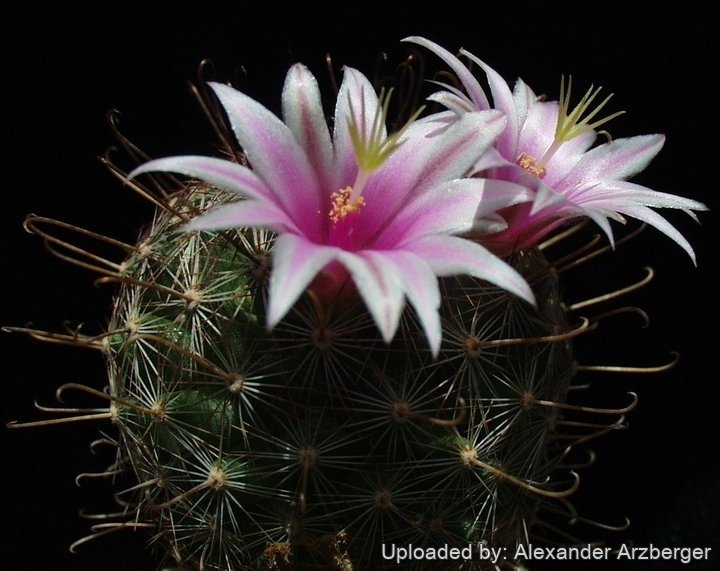
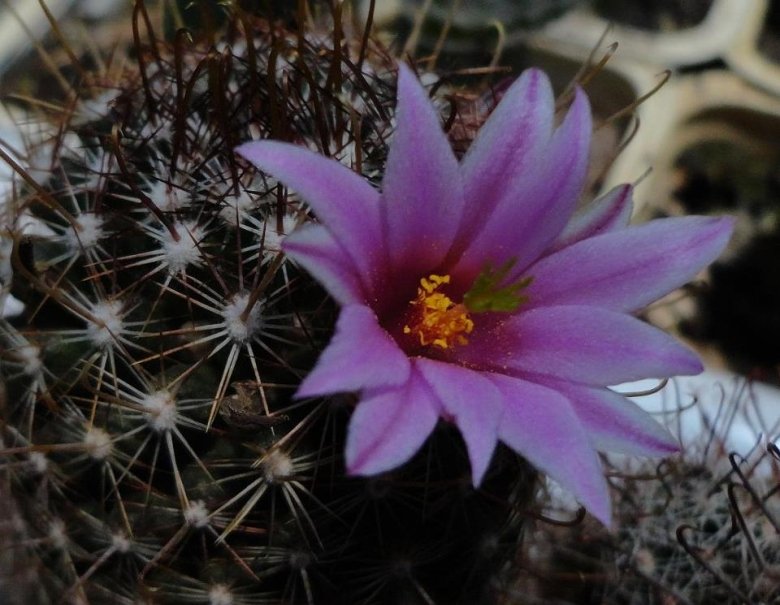
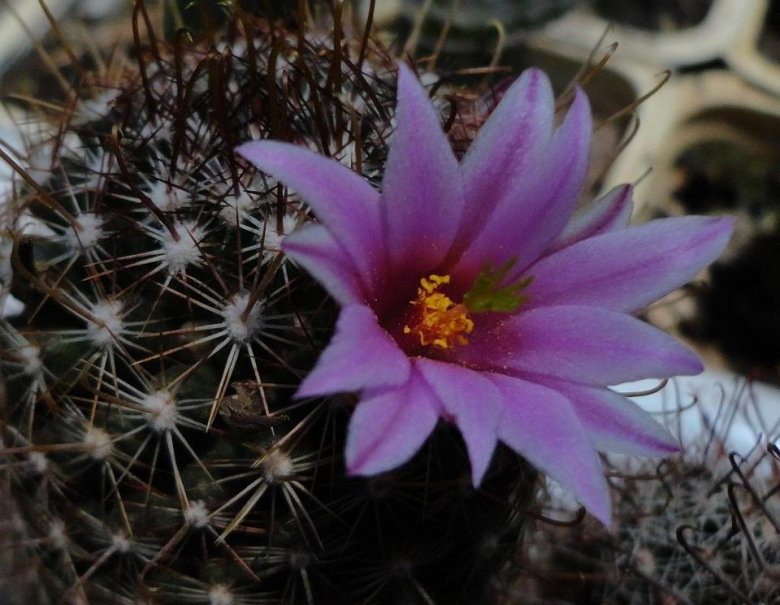
Flowers: The flower is large for the genus, broadly funnel-form, pink to lavender pink to reddish purple, sometimes white with a deeper central stripe, 20 - 45 mm in diameter. Tepals, obovate, acuminate, stile longer than stamens, purplish, stigma lobes 7-8, linear, green.
They grow just below the top of the cactus and sometimes form perfect, crown-like rings. The number of flowers produced by an individual plant depends largely on plant volume.
Blooming season: Flowers in the early summer and a plant can produce two or three batches of flowers. Individual flowers normally live one day, but can open a second day when pollination is inadequate.
Fruits: Clavate, slightly fleshy, bright red, 12 - 25 mm long.
Seeds: Black, shining, pitted, globose 0,8-1 mm in diameter.
Origin and Habitat
California, Arizona, New Mexico and Texas, USA; Sonora, Sinaloa and Chihuahua, Mexico.
Altitude: 200-1800 metres above sea level.
Habitat: These small cacti is found in desert mountains, sandy or rocky canyons, washes and plains on igneous or limestone substrate. They grow in sparse woodland, among desert creosote shrub (Larrea tridentata) or in grassland, and it is very easy to overlook them, except when they are blooming. They bloom about five days after the first summer rains of the monsoon.
Ecology: This plants uses nurse plants to protect against frosts, harsh sun, trampling, etc. so one must look carefully under shrubs and trees to find them. In the same area it is possible to find several cactus and succulent species like: Echinocactus parryi, Echinocereus fendleri, Echinocereus pectinatus, Coryphantha recurvata, Lophocereus schottii, Pachycereus pecten-aboriginum, Stenocereus thuberi, Opuntia fulgida, Opuntia leptocaulis, Opuntia engelmannii, Opuntia violacea, Opuntia bigelowii, Ferocactus wislizenii, Carnegiea gigantea, Ferocactus acanthodes, Ferocactus emoryi, Ephedra trifurca, Agave palmeri, Yucca elata, and Fouquieria macdougalii.
Cultivation and Propagation
This plant is not famous for being easy to cultivate, but in good conditions with excellent ventilation, it grows without difficulty. It is especially sensitive to over-watering. So careful watering and an open mineral potting soil are a must. Avoid the use of peat or other humus sources in the potting mixture. Don’t add limestone to the potting mix, which must be moderately acidic. It can be sensitive to frost (but some population are resistant to -10° C). It requires maximum sun exposure to reach its full potential, and to achieve success in flowering. A winter rest that allows the plant to shrivel (perhaps losing up to 25% of its summer height) will encourage flowering and long time survival. Be careful to encourage slow growth.
Propagation: Seeds or offsets.
Uses:
- Apache, Pima, Chiricahua & Mescaleros: They used the fresh and dried fruit primarily for children, as a snack food..
- Pima: They used the boiled plant placed warm in the ear for earaches and suppurating ears.
- Seri And Pima also used it in special ceremonies by shamans. Fruits are also said to produce hallucinatory effects.
Notes
Notes: The degree of difference between Mammillaria grahamii and Mammillaria microcarpa is still a matter for debate.
Bibliography
Major references and further lectures
-
Pilbeam J., “The Cactus file, Mammillaria” 6: 120, Cirio Pub. Services, 01/Dec/1999
-
John Pilbeam “Cacti for the Connoisseur: A Guide for Growers & Collectors” Timber Press, 01/lug/1987
-
James Cullen, Sabina G. Knees, H. Suzanne Cubey “The European Garden Flora Flowering Plants: A Manual for the Identification of Plants Cultivated in Europe, Both Out-of-Doors and Under Glass” Cambridge University Press, 11/Aug/2011
-
David R Hunt; Nigel P Taylor; Graham Charles; International Cactaceae Systematics Group. “The New Cactus Lexicon” dh books, 2006
-
Edward Anderson “The Cactus family” Timber Press, Incorporated, 2001
-
Brian Loflin, Shirley Loflin “Texas Cacti: A Field Guide” Texas A&M University Press, 26/ott/2009
-
Forrest Shreve, Ira Loren Wiggins “Vegetation and Flora of the Sonoran Desert” Volume 1 Stanford University Press, 1964
-
Heil, K., Terry, M. & Corral-Díaz, R. 2013. Mammillaria grahamii. In: IUCN 2013. “IUCN Red List of Threatened Species.” Version 2013.2. <www.iucnredlist.org>. Downloaded on 11 January 2014.
-
Del Weniger “Cacti of the Southwest: Texas, New Mexico, Oklahoma, Arkansas, and Louisiana” University of Texas Press, 1969
-
Ulises Guzmán, Salvador Arias, Patricia Dávila: “Catálogo de cactáceas mexicanas.” Universidad Nacional Autónoma de México, Mexico state. 2003
-
Urs Eggli, Leonard E. Newton “Etymological Dictionary of Succulent Plant Names” Springer, Berlin/Heidelberg 2010
From llifle page Chilita microcarpa
Description
Mammillaria microcarpa has long been a favorite in living collections. It is sensitive to any excess of moisture and does not do well in cultivation, but will reward the skilled growers with ring of fine rose-purple flowers circling the crown of the plant. This plant is generally known under the name of Mammillaria grahamii. This species is quite common in habitat, but variable throughout the region.
Habit: Simple or budding either at base or near middle, often cespitose, but in small clusters, sometimes 20 cm high.
Roots: Thickened.
Stem: Globose, conical to short cylindric, light green, up to 20 cm tall (but usually only 7-8 cm), 2,5-8(-11) cm in diameter.
Tubercles: Small, ovoid to cylindrical, often bases four-angled or flattened from side to side when old, corky when old. Without latex.
Areoles: Dimorphic. The spinous portion, at the tip of the tubercle, is small round or oval, with some white wool at first, but later bare. The floral or vegetative part in the axil is without wool, so the axils are naked.
Radial spines: 15 to 35, radiating evenly from the areole, lying flat upon the surface of the plant, interlocking with those of neighboring areoles and nearly hiding flesh of plant, straight, needle-like, white, sometimes with dark brown to reddish tips, slender, rigid, glabrous, 6 to 12 mm long, lateral ones longest. The upper centrals stand up-right just in front of the upper radials, forming a V if there are two of them, but there may be only one.
Central spines: 1 to 3, yellowish-brown, dark-brown to purplish black, when more than one the lower stouter, 12-25 mm long, the longest one usually hooked and standing out perpendicular to the plant surface.
Flowers: Forming a ring around the new growth near top of plant, 2 to 4,5 cm long, broadly funnel-shaped, opening widely, pink, lavender-pink or reddish purple, sometimes white. Outer perianth segments ovate, obtuse, or conical with brownish midlines and short-ciliate margins; inner perianth-segments longer purplish, slender, sometimes with whitish margins, obovate, acuminate. Filaments pink; anthers pale orange. Style longer than stamens, up to 6 mm long above the stamens, purplish; stigma-lobes 6 or 10, linear, light green.
Fruit: Subglobose to clavate, 12 to 25 mm broad, scarlet, with the dried flower parts remaining upon them. These fruits develop rather slowly, there is a long blooming season, and those started late in the summer remain as small, green, oval structures under the spines until during the winter they dry up without ripening properly at all. For this reason fruits have sometimes been called dimorphic.
Seeds: Black, shining, pitted, almost globose, 0,8 to 1 mm in diameter.
Notes: The degree of difference between Mammillaria grahamii and Mammillaria microcarpa is still a matter for debate.
Origin and Habitat
Southern USA ( Texas, New Mexico, Utah, California and Arizona) and Mexico (Chihuahua Sinaloa, and Sonora)
Type locality: “On the Gila, 3,000 to 4,000 feet above the sea.”
Altitude: It grows at elevations from 300 to 1,500 metres above sea level.
Habitat: It is wide-ranging and abundant in sandy plains, gravelly slopes, and rocky ridges in xerophyllous scrub and grasslands.
Ecology: This plants uses nurse plants to protect against frosts, harsh sun, trampling, etc. so one must look carefully under shrubs and trees to find them. In the same area it is possible to find several cactus and succulent species like: Echinocactus parryi, Echinocereus fendleri, Echinocereus pectinatus, Coryphantha recurvata, Lophocereus schottii, Pachycereus pecten-aboriginum, Stenocereus thuberi, Opuntia fulgida, Opuntia leptocaulis, Opuntia engelmannii, Opuntia violacea, Opuntia bigelowii, Ferocactus wislizenii, Carnegiea gigantea, Ferocactus acanthodes, Ferocactus emoryi, Ephedra trifurca, Agave palmeri, Yucca elata, and Fouquieria macdougalii.
Source: Chilita microcarpa, LLIFLE - Encyclopedia of living forms, CC-BY-SA, retrieved 2026-10-25.
From llifle page Mammillaria microcarpa var. auricarpa
Description
Mammillaria microcarpa var. auricarpa 9206] , suggesting that there is not really a fundamental difference between the two. The name auricarpa, meaning “golden yellow yellow fruits”, refers to the peculiar colour of mature berries. The yellow coloured fruits (never red), and pale yellow central spines helps distinguish this variety from the other red fruiting forms.
Origin and Habitat
U.S.A. (Arizona).
Cultivation and Propagation
Mammillaria microcarpa var. auricarpa is a large-flowered mammillaria which is sometimes difficult to cultivate. This plant blooms easily and needs lots of light. Use a pot with good drainage and a very porous mineral-based potting mix. Potted plants are quite wet-sensitive, especially in light of its small root system. Water sparingly during the growing season, let soil dry in between to prevent root rot, keep very dry in winter. Feed with a high potassium fertilizer in summer.
Usually it is recommended to over-winter this plant in a bright and warm greenhouse with at least 8-10° C, but it has proven to be quite frost resistant (if kept dry it is hardy as low as -7° C). A resting period in winter and strong light are necessary so that it can flower properly.
Propagation: Through seeds and cuttings.
Bibliography
Major references and further lectures
- Terry Smale “Notes on the 1979 Seed Distribution” The Cactus and Succulent Journal of Great Britain Volume 41 Number 1 February 1979 page 15
Source: Mammillaria microcarpa var. auricarpa, LLIFLE - Encyclopedia of living forms, CC-BY-SA, retrieved 2026-10-25.
From llifle page Mammillaria microcarpa f. cristata
Description
Mammillaria microcarpa is a small solitary or clustering cactus with globose stems, the areoles with usually hooked central spines standing out perpendicular to the plant surface. This plant is generally known under the name of Mammillaria grahamii.
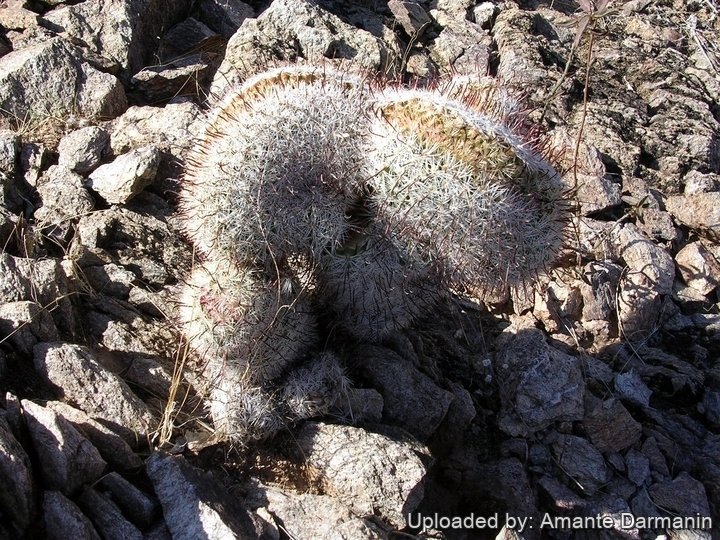
Crested form: The beautiful and very rare crested form (Mammillaria microcarpa f. cristata) is sought after by specialized collectors and impassioned for its unique tufted appearance. It forms fan-shaped stems densely covered by hooked spines.
Origin and Habitat
Crested form. The natural species grows in Southern USA (Texas, New Mexico, Utah, California and Arizona) and Mexico (Chihuahua Sinaloa, and Sonora).
Cultivation and Propagation
It is not too difficult in a greenhouse, although grows quite slowly. It is usually seen as a grafted plant but can grow on its own roots too.
Soil: Use a mineral well permeable soil with little organic matter (peat, humus).
Exposure: They need a good amount of light shade to full sun this help to keep the plants healthy, although slow growth.
Watering: Water sparingly from March till October (weekly during summertime, if the weather is sunny enough), with a little fertilizer added. Less or no water during cold winter months, or when night temperatures remain below 10° to prevent root loss. It is sensitive to overwatering (rot prone).
Fertilization: Feeding may not be necessary at all if the compost is fresh then, feed in summer only if the plant hasn’t been repotted recently. Do not feed the plants from September onwards as this can cause lush growth which can be fatal during the darker cold months.
Hardiness: Keep perfectly dry in winter at temperatures from 5 to 15 degrees centigrade. In the rest period no high atmospheric humidity!! (Temperature Zone: USDA 9-11)
Crested growth: Unlike ‘monstrose’ varieties of plants, where the variation from normal growth is due to genetic mutation, crested growth can occur on normal plants. Sometimes it’s due to variances in light intensity, or damage, but generally the causes are unknown. A crested plant may have some areas growing normally, and a cresting plant that looks like a brain, may revert to normal growth for no apparent reason. If you have any of the crested part left you need to remove the normal growth and leave the crested part behind this will need to be done regularly.
Propagation: Grafting or cuttings. Plants are usually grafted onto column-shaped cacti but proved to be able to produce their own roots if degrafted. Cuttings will take root in a minimum temperature of 20° C (but better in hot weather). Cuttings of healthy shoots can be taken in the spring and summer. Cut the stem with a sharp, sterile knife, leave the cutting in a warm, dry place for a week or weeks (depending on how thick the cutting is) until a callus forms over the wound. Once the callus forms, the cutting may be inserted in a container filled with firmed cactus potting mix topped with a surface layer of coarse grit. They should be placed in the coarse grit only; this prevents the cut end from becoming too wet and allows the roots to penetrate the rich compost underneath. The cuttings should root in 2 to 6 weeks. Large crested piece must be placed on the soil surface without burying the plant base down in the soil.
Source: Mammillaria microcarpa f. cristata, LLIFLE - Encyclopedia of living forms, CC-BY-SA, retrieved 2026-10-25.
Cultivars and forms (1)
Subspecies (1)
Gallery