Publication: Mammillaria Postscripts 6: 11 (1997)
Description
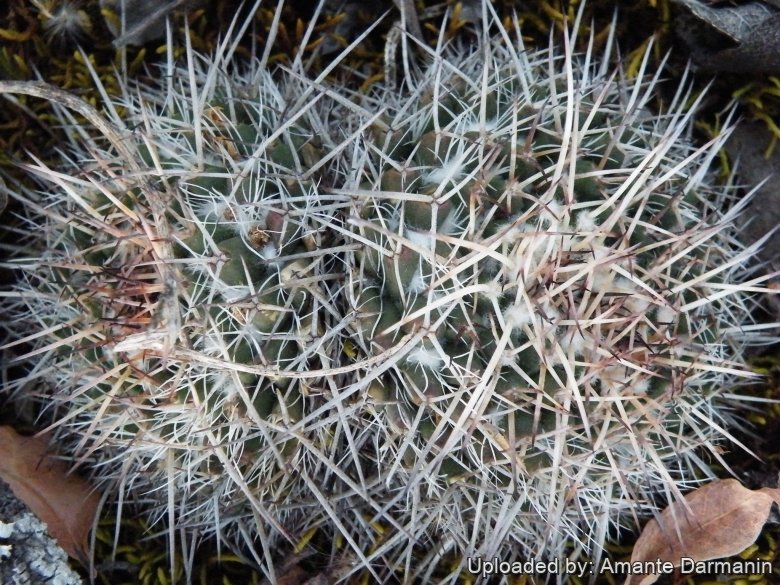
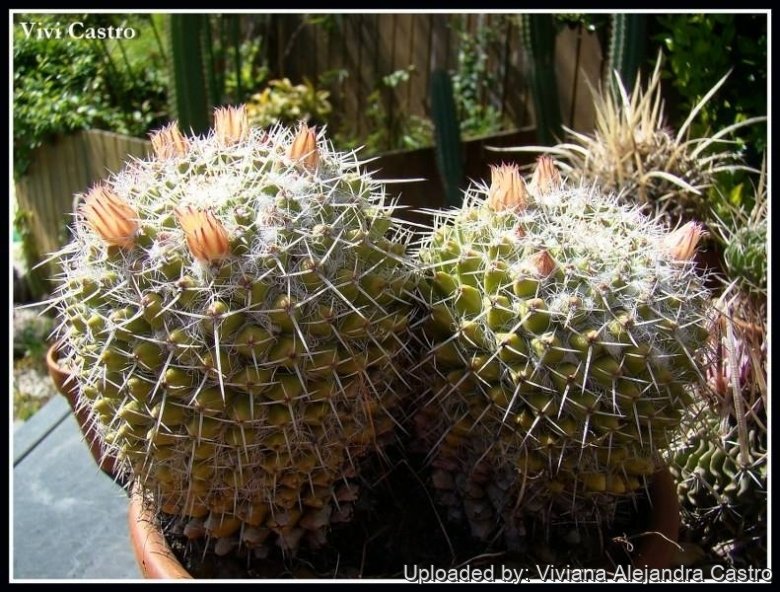
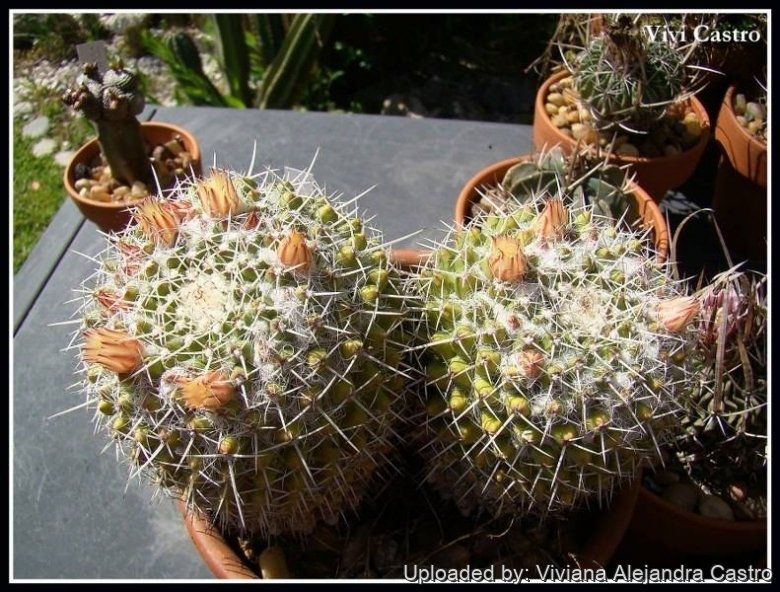
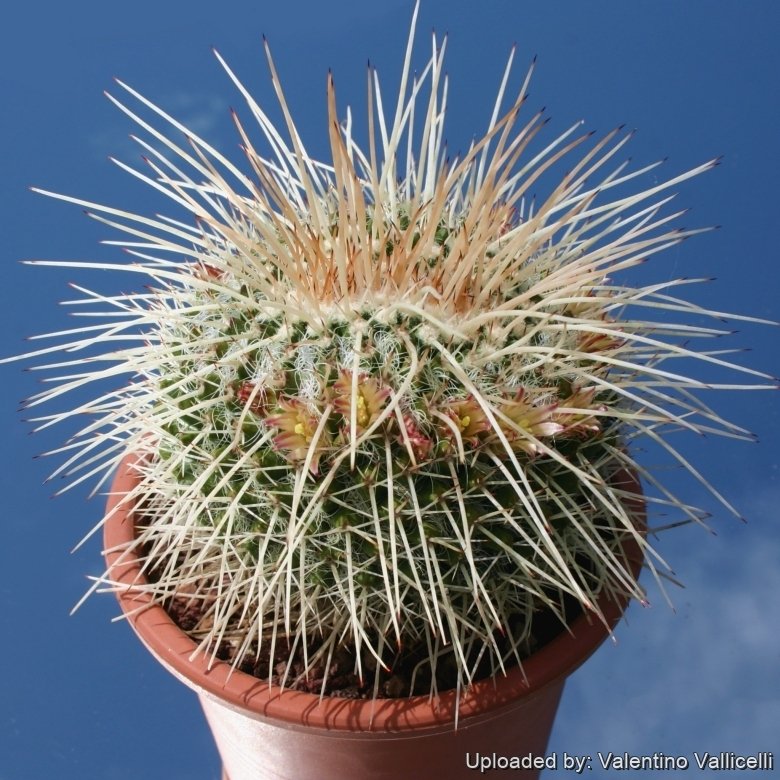
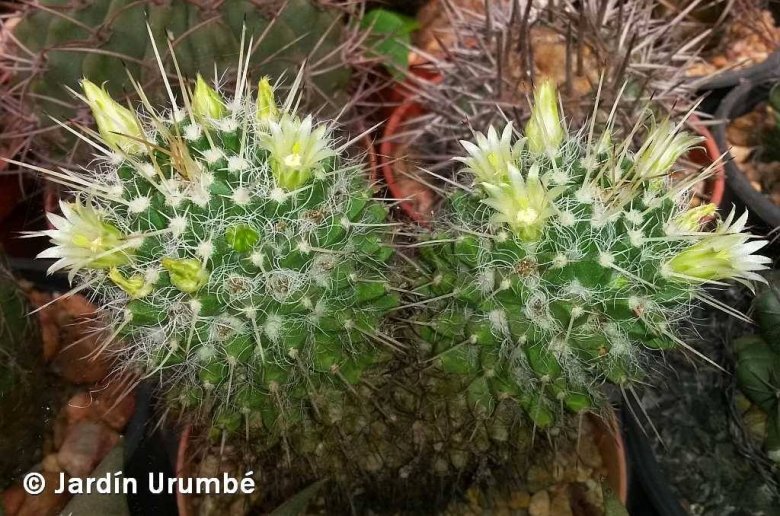
Mammillaria karwinskiana subs. nejapensis (Mammillaria nejapensis) is very variable, especially for the length of the spines, and at the beginning there were two recognized varieties: var. brevispina (short spined form) and var. longispina (long spined form), with respectively short and long spines, but they are merely local or individual variations. This species branches basally or more frequently forms large colonies by dichotomous division.
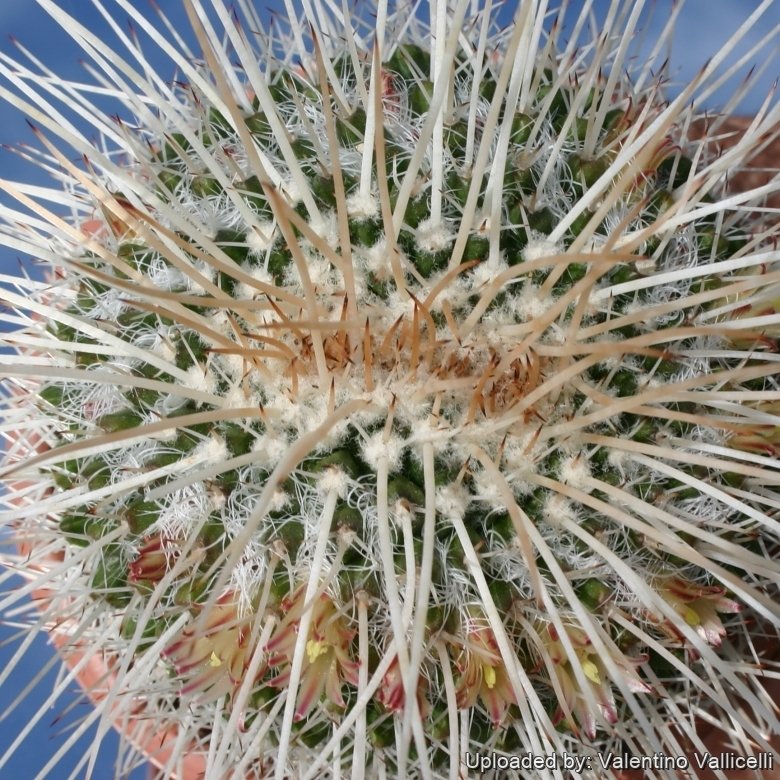
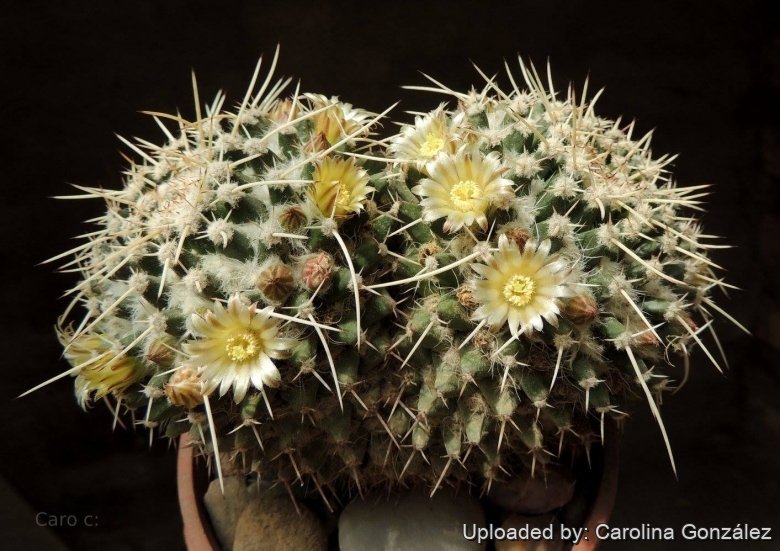
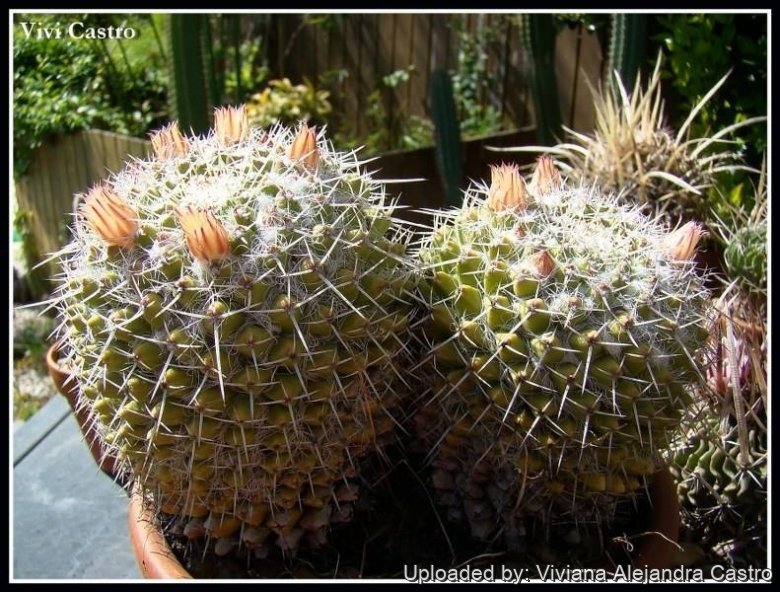
Stem: Globose to short cylindrical, somewhat wider in the upper part, blue-green to dark green, to 15 cm high and 5 - 7.5 in diameter, with latex. A cream coloured ‘snowy’ tomentum is present on the top of the plant.
Tubercles: Tubercles firm, pyramidal with the lacteal juice, arranged spirally with 13-21 parastichys the axil is very woolly with many tortuous bristles.
Radial spines: Only 3 - 5, awl-like, straight to slightly curved, ivory with reddish-brown tips, becoming chalky white with age, the upper shorter, 2 - 5 mm long, the lowermost the longest, to 25 or even 50 mm (or more) long.
Central spines: Absent.
Flowers: Diurnal, funnel-form, 18 mm long, 10 mm in diameter, pale cream with red-brown to scarlet midstripe on each petal. Blooms adorn the crown of the plant, usually in a ring, in the growth of the previous year.
Blooming seson: Spring to summer.
Fruits: Bright or clear red elongated and quite attractive.
Seeds: Brown.
Origin and Habitat
From Oaxaca city, towards Totalapan, in the NW area around Nejapa. (Rio Totolapan, San Pedro Totalapan-Mitla, Teotitlan, Las Animas, E of Miahuatlan, Los Cantiles, El Camaron-Mitla, San Cristobal, San Luis Amatalan- San Jose Lachiguri, Oaxaca-Tehuantepec)
Altitude range: 850 - 1.650 metres above sea level.
Habitat and Ecology: Mammillaria karwinskiana subs. nejapensis grows in tropical deciduous forest and xerophyllous scrub. It is quite common, but it is threatened by deforestation for small-holder agriculture and goat-ranching.
Cultivation and Propagation
It is easy to cultivate and make interesting specimens for any collection, and over time (in 12-15 years) it will form enormous colonies up to 50 cm or more in diameter! It grows by dichotomously dividing, and also by producing offsets, and doesn’t require any special treatment, except for the need for frequent transplanting, in order to manage its exuberance. It needs as much light as possible without burning the plant, to keep the stems compact. Provide a well-drained soil mix. Water well and then allow to dry thoroughly before watering again during the growing season. It doesn’t like much, if any, winter water, but can survive short exposures to freezing temperatures (-4° C.) if properly hardened off and kept dry.
Propagation: Mammillaria nejapensis is best propagated from seed. Seed readily germinates at 20°-22°C, or by offsets if available.
Notes
This is one of the Mammillaria commonly called “Owl Eye Cactus”, known for dichotomous branching (forking or dividing into two parts). Although dichotomous branching is not a common occurrence in cacti in general, it happens for some reason in this particular species. What is interesting about this cactus is that it began as a single head, one head became two, and so on. Other Owl Eye Cactus among others comprise Mammillaria crucigera, Mammillaria formosa, Mammillaria microthele and Mammillaria perbella.
Bibliography
Major references and further lectures.
-
Fitz Maurice, B, Fitz Maurice, W.A. & Bárcenas Luna, R. 2013. Mammillaria zeilmanniana. The IUCN Red List of Threatened Species. Version 2014.2. <www.iucnredlist.org>. Downloaded on 02 November 2014.
-
Wikipedia contributors. “Mammillaria zeilmanniana.” Wikipedia, The Free Encyclopedia. Wikipedia, The Free Encyclopedia, 23 Sep. 2014. Web. 2 Nov. 2014.
-
Robert T. Craig “The Mammillaria handbook: with descriptions, illustrations, and key to the species of the genus Mammillaria of the Cactaceae” E P Publishing, 1945
-
John Pilbeam “Mammillaria The Cactus File Handbook” Cirio Pub. Services, 01/Dec/1999Edward Anderson “The Cactus family” Timber Press, Incorporated, 2001
-
James Cullen, Sabina G. Knees, H. Suzanne Cubey “The European Garden Flora Flowering Plants: A Manual for the Identification of Plants Cultivated in Europe, Both Out-of-Doors and Under Glass” Cambridge University Press, 11/Aug/2011
-
David R Hunt; Nigel P Taylor; Graham Charles; International Cactaceae Systematics Group. “The New Cactus Lexicon” dh books, 2006
Gallery