Publication: Nova Acta Phys.-Med. Acad. Caes. Leop.-Carol. Nat. Cur. 16(1): 335, t. 22. 1832
Description
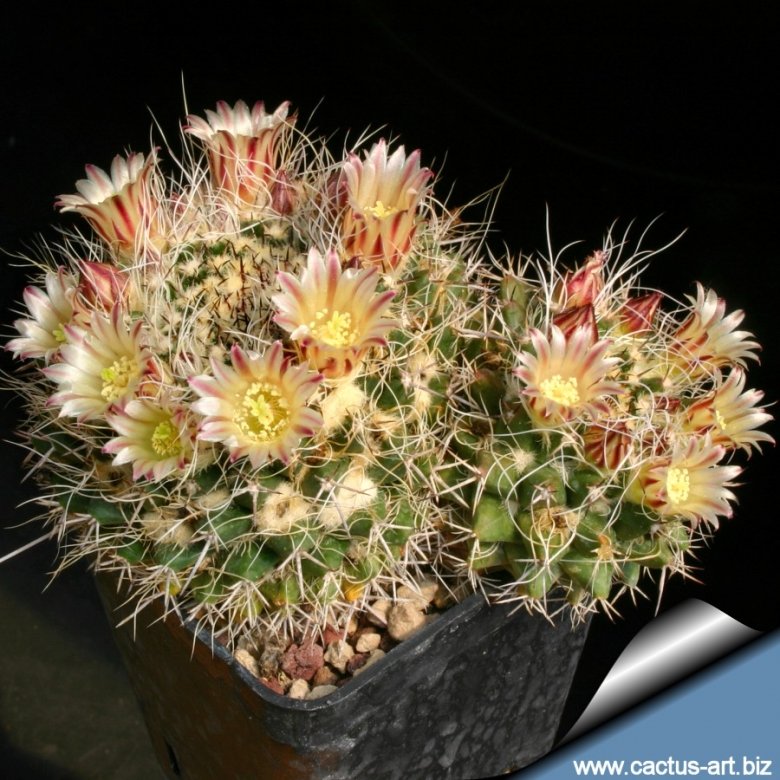
Mammillaria karwinskiana is a solitary, or slowly branching dichotomously (or basally) cactus, with cream coloured ‘snowy’ tomentum on the top of the plant. Four subspecies are recognized, the nominate, ssp. beiselii (Diers) D.R Hunt, ssp. collinsii (Orcutt) D.R.Hunt and ssp. nejapensis (R.T.Craig & E.Y Dawson) D.R.Hunt.
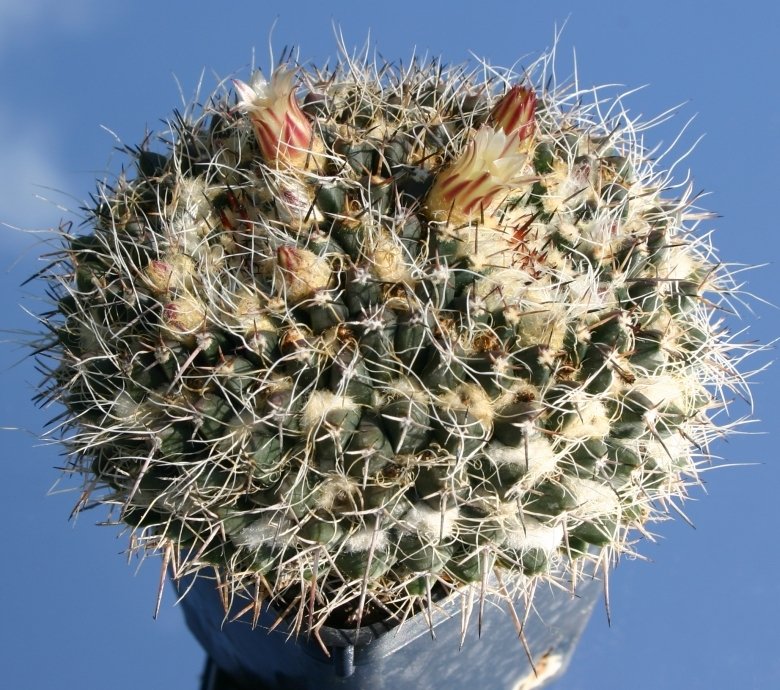
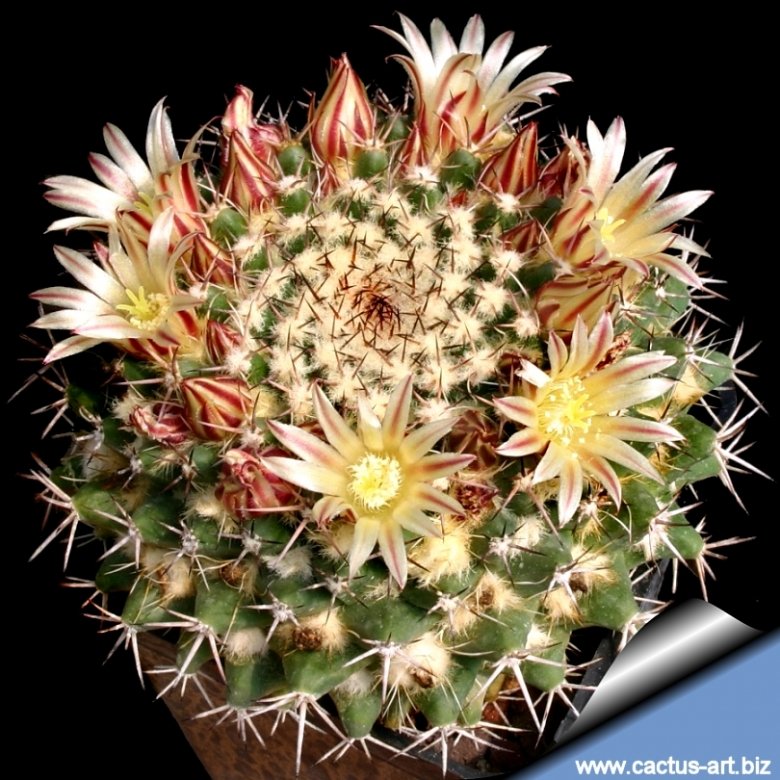
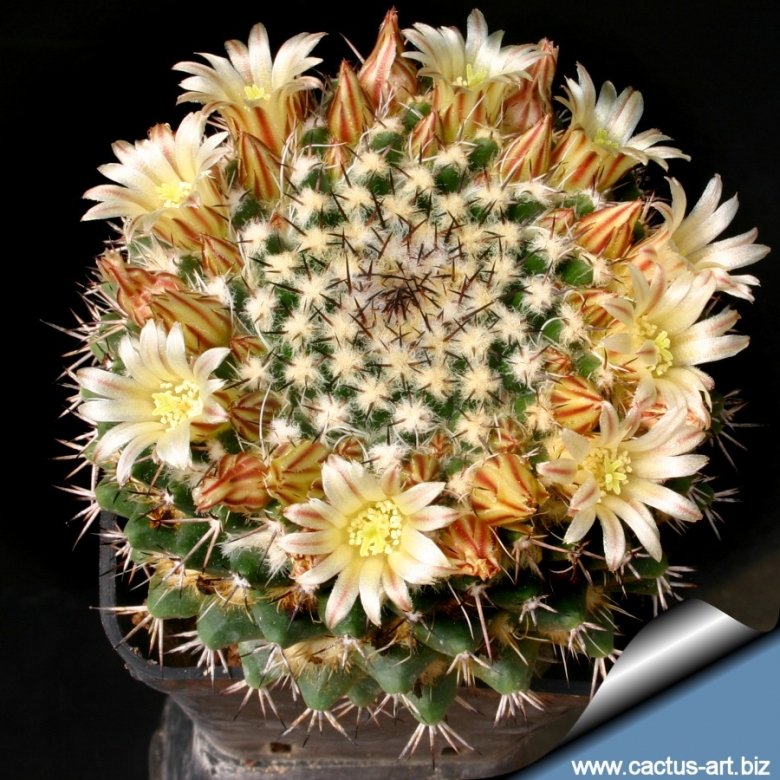
Stem: Globose to short cylindrical, blue-green to dark green, up to 12 cm in diameter, 8-20 cm tall. With latex. The Axil is very woolly, with tufts of white hair and long white bristles.
Tubercles: Firm, pyramidal, arranged spirally with 13-21 parastichys.
Radial spines: Usually 6, awl-like, straight to slightly curved, cream to reddish tipped with brown, becoming chalky white with age, 4 - 30 mm long, upper and lower ones longest.
Central spines: Absent.
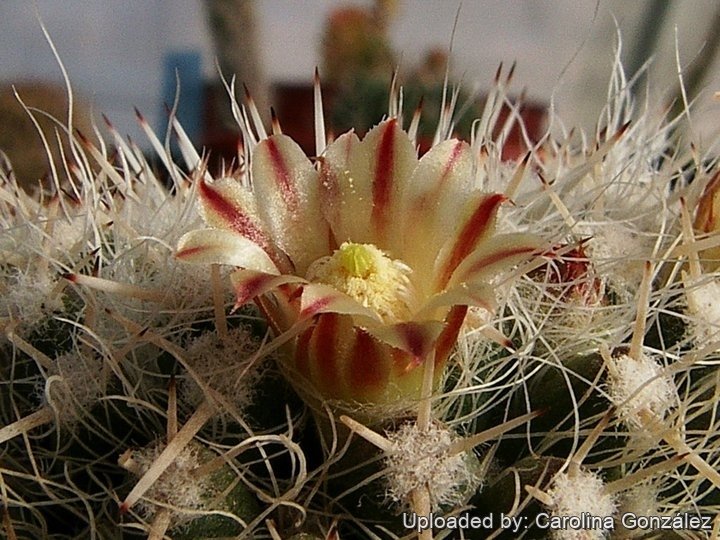
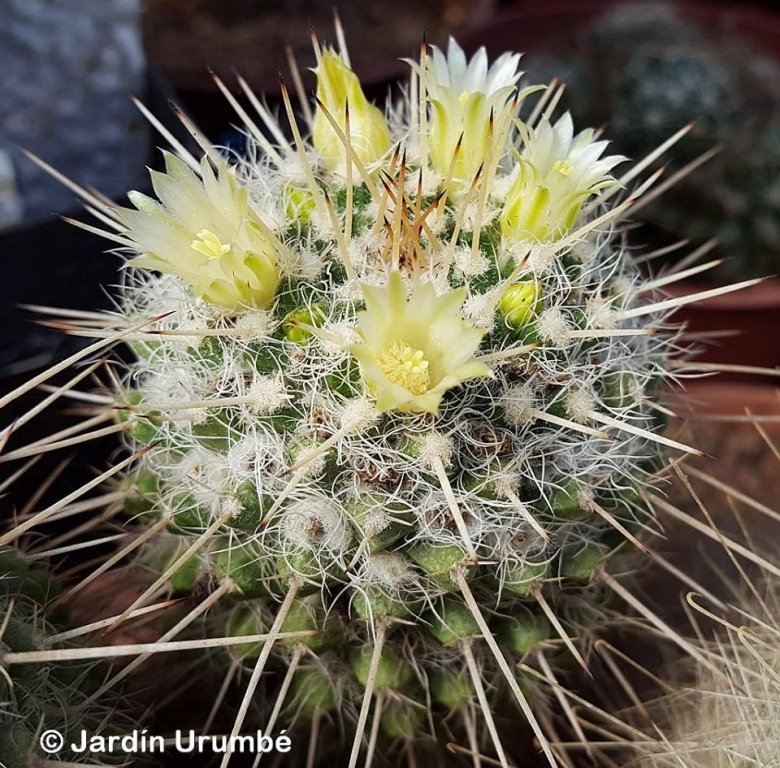
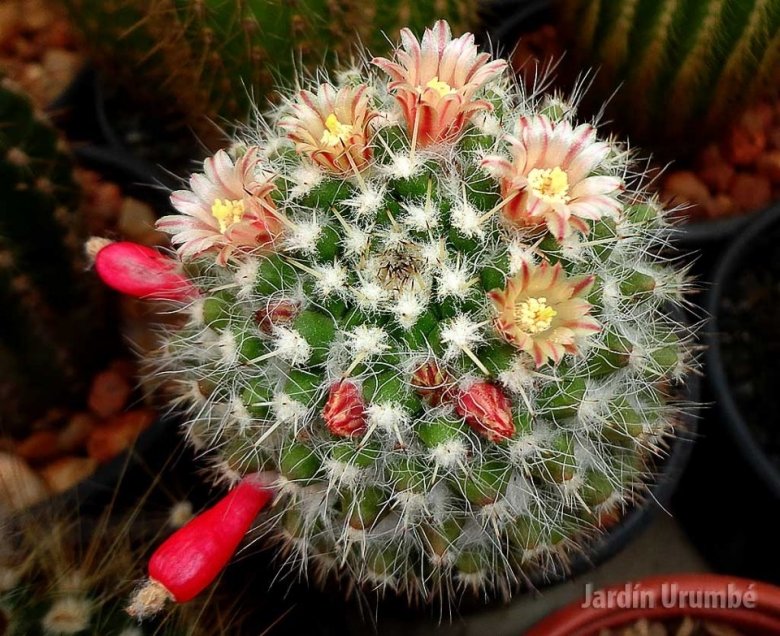
Flowers: Funnel-form, cream-white to yellow with purplish mid-veins, up to 25 mm long and 15 mm in diameter. Blooms adorn the crown of the plant, usually in a ring, in the growth of the previous year.
Flowering time: Early spring.
Fruits: Red, elongated, and quite attractive.
Origin and Habitat
Mammillaria karwinskiana has a very wide range in Guatemala and Mexico( Chiapas, Colima, Guerrero, Oaxaca, Morelos, Michoacán, and Puebla).
Altitude: 150 - 2100 metres above sea level.
Habitat: This species is common and abundant in tropical deciduous forest and xerophyllous scrub along with Ferocactus robustus, Heliabravoa chende, Agave karwinskii, Agave lechuguilla, Agave salmiana and Yucca periculosa. It is threatened by deforestation for small-holder agriculture and goat-ranching.
Cultivation and Propagation
They are easy to cultivate, and make interesting specimens for any collection. Over time they will produce large clumps. It grows by dichotomously dividing, and also by producing offsets and doesn’t require any special treatment, but needs as much light as possible without burning the plant, to keep the stems compact. It needs a well-drained soil mix. Water well and then allow to dry thoroughly before watering again, during the growing season. It doesn’t like much, if any, winter water, and can survive short exposures to freezing temperatures (-4° C.) if properly hardened off and kept dry.
Propagation: Mammillaria karwinskiana is best propagated from seed. Seed readily germinates at 20°-22°C, or by offsets if available.
Notes
This is one of the Mammillaria commonly called “Owl Eye Cactus”, known for dichotomous branching (forking or dividing into two parts). Although dichotomous branching is not a common occurrence in cacti in general, it happens for some reason in this particular species. What is interesting about this cactus is that it began as a single head, one head became two, and so on. Other Owl Eye Cactus among others comprise Mammillaria crucigera, Mammillaria formosa, Mammillaria microthele and Mammillaria perbella.
Bibliography
Major references and further lectures
-
David Hunt, Nigel Taylor “The New Cactus Lexicon” DH Books, 2006
-
John Pilbeam (1999) “Mammillaria The Cactus File Handbook” Nuffield Press.
-
Nathaniel Lord Britton, Joseph Nelson Rose “Cactaceae: Descriptions and Illustrations of Plants of the Cactus Family” vol. 4 The Carnegie Institution of Washington, Washington 1923
-
Stuart Max Walters “The European Garden Flora: Dicotyledons (Part I)” Cambridge University Press, 1989
-
Edward F. Anderson “The Cactus Family” Timber Press, 2001
-
Hernández, H.M. & Gómez-Hinostrosa, C. 2013. Mammillaria karwinskiana. In: IUCN 2013. “IUCN Red List of Threatened Species.” Version 2013.2. <www.iucnredlist.org>. Downloaded on 03 January 2014.
From llifle page Mammillaria confusa var. conzattii
Description
Small geophyte cactus, with a heavy tap root that may exceed the size of the plant above soil level. Stems solitary flattened globose, blue-green, up to 5 cm high and alsoin diameter.
Spines: About 12-16, thin, bristle-like radial spines, slightly pubescent with darker tips, up to 6 mm long. Central spine: not present or 1, straight, needle-like, darker, up to 6 mm long.
Flowers: White with pinkish midveins, very early in the season, February/March.
Fruits: Red clavate.
Origin and Habitat
Coahuila, Mexico.
Habitat: This plant is a mud crack dweller, growing almost sunken in cracks in the dry lake at the Laguna de Viesca. Altitude 1.000 to 1.230 m
Cultivation and Propagation
This species has few special demands. Whatever view one adopts, it is worth a place in every Mammillaria collection. The only problem is that it is very slow growing, a plant for patient growers.
Like all thick-rooted species, it requires careful watering (rot sensitive), and patience to match its slow growth. During the winter rest, the plant may pull near the surface of the potting mix.
Propagation: Direct sow after last frost. (it usually doesn’t produces offsets).
Source: Mammillaria confusa var. conzattii, LLIFLE - Encyclopedia of living forms, CC-BY-SA, retrieved 2026-10-25.
From llifle page Mammillaria strobilina
Origin and Habitat
Oaxaca (Mexico, Northern America)
Source: Mammillaria strobilina, LLIFLE - Encyclopedia of living forms, CC-BY-SA, retrieved 2026-10-25.
Cultivars and forms (2)
Gallery