Publication: Mammillaria Postscripts 6: 7 (1997)
Description
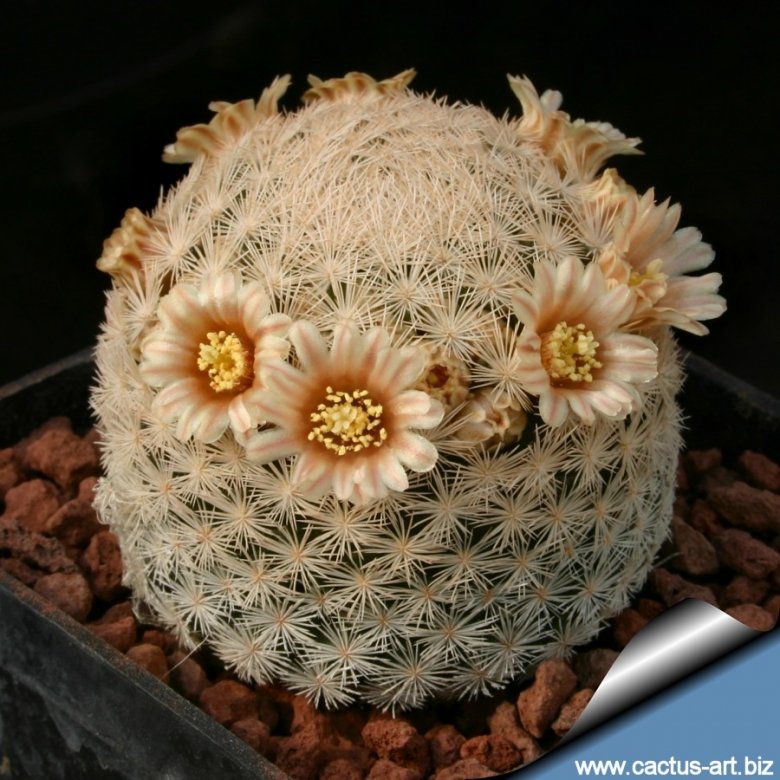
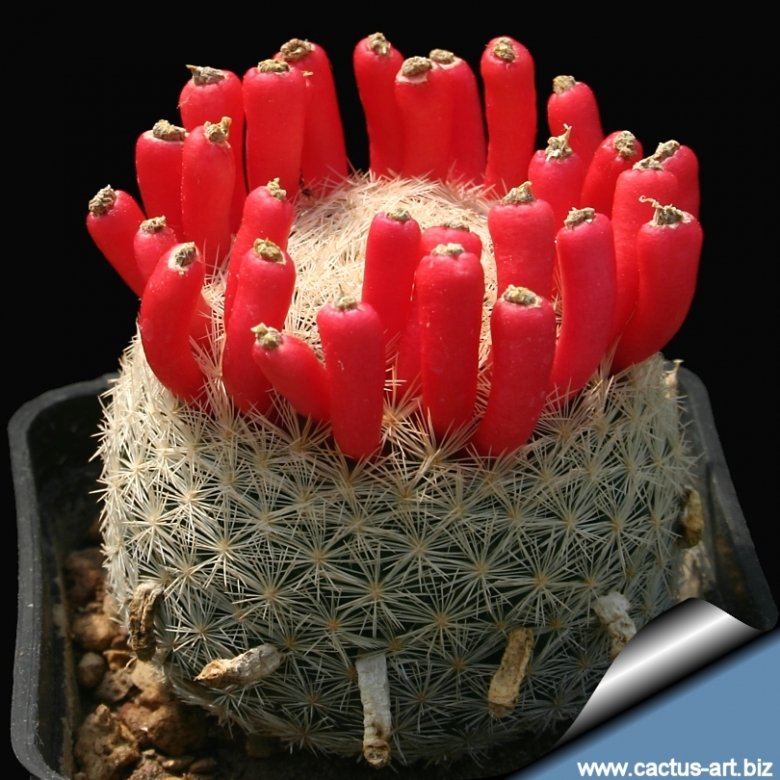
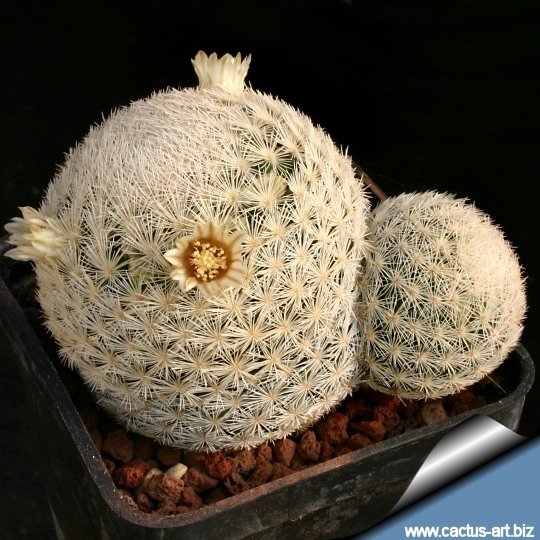
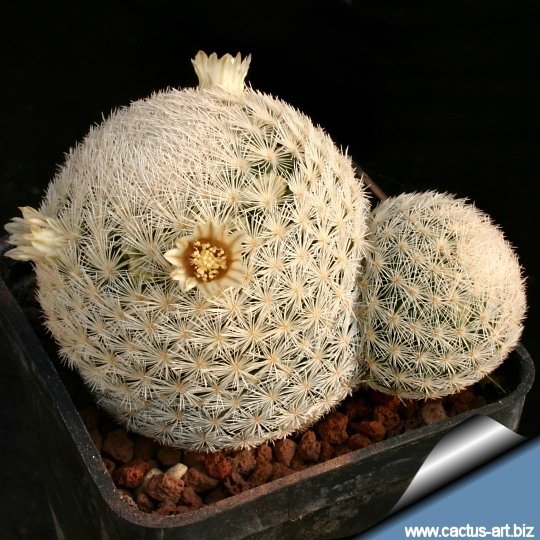
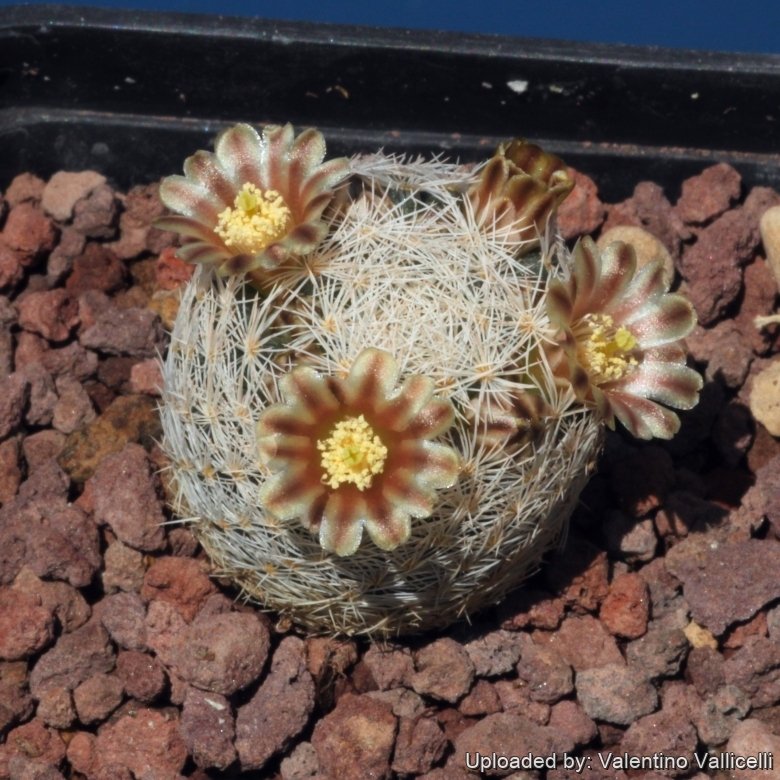
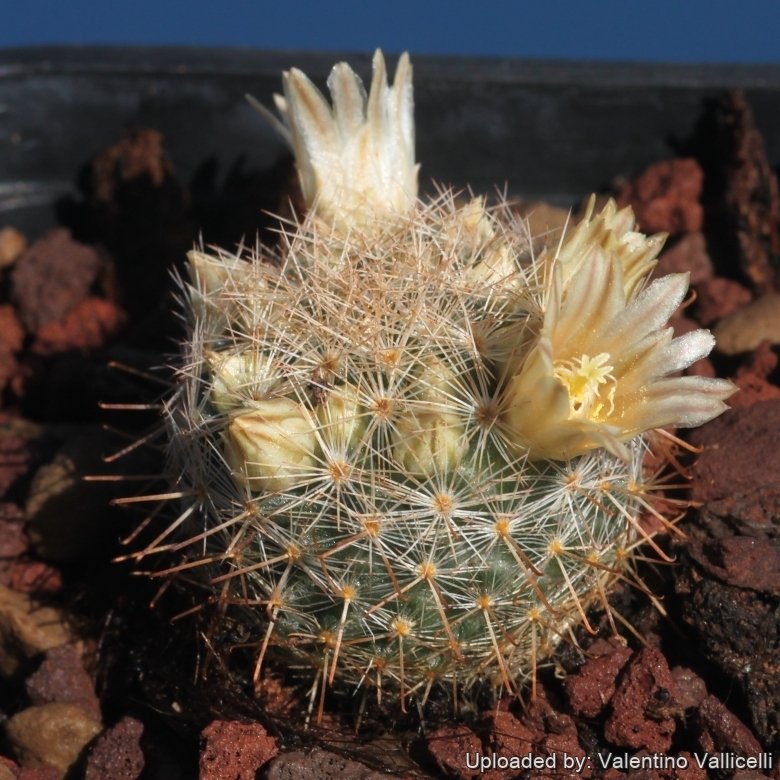
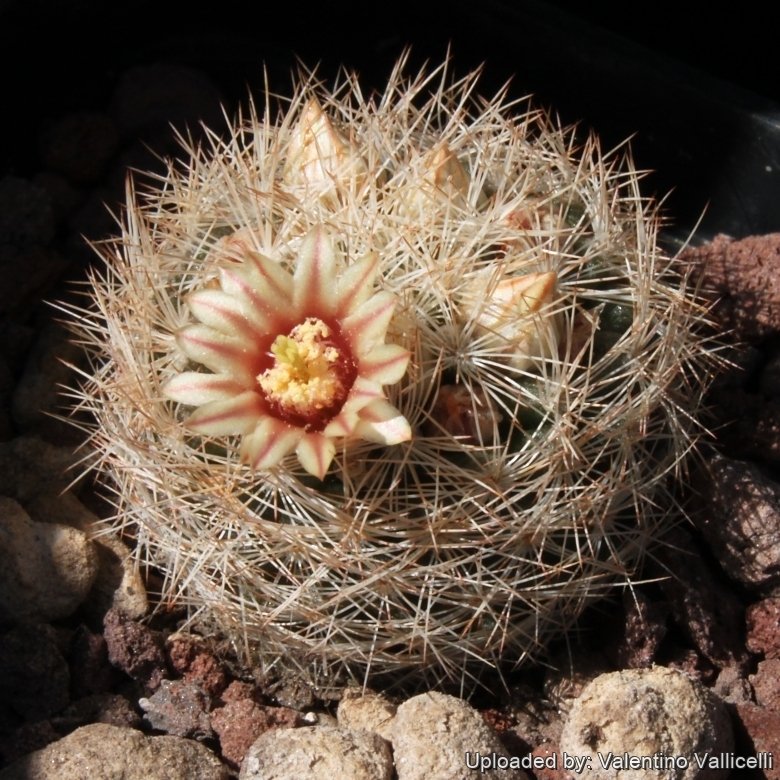
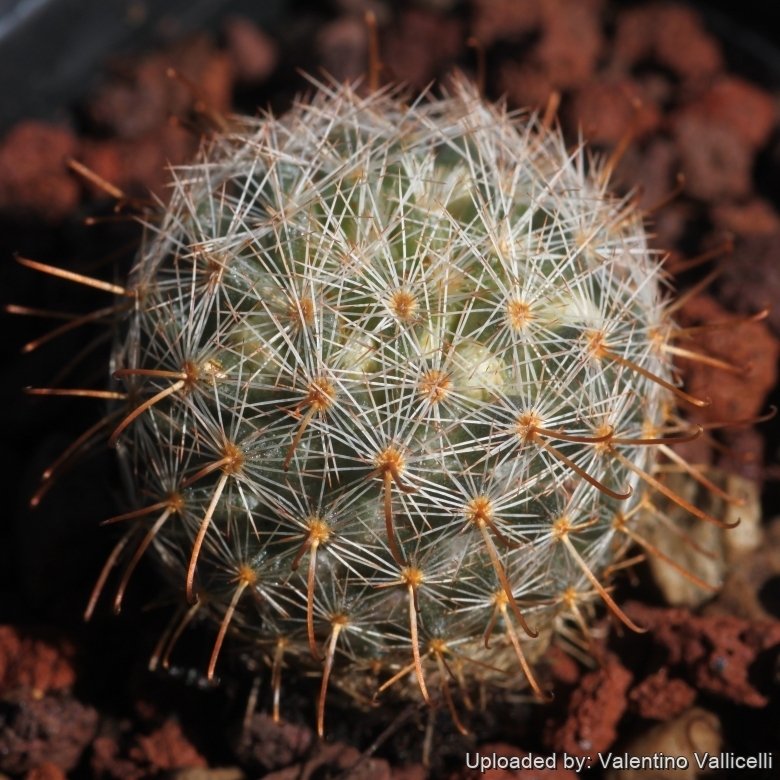
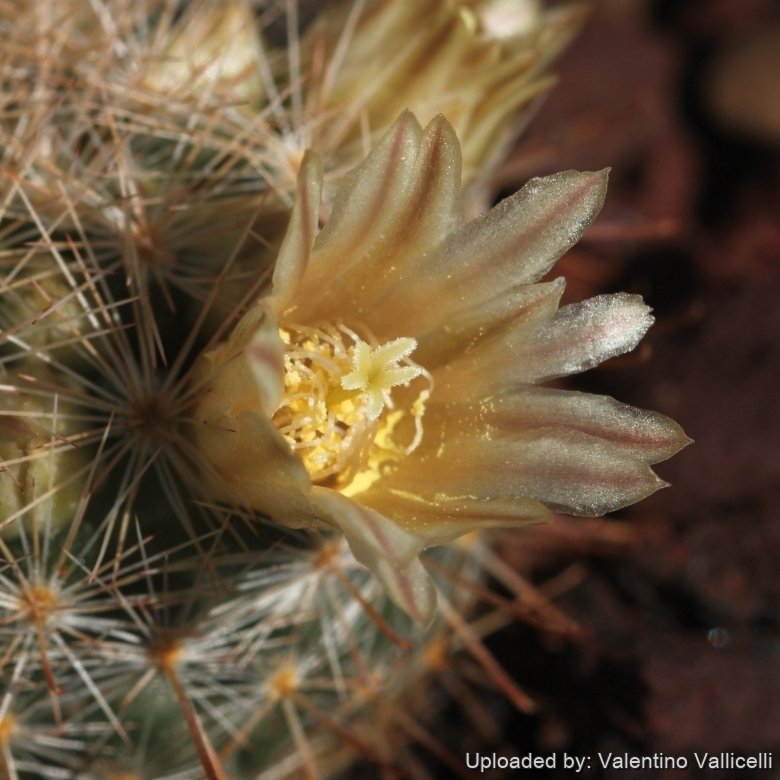
Mammillaria magallanii is a small slow growing species with tight white spines that look like a little golf ball. It has attractive little creamy brown blooms and red fruit, and is similar to Mammillaria lasiacantha. The most striking feature is the dense addpressed, white spination it possesses, which serve to protect it from the harsh sun common to its native habitat. More precisely the spines benefit the plant by reducing sun exposure and by trapping a layer of air next to the cactus body. This helps to cool the plant in the summer and keep it warm in the winter.
Habit: Plants usually solitary with a succulent tap root. With age it may offset from the base to form a small cluster.
Stem: Without latex, globose, short-cylindrical to club shaped, green, to 6 cm tall and 4,5 cm in diameter.
Tubercles: Short-cylindrical, without latex. Axils with few wool. Parastichy number: 13-21.
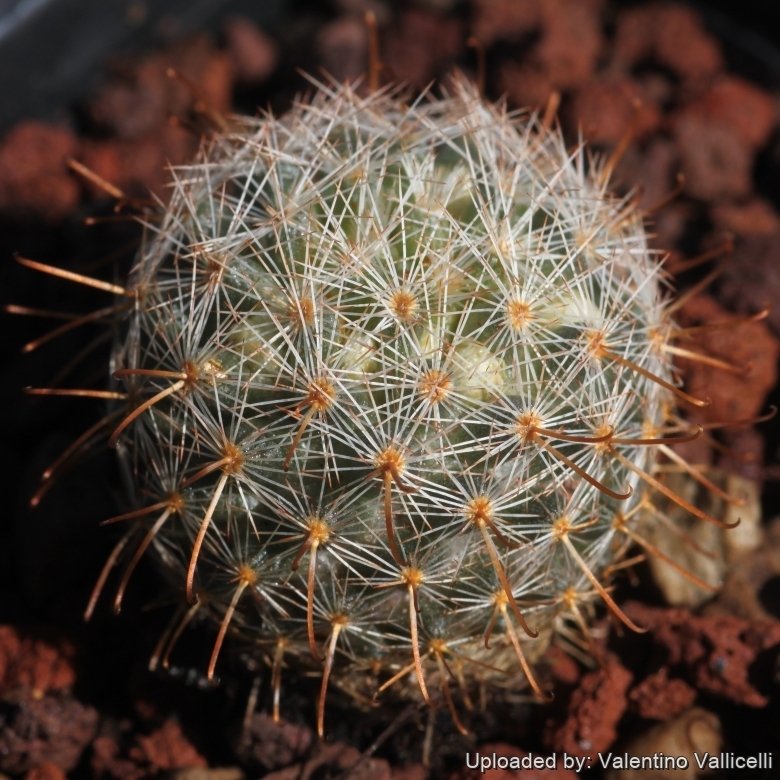
Radial spines: 70-75, interlacing, 2 - 5 mm long, chalky white to very pale pinkish-brown which are sometimes pinkish or orange-tan towards the growing point
Central spines: Usually absent, sometimes one, straight, curved or hooked, orange-tan with brown tips, to 3 mm long.
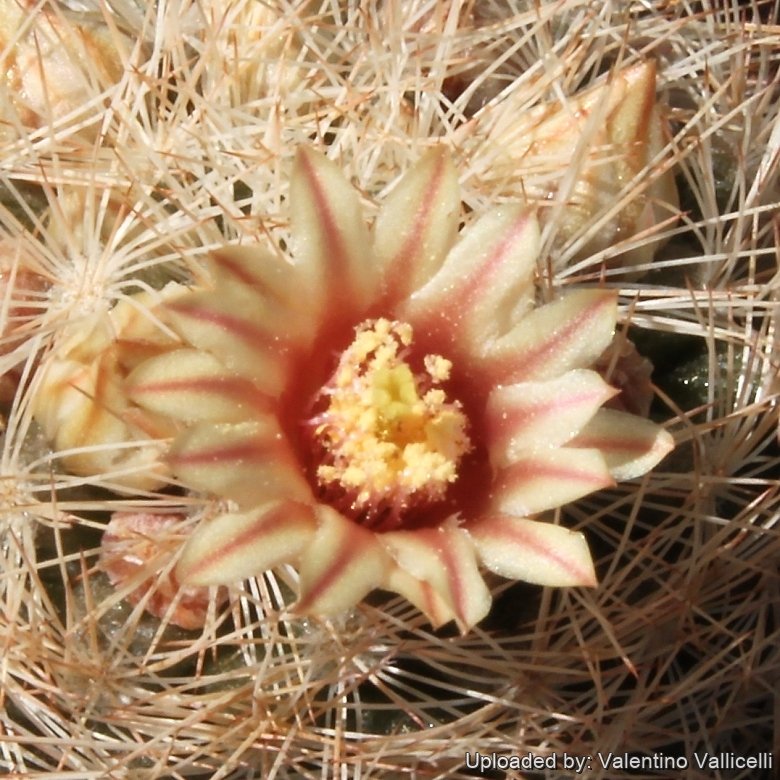
Flower: Cream coloured with pinkish-red to brownish mid-stripes, to 10 mm long and in diameter.
Blooming season: Early spring.
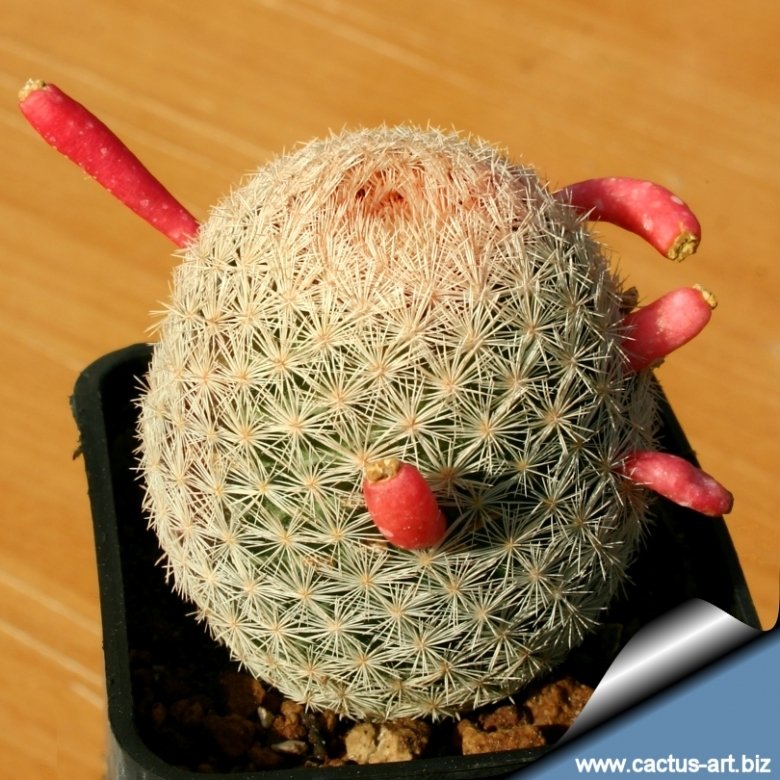
Fruit: Red and very showy.
Origin and Habitat
South-western part of the state of Coahuila in northern Mexico.
Altitude: 1100-1700 metres above sea level.
Habitat: It grows in hill slopes among volcanic rocks together with Larrea tridentata, Fouquieria splendens, Echinocereus stramineus, Echinocereus merkeri, Astrophytum capricorne, Echinocactus horizonthalonius and Ferocactus hamatacanthus.
Cultivation and Propagation
This plant has not the fame to be easy to cultivate, but in good conditions with very careful application of water and excellent ventilation, it grows without difficulty. Be careful to encourage slow growth, but if you succeed in growing a colony of stems, then the results will repay all the growing efforts.
Growing rate: It is a slow growing species that will make clumps given the best conditions, but rewards the patient grower with a beautiful displays of flowers since from an early age.
Soil: Requires excellent drainage provided by a very permeable open cactus soil (With not less than 50% grit content). Avoid the use of peat or other humus sources in the potting mixture.
Repotting: Repot every 2-3 years. Use small sized pots.
Feeding: During the beautiful season enrich the soil using a fertilizer rich in potassium and phosphorous, but poor in nitrogen, because this chemical element doesn’t help the development of succulent plants, making them too soft and full of water.
Watering: Water should be carefully applied and only when the soil is dry to the touch, as this cliff-dwelling species is very prone to root rot. Allow soil to drain thoroughly before watering again. Additionally, water should not be applied from above, as the feathery spines will retain water and add to rotting problems, but in good conditions with excellent ventilation, in bright light, it usually grows without particular difficulty. Do not water in the winter.
Light: Outside full sun or afternoon shade, inside it needs bright light, and some direct sun. Direct sun encourages flowering and heavy spine production.
Hardiness: Protect from frost. But it’s hardy to -5°C if kept dry. A winter rest that allows the plant to shrivel (perhaps losing up to 25% of its summer height) will encourage flowering and long time survival.
Pests & diseases: It may be attractive to a variety of insects, but plants in good condition should be nearly pest-free, particularly if they are grown in a mineral potting-mix, with good exposure and ventilation. Nonetheless, there are several pests to watch for:
- Red spiders: Red spiders may be effectively rubbed up by misting the vulnerable plants every day
- Mealy bugs: occasionally they develop aerial into the new growth among the wool with disfiguring results, but the worst types develop underground on the roots and are invisible except by their effects.
- Scales: Scales are rarely a problem.
- Rot: it is only a minor problem with cacti if the plants are watered and “aired” correctly. If they are not, fungicides won’t help all that much.
Propagation: Direct sow after last frost or (rarely) cuttings. Seeds germinate in 7-14 days at 21-27° C in spring, remove gradually the glass cover as soon the plants will be well rooted (ca 1-2 weeks) and keep ventilated, no full sun for young plants!
Bibliography
Major references and further lectures
-
Edward Anderson “The Cactus family” Timber Press, Incorporated, 2001
-
James Cullen, Sabina G. Knees, H. Suzanne Cubey “The European Garden Flora Flowering Plants: A Manual for the Identification of Plants Cultivated in Europe, Both Out-of-Doors and Under Glass” Cambridge University Press, 11/Aug/2011
-
David R Hunt; Nigel P Taylor; Graham Charles; International Cactaceae Systematics Group. “The New Cactus Lexicon” dh books, 2006
-
John Pilbeam “Mammillaria: the cactus file handbook” Cirio Publishing Services Ltd Dec/30,/1999
-
John Pilbeam “Cacti for the Connoisseur: A Guide for Growers & Collectors” Timber Press, 01/lug/1987
From llifle page Mammillaria roseocentra
Description
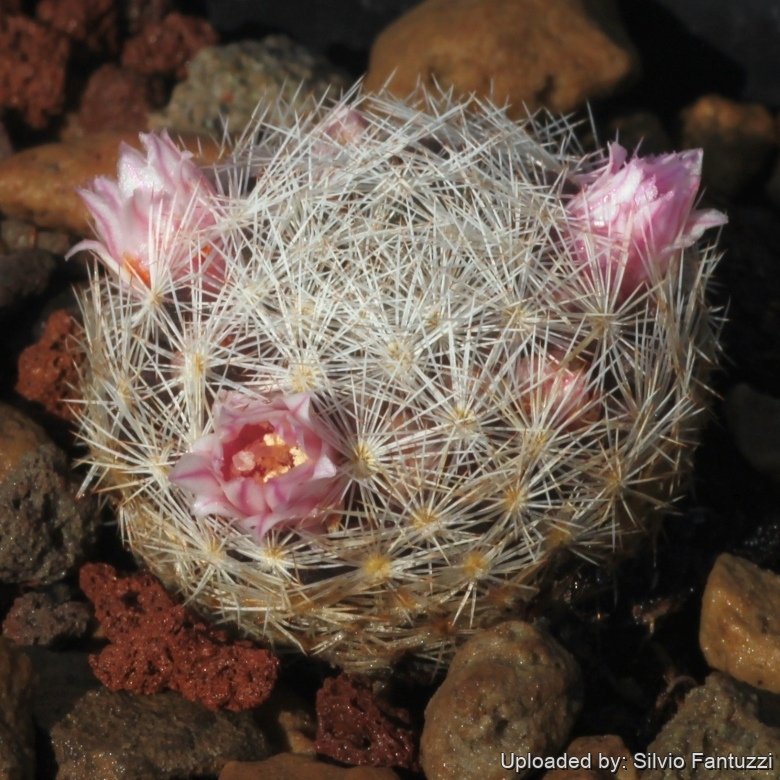
Mammillaria roseocentra is a controversial species considered by Pilbeam a form of Mammillaria magallanii, but the original description of M. roseocentra calls for 25 radial spines only and it is more likely that the name has subsequently been misapplied. It is a small slow growing species with tight, radial spines, in two rows, short, especially the inside one, initially beautiful pink, at the apex almost red then creamy white. It has attractive little creamy-pink blooms and red fruit, and is similar to Mammillaria lasiacantha.
Habit: Plants usually solitary with a succulent tap root. With age it may offset from the base to form a small cluster.
Stem: Without latex, globose, to club shaped, green, to 6 cm tall and 4,5 cm in diameter.
Tubercles: Short-cylindrical, without latex. Axils bare.
Radial spines: About 25, but usually much more numerous, interlacing, 2 - 5 mm long, chalky white to very pale pinkish-brown which are pinkish or reddish towards the growing point.
Central spines: Usually absent.
Flower: Cream coloured with pinkish-red or pinkish-brown midribs, to 10 mm long and in diameter.
Blooming season: Early spring (February–March in habitat).
Fruit: Red and very showy.
Origin and Habitat
Durango and Lerdo (also Coahuila and Baja California ?), Mexico
Ecology: The dense addpressed spination of Mammillaria roseocentra serves to protect it from the harsh sun common to its native habitat. More precisely the spines benefit the plant by reducing sun exposure and by trapping a layer of air next to the cactus body. This helps to cool the plant in the summer and keep it warm in the winter.
Bibliography
Major references and further lectures
-
Edward Anderson “The Cactus family” Timber Press, Incorporated, 2001
-
James Cullen, Sabina G. Knees, H. Suzanne Cubey “The European Garden Flora Flowering Plants: A Manual for the Identification of Plants Cultivated in Europe, Both Out-of-Doors and Under Glass” Cambridge University Press, 11/Aug/2011
-
David R Hunt; Nigel P Taylor; Graham Charles; International Cactaceae Systematics Group. “The New Cactus Lexicon” dh books, 2006
-
John Pilbeam “Mammillaria: the cactus file handbook” Cirio Publishing Services Ltd Dec/30,/1999
-
John Pilbeam “Cacti for the Connoisseur: A Guide for Growers & Collectors” Timber Press, 01/lug/1987
-
Walther Haage “Kakteen von A bis Z” Neumann Verlag , 1981
Source: Mammillaria roseocentra, LLIFLE - Encyclopedia of living forms, CC-BY-SA, retrieved 2026-10-25.
From llifle page Mammillaria magallani var. hamatispina
Description
Mammillaria magallani var. hamatispina is a controversial tiny solitary cactus with hooked central spines in immature seedlings, but often with no central spines in the mature specimens. It is part of a controversial group of related species (Mammillaria gasseriana, Mammillaria stella-de-tacubaya, Mammillaria chica, Mammillaria lasiacantha, Mammillaria magallani, magallani hamatispina… etc) hard to name accurately without knowing where they come from, and there remains a considerable confusion surrounding the true identity of this this plant. Whatever view one adopts, it is worth a place in every Mammillaria collection.
Stem: Cylindrical, dark green, 5 cm in diameter and up to 7 cm tall.
Tubercles: Cylindrical 5 mm long 2 mm in diameter evenly disposed. Axil with white-yellowish wool.
Radial spines: 50-70 short, sharp, creamy-yellowish 3 mm long.
Central spines: (0-)1(-3) hooked usually present in the seedling stage, 3-5 (or more) mm long, yellow-orangish with a darker coffee coloured tip. Adult specimens usually have only pure radial spines.
Flowers: Creamy coloured 10 mm long, 6 mm across.
Fruit: Bright red about 10 mm long and 3 mm in diameter.
Seeds: Circular, black, 2 mm in diameter, 1 mm thick.
Origin and Habitat
Municipio de Parras de la Fuente, Coahuila (Towards Saltillo).
Habitat: Between rock among xerophyte vegetation at 1300 m of altitude. In a very small population with not more than 1 or 2 specimens per 10 square meters.
Cultivation and Propagation
This plant has not the fame to be easy to cultivate, but in good conditions with excellent ventilation, it grows without difficulty. It is especially sensitive to overwatering. So careful watering and an open mineral potting soil are a must. Avoid the use of peat or other humus sources in the potting mixture. Don’t add limestone to the potting mix which must be moderately acidic. Can be sensitive to frost (but if dry they are resistant to -5° C). Requires maximum sun exposure to reach its full potential and to achieve success in flowering. A winter rest that allows the plant to shrivel (perhaps losing up to 25% of its summer height) will encourage flowering and long time survival. Be careful to encourage slow growth. Provide very good ventilation.
Propagation: Direct sow after last frost. (it usually doesn’t produces offsets).
Bibliography
Major references and further lectures
-
David Hunt, Nigel Taylor “The New Cactus Lexicon” DH Books, 2006 ISBN 0953813444, 9780953813445
-
John Pilbeam (1999) “Mammillaria The Cactus File Handbook” Nuffield Press. ISBN 10: 0952830280
Nathaniel Lord Britton, Joseph Nelson Rose “Cactaceae: Descriptions and Illustrations of Plants of the Cactus Family” Courier Dover Publications, 1963
-
Edward F. Anderson “The Cactus Family” Timber Press, 2001
-
James Cullen, Sabina G. Knees, H. Suzanne Cubey “The European Garden Flora Flowering Plants: A Manual for the Identification of Plants Cultivated in Europe, Both Out-of-Doors and Under Glass”Cambridge University Press, 11/Aug/2011
Source: Mammillaria magallani var. hamatispina, LLIFLE - Encyclopedia of living forms, CC-BY-SA, retrieved 2026-10-25.
Gallery