Publication: Mammillaria Postscripts 6: 8 (1997)
Description
Slowly clustering , at about 3 or 5 years old from seed.
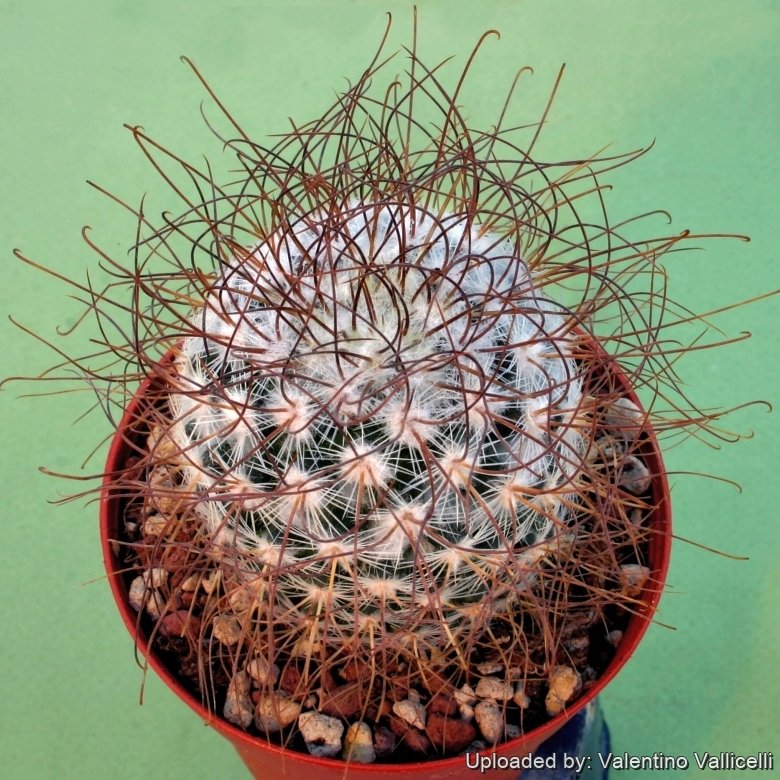
Stems: Globose to short, cylindrical, green, 12-13 cm tall, 5-6 cm thick. Sometimes with latex.
Tubercle: Conical to cylindrical. The axil has short white wool and white bristles. Tubercle arrangement: 8-13.
Areoles: Woolly, white. ( )
Radial spines: About 27-30, radiating, finely bristly, needle-like, white to golden yellow, 4 - 6 mm long.
Central spines: 4-6, much stouter than the radials, yellow, amber or brown, hooked, sometimes twisted, 15-20(-25) mm long, the lower one sometimes strongly hooked.
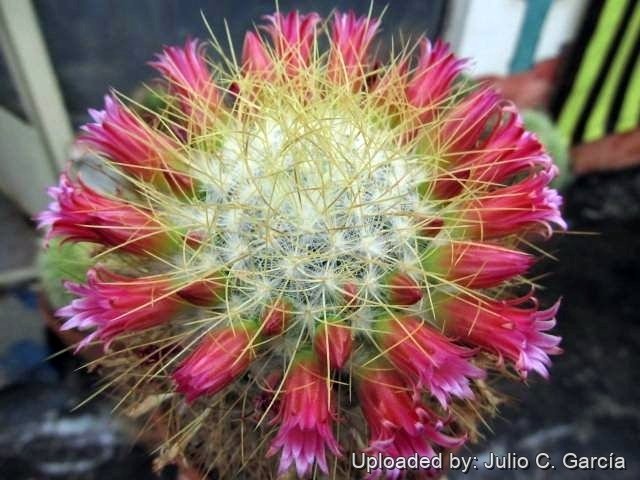
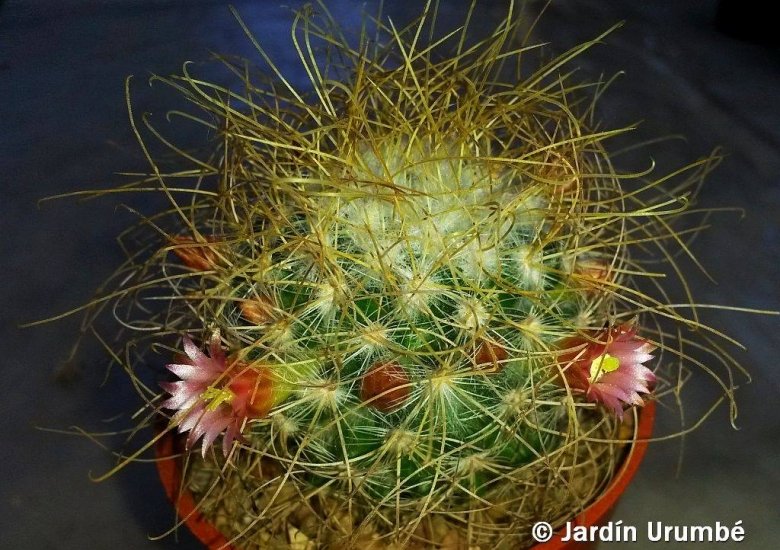
Flowers: Diurnal, purple, generally with darker midribs, up to 15 mm long. The petals flare back at the ends, rather than opening widely.
Blooming season: Spring.
Fruits: Red.
Seeds: Brown.
Origin and Habitat
Oaxaca: Mitla, Mexico.
Cultivation and Propagation
Mammillaria rekoi subs. leptacantha requires excellent drainage provided by porous cactus soil. Easily clustering, it’s an easy bloomer.
Growth rate: Most plants will offset readily, and clumps can be produced in a few years.
Repotting: We suggest repotting every 2-3 years.
Fertilization: During the beautiful season enrich the soil using a fertilizer rich in potassium and phosphorous, but poor in nitrogen, because this chemical element doesn’t help the development of succulent plants, making them too soft and full of water.
Exposure: It prefers bright light and ample airflow. Outside full sun or afternoon shade, inside it needs bright light, and some direct sun.
Moisture: Water the soil abundantly when it is dry to the touch. Allow soil to drain thoroughly before watering again. Do not water much in the winter (rot prone). Overwintering: Protect from frost. But it’s hardy to -5°C if kept dry.
Propagation: Division, direct sow after last frost.
Bibliography
Major references and further lectures
-
John Pilbeam (1999) “Mammillaria The Cactus File Handbook” Nuffield Press.
-
Edward F. Anderson “The Cactus Family” Timber Press, 2001