Publication: Enum. Diagn. Cact. 46. 1837
Description
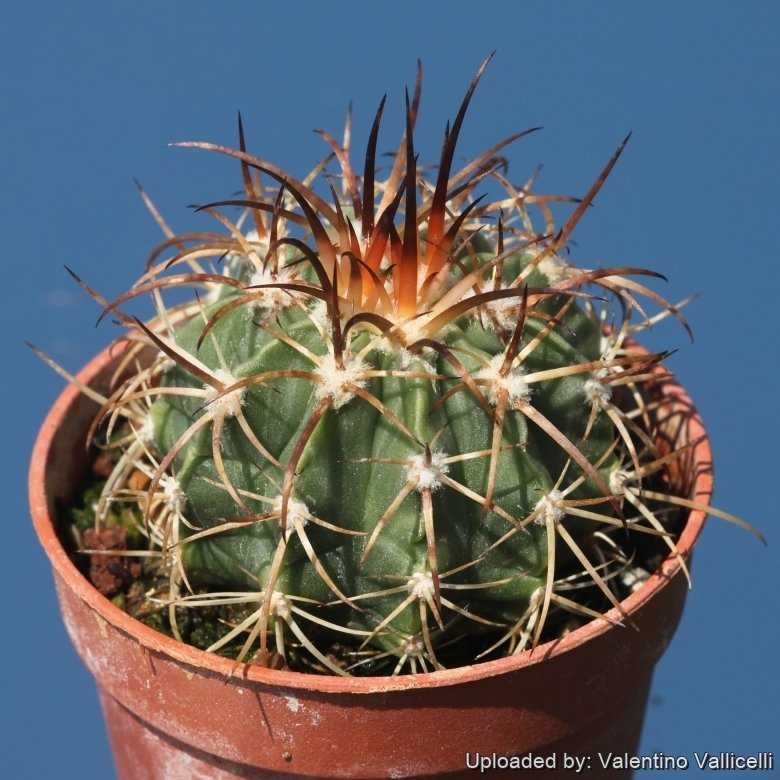
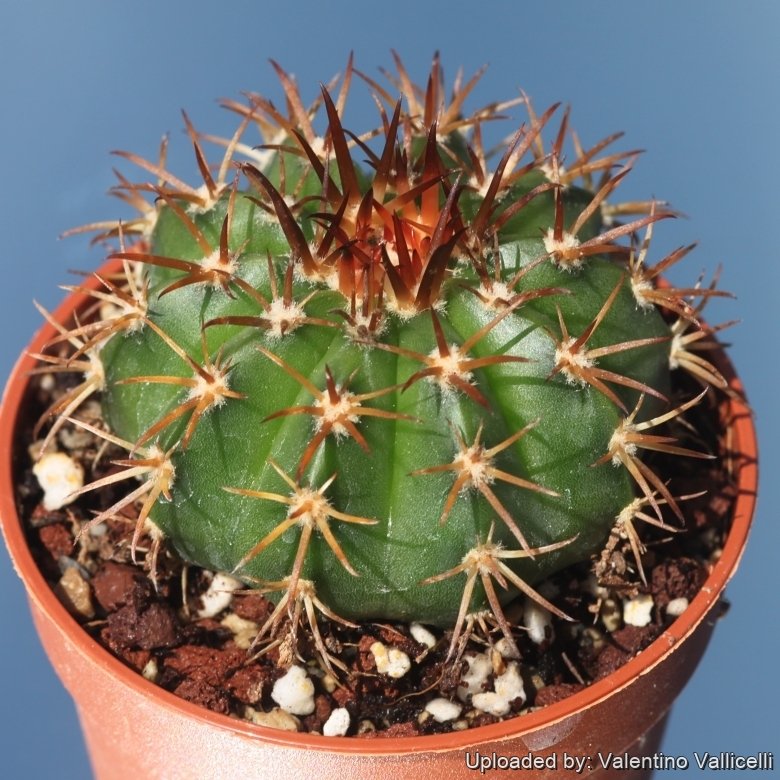
Melocactus curvispinus is highly variable in shape, it has has been divided into several species and subspecies by hobbyists, but only 3 subspecies are valid (subsp. curvispinus, subsp. caesius and subsp. dowsonii).
Habit: Usually solitary.
Stem: Depressed globular to short cylindrical, light to dark green, slightly glaucous, 8 to 27 cm in diameter, 6 to 30 cm tall.
Ribs: 10 to 16 ribs sharp and sometimes tuberculated.
Areoles: Slightly sunken in the notches.
Spines: Dirty white to almost black more or less curved. Central spines erect, 1 to 4 often missing, 15 to 52 mm long. Radial spines 6 to 11 (rarely more), 3-42 mm long, the lowest often longer.
Cephalium: Relatively small 3 to 4 cm tall and 7 to 11 cm in diameter with long reddish-brown bristles.
Flowers: From the cephalium, dark purple to light pink, 18 to 43 mm long and 10 to 25 mm in diameter.
Blooming season: spring to summer open late in the afternoon.
Fruit: Club-shaped, pink to bright red to deep magenta slightly lighter at the base.subspecies by hobbyists, but only 3 subspecies are valid.
Origin and Habitat
The distribution area of Melocactus curvispinus extends from Mexico to the south of Peru, comprising the north-east of Colombia,Venezuela and the Caribbean.
Cultivation and Propagation
These cacti are not the easiest things to grow and aren’t plants for beginners. Melocactus guaricensis grows from April to October, it can’t endure long stretches of total dryness, and also too much water will rot it, as its weak root systems tends to be inefficient at sucking up water from wet soil. Nonetheless, again as a result of their tropical origins, they need a fair amount of water, but allow the soil to dry quite a bit before watering again.
Melocactus rests from October to April but can’t stand cold, or even fairly cool temperatures, so is indispensable to keep it above 8-12°C at all times, severe damage or death occurring at temperatures that the great majority of cacti wouldn’t mind in the least and prefer more frequent water in winter than other cacti, say once a month. Do not feed in winter.
The root system is weak and generally resents being repotted and can take a long time to re-establish. The soil mix should be very quick draining, prefers very bright light, not as much as the most arid growing cacti, but plenty nonetheless.
Propagation: Exclusively by Seeds. Sow in February-march in a light, sandy, porous soil. Cover germinating tray with glass to prevent seed from drying out. Germination is most successful at a temperature of 18 to 22° C.
Notes
The most remarkable part of a Melocactus is its cephalium a bristle-coated structure on the summit of the plant, only Melocactus , and the similar genus Discocactus possesses this type of permanent, apical, hatlike appendage. It’s only when a Melocactus reaches maturity that the cephalium begins to grow. Cylindrical, with a diameter distinctly smaller than that of the plant body below, the cephalium will keep growing for the rest of the plant’s life, but the body of the plant stops growing the moment the cephalium starts to form. As the plants age the cephalium doesn’t increase in circumference it will steadily grow taller.
Bibliography
Major references and further lectures
-
Stuart Max Walters “The European garden flora. 3.[Angiospermae], Dicotyledons. [Casuarinaceae to Aristolochiaceae]” Cambridge University Press, 1989
-
Edward Anderson “The Cactus family” Timber Press, Incorporated, 2001
-
David R Hunt; Nigel P Taylor; Graham Charles; International Cactaceae Systematics Group. “The New Cactus Lexicon” dh books, 2006
-
Urs Eggli, Leonard E. Newton “Etymological Dictionary of Succulent Plant Names” Birkhäuser 2004
From llifle page Cactus oaxacensis
Origin and Habitat
Mexico (Northern America)
Source: Cactus oaxacensis, LLIFLE - Encyclopedia of living forms, CC-BY-SA, retrieved 2026-10-25.
From llifle page Cactus salvador
Origin and Habitat
West of Seabra, Bahia, Brazil
Notes
The most remarkable part of a Melocactus is its cephalium a bristle-coated structure on the summit of the plant, only Melocactus, and the similar genus Discocactus possesses this type of permanent, apical, hatlike appendage. It’s only when a Melocactus reaches maturity that the cephalium begins to grow. Cylindrical, with a diameter distinctly smaller than that of the plant body below, the cephalium will keep growing for the rest of the plant’s life, but the body of the plant stops growing the moment the cephalium starts to form. As the plants age the cephalium doesn’t increase in circumference it will steadily grow taller.
Source: Cactus salvador, LLIFLE - Encyclopedia of living forms, CC-BY-SA, retrieved 2026-10-25.
From llifle page Melocactus guatemalensis
Origin and Habitat
Guatemala (Central America, Southern America)
Source: Melocactus guatemalensis, LLIFLE - Encyclopedia of living forms, CC-BY-SA, retrieved 2026-10-25.
From llifle page Melocactus guitartii
Description
Melocactus guitartii is the the rarest of these Cuban species, nowadays considered nothing else than one of the local or morphological form of the very variable Melocactus curvispinus. It is about 10 cm broad and 12 cm high, densely armed with long spreading rigid spines. There are no other clear distinguishing features, and they must all be regarded as the same species.
Habit: Usually solitary.
Stem: Depressed globular to short cylindrical, light to dark green, slightly glaucous, 10-16 cm in diameter, 6 to 30 cm tall.
Ribs: 10 to 16 sharp.
Areoles: Slightly sunken in the notches.
Spines: Dirty white to almost black more or less curved.
Central spines: 2 erect or spreading, rigid, up to 35 mm long.
Radial spines: 9 to 10.
Cephalium: Relatively small 3 to 4 cm tall and 7 to 11 cm in diameter with long reddish-brown bristles.
Flowers: From the cephalium, pink, 18 to 43 mm long and 3 to 4 cm long. It is self-fertile!
Blooming season: Spring to summerand opening late in the afternoon.
Fruit: Club-shaped, pink to red-violet slightly lighter at the base.
Origin and Habitat
Cuba (Caribbean, Southern America)
Cultivation and Propagation
These cacti are not the easiest things to grow and aren’t plants for beginners. Melocactus guitartii grows from April to October, it can’t endure long stretches of total dryness, and also too much water will rot it, as its weak root systems tends to be inefficient at sucking up water from wet soil. Nonetheless, again as a result of their tropical origins, they need a fair amount of water, but allow the soil to dry quite a bit before watering again.
Melocactus rests from October to April but can’t stand cold, or even fairly cool temperatures, so is indispensable to keep it above 8-12°C at all times, severe damage or death occurring at temperatures that the great majority of cacti wouldn’t mind in the least and prefer more frequent water in winter than other cacti, say once a month. Do not feed in winter.
The root system is weak and generally resents being repotted and can take a long time to re-establish. The soil mix should be very quick draining, prefers very bright light, not as much as the most arid growing cacti, but plenty nonetheless.
Propagation: Exclusively by Seeds. Sow in February-march in a light, sandy, porous soil. Cover germinating tray with glass to prevent seed from drying out. Germination is most successful at a temperature of 18 to 22° C.
Bibliography
Major references and further lectures
-
Stuart Max Walters “The European garden flora. 3.[Angiospermae], Dicotyledons. [Casuarinaceae to Aristolochiaceae]” Cambridge University Press, 1989
-
Edward Anderson “The Cactus family” Timber Press, Incorporated, 2001
-
David R Hunt; Nigel P Taylor; Graham Charles; International Cactaceae Systematics Group. “The New Cactus Lexicon” dh books, 2006
-
Urs Eggli, Leonard E. Newton “Etymological Dictionary of Succulent Plant Names” Birkhäuser 2004
-
Clive Innes “Complete Handbook of Cacti and Succulents” Van Nostrand Reinhold Company, 01/dic/1981
Source: Melocactus guitartii, LLIFLE - Encyclopedia of living forms, CC-BY-SA, retrieved 2026-10-25.
From llifle page Melocactus humilis
Origin and Habitat
Venezuela (Northern South America, Southern America)
Source: Melocactus humilis, LLIFLE - Encyclopedia of living forms, CC-BY-SA, retrieved 2026-10-25.
From llifle page Melocactus delessertianus
Description
Melocactus delessertianus, Lemaire (Hort. Univ. 1 : 225. 1839), has been described from Mexico (Veracruz) which may or may not be this plant. It was described as slightly depressed, about 10 cm. high with 12 to 15 ribs. Radial spines 8 or 9, centrals 2. The flowers and fruit unknown.
The characteristics of Melocactus delessertianus, appear to fall within the natural variation of Melocactus curvispinus. Melocactus delessertianus is not accepted by botanists that treat it as synonym.
Origin and Habitat
Veracruz, Mexico
Altitude range: 0-400 metres above sea level.
Habitat and ecology: Melocactus delessertianus used to be common but now is almost extinct because of overcollecting by horticulturists. It grows together with Mammillaria erinacea, Acanthocereus pentagonus, Opuntia puberula, Selenicereus pteranthus, Nopalea dejecta and Bromelia pinguin.
Cultivation and Propagation
These cacti are not the easiest things to grow and aren’t plants for beginners. It grows from April to October, it can’t endure long stretches of total dryness, and also too much water will rot it, as its weak root systems tends to be inefficient at sucking up water from wet soil. Nonetheless, again as a result of their tropical origins, they need a fair amount of water, but allow the soil to dry quite a bit before watering again. Melocactus rests from October to April but can’t stand cold, or even fairly cool temperatures, so is indispensable to keep it above 8-12°C at all times, severe damage or death occurring at temperatures that the great majority of cacti wouldn’t mind in the least and prefer more frequent water in winter than other cacti, say once a month. Do not feed in winter.
The root system is weak and generally resents being repotted and can take a long time to re-establish. The soil mix should be very quick draining, prefers very bright light, not as much as the most arid growing cacti, but plenty nonetheless.
Propagation: Exclusively by Seeds. Sow in February-march in a light, sandy, porous soil. Cover germinating tray with glass to prevent seed from drying out. Germination is most successful at a temperature of 18 to 22° C.
Bibliography
Major references and further lectures
-
Britton, N. L., and J. N. Rose. 1922. “The Cactaceae.” Vol. 3. Canegie Institute: Washington.
-
Miguel J. Chazaro “Miscellaneous papers on the flora of Veracruz, Mexico” University of Wisconsin-Madison, 1989
Source: Melocactus delessertianus, LLIFLE - Encyclopedia of living forms, CC-BY-SA, retrieved 2026-10-25.