Publication: Bradleya 5: 93. 1987
Description
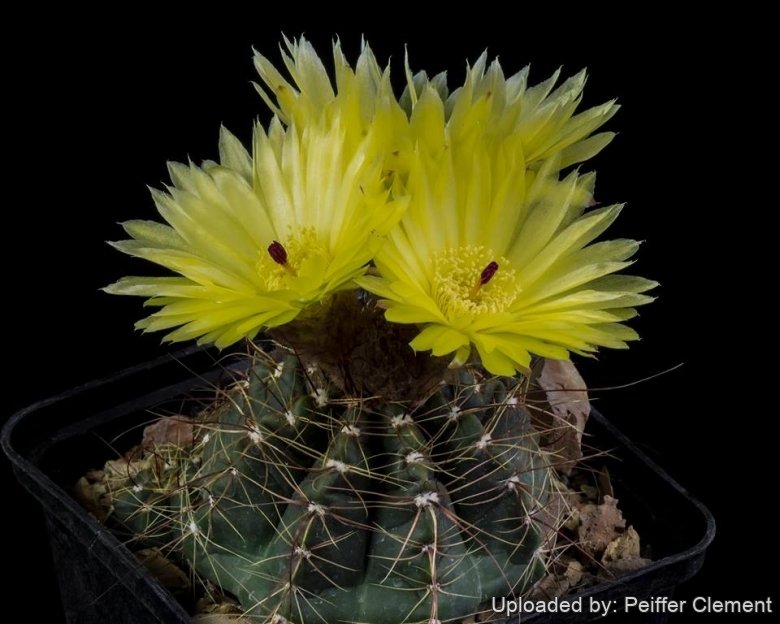
Parodia ottonis var. tortuosa (Notocactus ottonis var. tortuosus) is a cryptic species allied both to Parodia linkii and the very variable Parodia ottonis that has numerous synonyms for its various regional forms. Parodia ottonis var. tortuosa has a very large body (13-18 cm), small flower (25 mm long and 25-50 mm in width) and its spines are almost equal. These characteristics are not usually found in Parodia ottonis but closely correspond to the description of Parodia linkii.
Derivation of specific name: tortuosus,-a,-um; from Latin. tortuosus (from torus, bend, curve), for the spines that are bent or twisted in different directions.
Stems: Hemispherical to depressed, dark green, 13-18 cm in diameter, apex woolly and somewhat depressed.
Ribs: 10-15, occasionally more, sub-vertical, arched, rounded-triangular in cross section, sides surfaces convex, forming deep angled sinuses and rounded apically
Areoles: Shallowly notches between tubercles, closely set. Juvenile ones woolly.
Spines: 4-16 mm long straight or somewhat curved and twisted, pale yellowish to reddish. Radial spines in 4-6(-7) pairs, the upper ones slightly shorter, the other all equally long. Central spines 4 to 6, brown, slightly larger and spreading, the upper one shorter.
Flowers: Several produced together at apex, yellow, about 2.5-5 cm in diameter. Tube short filled with wool, bristly brown hairs and green scales becoming gradually longer above. Outer segments oblong shortly pointed. Inner perianth-segments in two whorls, mucronate and fringed at apex. Stigma yellow or pale red.
Fruits (berries): Protruding, sub-globose, scales thin, with short wool and longer bristles.
Seeds: Sub-cylindrical, rounded, sometimes enlarged at base.
Origin and Habitat
Brazil and Uruguay.
Cultivation and Propagation
It is easy to grow. It prefers a neutral to slightly acidic mineral-based potting mix with plenty of extra grit and feed during the summer. It likes a warm bright location, does great in partial shade but doesn’t like full, hot blazing sun in the central summer month. Can support quite some water during the growing season but pot plants in winter are wet-sensitive and needs to be kept dry (rots easily if soil is wet and cold) tends to lose its roots in winter. Water Best if watered with rain water. Usually it is recommended to over-winter this plant in a bright and warm greenhouse with at least 8-10° C and rather dry (it tends to lose its roots and to rot if the substrate is wet and cold) but it has proved to tolerate temperatures as low as -5° C for short periods. It is susceptible to spider mites, so it should be check once in a while for it.
Propagation: Seeds, cuttings or root suckers (if available). Not too difficult to raise from seed.
Bibliography
Major references and further lectures
-
Linnaea: Ein Journal Für Die Botanik in Ihrem Ganzen Umfange, Volume 5 P. Parey, 1830
-
Edouard Spach “Histoire naturelle des végétaux: Phanérogames”, Volume 13 Librairie encyclopédique de Roret, 1846
-
Karl Friedrich Philipp von Martius “Flora Brasiliensis, Enumeratio Plantarum in Brasilia Hactenus Detectarum: Quas Suis Aliorumque Botanicorum Studiis Descriptas Et Methodo Naturali Digestas Partim Icone Illustratas”, 1840
-
James Cullen, Sabina G. Knees, H. Suzanne Cubey “The European Garden Flora Flowering Plants: A Manual for the Identification of Plants Cultivated in Europe, Both Out-of-Doors and Under Glass” Cambridge University Press, 11/August /2011
-
Friedrich Ritter “Kakteen in Suedamerika: Ergebnisse Meiner 20 Jaehrigen Feldforschungen” F. Ritter Selbstverlag, 1979
Gallery