Publication: Bradleya 5: 93. 1987
Description
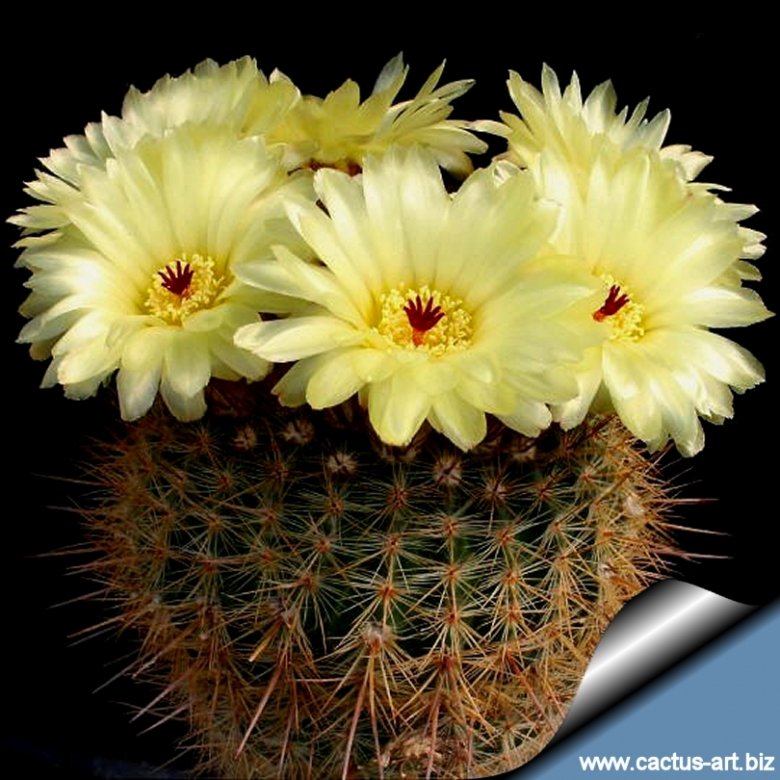
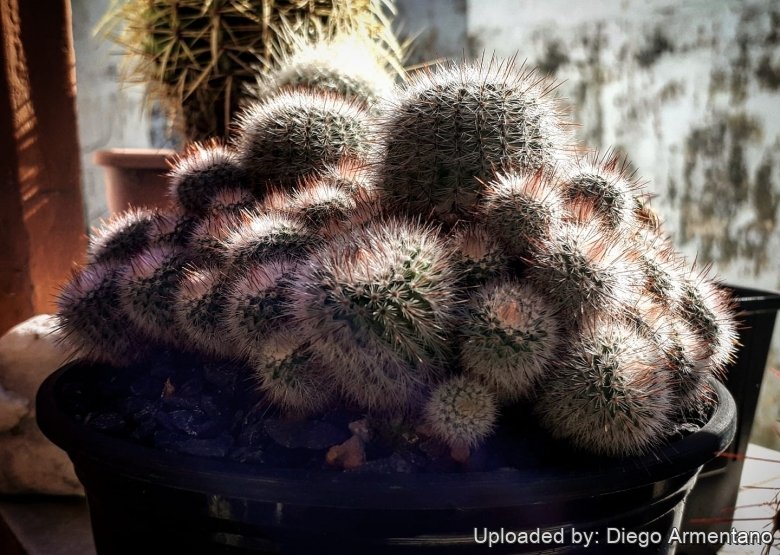
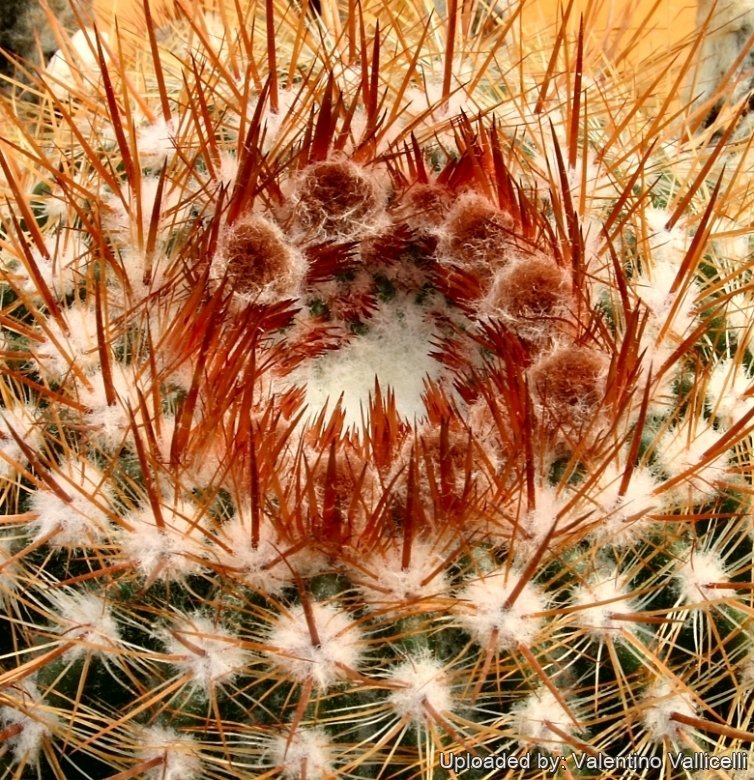
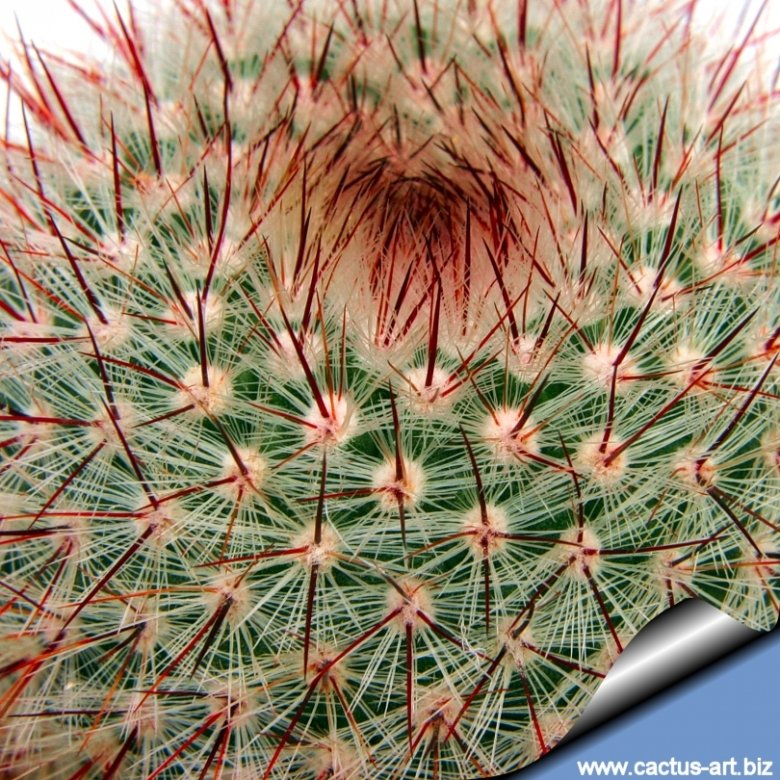
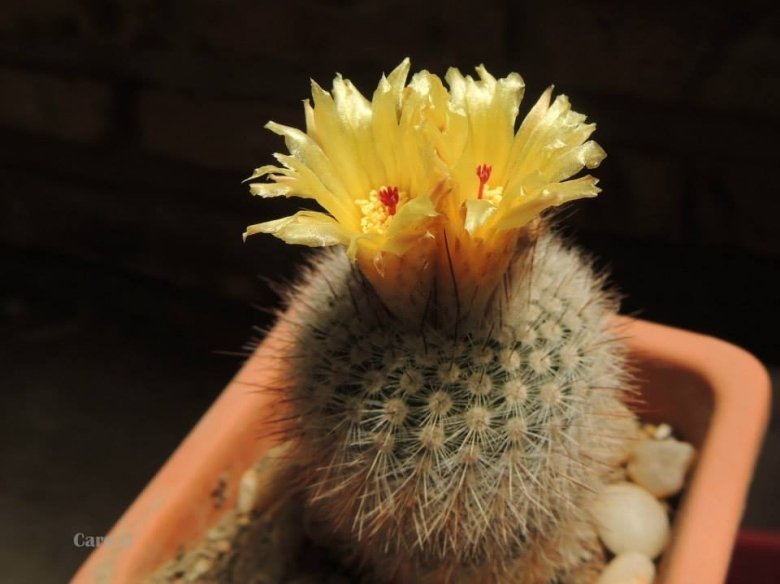
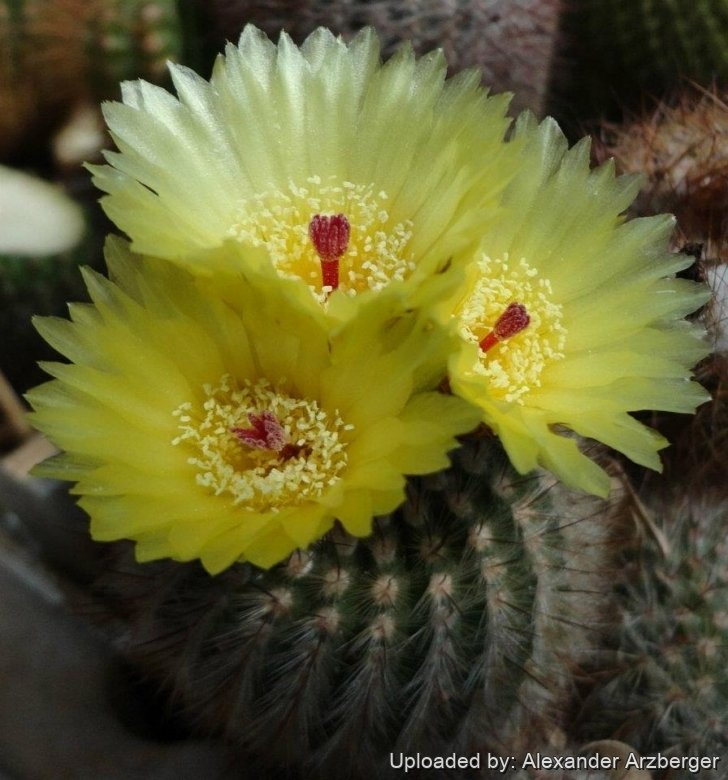
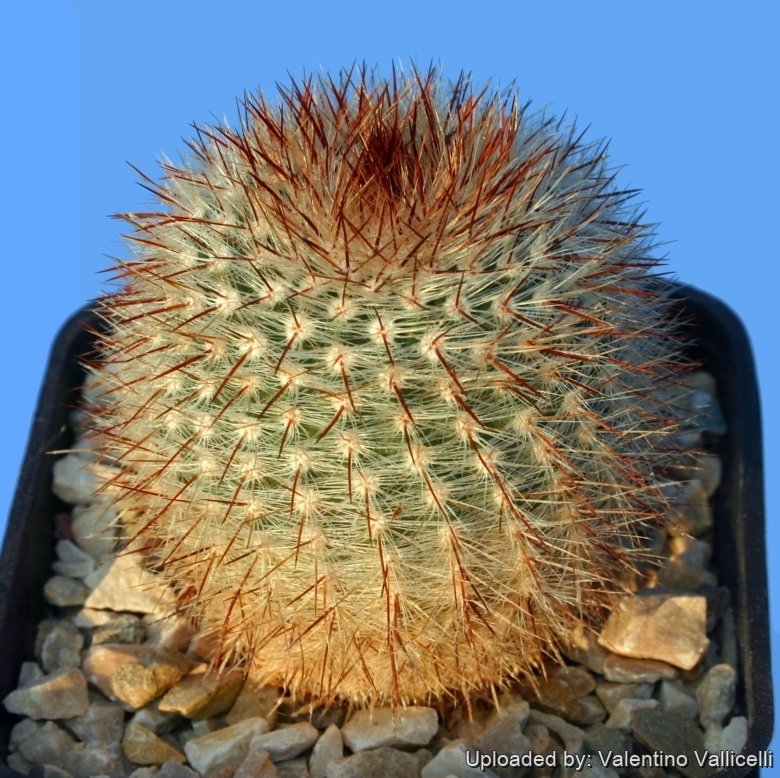
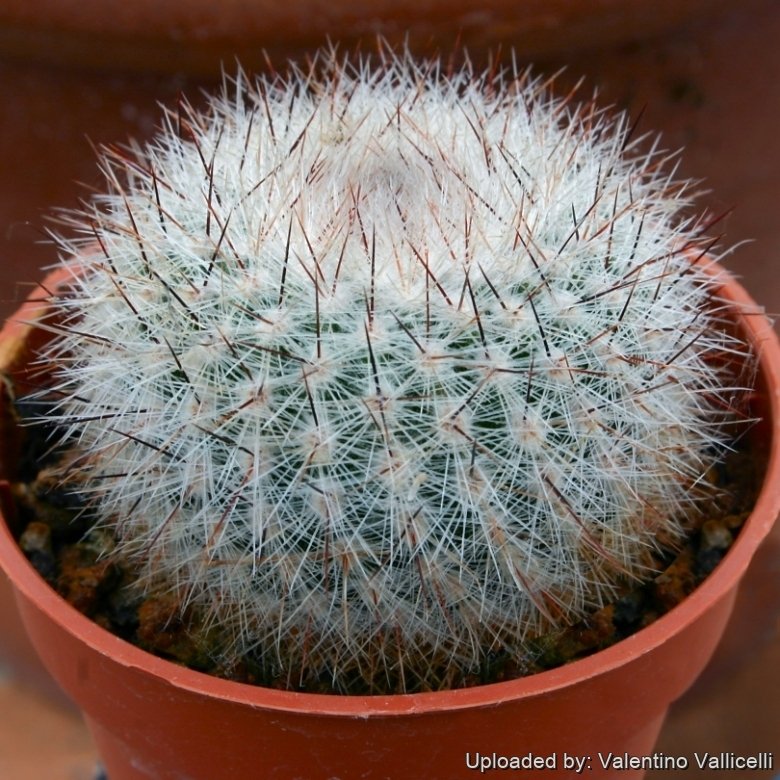
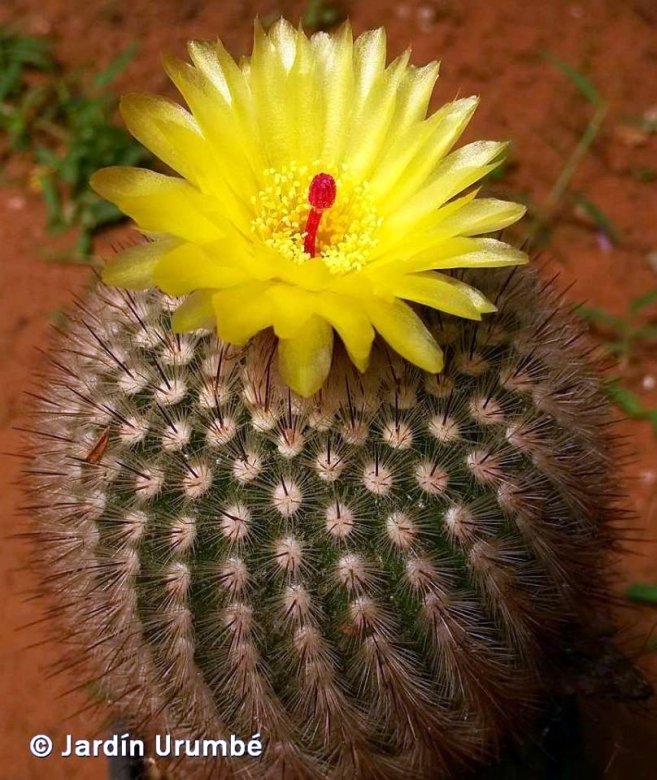
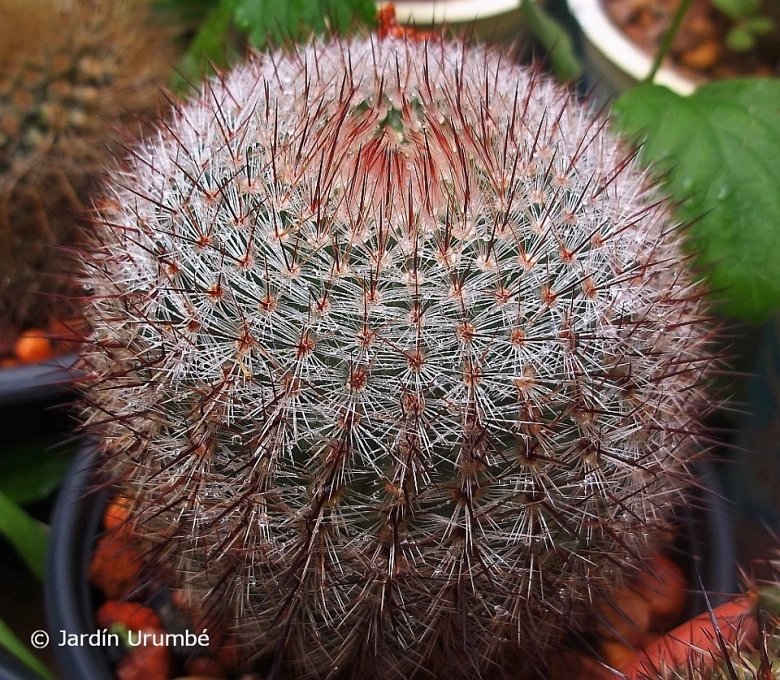
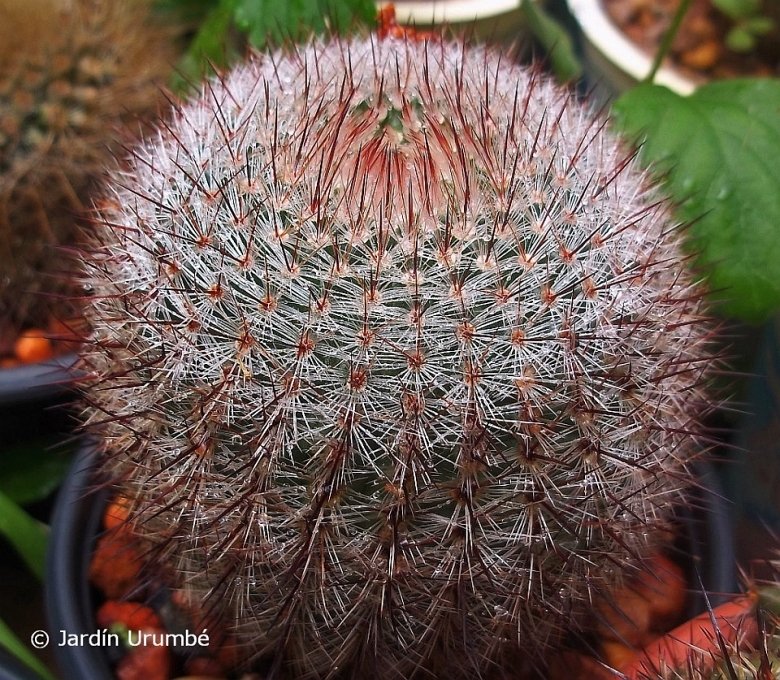
Parodia scopa is a silvery spined cactus often clustering with showy yellow flowers. The stems are almost hidden by soft tufts of bristly spines somewhat similar to small brushes. The mixture of white and red-brown spines, varying from plant to plant.
Stem: Dark green, at first globular, becoming bit columnar to clavate with age, depressed apically, up to 45 cm tall, 6-10 cm in diameter.
Ribs: 25-30 (sometime up to 40 or more) low, obtuse, finely notched into low warts tipped with areoles, which may spiral slightly.
Areoles: White woolly.
Central spines: About 4 (but varying from 2 to 12) medium length (6-12 mm long), needle-like, stouter than radials, purple, red-brown, orangish or white.
Radial spines: Shorter, fine, bristles-like, glassy white or yellowish, 5-7 mm long, spreading around.
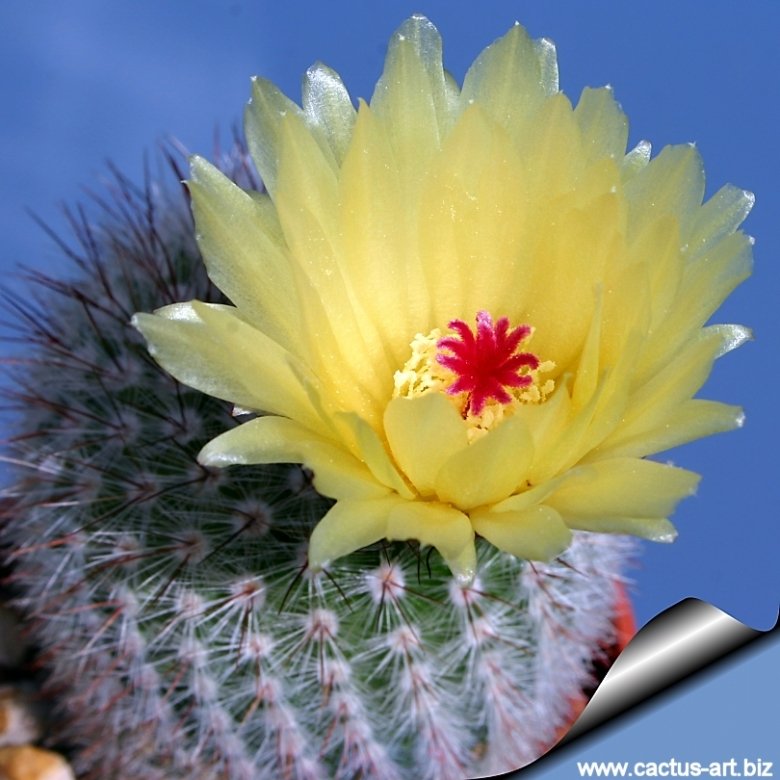
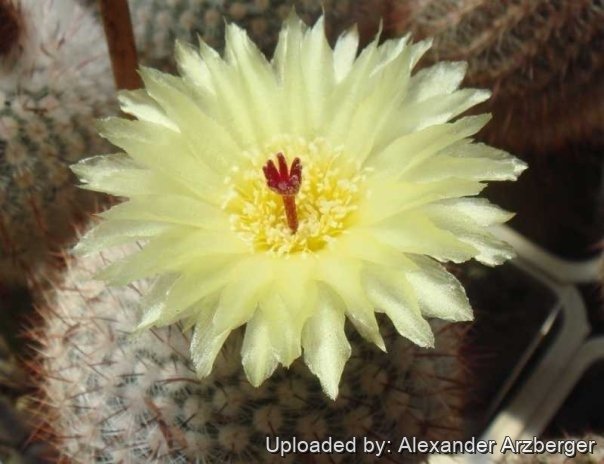
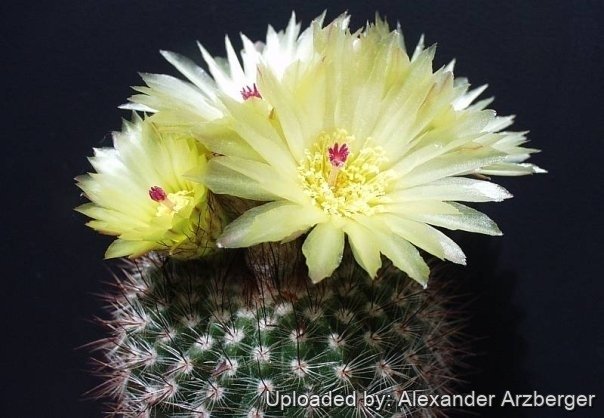
Flowers: A cluster of satiny, bright yellow flowers spring in the upper part of the stem forming a ring, The are 2-4 cm long and 3,5-4,5 cm in diameter. , Pistil with about 10, rayed, bright crimson stigma lobes. Tube short. Scales on the ovary woolly with brown bristles.
Blooming season: June-July.
Fruits: Globose, about 7 mm in diameter, opening at maturity, with numerous seeds.
Seeds: Dull black tuberculate.
Origin and Habitat
Southern Brazil (Rio Grande do Sul), Uruguay, Paraguay, northern Argentina.
Habitat: Native to the grasslands.
Cultivation and Propagation
It is easy to grow. It prefers a neutral to slightly acidic mineral-based potting mix with a good drainage. It likes a warm bright location, does great in partial shade but doesn’t like full, hot blazing sun in the central summer month. Can support quite some water during the growing season but pot plants in winter are wet-sensitive and needs to be kept dry (rots easily if soil is wet and cold) tends to lose its roots in winter. Usually it is recommended to over-winter this plant in a bright and warm greenhouse with at least 8-10° C , but it has proved to tolerate temperatures as low as -5° C for short periods.
Propagation: Seeds, cuttings or root suckers (if available). Not too difficult to raise from seed.
Notes
The Notocactus scopa aggregate is an ensemble of related species comprising Notocactus scopa, Notocactus schlosseri, Notocactus scopa var. xicoi, Notocactus sucineus. This plant has been Transferred to Parodia in 1997 by David Hunt.
Bibliography
Major references and further lectures
-
James Cullen, Sabina G. Knees, H. Suzanne Cubey “The European Garden Flora Flowering Plants: A Manual for the Identification of Plants Cultivated in Europe, Both Out-of-Doors and Under Glass” Cambridge University Press, 11/Aug./2011
-
David Hunt, Nigel Taylor “The New Cactus Lexicon” DH Books, 2006
-
Edward F. Anderson “The Cactus Family” Timber Press, 2001
From llifle page Notocactus scopa var. cobrensis
Description
It is a small and very beautiful cactus completely covered with wool and spines. Branches to form small groups or rarely remain solitary,
Stem: Cylindrical, 3,5-7 cm in diameter, 6-10(-15) cm tall, epidermis dark green concealed by the dense spines.
Ribs: 21 to 27, approx 5 -7 mm wide and 2-4 mm highly, arranged into tubercles, on which the areoles sits.
Areoles: Roundish, 2-3 mm in diameter, very close one to each other (approx 2 mm apart), filled by white wool that persist for some years, then naked. Annual increase 5-6 areoles per ribs.
Spines: Very dense white and copper coloured, not stinging. The spines in the blooming areoles are often darker.
Radial spines: 40 - 50 up to 7 mm long, very fine, pure white, lying close, radiating, interlacing with the spines of the adjacent areoles.
Central spines: 4 – 8 (of which 4 true centrals and 3-4 intermediate), up to5 mm long, Longer and stouter, spreading, copper-red or brown. The central spines often are not present in the new apical growth but appears later.
Flowers: Opening at the top of the stem, approx 35 mm long and 40 mm wide, sulphur-yellow, odourless, self sterile.
Tube: 12 - 15 mm long, funnel-shaped, diameter at the base 4 mm, above 13-15 mm Ø, with yellowish epidermis, completely covered by wool and red-brown to dark-brown bristles up to 10 mm long. Stamens 7-9 mm long, golden-yellow.
Petals: lanceolate to narrowly lanceolated, up to 4 mm wide and 21 mm long, inside and outside sulphur-yellow, shining. Stylus: 17 mm long, 1.2-1.5 mm Ø, dark-carmine, with 11 (12) stigma lobes up to 3.5 mm long. Blooming season: Summer. The flowers pen on the late morning and close at night.
Fruits: Small 6-7 mm broad and long, fleshy, pinkish, cover with white cotton wool, drying yellowish, irregularly opening with the releasing of part of the seeds to the ground (but some of the seeds remain on the plant). Each fruit contains approx 80 seeds.
Seeds: Helmet-shaped, black. Length 0.65 mm, width 0.5 mm, height of 0.4 mm, Hilum oval, curved, light brown. Testa convex to hemispherical, bordered with 5 to 7 adjoining cells, 0.03 - 0.07 mm Ø. Microphylar hole 0.13-0.1 mm Ø and 0.04 mm.
Origin and Habitat
Rio Grande do Sul (Brazil) Type location: Minas DO Camaqua, Rio Grande Do Sul, Brazil (field number HU80)
Habitat: Grows together with Echinopsis spec. HU 87 and N. ottonis HU11a among grasses and Bromelia sp. partly among larger rock fragment in the crevices and niches.
Cultivation and Propagation
This is an easy plant to cultivate. It require a mineral-based potting mix with a good drainage. Can support quite some water during the growing season but pot plants in winter are wet-sensitive and needs to be kept dry (rots easily if soil is wet and cold). Usually it is recommended to over-winter this plant in a bright and warm greenhouse with at least 8-10° C , but it has proved to tolerate temperatures as low as -5° C for short periods.
Sun Exposure: Light shade to full sun but doesn’t like full, hot blazing sun in the central summer month.
Propagation: Seeds, cuttings. Not too difficult to raise from seed.
Notes
The Notocactus scopa aggregate is an ensemble of related species. This plant has been Transferred to Parodia in 1997 by David Hunt.
Source: Notocactus scopa var. cobrensis, LLIFLE - Encyclopedia of living forms, CC-BY-SA, retrieved 2026-10-25.
From llifle page Notocactus scopa var. glauserianus
Origin and Habitat
Uruguay (Southern South America)
Source: Notocactus scopa var. glauserianus, LLIFLE - Encyclopedia of living forms, CC-BY-SA, retrieved 2026-10-25.
From llifle page Notocactus scopa var. machadoensis
Description
Notocactus scopa fa machadoensis is a microendemic form collected as early as 1968, by Buining and Horst at Pinheiro Machado, to which was given the field number HU 184 and the provisional name N. scopa var. Machadoensis. The stem is much larger than to the type, up to 70 cm long and 13 cm thick with yellow to brown central spines. The lobes of the stigma are yellow.
Stem: Solitary, 35-70 cm long and 13 cm in diameter, cylindrical, with the base lying on the ground but with erect or rising tip, epidermis pale green.
Ribs: Flat, 24 - 33 (mostly around 28), straight to slightly turned.
Areoles: 2 mm in diameter, sunken in about 1 mm deep indentations, 3-5 mm apart.
Radial spines: About 30, spreading radially, white, 4-6 mm long.
Central spines: 1-3 (usually 3), one longest, erect up to 10 mm long, yellow-brown to brown, the others pointing obliquely downwards, often shorter than the protruding central spine and in some plants aften light coloured. Occasionally on the site some plants with whitish yellow central spines are also referred.
Flowers: 30-35 mm long, 40 mm wide. Inner perianth segments, sulphur-yellow. Anthers yellow. Pistil sulphur yellow, up to 20 mm long, stigma-lobes about 7-9 sulphur yellow, occasionally also somewhat reddish on the tips. Self-sterile.
Fruit: Up to 6 mm long, 4 mm wide.
Seed: Dull black, shining, warts oval to round, arched.
Origin and Habitat
Municipality of Pinheiro Machado, Rio Grande do Sul, Brazil.
Altitude range: 200 m above sea level.
Habitat and ecology: Notocactus scopa fa machadoensis in a very open grazing land with eroded rock terraces on streams or on terraces together with Parodia mammulosa, Notocactus sellowii var. courantii and Frailea gracillima. The population is extremely exiguous (Only a few dozen specimens). The PH of the substrate is 5.5.
Bibliography
Major references and further lectures
-
Abraham, Wolf-Rainer (1988): Succulenta 67 (4): 81 – 84.
-
Gebauer, Alfred: Notocactus (1988) S. 36
-
Gerloff & Neduchal “Die Pflanzen um Notocactus scopa”, INTERNOTO 3/4, 2003.
Source: Notocactus scopa var. machadoensis, LLIFLE - Encyclopedia of living forms, CC-BY-SA, retrieved 2026-10-25.
From llifle page Notocactus scopa var. murielii
Description
Parodia scopa f. murielii, only published under the genus Notocactus, is one of the varieties of the wide ranging and very variable Parodia scopa distinguished for its silvery spined stems. The flowers are very showy, glossy yellow.
Habit: It is perennial stem succulent often clustering. The stems are almost hidden by soft tufts of bristly spines somewhat similar to small brushes.
Stem: Dark green, at first globular, becoming bit columnar to clavate with age, depressed apically, up to 45 cm tall, 6-10 cm in diameter.
Ribs: 25-30 (sometime up to 40 or more) low, obtuse, finely notched into low warts tipped with areoles, which may spiral slightly.
Areoles: White woolly.
Central spines: About 4 (but varying from 2 to 12) medium length (6-12 mm long), needle-like, stouter than radials, purple, red-brown.
Radial spines: Shorter, very numerous fine, bristles-like, glassy white, 5-7 mm long, spreading around.
Flowers: A cluster of satiny, bright yellow flowers spring in the upper part of the stem forming a ring, The are 2-4 cm long and 3,5-4,5 cm in diameter. , Pistil with about 10, rayed, bright crimson stigma lobes. Tube short. Scales on the ovary woolly with brown bristles.
Blooming season: June-July.
Fruits: Globose, about 7 mm in diameter, opening at maturity, with numerous seeds.
Seeds: Dull black tuberculate.
Origin and Habitat
Uruguay.
Habitat: Native to the grasslands.
Bibliography
Major references and further lectures
-
Edward Anderson “The Cactus family” Timber Press, Incorporated, 2001
-
James Cullen, Sabina G. Knees, H. Suzanne Cubey “The European Garden Flora Flowering Plants: A Manual for the Identification of Plants Cultivated in Europe, Both Out-of-Doors and Under Glass” Cambridge University Press, 11/Aug/2011
-
David R Hunt; Nigel P Taylor; Graham Charles; International Cactaceae Systematics Group. “The New Cactus Lexicon” dh books, 2006
Source: Notocactus scopa var. murielii, LLIFLE - Encyclopedia of living forms, CC-BY-SA, retrieved 2026-10-25.
From llifle page Notocactus scopa var. xicoi
Description
Notocactus scopa f. xicoi is one of the morphological or local forms of Parodia scopa, distinguished by fewer ribs and fewer spines. Particularly striking are the numerous purple brown central spines (often lacking in younger specimen). Unlike the clustering and similarly red-spined Notocactus scopa f. ruberrimus Fric, and Notocactus scopa f. rubrispinus n.n. mentioned in the La Plata coast, the Notocactus scopa f. xicoi usually has a solitary growing stem up to 50 cm long. At present most authors have dismissed Notocactus scopa f. xicoi as perhaps not worthy of even varietal status, but it still has a value for a collector because they identify plants with particular characters.
Derivation of specific name: This member of the Cactaceae family was named after the Brazilian artist and cactus collector Francisco (Xico) Stockinger.
Stems: Solitary, rarely clumping, blue-green, up to 11 cm in diameter and more than 50 cm long, at first erect then lying on the ground except for their raised tips.
Ribs: 21-28, flat, vertical with an indentations between the areoles c. 1 mm deep.
Areoles: 3 mm in diameter, 3-5 mm apart.
Radial spines: 20-25, white, 4-6 mm long, straight and laterally spreading.
Central spines: 10-17, reddish brown to almost black, straight and pungent. One of the central spines almost always vertical, the other surrounding it in a circle, at the same angle of inclination of the radial spines.
Flower: 30 mm long, 34-40 mm wide. Tepals sulphur yellow to yellow, lanceolate, obtuse without a hooked tip. Stamens yellow, inserted about 2 mm below the margin. Pistil red with about 9 stigma lobes, 2-3 mm long, moderately spreading, self-sterile.
Fruit: up to 8 mm long and 5 mm wide.
Seeds:: 0.7 mm long and wide. Testa dull black. Testa cells oval to round, curved, pitted punctured. Microphile recognizable as a distinct cone.
Origin and Habitat
Municipality of Pedras Altas and Herval, Rio Grand do Sul, in southern Brazil (Southern America).
Altitude range: Around 200 m above sea level. N. N.
Habitat and ecology: The plants grow in full sun on a east-facing slope, together with Notocactus mammulosus, Notocactus arechavaletae and a Malalocarpus spec. The pH of the substrate is 5.2.
Bibliography
Major references and further lectures
-
Gebauer, Alfred: Notocactus 1988 S. 37
-
Gerloff & Neduchal “Die Pflanzen um Notocactus scopa”, INTERNOTO 3/4, 2003.
-
Abraham, Wolf-Rainer (1988): Succulenta 67 (5): 111 – 114.G
Source: Notocactus scopa var. xicoi, LLIFLE - Encyclopedia of living forms, CC-BY-SA, retrieved 2026-10-25.
From llifle page Notocactus scopa var. xiphacanthus
Description
Notocactus scopa fa xiphacanthus is one of the morphological or local forms of Notocactus scopa distinguished by larger stems with fewer ribs and usually a long, dark, sword-shaped central spine. Also the flowers are somewhat larger. This variety has a great variability at the site.
Stem: Up to 60 cm long, 11 cm in diameter, epidermis blue-green.
Ribs: 19-23, flat, about 3 mm high, straight to slightly turned.
Radial spines: About 30, white, 4-6 mm long.
Central spines: 1-5, but usually only one, upright, up to 35 mm long, dark brown, occasionally light brown. In habitat at the type site about 30% of the plants have more than one central spine. In these plants, the central spines stand side by side, and are usually lighter in colour, shorter and sometimes indistinguishable from the radials.
Flowers: 40 mm long, 50 mm wide, buds and basal part of the flower covered with grey wool, petals yellow, lanceolate. Self-sterile.
Seeds: In this variety the seeds have bigger testa cells.
Origin and Habitat
Notocactus scopa var. xiphacanthus is a micro endemic form, found only on a very isolated hill north of Minas Dept. Lavalleja, Uruguay.
Habitat and ecology: The plants grow in crevices on very steep, partially inaccessible rocks. The substrate is acidic (pH 5.3), no other cacti grows at the site.
Cultivation and Propagation
It is easy to grow. It prefers a neutral to slightly acidic mineral-based potting mix with a good drainage. It likes a warm bright location, does great in partial shade but doesn’t like full, hot blazing sun in the central summer month. Can support quite some water during the growing season but pot plants in winter are wet-sensitive and needs to be kept dry (rots easily if soil is wet and cold) tends to lose its roots in winter. Usually it is recommended to over-winter this plant in a bright and warm greenhouse with at least 8-10° C, but it has proved to tolerate temperatures as low as -5° C for short periods.
Propagation: Seeds, cuttings or root suckers (if available). Not too difficult to raise from seed.
Bibliography
Major references and further lectures
-
Abraham, Wolf-Rainer (1987): Succulenta 66 (12): 256 – 260.
-
Gebauer, Alfred “Die Erstbeschreibung des Jahres 1987” in Notocactus (1988)
-
Gerloff & Neduchal “Die Pflanzen um Notocactus scopa,” INTERNOTO 3/4, 2003.
Source: Notocactus scopa var. xiphacanthus, LLIFLE - Encyclopedia of living forms, CC-BY-SA, retrieved 2026-10-25.
Cultivars and forms (11)
Subspecies (2)
Varieties (1)
Forms (6)
Gallery