Publication: Bradleya 5: 93. 1987
Description
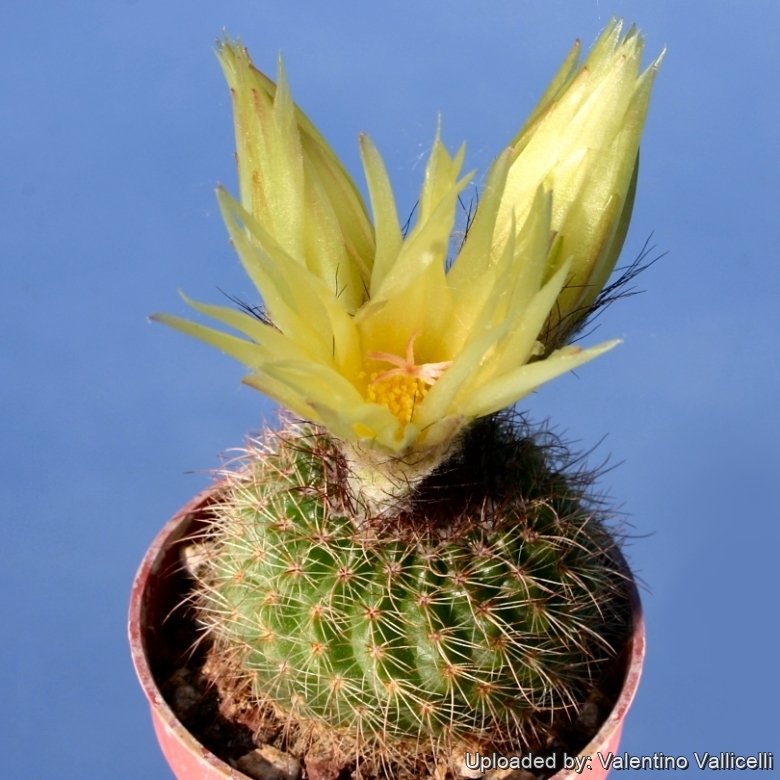
Parodia werdermanniana (best known as Notocactus werdermannianus) is a poorly known species from Uruguay with delicate and colourful spines varying from yellowish-white to brown. Several of its colour and morphological variant was early classified in garden trade as different independent varieties, but nowadays all this plant are considered part of a multiform species, where each variant form is linked to others by populations of plants with intermediate characteristics. The flowers are very showy, glossy yellow.
Habit: Plants usually solitary. Multiple branches may also been produced when the apex is damaged.
Stem: Spherical to club shaped, yellow-green, slightly depressed apically, to 13 cm high and 10 cm in diameter.
Ribs: Numerous (up to 40), straight, low, with many fairly large chinlike humps below the areoles..
Central spines: 4, cross shaped, lowermost one longest, blunt, needle-like, stout, mostly yellowish,but also reddish or brownish, inclined outward, to 15 mm long.
Radial spines: 10-20, (5-merous) yellowish white, adpressed or more or less erect, to 5 mm long.
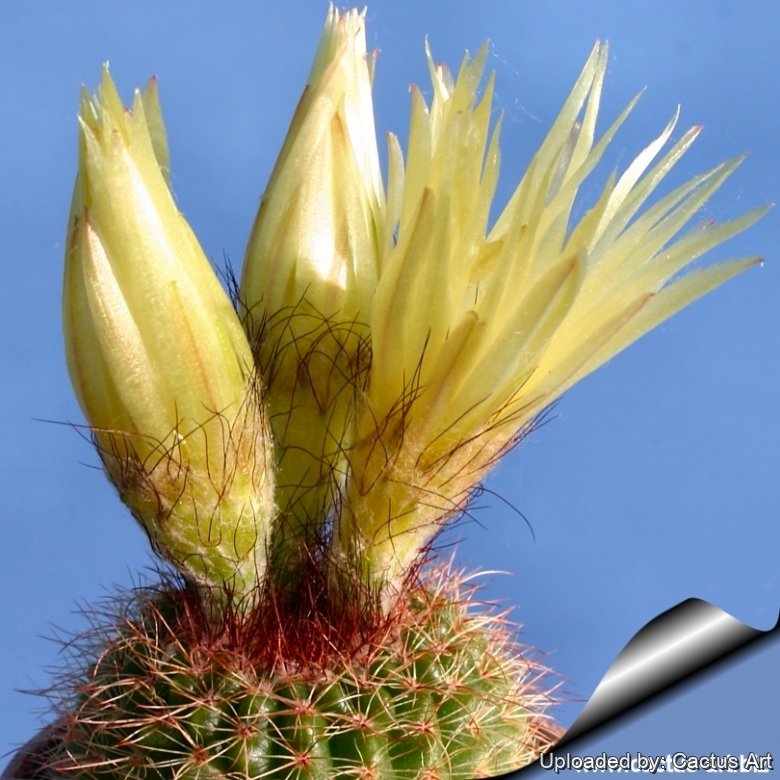
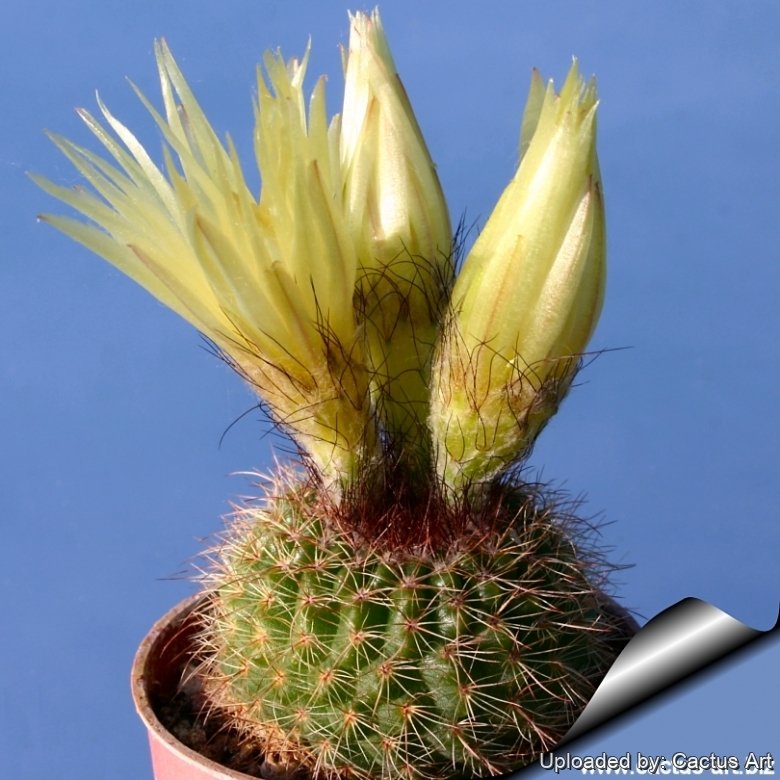
Flowers: 6 or more produced together around the stems apex, sulfur yellow, to 6 cm long and 7 cm in diameter.
Fruits:
Seeds: With a distinctive longitudinally-oriented fine striate cuticular sculpturing.
Origin and Habitat
Uruguay in Tacuarembó. It has a very restricted and severely fragmented range (extent of occurrence is only 35 km2)
Altitude: It grows at elevations between 50 and 200 metres above sea level.
Habitat: This species occurs on mountain tables in sandstone cliffs, as well as in vertical surfaces at lower elevations. Almost all subpopulations are facing south or south-east.
Cultivation and Propagation
It is easy to grow. It prefers a neutral to slightly acidic mineral-based potting mix with a good drainage. It likes a warm bright location, does great in partial shade but doesn’t like full, hot blazing sun in the central summer month. Can support quite some water during the growing season but pot plants in winter are wet-sensitive and needs to be kept dry (rots easily if soil is wet and cold) tends to lose its roots in winter. Usually it is recommended to over-winter this plant in a bright and warm greenhouse with at least 8-10° C , but it has proved to tolerate temperatures as low as -5° C for short periods.
Propagation: Seeds, cuttings or root suckers (if available). Not too difficult to raise from seed.
Bibliography
Major references and further lectures
-
Tony Mace “Notocactus: a review of the genus incorporating Brasilicactus, Eriocactus and Wigginsia” Editorial Board/National Cactus & Succulent Society, 1975
-
Edward Anderson “The Cactus family” Timber Press, Incorporated, 2001
-
James Cullen, Sabina G. Knees, H. Suzanne Cubey “The European Garden Flora Flowering Plants: A Manual for the Identification of Plants Cultivated in Europe, Both Out-of-Doors and Under Glass” Cambridge University Press, 11/Aug/2011
-
David R Hunt; Nigel P Taylor; Graham Charles; International Cactaceae Systematics Group. “The New Cactus Lexicon” dh books, 2006
-
Duarte, W. 2013. Parodia werdermanniana. In: IUCN 2013. “IUCN Red List of Threatened Species.” Version 2013.1. <www.iucnredlist.org>. Downloaded on 28 October 2013.
From llifle page Notocactus ferrugineus
Description
Parodia ferruginea (best known as Notocactus ferrugineus) is one of the morphological or local forms of the variable Parodia werdermanniana from Uruguay and Brazil. True to its name, it has distinguishing rusty red bristly spines. With the exception of the spination, all the other characteristics are absolutely identical with standard Parodia werdermanniana, namely size and form of stems, number of spines, size and colour of flowers. The flowers, like in other varieties, are very showy, bright pink or purple up to 12 cm in diameter.
Habit: Plants usually solitary. Multiple branches may also been produced when the apex is damaged.
Stem: Spherical to club shaped, yellow-green, slightly depressed apically, to 13 cm high and 10 cm in diameter.
Ribs: Numerous (up to 40), straight, low, with many fairly large chinlike humps below the areoles.
Spines: Thin needle-like or bridtly, rusty-red or or brownish turning grey as they age.
Central spines: 4, cross shaped up to15 mm long.
Radial spines: 10-20 adpressed or more or less erect, to 5 mm long.
Flowers: 6 or more produced together around the stems apex, sulfur yellow, to 6 cm long and 7 cm in diameter.
Seeds: With a distinctive longitudinally-oriented fine striate cuticular sculpturing.
Origin and Habitat
Uruguay and Rio Grande do Sul, Brazil
Source: Notocactus ferrugineus, LLIFLE - Encyclopedia of living forms, CC-BY-SA, retrieved 2026-10-25.
From llifle page Notocactus vanvlietii
Origin and Habitat
Uruguay (Southern South America, Southern America)
Source: Notocactus vanvlietii, LLIFLE - Encyclopedia of living forms, CC-BY-SA, retrieved 2026-10-25.
From llifle page Notocactus werdermannianus f. monstruosus
Description
Notocactus werdermannianus is a (usually) simple stemmed small cactus with bright yellow flowers. This species shares some characteristics with wigginsia
Stem: Globular to slightly cylindrical, often flattened up to 13 cm tall and 10 cm in diameter, yellowish-green to green.
Ribs: up to 40, vertical, straight rounded with many small tubercles.
Areoles: White, wooly and closely set one to each other.
Radial spines: About 15-20, setaceous, more or less erected, whitish or yellowish 4-5 mm long.
Central spines: 4-partite yellowish or reddish (N. ferrugineus) acicular, sharp and flexible up to 15 mm long, the lowest of them longer and pointing downward.
Flowers: About 6 cm long, up to 7 cm in diameter, pale yellow and satiny. Tepals lanceolate darker at the tip, style quite long rich egg-yellow coloured, stigma lobes10-12 carmine red.
Seeds: With distinctive longitudinally-oriented fine striate cuticular sculpturing.
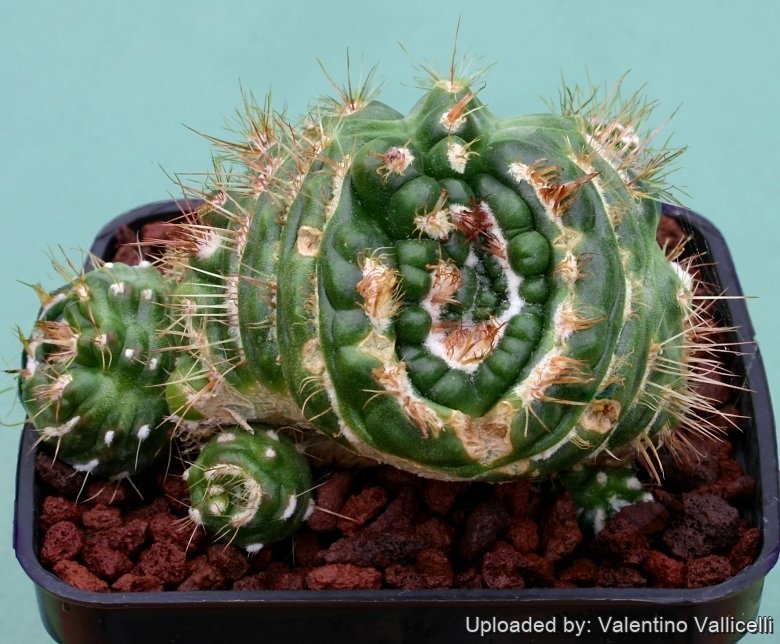
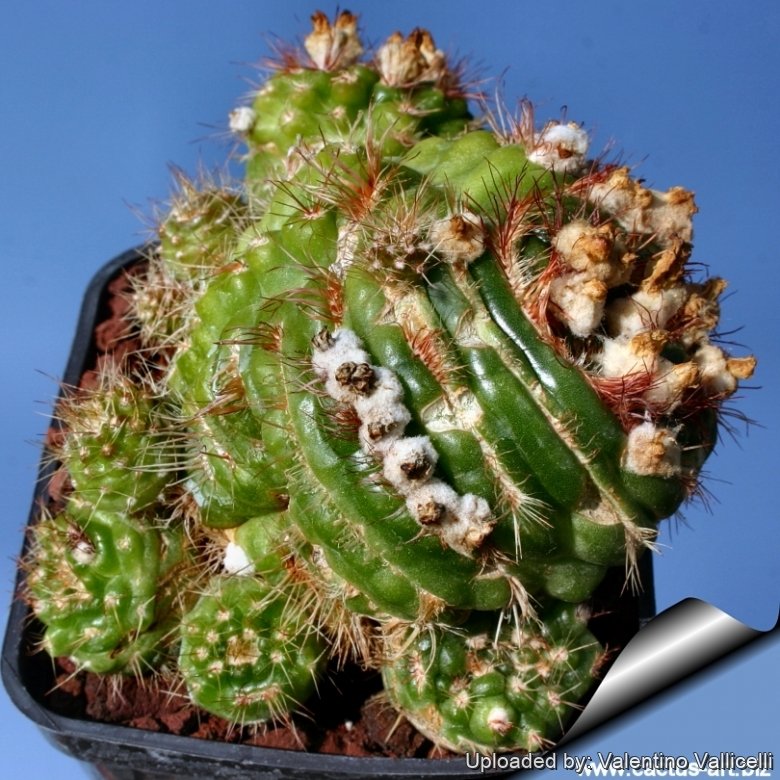
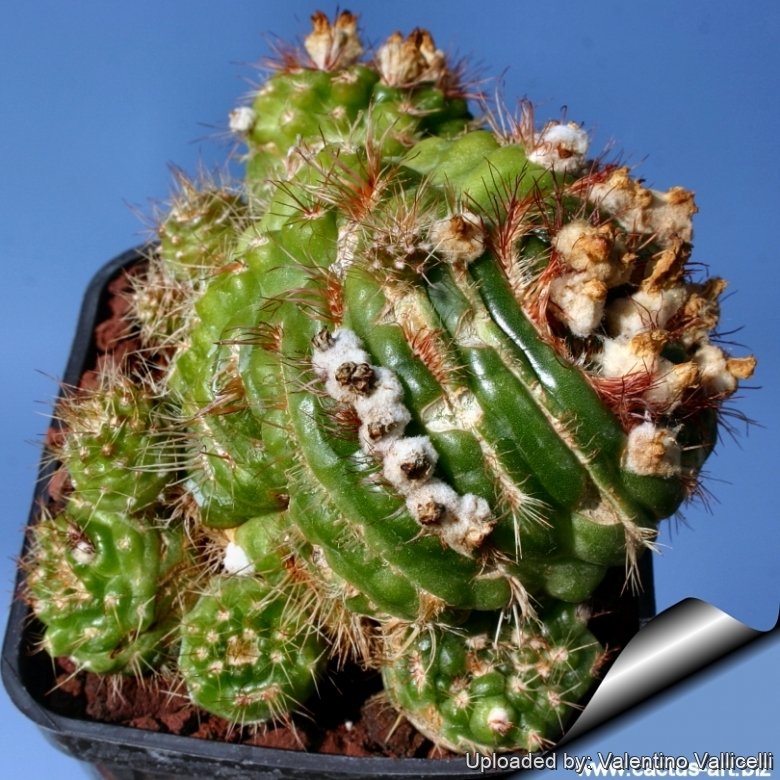
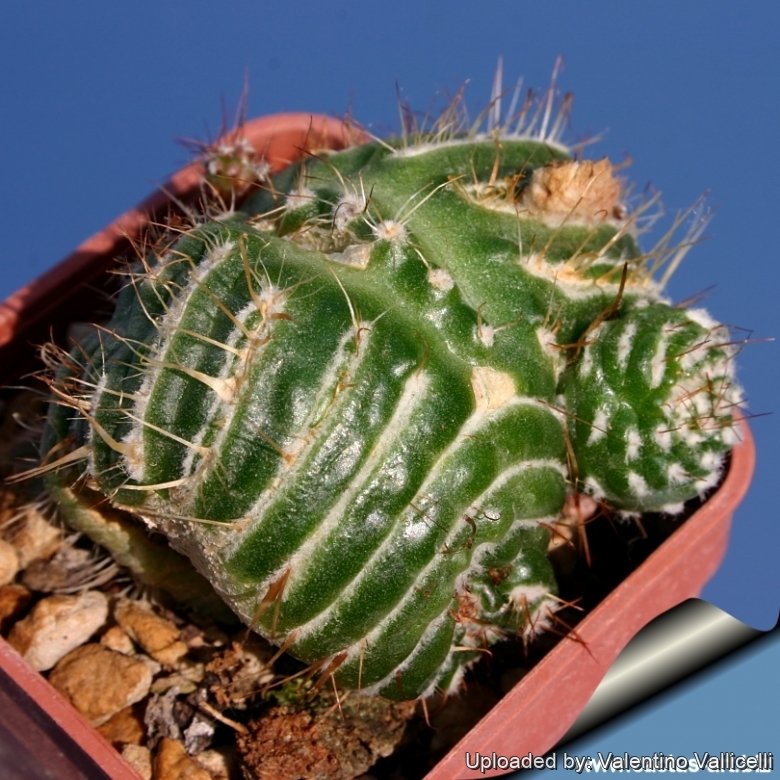
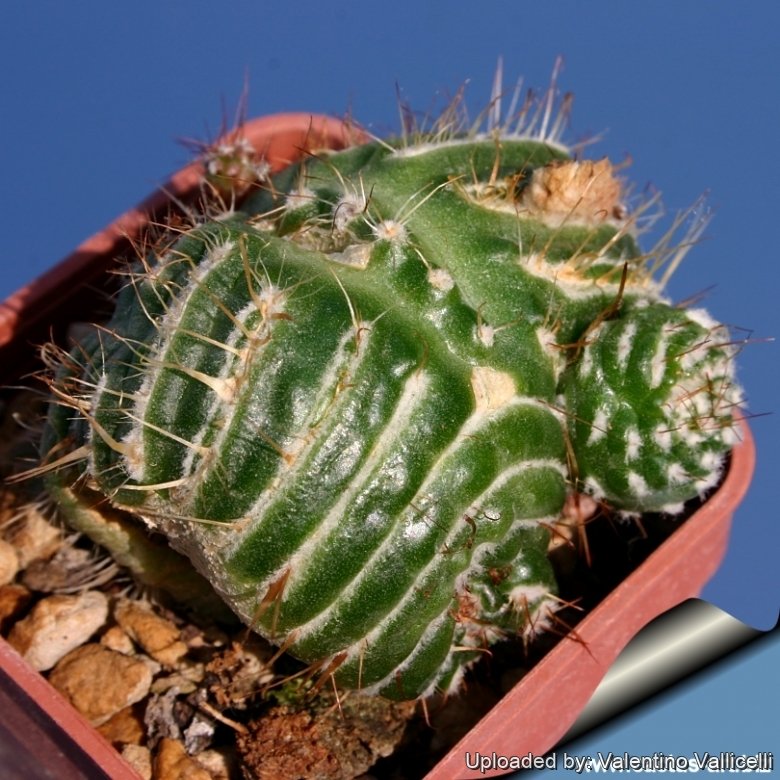
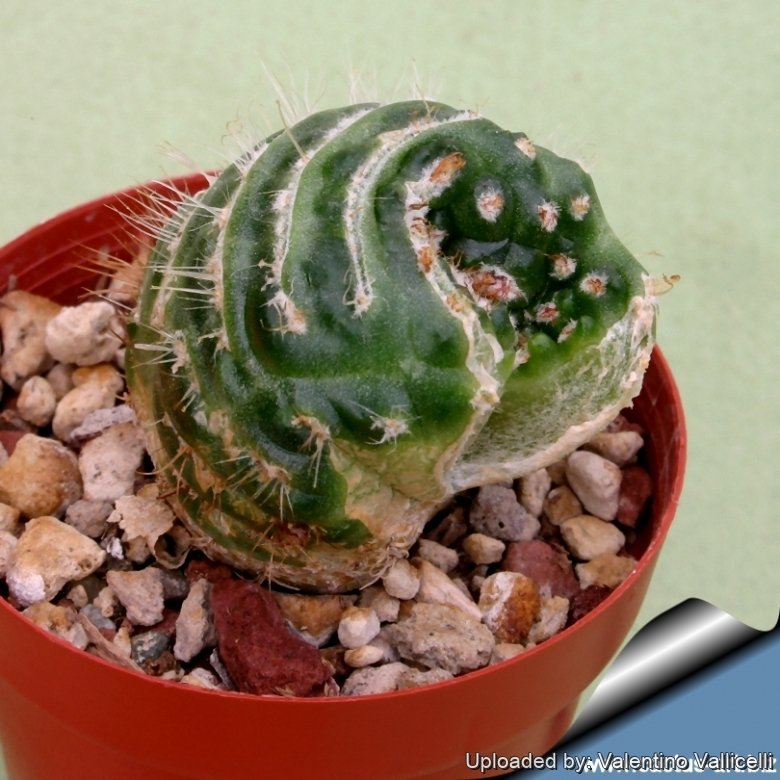
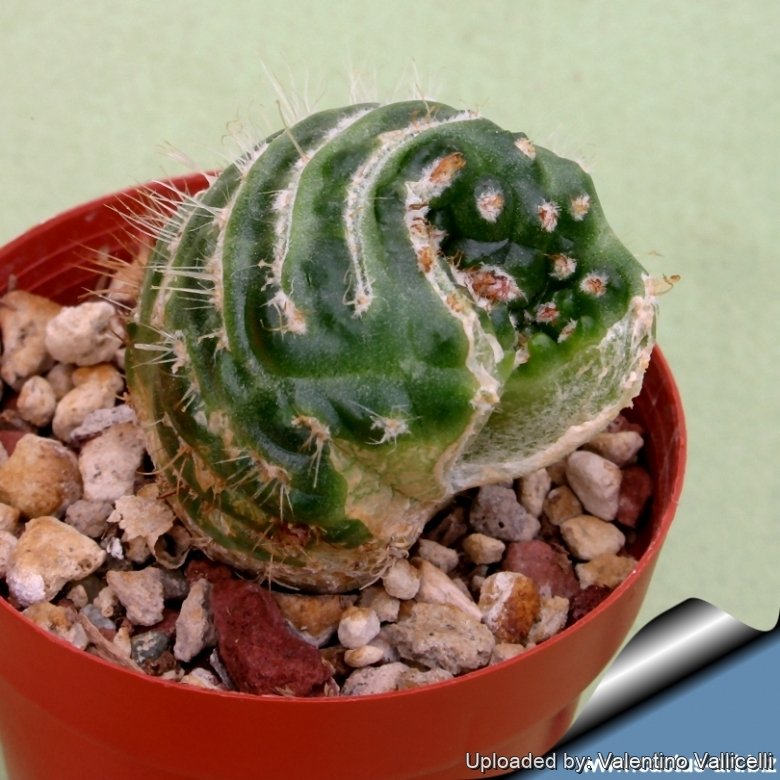
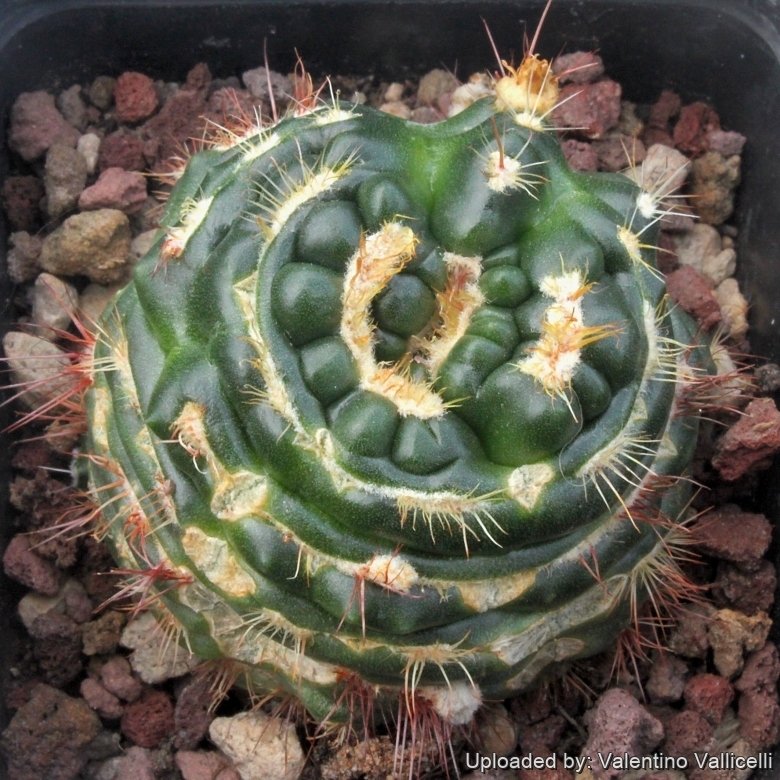
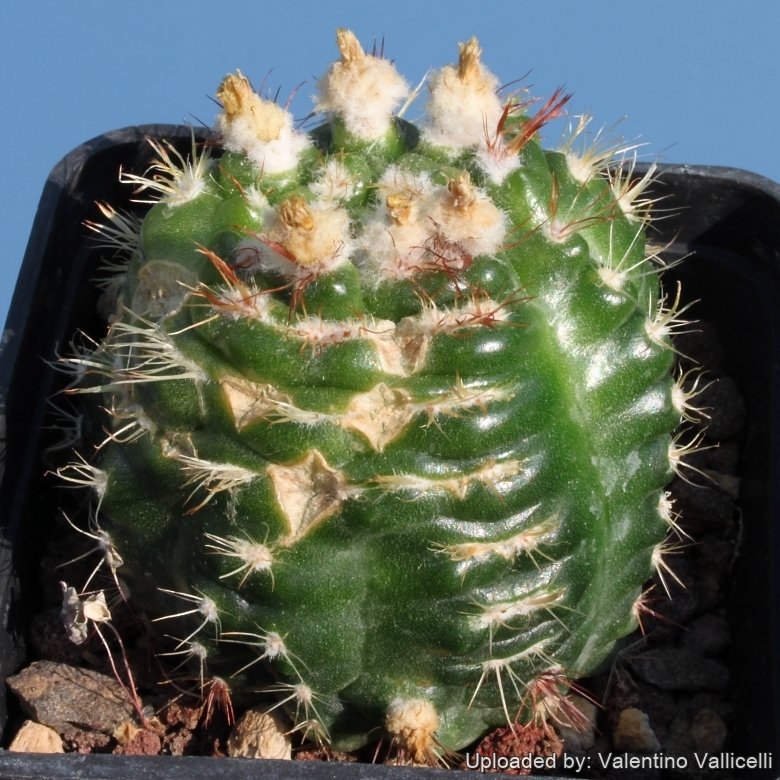
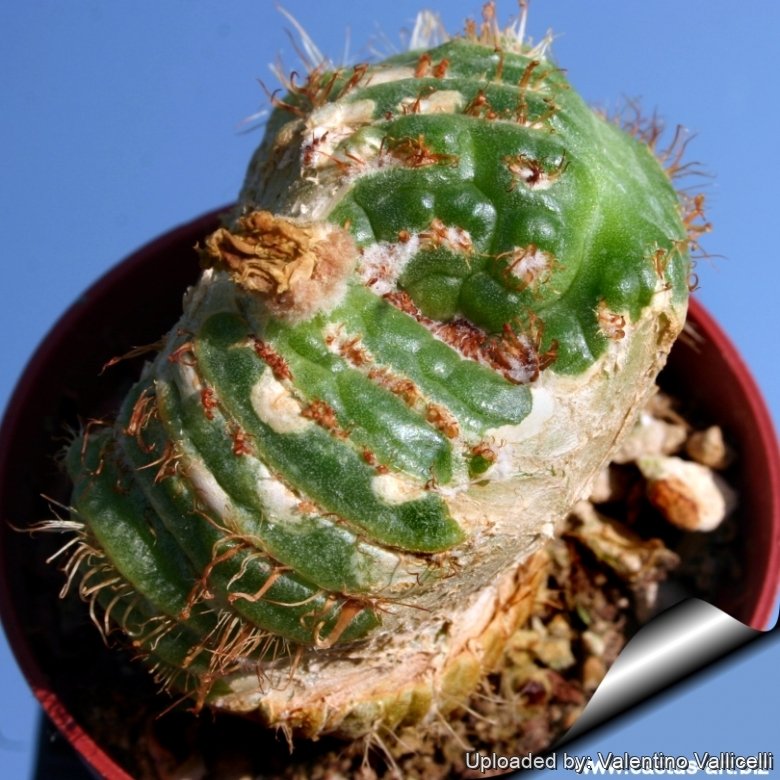
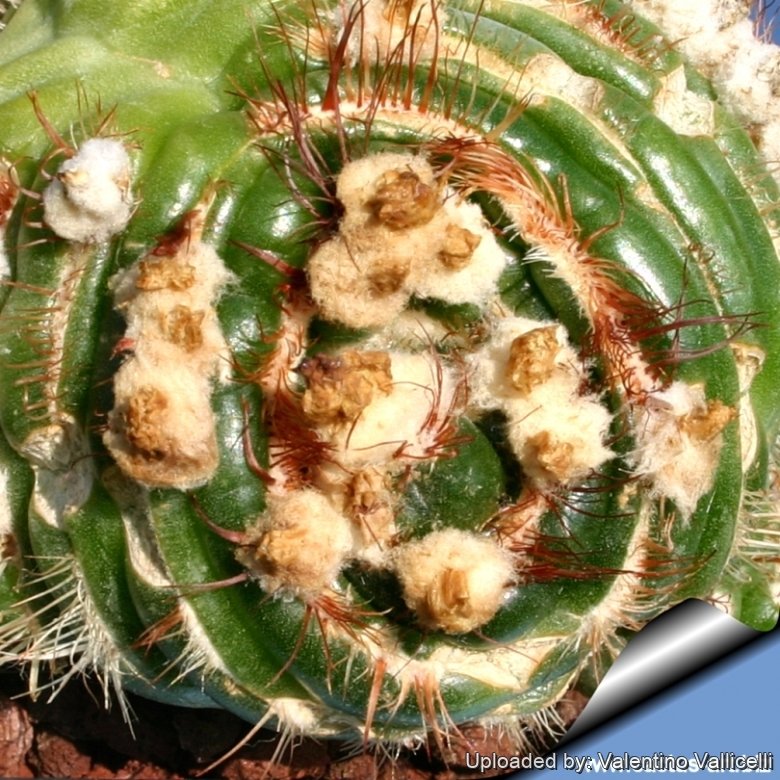
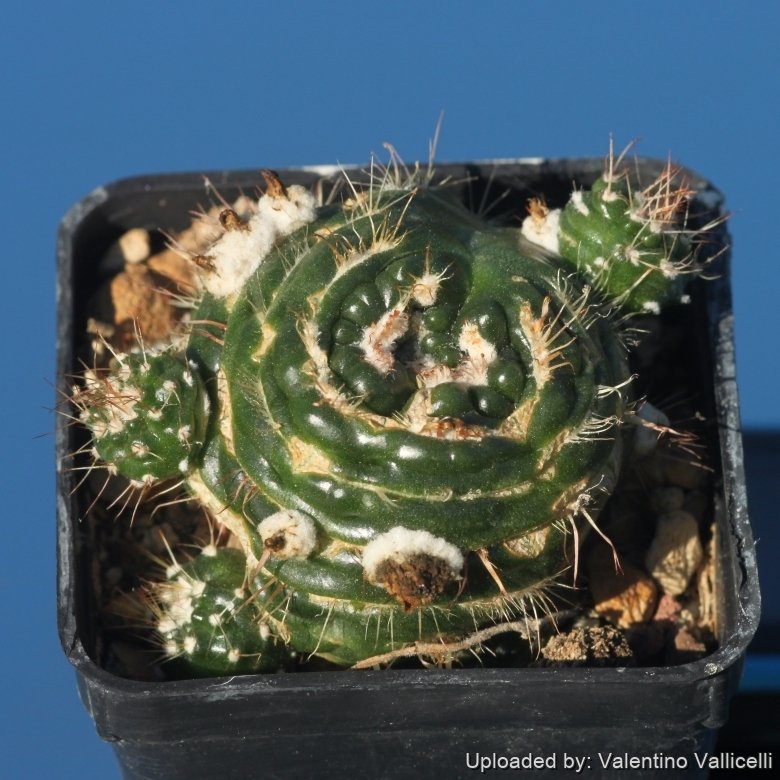
Remarks: The “forma mostruosa” (Monstous form) is a rare oddity with areoles merging to form concentric lines. The epidermis is harder than in the normal Notocactus and cracks easily, but this is not a defect and the plant will not suffer for this, and also the fact that the body splits open permits to the plant to develop original and strange shapes.
Origin and Habitat
Garden origin (Nursery produced cultivar) The standard species comes from Brazil (Rio Grande do Sul) and Uruguay (Tacuarembo)
Cultivation and Propagation
It is easy to grow. They like a warm bright location, does great in partial shade avoid full sun. They need good drainage and prefer a neutral to slightly acidic compost with plenty of extra grit. Water during the summer. Best if watered with rain water. Keep above 0°C and rather dry in winter, rot easily if the substrate is wet and cold, tends to lose its roots in winter.
Propagation: Grafting or cutting.
Source: Notocactus werdermannianus f. monstruosus, LLIFLE - Encyclopedia of living forms, CC-BY-SA, retrieved 2026-10-25.
Cultivars and forms (1)
Forms (1)
Gallery