Publication: Bot. Jahrb. Syst. 106(4): 476. 1986 [28 Aug 1986]
Description
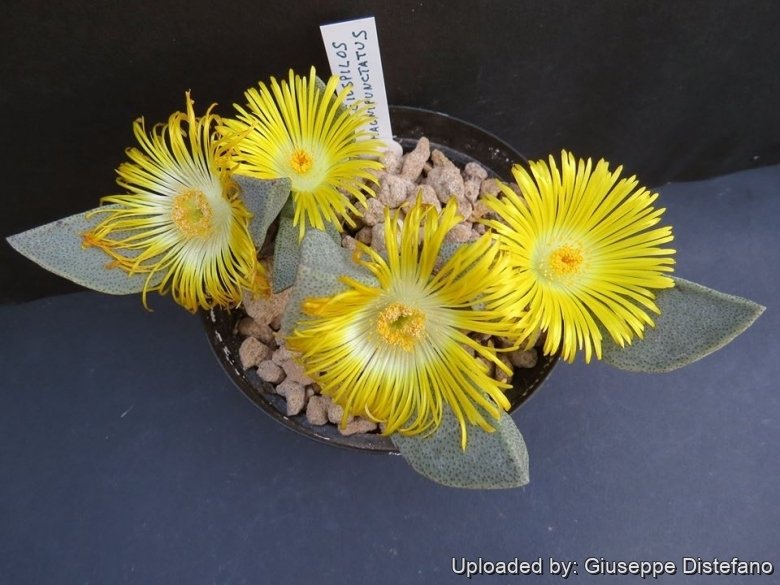
Pleiospilos compactus subs. canus is a mesemb that forms rounded clusters of branches, each branch having 1-3 pairs of pale green speckled leaves looking like split rocks. It is a free-flowering species with showy daisy-like flowers that appear between the paired leaves in summer-autumn. It distinguishes from the standard species for having 12 ovary-cells in most flowers and capsule shortly stalked. It is a very variable rock “mimic”species, that takes in a large synonomy of about 20 names.
Habit: Growths with 1-3 leaf-pairs, it it may form small mats.
Leaves: Swollen very variable in shape, half-spherical to long, narrow and speckled (20-)50-60(-80) cm long 5-30 mm wide, the lower surface keeled towards the trigonous tip, usually pale green or greyish green often flushed with pink, but covered with dark green dots.
Flowers: Mostly solitary, usually stalk-less though sometimes stalks to 8 mm. The typical subspecies has 10 ovary-cells in most flowers. Dark green, ring-shaped nectar glands surround the 9-15 thread-like stigmas.
Flowers: Petals more than 80, yellow or pale yellow with age petals wither and turn orange-pink in colour, remaining attached to the developing fruit. Stamens not papillose below.
Fruits (Capsules): Capsules with large tubercles. South Africa (Cape Province). The typical subspecies has shortly stalked capsules.
Blooming season: The large yellow flowers open in the afternoon in late summer-autumn.
Origin and Habitat
Pleiospilos compactus subs. canus is found near Bloemfontein in the Orange Free State. South Africa.
Cultivation and Propagation
It is a very adaptable plant, it will grow whenever it has water and good sunlight, but it will become dormant in very hot weather to conserve water. It need full sun to light shade with a very open compost that drains quickly. The container should be at least 10 cm deep to accommodate the long tap root. Very little water is needed during the growing season, and we do not fertilize the plants. In late summer to early fall before nighttime temperatures fall, watering of the plants is stepped up to once a week. When the nighttime temperatures drop to 9°C, watering is restricted throughout the winter months. In the winter, it grows new leaves from the centre of the split, and the new leaves then consume the old leaves. If the plant is over watered, the old leaves remain and the plant usually rots and dies. Not to water it when it is splitting, just leave it alone. Even with no watering the leaves don’t shrink and prune up like some succulents do when they are not watered they stays plump even after several months with no water. For an idea of how succulent these plants are, a mature specimen can easily go a whole year without any water in a typical European or North American climate. If the plants are grown correctly, ideally there should only ever be 2 pairs of leaves. The lower ones are the previous years, and the top ones, the current years. One sign of good care is a firm, round, symmetrical plant with no old leaves still attached at the end of summer. The plants are hardy down to -5°C.
Propagation: Seeds or by division in early spring before new growth starts. One should not divide clumps too often because they bloom best when crowded.
Bibliography
Major references and further lectures
-
Heidrun E. K. Hartmann “Aizoaceae F – Z” Springer, 2002
-
James Cullen, Sabina G. Knees, H. Suzanne Cubey “The European Garden Flora Flowering Plants: A Manual for the Identification of Plants Cultivated in Europe, Both Out-of-Doors and Under Glass - Casuarinaceae to Aristolochiaceae” Cambridge University Press, 11/Aug/2011
-
Hermann Jacobsen, Vera Higgins “Succulent Plants:Description, Cultivation and Uses of Succulent Plants, Other Than Cacti” Williams and Norgate, Limited, 1935
-
Jacobsen. “Handbook of succulent plants” 1328 (1960)
-
Doreen Court “Succulent Flora of Southern Africa” CRC Press, 01/Jun/2000
From llifle page Mesembryanthemum magnipunctatum
Description
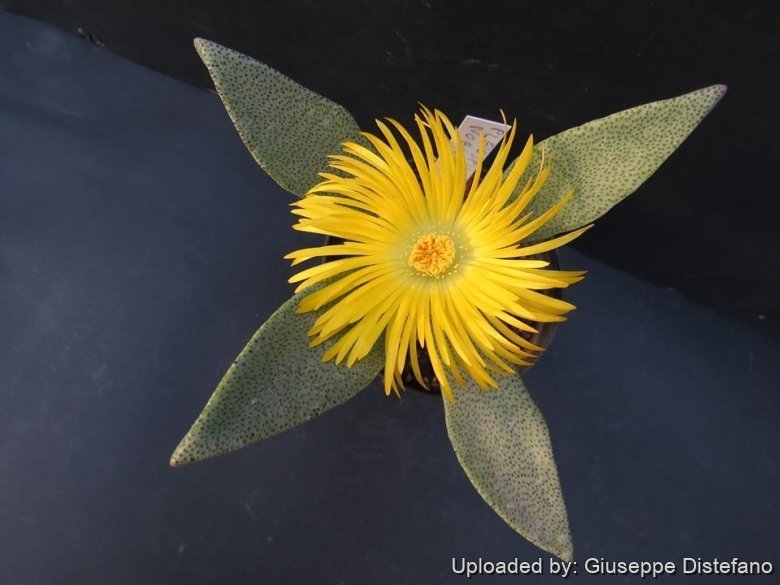
Pleiospilos magnipunctatus is a local or morphological form of the very variable Pleiospilos compactus subs. canus. It distinguishes from the other canus for the narrower, somewhat thinner and longer leaves covered with dark green dots, however Pleiospilos magnipunctatus is not readily distinguishable from other similar firms, if not for the geographical provenance. It is a free-flowering species with showy daisy-like flowers that appear between the paired leaves in summer-autumn. It is a relatively common garden or pot plant.
Habit: It is a perennial mesemb species that forms rounded clusters of branches, each branch having 1-3 pairs of leaves. It may form small mats.
Leaves: Swollen or half-spherical, speckled 50-60 cm long 5-30 mm wide, very variable in shape, the lower surface keeled towards the trigonous tip, usually pale green or greyish green often flushed with pink, but heavily speckled with dark green dots.
Flowers: Mostly solitary, usually stalk-less though sometimes stalks to 8 mm. The typical subspecies has 10 ovary-cells in most flowers. Dark green, ring-shaped nectar glands surround the 9-15 thread-like stigmas.
Flowers: Petals more than 80, yellow or pale yellow with age petals wither and turn orange-pink in colour, remaining attached to the developing fruit. Stamens not papillose below.
Fruits (Capsules): Capsules with large tubercles. South Africa (Cape Province). The typical subspecies has shortly stalked capsules.
Blooming season: The large yellow flowers open in the afternoon in late summer-autumn.
Origin and Habitat
Pienaar’s Poort near Coega and adjacent areas, South of Mount Stewart. South Africa.
Altitude: Around 700-1700 metres above sea level.
Habitat: Pleiospilos magnipunctatus grows in a situation of remarkable aridity on Witteberg quartzite outcrops.
Bibliography
Major references and further lectures
-
Heidrun E. K. Hartmann “Aizoaceae F – Z” Springer, 2002
-
James Cullen, Sabina G. Knees, H. Suzanne Cubey “The European Garden Flora Flowering Plants: A Manual for the Identification of Plants Cultivated in Europe, Both Out-of-Doors and Under Glass - Casuarinaceae to Aristolochiaceae” Cambridge University Press, 11/ago/2011
-
Hermann Jacobsen, Vera Higgins “Succulent Plants:Description, Cultivation and Uses of Succulent Plants, Other Than Cacti” Williams and Norgate, Limited, 1935
-
Jacobsen. “Handbook of succulent plants” 1328 (1960)
-
Doreen Court “Succulent Flora of Southern Africa” CRC Press, 01/giu/2000
Source: Mesembryanthemum magnipunctatum, LLIFLE - Encyclopedia of living forms, CC-BY-SA, retrieved 2026-10-26.
From llifle page Mesembryanthemum nobile
Description
Pleiospilos nobilis is a local or morphological form of the very variable Pleiospilos compactus subs. canus that forms short woody stem which branches so that clumps up to 30 cm diameter are formed; each branch bears 2 to 3 pairs of leaves which are long, narrow and very thick; the colour is greyish-green, often reddened in the sun, and with raised dots. It is a free-flowering species with showy yellow daisy-like flowers that appear between the paired leaves in summer-autumn. It distinguishes from the standard species for having (11-)12 ovary-cells in most flowers and capsule shortly stalked.
Habit: Growths with 1-3 leaf-pairs, it it may form small mats.
Leaves: Swollen, long, narrow and very thick, speckled (20-)50-60(-80) cm long 5-30 mm wide, variable in shape, the lower surface keeled towards the trigonous tip, usually pale green or greyish green often flushed with pink, but covered with dark green dots.
Flowers: Mostly solitary, usually stalk-less though sometimes stalks to 8 mm. The typical subspecies has 10 ovary-cells in most flowers. Dark green, ring-shaped nectar glands surround the 9-15 thread-like stigmas.
Flowers: Petals more than 80, yellow or pale yellow with age petals wither and turn orange-pink in colour, remaining attached to the developing fruit. Stamens not papillose below.
Fruits (Capsules): Capsules with large tubercles. South Africa (Cape Province). The typical subspecies has shortly stalked capsules.
Blooming season: The large yellow flowers open in the afternoon in late summer-autumn.
Origin and Habitat
Orange Free State. South Africa.
Bibliography
Major references and further lectures
-
Vera Higgins “Succulents in Cultivation (Cacti Included)” St. Martin’s Press, 1960
-
Victor, J.E. 2004. “Pleiospilos compactus (Aiton) Schwantes subsp. canus (Haw.) H.E.K.Hartmann & Liede.” National Assessment: Red List of South African Plants version 2014.1. Accessed on 2014/12/07
-
Hermann Jacobsen, Vera Higgins “Succulent Plants:Description, Cultivation and Uses of Succulent Plants, Other Than Cacti” Williams and Norgate, Limited, 1935
-
Jacobsen. “Handbook of succulent plants” 1328 (1960)
-
Doreen Court “Succulent Flora of Southern Africa” CRC Press, 01/Jun/2000
-
Heidrun E. K. Hartmann “Aizoaceae F – Z” Springer, 2002
-
James Cullen, Sabina G. Knees, H. Suzanne Cubey “The European Garden Flora Flowering Plants: A Manual for the Identification of Plants Cultivated in Europe, Both Out-of-Doors and Under Glass - Casuarinaceae to Aristolochiaceae” Cambridge University Press, 11/Aug/2011
Source: Mesembryanthemum nobile, LLIFLE - Encyclopedia of living forms, CC-BY-SA, retrieved 2026-10-26.