Publication: Z. Sukkulentenk. 3: 23 1927
Description
Pleiospilos compactus is another rock “mimic” and very variable species, that never exhibit the extreme mimicry forms found in the members of subgen. Pleiospilos. Five subspecies are recognized by Hartmann & Leide, the nominate form, subsp. canus (Haworth) Hartmann & Leide, subsp. sororius (N.E. Brown) Hartmann & Leide, subsp. fergusoniae H.E.K. Hartmann & Liede and subsp. minor H.E.K. Hartmann & Liede.
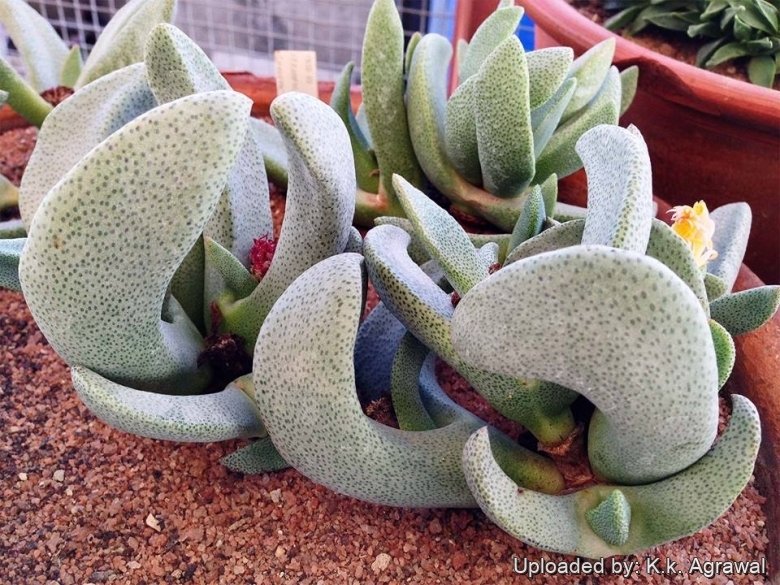
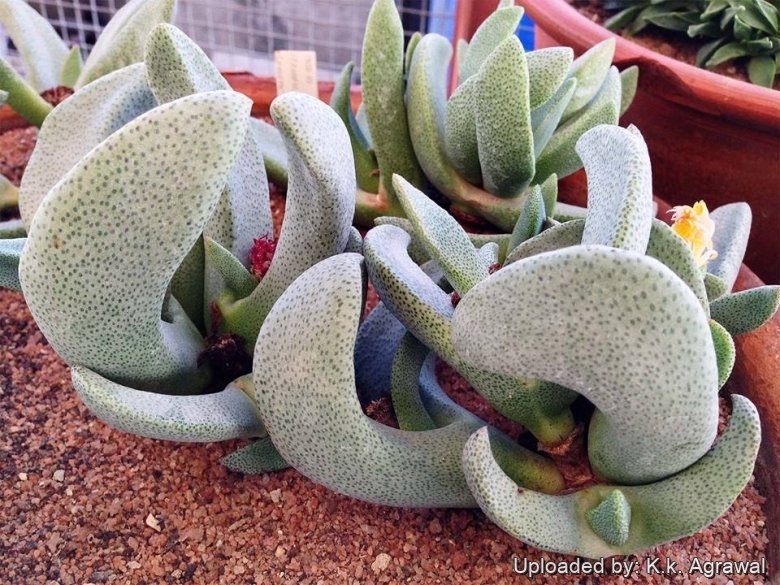
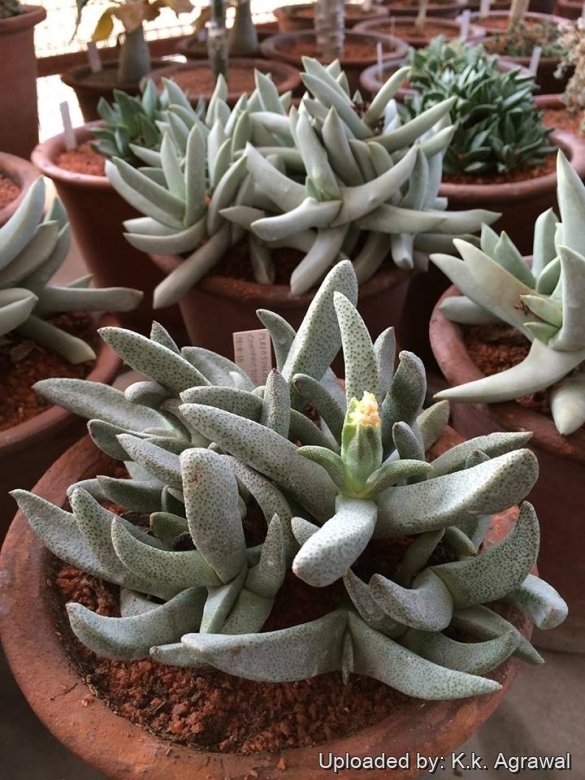
Habit: Growths with 1-3 leaf-pairs, it may form small mats.
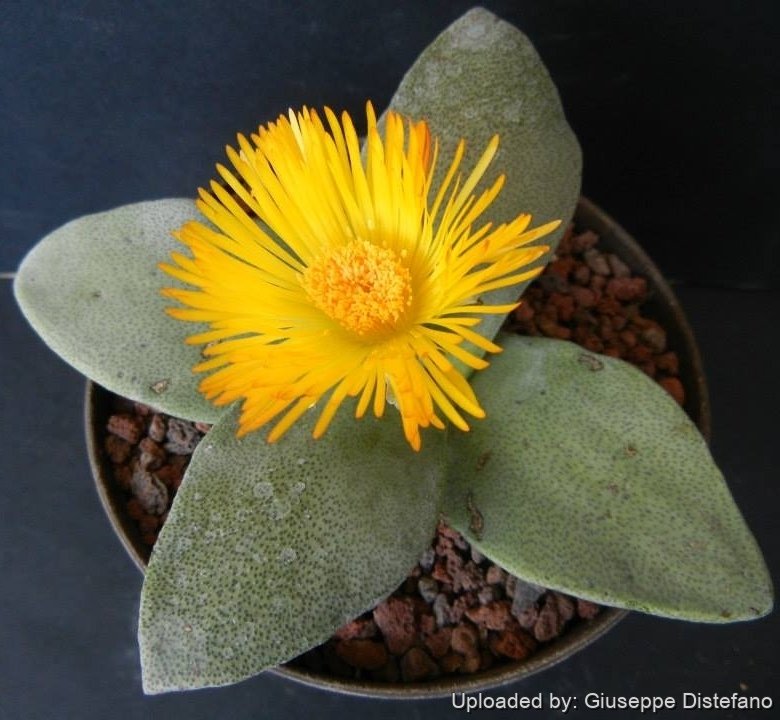
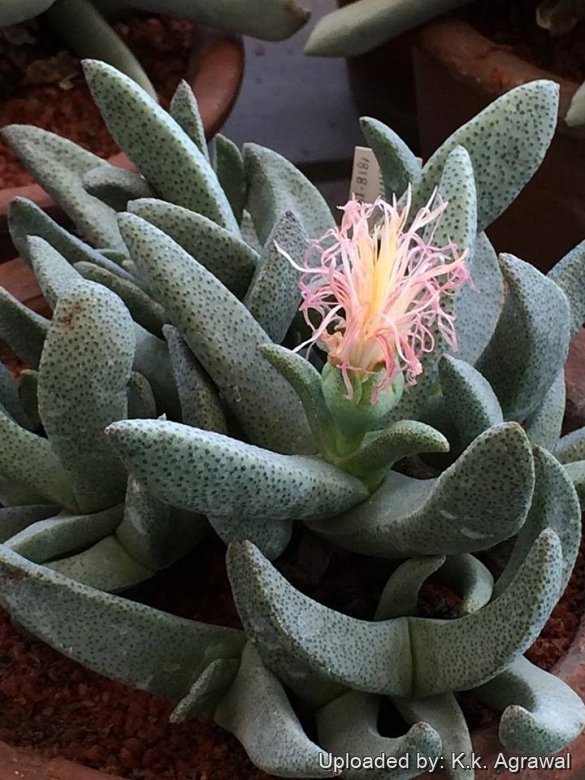
Leaves: Swollen or half-spherical, (20-)50-60(-80) cm long 5-30 mm wide, very variable in shape, the lower surface keeled towards the trigonous tip, usually greyish green but covered with dark green dots.
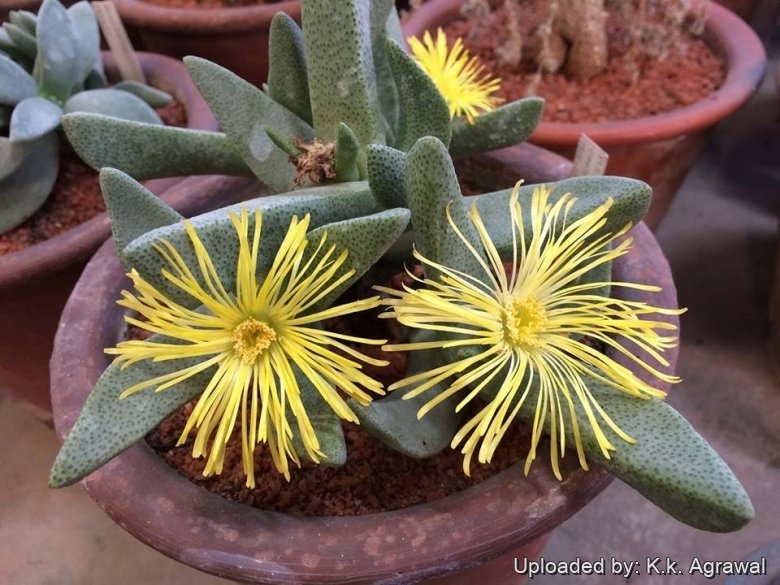
Flowers: Mostly solitary, usually stalk-less though sometimes stalks to 8 mm. The typical subspecies has 10 ovary-cells in most flowers.
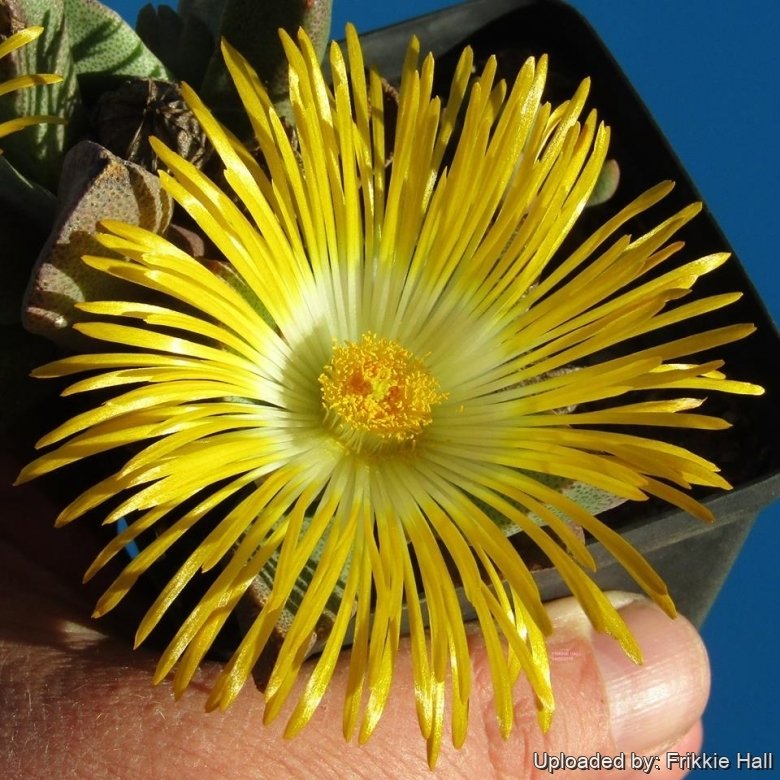
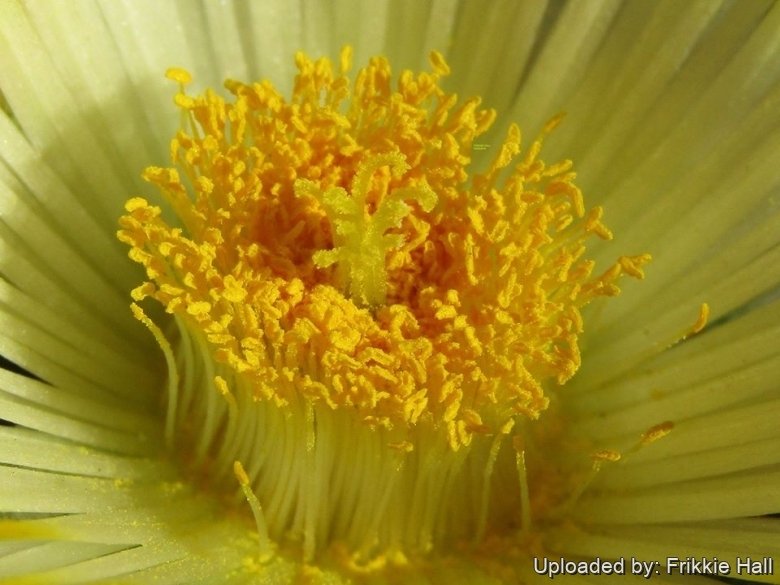
Flowers: Petals more than 80, yellow, pale yellow or pink. Stamens not papillose below.
Fruits (Capsules): Capsules with large tubercles. The typical subspecies has shortly stalked capsules.
Blooming season: Summer-autumn.
Origin and Habitat
Cape Province, South Africa.
Altitude: Around 700-1700 metres above sea level.
Habitat: it grows in a situation of remarkable aridity on quartzite outcrops.
Cultivation and Propagation
It is a very adaptable plant, it will grow whenever it has water and good sunlight, but it will become dormant in very hot weather to conserve water. It need full sun to light shade with a very open compost that drains quickly. The container should be at least 10 cm deep to accommodate the long tap root. Very little water is needed during the growing season, and we do not fertilize the plants. In late summer to early fall before nighttime temperatures fall, watering of the plants is stepped up to once a week. When the nighttime temperatures drop to 9°C, watering is restricted throughout the winter months. In the winter, it grows new leaves from the centre of the split, and the new leaves then consume the old leaves. If the plant is over watered, the old leaves remain and the plant usually rots and dies. Not to water it when it is splitting, just leave it alone. Even with no watering the leaves don’t shrink and prune up like some succulents do when they are not watered they stays plump even after several months with no water. For an idea of how succulent these plants are, a mature specimen can easily go a whole year without any water in a typical European or North American climate. If the plants are grown correctly, ideally there should only ever be 2 pairs of leaves. The lower ones are the previous years, and the top ones, the current years. One sign of good care is a firm, round, symmetrical plant with no old leaves still attached at the end of summer. The plants are hardy down to -5°C.
Propagation: Seeds or by division in early spring before new growth starts. One should not divide clumps too often because they bloom best when crowded.
Bibliography
Major references and further lectures
-
Heidrun E. K. Hartmann “Aizoaceae F – Z” Springer, 2002
-
James Cullen, Sabina G. Knees, H. Suzanne Cubey “The European Garden Flora Flowering Plants: A Manual for the Identification of Plants Cultivated in Europe, Both Out-of-Doors and Under Glass - Casuarinaceae to Aristolochiaceae” Cambridge University Press, 11/ago/2011
-
Hermann Jacobsen, Vera Higgins “Succulent Plants:Description, Cultivation and Uses of Succulent Plants, Other Than Cacti” Williams and Norgate, Limited, 1935
-
Jacobsen. “Handbook of succulent plants” 1328 (1960)
-
Doreen Court “Succulent Flora of Southern Africa” CRC Press, 01/giu/2000
Cultivars and forms (4)
Gallery